
1) Net accounts receivable is carried on the balance sheet at expected net realizable
value, not at original historical cost.
2) The FASB addressed simultaneous financing and investing activities by requiring
they be ignored.
3) Contracts often contain language that refers to financial statement numbers.
4) The type of analysis that uses financial statements along with industry and
macroeconomic data to forecast future stock movements is technical analysis.
5) The MD&A section found in published financial statements only provides a brief
overview of the company’s business risks and results of operations.
6) Seizure of collateral is one possible remedy for breach of covenant restrictions.
7) In U.K. financial reports, receivables are called “creditors.”
8) Negative operating cash flows are often attributable to increasing receivables and

inventories.
9) Operating activities result from the cash effects of producing and delivering goods
and services.
10) When accounting estimates are changed, the income effect of the changed estimate
is accounted for in the period of the change and in future periods if the change affects
both.
11) Cash paid to suppliers can be derived by adjusting costs of goods sold for changes
in inventory.
12) The accounts receivable turnover ratio can be used by the analyst to spot changing
customer payment patterns.
13) When future income tax rates change, the effect of the change on net income will be
consistent across most companies regardless of their deferred tax balances.
14) An investment of 30% of a company’s voting shares must be accounted for using
the equity method.

15) Firms are required to disclose separately total expensed R&D costs; thus, analysts
can use these disclosures to reconstruct what asset and amortization amounts would be
if GAAP allowed R&D to be capitalized.
16) When a company changes from straight-line to the declining balance method of
accounting for depreciation, the financial statements lack
A.comparability
B.consistency
C.neutrality
D.faithful representation
17) The Reid Co. acquired a piece of land for a new factory paying $100,000. Reid
demolished the old building at a cost of $20,000, and sold scrapped material salvaged
from the old building for $5,000. The architect’s fees were $25,000, and the title
insurance upon acquisition of the land was $1,000. The construction period interest was
$8,000, and the contractor received $300,000 for the building. A pavement assessment
made by the city cost Reid $2,000 at the purchase date.
The cost of the building recorded by Reid Co. is
A.$300,000
B.$326,000
C.$333,000
D.$335,000
18) All of the following are true of constructive capitalization except
A.It’s a method for making balance sheet data historically correct
B.It treats all leases as if they were capital leases
C.The liability is the discounted present value of the stream of minimum operating
lease payments
D.The method makes use of a discount rate that is the weighted average rate implicit in
all leases, or the weighted average rate on interest-bearing long-term debt

19) The Barden Company provides the following information from its Year 3 and Year
4 balance sheets:
The following information is available from the Year 4 income statement:
Assuming that the information provided from the income statement represents all of the
pre-tax income of Barden Company, what is the difference between the accrual-basis
and cash-basis income in Year 4?
A.Accrual exceeds cash basis by $16,500
B.Cash exceeds accrual basis by $23,500
C.Accrual exceeds cash basis by $25,000
D.Cash exceeds accrual basis by $48,500
20) Losses must be disclosed if they are
A.remote and estimable
B.reasonably possible and estimable
C.probable and reasonably estimable
D.reasonably possible but not estimable
21) If a long-lived asset’s remaining expected future value falls below its net book
value, the asset is considered to be a/an
A.extraordinary item
B.discontinued operation
C.valuable asset
D.impaired asset
22) If Edsel uses the sales revenue approach for estimating bad debt expense, the
allowance for uncollectibles account after the proper adjustments to the accounts are
recorded, should show a balance of
A.$11,500

B.$13,500
C.$15,500
D.$21,500
23) ASC content is organized
A.alphabetically by topic
B.in chronological order based on the issue date of the major pronouncement on which
the content is based
C.without regard to the original standard from which the content was derived
D.in the manner prescribed by the IASB
24) During 2011, its first year of operations, a company recorded depreciation expense
of $50,000 for book purposes. For tax purposes during 2011, $100,000 of depreciation
expense was deducted. The temporary difference created during 2011 will reverse
equally during 2012 and 2013 . Book income from operations during the first year was
$570,000. The income tax rate is 40%. The income tax expense to be reported in the
income statement for the first year of operations is
A.$228,000
B.$208,000
C.$248,000
D.$188,000
25) On January 1, 2012, the Regal Company purchased 30% of the outstanding voting
stock of the Air Corporation for $300,000; the book value of Air’s net assets at the date
of purchase was $900,000. Regal was willing to pay more than the book value of the
acquired shares because Air’s depreciable assets with a ten-year remaining life were
undervalued. Regal uses straight-line depreciation. During 2012, Air reported net
income of $75,000 and paid dividends of $30,000.
The income reported by Regal during 2012 pertaining to the Air investment was
A.$9,000
B.$22,500

C.$31,500
D.$19,500
26) In August 2010, the FASB and the IASB issued a jointly developed leasing
exposure draft which
A.Takes a property rights approach and would require lessees to record a “right-of-use”
asset and the associated liability
B.Takes a performance obligation approach for lessees and removes the asset from the
balance sheet rather than establishing a lease liability
C.Takes a derecognition approach for lessees and establishes a lease asset and a lease
liability for the present value of the expected rental payments
D.All of the choices are correct
27) Dot Company issued $200,000 of bonds on January 1, 2011 with interest payable
each year. The bonds had a stated rate of 8%. The bonds were set up as floating-rate
debt with the rated pegged to LIBOR plus 3%. Interestexpense for year one if LIBOR is
7% will be which one of the following?
A.$6,000
B.$14,000
C.$16,000
D.$20,000
28) An argument raised by opponents to the FASB’s proposal that employee stock
options should be recognized as an expense was that it could
A.violate the historical cost principle
B.violate the cost-benefit rule
C.violate materiality concepts
D.jeopardize compliance with contract terms and conditions

29) Manero Company included the following information in its annual report:
In a trend income statement for 2010, where 2010 is the base year, sales are expressed
as
A.84.4%
B.92.6%
C.100.0%
D.150.5%
30) The earnings conservatism ratio is computed as
A.Taxable income per the tax return/Pretax book income (adjusted for permanent
differences)
B.Pretax book income (adjusted for permanent differences)/Taxable income per the tax
return
C.Taxable income per the tax return/Net income (adjusted for permanent differences)
D.(Net income/Pretax book income) x Statutory rate
31) According to current GAAP, the date when the terms for stock options are mutually
agreed-upon and the stock options are awarded to employees is the
A.vesting date
B.grant date
C.exercise date
D.payment date
32) Rate regulation provides incentives for public utility managers to
A.artificially decrease the asset base
B.artificially increase the asset base
C.artificially decrease operating expenses
D.artificially decrease taxes

33) Which of the following transactions would be reported within the investing
activities section of the cash flow statement?
A.The cash sale of a building at a loss
B.The sale of a building in exchange for a parcel of land
C.The exchange of a stock investment in order to retire a long-term debt
D.The acquisition of treasury stock in exchange for cash
34) Which of the following criteria is applicable with respect to determining when a
variable interest entity (VIE) must be consolidated into the sponsoring firm’s financial
statements?
A.A consolidation must occur if the firm has a controlling financial interest and is the
VIE’s primary beneficiary
B.A consolidation must occur if the firm is entitled to receive all of the VIE’s residual
returns
C.A consolidation must occur regardless of the risk of loss exposure
D.A consolidation must occur if the sponsoring firm owns more than 50% of the VIE’s
equity
35) As transitory components become a more important part of a firm’s reported
earnings, the reported earnings
A.become a more reliable indicator of sustainable cash flows
B.are more quality enhanced
C.are a more reliable indicator of fundamental value
D.are a less reliable indicator of sustainable cash flows
36) On January 1, 2011, Ross Corporation issued bonds with a maturity value of
$200,000; the bond’s stated rate of interest equaled the market interest rate on the issue
date. On December 31, 2011, the market value of the bonds was $188,926; on
December 31, 2012, the market value of the bonds was $191,325. Which of the
following correctly describes Ross Corporation’s financial reporting if Ross elects to
measure the bond liability using the fair value option?
A.For the year ending December 31, 2011, Ross will report an unrealized holding loss
of $11,074 in its income statement
B.For the year ending December 31, 2012, Ross will report an unrealized holding gain
of $8,675 in its income statement
C.For the year ending December 31, 2012, Ross will report an unrealized holding loss
of $8,675 in its income statement
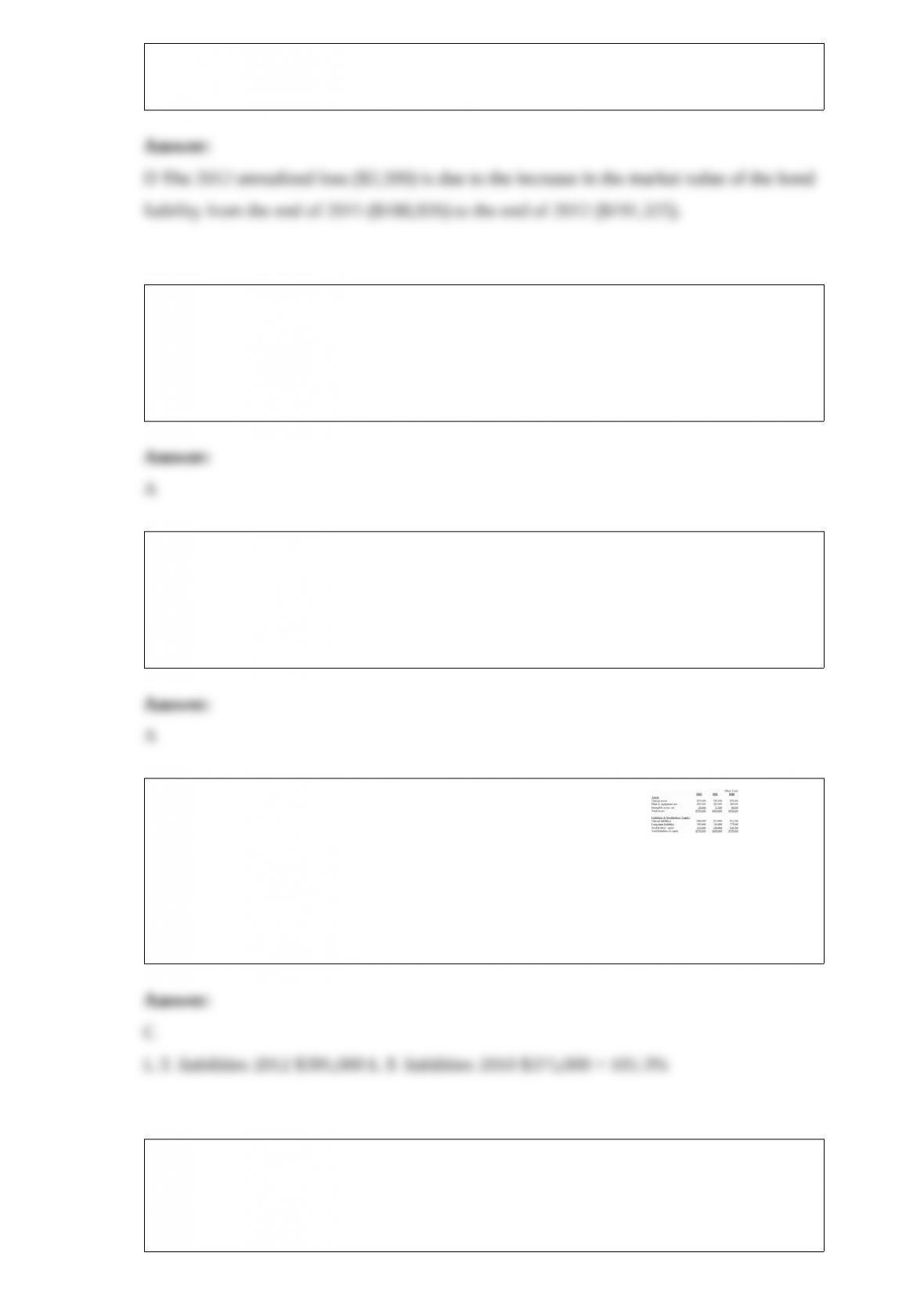
D.For the year ending December 31, 2012, Ross will report an unrealized holding loss
of $2,399 in its income statement
37) The matching principle requires that bad debts be treated as an expense in the year
A.the sale is made
B.the customer files bankruptcy
C.in which the debt becomes six months past due
D.a court declares it to be uncollectible
38) An increase in inventory of $7,000 for the year
A.decreases cash flow from operating activities by $7,000
B.increases cash from operating activities by $7,000
C.decreases cash flow from operating activities by $14,000
D.increases cash flow from operating activities by $14,000
39) Hansel Corporation’s condensed balance sheets appear below:
In a trend balance sheet for 2012, long-term liabilities are expressed as
A.69.3%
B.100.0%
C.105.3%
D.127.4%
40) SFAS No. 123 was issued as a compromise to the FASB’s original position
regarding stock options as it
A.required companies to continue following the approach used in APB No. 25
B.required companies to measure the fair value of stock options and charge this to

expense
C.allowed companies to choose either the APB No. 25 approach or expense the fair
value of the options
D.abandoned any reference to recognition of expense for options
41) Sand engaged in operations at the start of 2011 and reported $550,000 in pre-tax
book income for the year. Tax depreciation for Sand exceeded book depreciation by
$50,000. The tax rate for 2011 was 30%, and Congress had enacted a tax rate of 20%
for the years after 2011 .
What is the deferred tax liability for Sand at December 31, 2011?
A.$10,000
B.$15,000
C.$20,000
D.$40,000
42) Penn Company had 10,000,000 shares of common stock outstanding on January 1,
2012 . Penn entered into the following stock transactions during 2012:
2,000,000 shares of common stock were issued on April 1st.
600,000 shares of common stock were purchased on May 1st and were being held as
treasury stock.
500,000 shares of preferred stock were issued on July 1st.
400,000 shares of treasury stock were reissued on October 1st.
A 2-for-1 common stock split was declared on November 1st.
Bonds convertible into 1,200,000 shares of common stock were issued on December
1st; the bonds are considered to be dilutive.
Determine the number of shares to be used in the calculation of basic EPS and diluted
EPS.
43) Harrison Company owns a manufacturing plant with a fair value of $3,000,000, a
recorded cost of $6,200,000, and accumulated depreciation of $2,400,000. Pablo
Company owns a warehouse with a fair value of $3,500,000, a recorded cost of
$5,500,000, and accumulated depreciation of $2,800,000. Harrison and Pablo exchange

assets with Harrison also receiving cash of $500,000 from Pablo. The exchange is
considered to have commercial substance.
Required:
Record the exchange on the books of:
1> Harrison.
2> Pablo.
44) Sub Company is a 100% owned subsidiary of Parent Corporation. During 2012,
Parent sold inventory costing $500,000 to Sub for $750,000. Sub Company still had
$150,000 (at transfer price) of the inventory on hand as of December 31, 2012 . During
2012, Parent Company reported sales of $2,250,000 and cost of goods sold of
$1,500,000, while Sub Company reported sales of $1,200,000 and cost of goods sold of
$1,000,000.
Required:
Determine the 2012 consolidated gross profit.
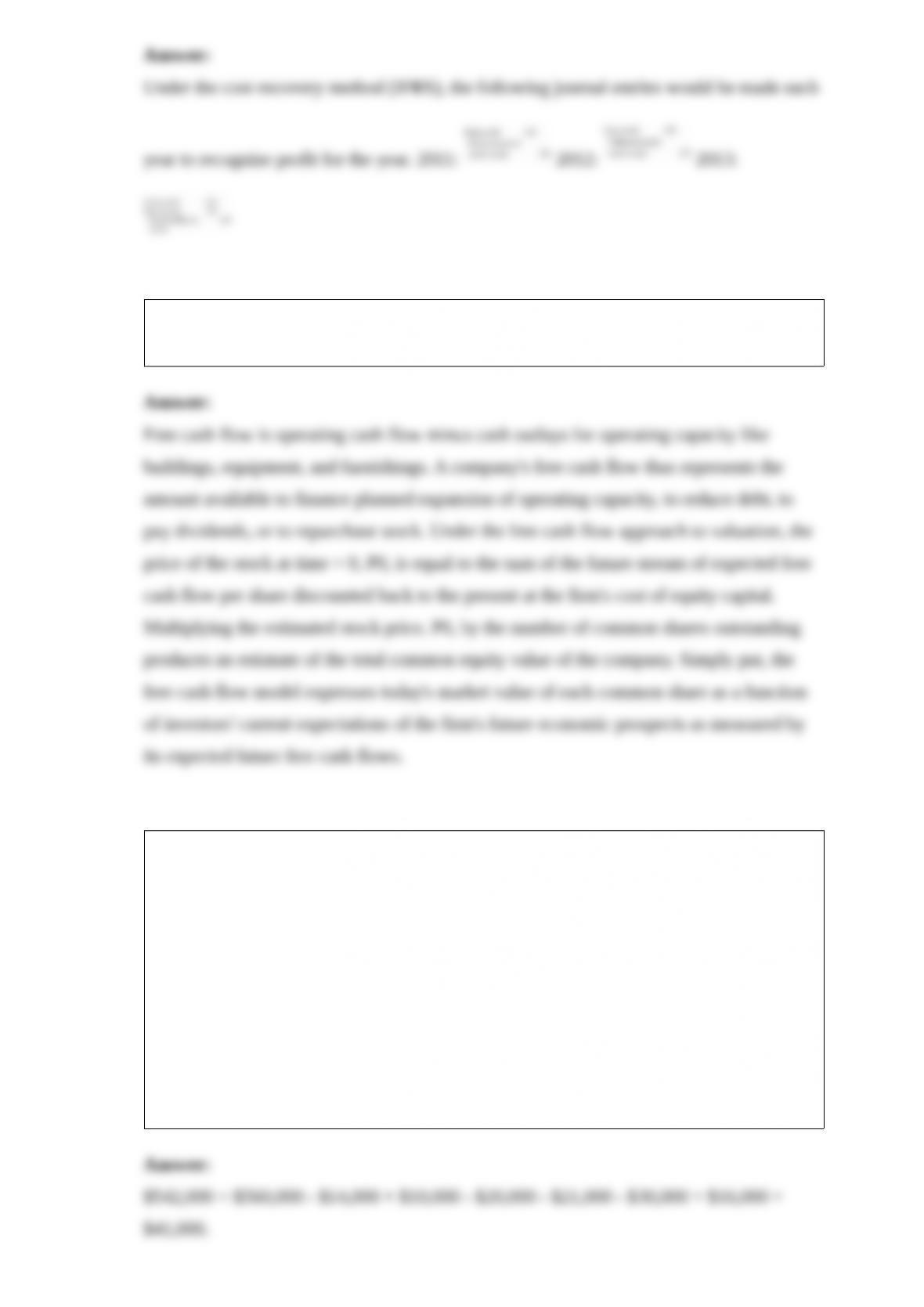
45) At the beginning of 2011, the Arbuckle Construction Company signed a contract
with the state to build a highway for $10,000,000. The project is estimated to be
completed by the end of 2013 . Arbuckle will bill the state in installments over the
construction period per a schedule in the contract. Information related to the contract is
as follows:
Because the highway is being built in an area that is home to the Eastern Spadefoot
Toad (an endangered species), Arbuckle is required to construct a toad habitat to replace
the one being lost in the project. As Arbuckle has no prior experience building swamps,
it believes it is not able to reasonably estimate the contract’s completion costs. Assume
that Arbuckle follows IFRS rules when accounting for construction contracts.
Required:
Prepare the journal entry that Arbuckle would make at the end of each year to
appropriately recognize profit on the project.
46) Briefly define “free cash flows” and describe the key features of the free cash flow
approach to valuation.
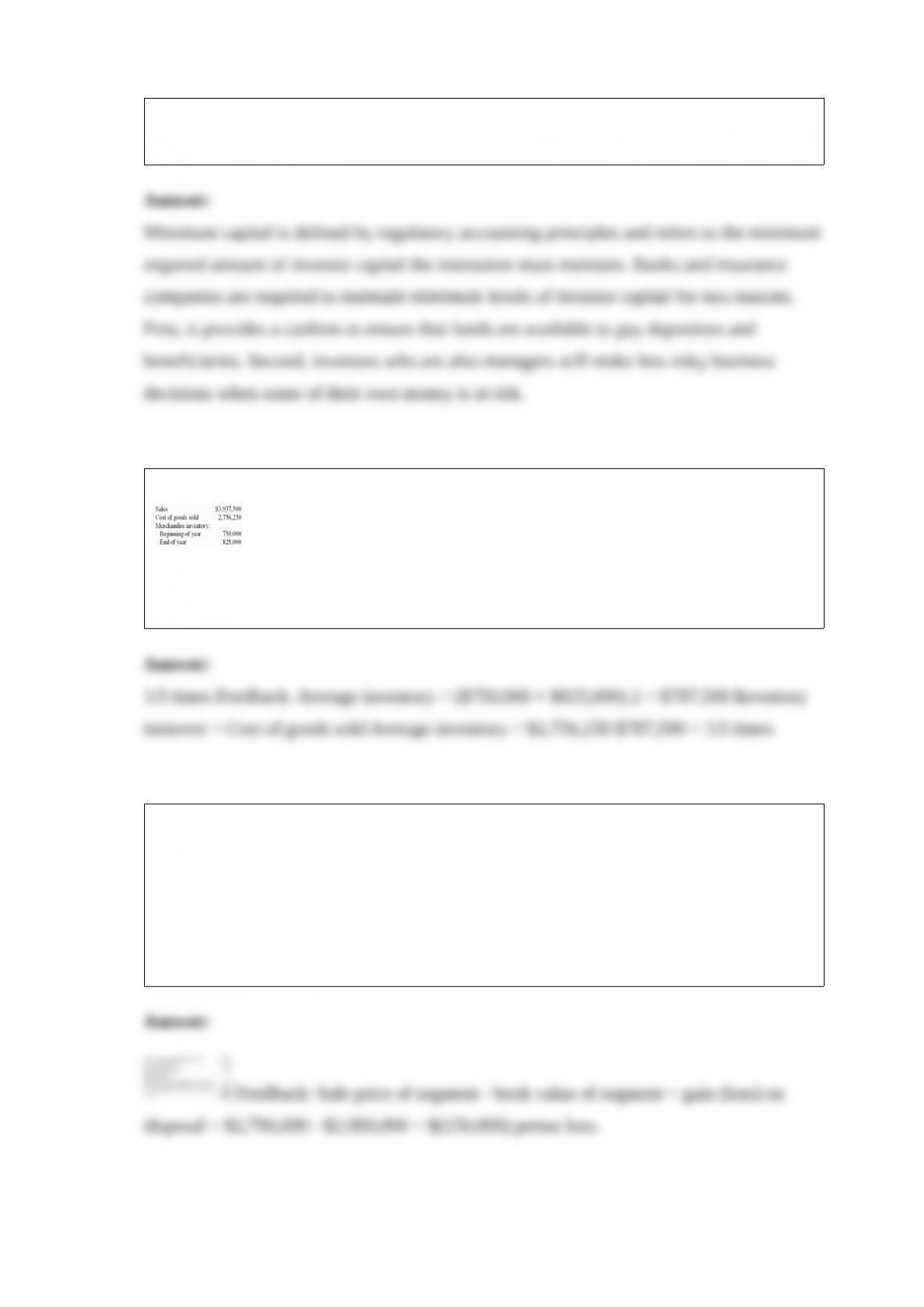
47) The Black Corporation has provided the following information:
Net income: $560,000
Increase in prepaid expenses: $14,000
Amortization of discount on bonds payable: $10,000
Decrease in accounts payable: $20,000
Increase in inventory: $21,000
Dividends declared: $39,000
Dividends paid: $36,000
Increase in accounts receivable: $30,000
Increase in wages payable: $16,000
Increase in deferred tax liability: $41,000
Required: Determine the cash flow from operating activities.
48) Define the term “minimum capital requirements” and explain why banks and
insurance companies are required by regulators to maintain such capital minimums.
49) Crue Company’s merchandise inventory and other related accounts for 2011 follow:
Required:
Calculate Crue’s inventory turnover during 2011 assuming that the merchandise
inventory buildup was relatively constant during the year.
50) On November 15, 2011, Jones Co. sold a segment of its business for $2,750,000.
The net book value of the segment at the time of its disposal was $2,900,000. Jones had
pretax operating income of $1,750,000 for 2011 which included $360,000 earned by the
discontinued segment prior to its disposal. Assume Jones’ tax rate is 30%.
Required:
Prepare a partial income statement for Jones Co. for 2011, beginning with pretax
income from continuing operations.