
Dividends are best defined as:
A. cash payments to shareholders.
B. cash payments to either bondholders or shareholders.
C. cash or stock payments to shareholders.
D. cash or stock payments to either bondholders or shareholders.
E. distributions of stock to current shareholders.
Youve observed the following returns on Blast It Corporations stock over the past five
years: 11 percent, -28 percent, 16 percent, 18 percent, and – 3 percent, respectively.
What was the variance of the returns over this period?
A. 0.03598
B. 0.03637
C. 0.03692
D. 0.03714
E. 0.03781

Which one of the following statements is correct? Assume the pretax cost of debt is less
than the cost of equity.
A. A firm may change its capital structure if the government changes its tax policies.
B. A decrease in the dividend growth rate increases the cost of equity.
C. A decrease in the systematic risk of a firm will increase the firms cost of capital.
D. A decrease in a firms debt-equity ratio will decrease the firms cost of capital.
E. The cost of preferred stock decreases when the tax rate increases.
Which one of the following best indicates a firm is utilizing its assets more efficiently
than it has in the past?
A. Decrease in the total asset turnover
B. Decrease in the capital intensity ratio
C. Increase in days sales in receivables
D. Decrease in the profit margin
E. Decrease in the inventory turnover rate
Suppose the Swiss franc exchange rate is SF 1.1582 = $1, and the euro exchange rate is
0.7538 = $1. What is the cross-rate in terms of Swiss francs per euro?
A. SF 1.5074 = 1
B. SF 1.5098 = 1
C. SF 1.5132 = 1
D. SF 1.5246 = 1
E. SF 1.5365 = 1
A firm has the following account balances. Which one of the following statements is
correct concerning those balances?
A. Accounts receivable is a $900 source of cash.
B. Common stock is a $1,500 source of cash.
C. Net working capital, excluding cash, is a $1,500 use of cash.
D. Long-term debt is a $5,800 source of cash.
E. Total debt is a $6,100 use of cash.
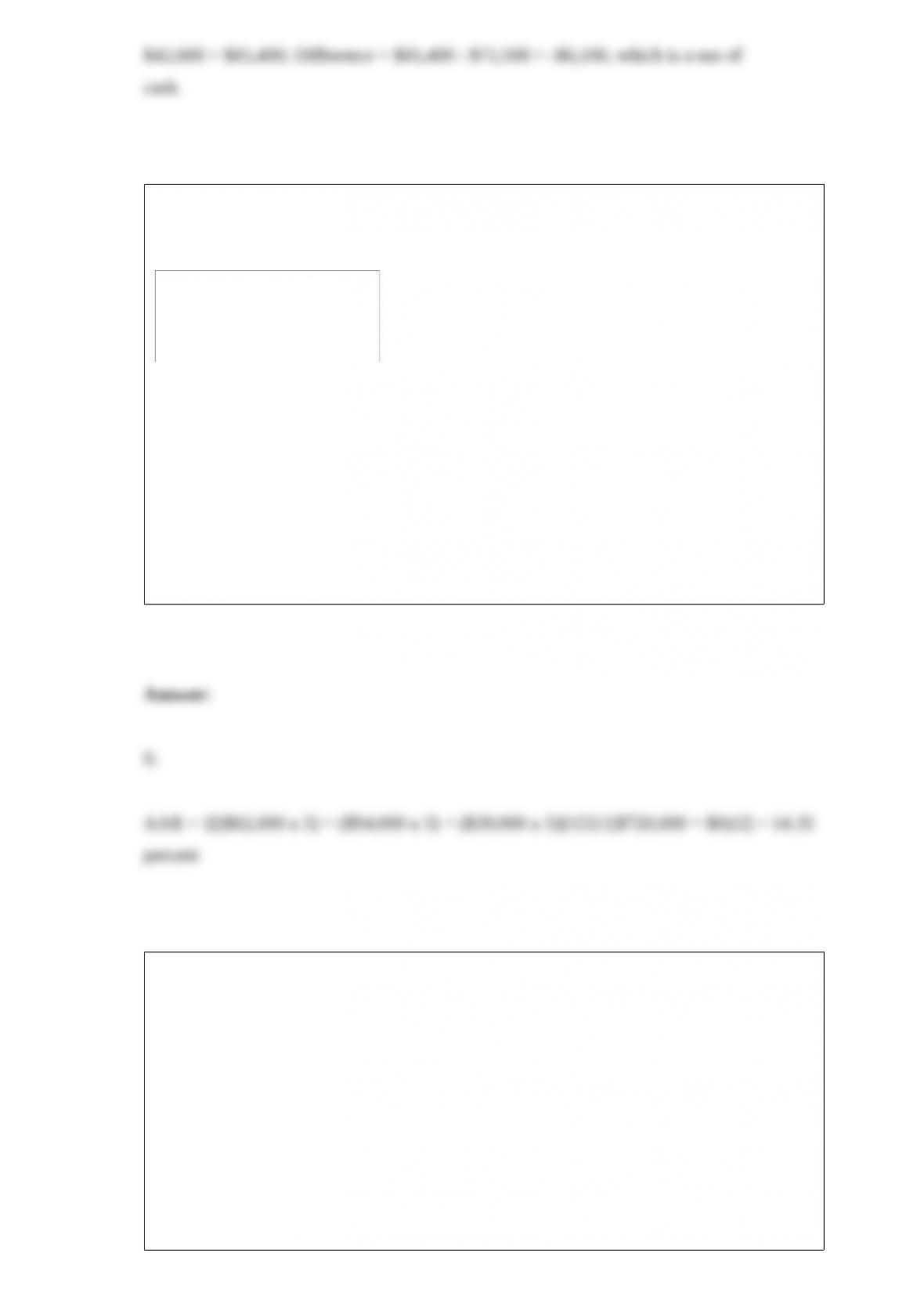
The Nifty Fifty is considering opening a new store at a start-up cost of $720,000. The
initial investment will be depreciated straight-line to zero over the 15-year life of the
project. What is the average accounting rate of return?
A. 13.05 percent
B. 13.68 percent
C. 14.01 percent
D. 14.18 percent
E. 14.35 percent
Reynolds Metals common stock is selling for $25 a share and has a dividend yield of
3.1 percent. What is the dividend amount?
A. $0.31
B. $0.78
C. $3.49
D. $4.25
E. $7.80

Centre Bank pays 2.5 percent interest, compounded annually, on its savings accounts.
Country Bank pays 2.5 percent simple interest on its savings accounts. You want to
deposit sufficient funds today so that you will have $1,500 in your account 2 years from
today. The amount you must deposit today:
A. is the same regardless of which bank you choose because they both pay compound
interest.
B. is the same regardless of which bank you choose because they both pay simple
interest.
C. is the same regardless of which bank you choose because the time period is the same
for both banks.
D. will be greater if you invest with Centre Bank.
E. will be greater if you invest with Country Bank.
You want to invest an amount of money today and receive back twice that amount in
the future. You expect to earn 6 percent interest. Approximately how long must you
wait for your investment to double in value?
A. 6 years
B. 7 years
C. 8 years
D. 12 years
E. 14 years
Best Western has $1,000 face value bonds outstanding. These bonds pay interest
semiannually, mature in six years, and have a 5 percent coupon. The current price is
quoted at 101. What is the yield to maturity?
A. 2.32 percent
B. 4.64 percent
C. 5.00 percent
D. 5.13 percent
E. 5.27 percent
Which one of the following formulas illustrates the mechanics of covered interest
arbitrage? Assume the $1 is borrowed and S0 = spot rate; F1 = one-year forward rate; RF
= foreign country risk-free rate; and RUS = U.S. risk-free rate.
A. $1 x F1 x (1 + RF)/S0 – $1 x (1 + RUS)
B. $1 x S0 x (1 + RF)/F1 – $1 x (1 + RUS)

C. $1 x F1 x (1 + RF)/S0 + $1 x (1 + RUS)
D. $1 x S0 x (1 + RF) – $1 x (1 + RUS)/F1
E. $1 x S0 x (1 + RF)/F1 + $1 x (1 + RUS)
Which one of the following best defines a regular cash dividend?
A. Distribution by a firm to its shareholders
B. Payment from any source by a firm to its owners
C. One-time payment of cash by a firm to its shareholders
D. Cash payment by a firm to its owners as part of a firms normal operations
E. Distribution of the proceeds from the sale of a portion of a firms operations
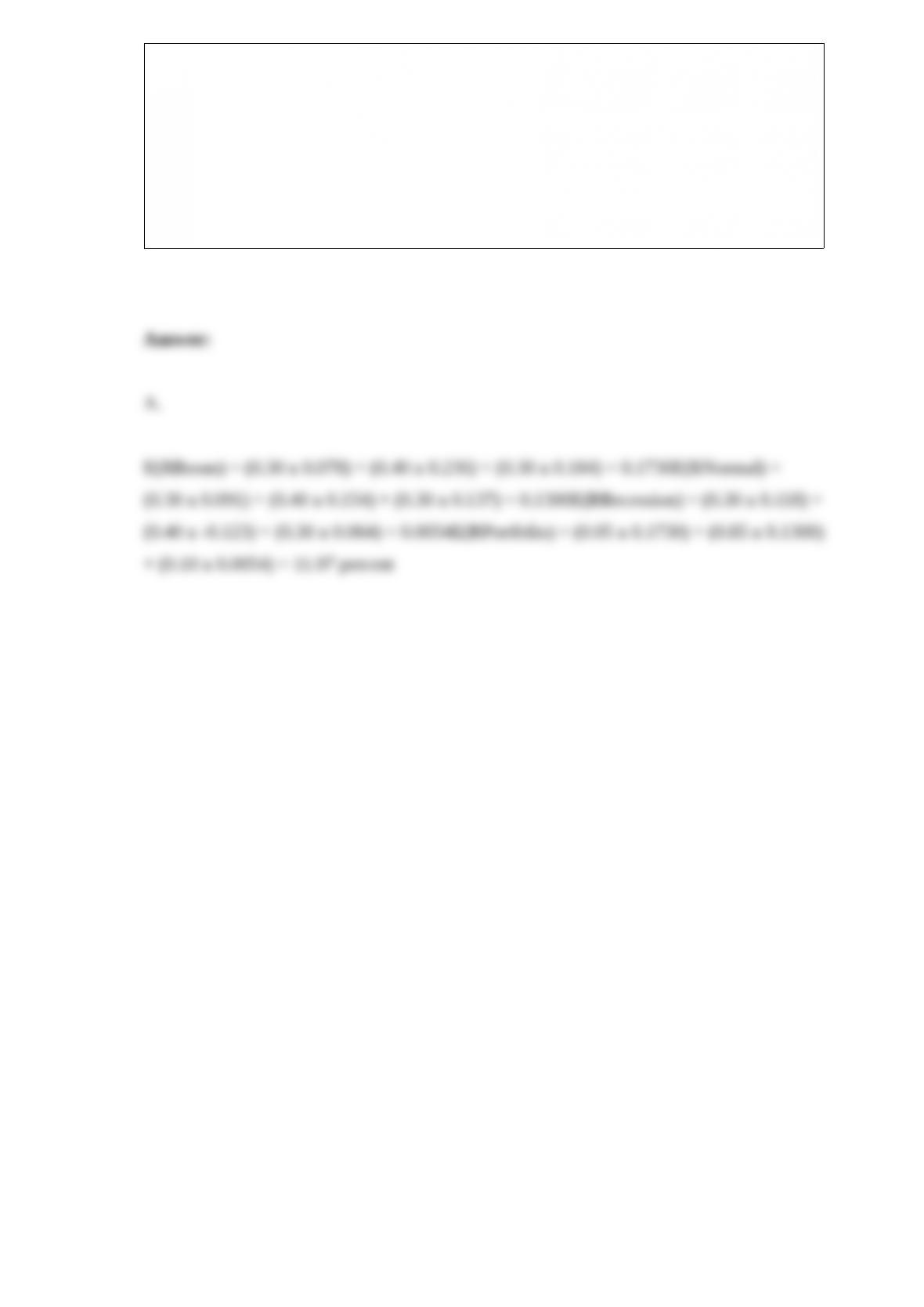
Given the following information, what is the expected return on a portfolio that is
invested 30 percent in both Stocks A and C, and 40 percent in Stock B?
A. 11.97 percent
B. 12.94 percent
C. 13.33 percent
D. 13.84 percent
E. 14.42 percent