1) Using total sales instead of credit sales in the accounts receivable turnover
calculation can produce misleading results and is a problem primarily for companies
that have a material amount of cash sales.
2) Large amounts of high interest debt on a company’s balance sheet signal an ability to
take advantage of profitable investment opportunities when they arise because the
borrowed funds are available for use by management.
3) The first step to informed financial statement analysis is a careful examination of the
auditor’s opinion.
4) The balance sheet carrying value for internally generated intangibles is often below
the value of the property rights.
5) A revenue item that causes book income to be more (less) than taxable income when
it is initially recorded, is called an original timing difference.
6) The installment sales method recognizes revenue and income proportionately as cash
is collected.
7) A restructuring of debt constitutes a troubled debt restructuring if the creditor, for
legal or economic reasons related to the debtor’s financial difficulties, grants a
concession to the debtor that it would otherwise not consider.

8) The direct method and the indirect method are two alternative presentations for cash
flows from investing activities.
9) When a company acquires another company, the merger gives rise to a type of
accounting change.
10) Under IFRS firms are encouraged to use the direct method and are required to
provide a reconciliation of net income to cash flows from operating activities.
11) Factoring can either be with, or without, recourse.
12) GAAP established specific criteria for the treatment of leases. One of the criteria
states that the lessee must capitalize a lease if the present value of the minimum lease
payments is greater than or equal to 75% of the leased asset’s fair value.
13) The difference between the actual and expected return on plan assets during year
two is a component of pension expense for year two.
14) In the U.S., accelerated depreciation is almost universally used for tax purposes.

15) The choice of method for allocating the cost of goods available for sale between
ending inventory and cost of goods sold represents the major issue in inventory
accounting.
16) Which of the following is not true regarding consolidations under IFRS?
A.A parent and a subsidiary are permitted to have different accounting policies
B.While both IFRS and GAAP require a firm to consolidate entities it controls, IFRS
defines control more broadly than does GAAP
C.The noncontrolling interest is classified on the balance sheet in the stockholders’
equity section shown separate from the equity of the parent
D.On the income statement, noncontrolling interest is shown as a deduction from total
entity (parent + 100% subsidiary) consolidated earnings
17) The value of Accounts Receivable is adjusted on the balance sheet by the
contra-asset account
A.Allowance for Amortization
B.Allowance for Doubtful Accounts
C.Bad Debt Expense
D.Doubtful Accounts Expense
18) Yarnco, Inc. is primarily a diversified North American producer and processor of
multi-filament polyester and nylon yarns, including specialty yarns with enhanced
performance characteristics. The Company manufactures partially oriented, textured,
dyed, twisted and beamed polyester yarns as well as textured nylon and nylon covered
spandex products. Refer to the excerpts of the 2011 Yarnco, Inc. Annual Report. All
questions relate to 2011 unless stated otherwise. Assume a 35% corporate tax rate
where necessary.
Inventories.The Company utilizes the last-in, first-out (“LIFO”) method for valuing
certain inventories representing 38.6% and 38.2% of all inventories at June 24, 2011,
and June 25, 2010, respectively, and the first-in, first-out (“FIFO”) method for all other
inventories. Inventories are valued at lower of cost or market including a provision for
slow moving and obsolete items. Market is considered net realizable value. Inventories

valued at current or replacement cost would have been approximately $8.2 million and
$7.3 million in excess of the LIFO valuation at June 24, 2011, and June 25, 2010,
respectively. The Company did not have LIFO liquidations during fiscal year 2011 and
fiscal year 2010. The Company maintains reserves for inventories valued utilizing the
FIFO method and may provide for additional reserves over and above the LIFO reserve
for inventories valued at LIFO. Such reserves for both FIFO and LIFO valued
inventories can be specific to certain inventory or general based on judgments about the
overall condition of the inventory. General reserves are established
based on percentage markdowns applied to inventories aged for certain time periods.
Specific reserves are established based on a determination of the obsolescence of the
inventory and whether the inventory value exceeds amounts to be recovered through
expected sales prices, less selling costs; and, for inventory subject to LIFO, the amount
of existing LIFO reserves. The total inventory reserves on the Company’s books,
including LIFO reserves, at June 24, 2011 and June 25, 2010 were $15.7 million and
$10.7 million, respectively. The following table reflects the composition of the
Company’s inventory as of June 24, 2011 and June 25, 2010:
Required:
a. What amount of inventory is on the balance sheet?
b. Compute Yarnco’s cost of goods sold using FIFO instead of LIFO.
c. Compute the amount of the cumulative tax deferral resulting from LIFO existing at
the end of 2011 .
d. Compute how the use of LIFO affects Yarnco’s book value (common stockholders’
equity) at the end of 2011 .
e. Compute the inventory turnover ratio to approximate physical unit flow for 2011.
Show your work.
19) Doggy Co. began construction of a new cutter for the U.S. Coast Guard on January
1, 2011 and completed construction of the ship on October 31, 2012 . To finance
construction, Doggy took out an $8,000,000, 2-year 6% construction loan on February
1, 2011 . Interest on the loan was to be paid annually on the anniversary date of the
loan. Doggy has no other outstanding interest-bearing debt. Doggy made the following
expenditures in conjunction with this construction project:
What amount would appear in Doggy’s construction in progress account at December
31, 2011?
A.$2,325,000
B.$4,300,000

C.$4,439,500
D.$4,740,000
20) The FASB has been able to guard against management manipulation of earnings as
a result of asset impairments by
A.fining any managers found guilty of such manipulation
B.requiring restoration of previously recognized impairment losses
C.prohibiting restoration of previously recognized impairment losses
D.relying on State Boards of Public Accountancy to police the transactions
21) Smith Company reported $350,000 in book income before income tax during 2012,
its first year of operation. The tax depreciation exceeded its book depreciation by
$30,000. The tax rate for 2012 and all future years was 40%.
Income tax expense reported on the income statement for the year ending December 31,
2012 would be
A.$100,000.
B.$120,000.
C.$128,000.
D.$140,000.
22)
Assume that Firm A can increase earnings by $4,000, by cutting costs. Abnormal
earnings would be
A.$(1,000)
B.$0
C.$1,000
D.$1,500
23) Pona, Inc. has a defined benefit pension plan for its employees. The plan assets and
projected benefit obligation at the beginning of the year were $608,000. The
accumulated benefit obligation at the beginning of the year was $456,000. The expected
return on plan assets was 8% while the actual return was 9%. The service cost for the
year was $130,841. The actuarially assumed discount rate was 7% and amortization of
prior service costs was $17,750.
The interest cost for the year is
A.$42,560
B.$31,920
C.$36,480
D.$41,040
24) Regulatory accounting principles are important to those outside the regulatory
agencies because
A.GAAP may allow reporting for assets and liabilities consistent with the way in which
regulators establish rates
B.GAAP does not allow reporting for assets and liabilities consistent with the way in
which regulators establish rates
C.regulatory accounting principles are not compatible with GAAP
D.the SEC requires them
25) Which one of the following has statutory authority to determine accounting rules?
A.American Institute of Certified Public Accountants
B.State Boards of Accountancy
C.Securities and Exchange Commission
D.Financial Accounting Standards Board
26) When accounting for sales where the risk of non-collection of installments is high
or when there is no reasonable basis for estimating uncollectible accounts, IFRS
A.requires use of the installment sales method

B.permits either the cost recovery or the installment sales method
C.takes a more conservative approach than that allowed under U.S. GAAP
D.takes a less conservative approach than that allowed under U.S. GAAP
27) Common-size financial statements recast each statement item as
A.a percentage using industry averages for the “base number”
B.a percentage using a base year number for each line item
C.a percentage of some “base number” on the financial statement in question
D.a percentage of the “bottom line”
28) During its first year of operations a company recorded accrued expenses totaling
$250,000 for book purposes. For tax purposes, $100,000 of the expenses are deductible
during the first year of operations and $150,000 are deductible during the second year
of operations. The income tax rate for both years is 45%. The balance sheet at the end
of the first year of operations will report a deferred tax
A.asset of $67,500
B.liability of $67,500
C.liability of $45,000
D.asset of $100,00
29) A covenant that specifies a required minimum level of net worth and working
capital is a/an
A.compliance covenant
B.financial covenant
C.implicit covenant
D.negative covenant
30) Madrid Incorporated’s 2012 income statement reported income tax expense of
$635,375. During 2012, Madrid’s income taxes payable account increased $19,735
while the deferred tax asset account increased $39,365. How much cash was paid for
taxes during 2012?
A.$615,745
B.$694,475
C.$655,005
D.$576,275
31) When consolidating foreign subsidiaries, the foreign subsidiary’s financial numbers
must be translated into the parents’ currency unit. Under U.S. GAAP if the foreign
subsidiary is a self-contained unit the
A.current rate method is used
B.temporal method is used
C.present value method is used
D.historical cost method is used
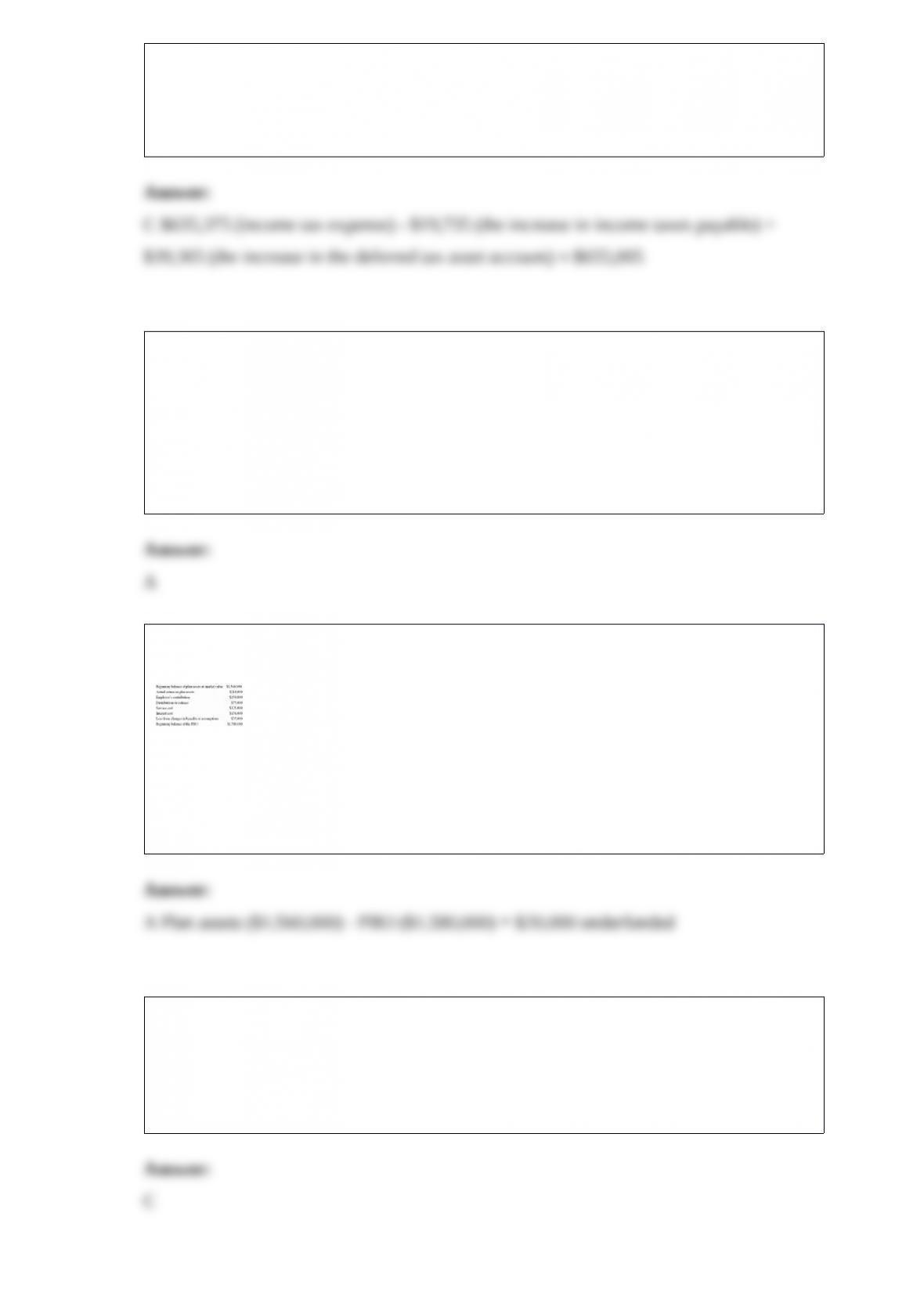
32) The trustee for the Bronson Corporation pension sent a report to the CEO with the
following information for the fiscal year:
At the beginning of the year, the pension plan is
A.underfunded by $20,000
B.overfunded by $20,000
C.underfunded by $35,000
D.overfunded by $35,000
33) When accounting for a capital lease, depreciation expense is equal to the
A.lease payments
B.principal portion of the lease payments
C.normal depreciation computed on the depreciable base of the asset
D.straight-line depreciation only on the full amount of the leased asset
34) Which of the following statements pertaining to preferred stock is not correct?
A.Preferred stock may have an adjustable rate which pays a dividend that is adjusted,
usually on a quarterly basis
B.Preferred stock dividends are contractual obligations that must be paid in profitable
years
C.Most preferred stock issues are nonparticipating, meaning that the shareholders are
entitled to receive only dividends based on the stated dividend rate
D.Preferred shareholders are given preference with respect to both dividend
distributions and in liquidation of the company
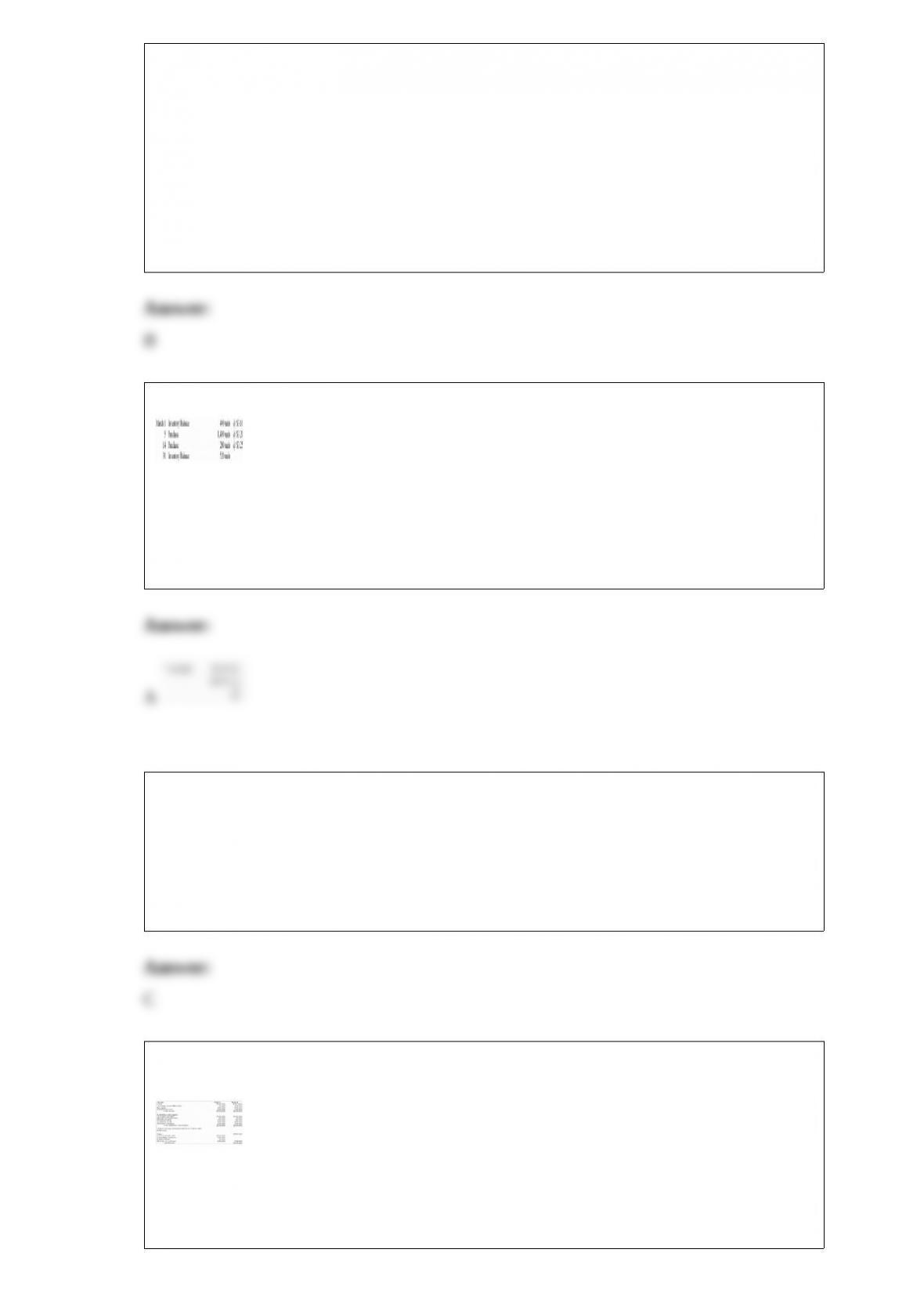
35) The following information pertains to the Fan Company’s inventory item B1008:
In a periodic inventory system, the FIFO cost of goods sold is
A.$4,952
B.$4,967
C.$4,993
D.$5,006
36) Cash dividends paid by a corporation
A.are an expense of the corporation that declared the dividend
B.reduces the net income of the corporation that declared the dividend
C.reduces the retained earnings of the corporation that declared the dividend
D.reduces the retained earnings of the corporation that declared the dividend because
net income is reduced by the amount of the dividend
37) Selected data for Kris Corporation’s comparative balance sheets for Year 1 and Year
2 are as follows:
How much did Kris pay in dividends to shareholders in Year 2?
A.$30,000
B.$120,000
C.$150,000
D.$330,000
38) Common-size balance sheets may be used for all of the following except
A.gaining insights into the nature of a company’s operations
B.analyzing a company’s asset and financial structure
C.determining how management assesses the risks a company faces
D.learning about the underlying economics of an industry
39) A corporation reported the following during 2012: Net income $175,250; a sale of
10,000 shares of $5 par value common stock for $8.75 per share; a purchase of treasury
stock costing $24,750; a sale of treasury stock costing $15,500 for $14,695; a
declaration and distribution of a $39,000 cash dividend; a declaration and distribution
of a ‘small” stock dividend of 5,000 shares of $5 par value common stock at a total
market value of $50,000. What was the increase in owners’ equity during 2012?
A.$213,695
B.$188,695
C.$198,195
D.$173,195
40) Which of the following correctly describes the accounting for assets and liabilities
that were created from foreign currency transactions?
A.Foreign currency monetary assets and liabilities are measured using the current rate
of exchange as of the date of the initial transaction
B.Foreign currency monetary assets and liabilities are measured using the current rate
of exchange as of the balance sheet date
C.Foreign currency nonmonetary assets and liabilities are measured using the current
rate of exchange as of the balance sheet date
D.Foreign currency nonmonetary assets and liabilities are measured using the average
annual rate of exchange during the year

41) If a company currently earns $5.00 per share, and has a risk-adjusted cost of equity
capital of 9%, a share of common stock should theoretically sell for
A.$0.45
B.$5.00
C.$48.00
D.$55.55
42) On October 31, 2010, Sterling Construction Company entered into a credit
agreement with Comerica Bank. The following appeared among the agreement’s
financial covenants: “Commencing with the fiscal quarter ending December 31, 2010,
maintain as of the end of each fiscal quarter a Fixed Charge Coverage Ratio of not less
than 1.25 to 1.00.” The credit agreement also contained a “definitions” section where
this item was listed: ” Fixed Charge Coverage Ratio’ shall mean as of any date of
determination a ratio the numerator of which is EBITDA for the Applicable Measuring
Period, minus cash taxes and cash tax distributions with respect to such period and the
denominator of which is the sum of Current Maturities of Long Term Debt plus interest
paid during the trailing twelve month period, plus twenty-five percent (25%) of the
daily average total non-amortizing debt during the trailing twelve month period.”
Required:
a. What is a minimum fixed charge coverage ratio and what purpose does it serve in the
company’s loan agreements?
b. Why is it necessary for the loan agreement to precisely define “Fixed Charge
Coverage Ratio?”

43) The following information pertains to a bond issue of the Atomic Corporation:
Maturity value: $1,000,000
Maturity date: January 31, 2015
Stated interest rate: 8%
Interest payments are made annually on December 31st
Date of issue: January 1, 2011
The bond is dated January 1, 2011
Effective (market) interest rate: 10%
Requirements:
1> At what price were the bonds issued?
2> Using the effective interest method, prepare an amortization schedule showing
annual interest expense, annual discount or premium amortization, and carrying value
through December 31, 2013 .
3> Prepare the necessary journal entries on January 1, 2011 and December 31, 2012 .
4> How should the bonds be shown on Atomic’s December 31, 2011 balance sheet?
44) Evert Company recently acquired 5,000 shares of its $2 par value common stock for
$10 per share. Evert initially issued the stock for $7.50 per share.
Required:
1> Assuming the shares were purchased as treasury shares, prepare the necessary
journal entry to record the purchase of the 5,000 shares.
2> Continuing with the assumption that the shares were purchased as treasury shares,
prepare the journal entry to record the sale of 2,500 shares of the treasury stock for
$11.50 per share.
3> Continuing with the assumption that the shares were purchased as treasury shares,
prepare the journal entry to record the subsequent sale of 2,000 shares of treasury stock
for $9.75 per share.
4> Assuming the shares were purchased and retired, prepare the journal entry to record
the retirement of the shares.
45) The following information is available for the Bench Company:
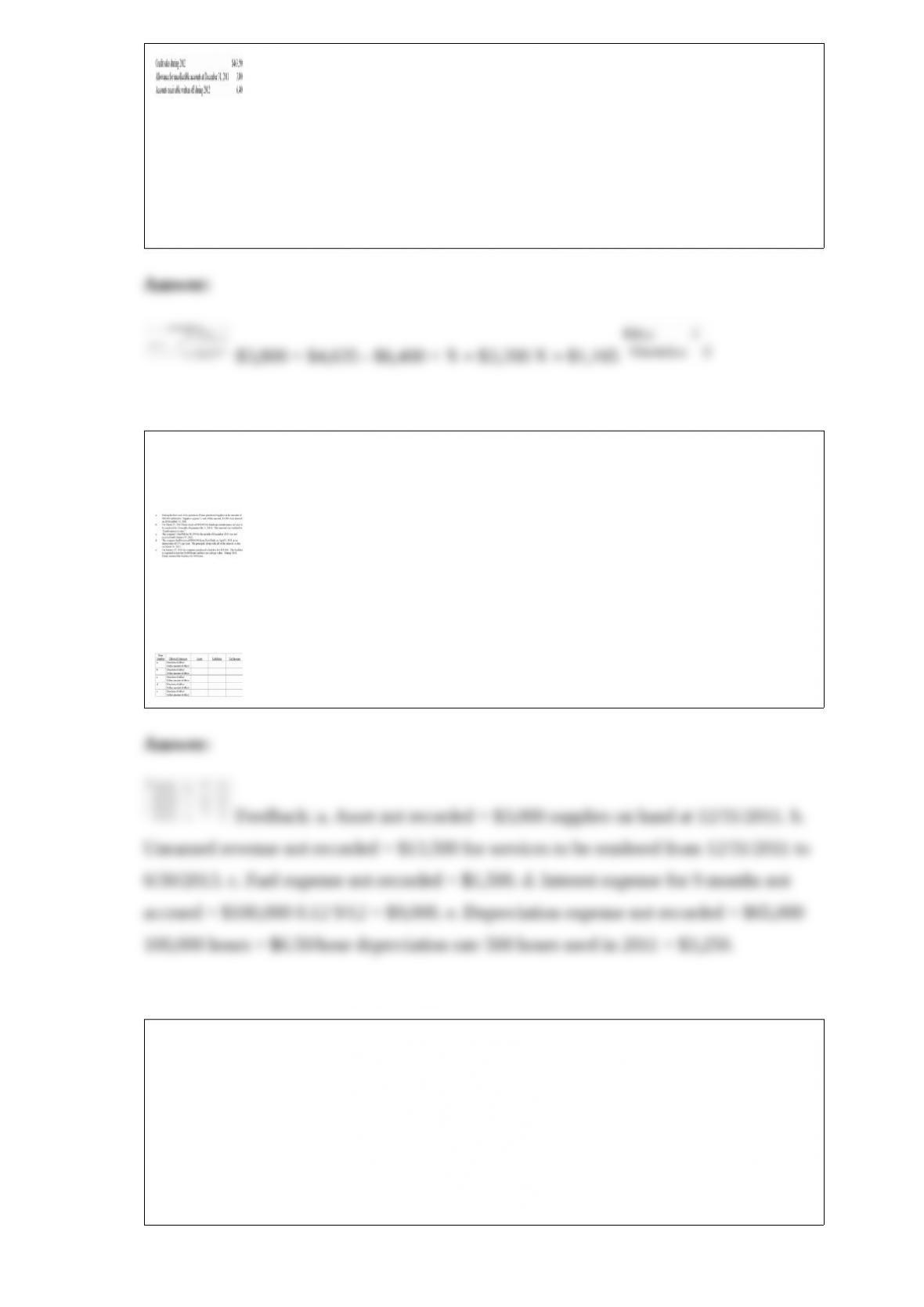
During 2012, Bench estimated that its bad debt expense should be 1% of all credit sales
and made the appropriate monthly adjusting entries. As a result of a review and aging of
accounts receivable in early January 2013, it has been determined that an allowance for
uncollectible accounts of $3,200 is needed at December 31, 2012 .
Required:
What is the journal entry that Bench should make after the aging is completed?
46) Primo Landscaping commenced its business on January 1, 2011 . On December 31,
2011, Primo Landscaping did not record any adjusting entries with respect to the
following transactions:
Required:
Complete the table below, showing the effect of the omission of each year-end adjusting
entry on assets, liabilities, and net income. Use “OS” for overstated, “US” for
understated, and “NE” for no effect.
47) The Kruk Company regularly sells merchandise to German customers. On
December 1, 2012, Kruk sold merchandise to a German customer at a price of three
million Euros; the customer is required to pay for the goods on February 1, 2013 . The
spot rate was $.875 per euro on December 1, 2012, it was $.8875 per euro on December
31, 2012, and it was $.865 per euro on February 1, 2013 .
Required:
Prepare the journal entries that might be necessary on December 1, 2012, December 31,
2012, and on February 1, 2013