
The most important economic benefit from specialization is that it
(a) makes it possible for an economy to begin using money.
(b) leads to an increase in the standard of living in an economy.
(c) makes barter possible.
(d) eliminates the need for financial markets.
Answer:
Economists generally agree that in the long run changes in aggregate demand affect
(a) aggregate output but not the price level.
(b) the price level but not aggregate output.
(c) both the price level and aggregate output.
(d) neither the price level nor aggregate output.
Answer:
Finance companies
(a) take in deposits from savers and make loans to borrowers.

(b) sell commercial paper and securities and make loans to borrowers with the funds.
(c) take in deposits from savers and purchase assets with the funds.
(d) bring together small savers and large borrowers.
Answer:
The bond supply curve
(a) shows the quantity of bonds lenders are willing to supply as bond prices change.
(b) shows the quantity of bonds lenders are willing to supply as interest rates change.
(c) shows the quantity of bonds borrowers are willing to supply as bond prices change.
(d) is represented by a downward sloping line when the price of bonds is on the vertical
axis and the quantity of bonds supplied is on the vertical axis.
Answer:
The largest category of U.S. government lending activities is government lending to
(a) individual home buyers.
(b) students.
(c) large corporations.

(d) farmers.
Answer:
A car loan that a bank grants to you is
(a) a source of funds to you, but a use of funds to the bank.
(b) a use of funds to you, but a source of funds to the bank.
(c) a source of funds to both you and the bank.
(d) a use of funds to both you and the bank.
Answer:
In a call options contract the
(a) seller has the obligation to deliver the instrument at a specified time.
(b) buyer has the obligation to receive the instrument at a specified time.
(c) seller may choose whether or not to deliver the instrument at a specified time.
(d) buyer will choose to exercise his option only if the value of the underlying security
falls.

Answer:
The Securities and Exchange Commission was founded in
(a) 1805.
(b) 1933.
(c) 1965.
(d) 1995.
Answer:
If an investment bank underwrites an issue on a “best efforts” basis,
(a) the issuing company receives nothing unless the investment bank sells the complete
issue at the offering price.
(b) the issuing company must pay the investment bank’s fee only if the investment bank
is found to have done its best to market the security issue.
(c) the investment bank makes no guarantee and is required to sell to investors only as
much of the issue as it can.
(d) the investment bank will raise the indicated funds from an issue that is either all
stock or all bonds.

Answer:
Price controls tend to be ineffective in controlling inflation because they
(a) fail to shift the SRAS curve sufficiently far to the right.
(b) suppress inflation rather than eliminate it.
(c) widen the government’s budget deficit.
(d) reduce the rate of growth of the money supply.
Answer:
Fluctuations in the price of the underlying security or commodity during the life of
forward transactions
(a) have no effect on the contracting parties.
(b) are disallowed under current government regulations.
(c) confer capital gains and losses on the contracting parties.
(d) will occur during times of extreme economic instability.
Answer:

The simplest type of payments system is
(a) the use of definitive money for trading goods and services.
(b) the use of electronic funds transfers.
(c) barter.
(d) the use of checks issued against accounts at commercial banks for trading goods and
services.
Answer:
A key difference between small-denomination and large-denomination time deposits is
that
(a) small-denomination time deposits pay no interest.
(b) large-denomination time deposits may be bought and sold on secondary markets.
(c) large-denomination time deposits carry a significant penalty for early withdrawal.
(d) small-denomination time deposits carry a significant penalty for early withdrawal.
Answer:

Money eliminates the need for
(a) any government role in the economy.
(b) specialization.
(c) people to have a double coincidence of wants.
(d) the market system.
Answer:
If the money market is in equilibrium
(a) the inflation rate equals the nominal interest rate.
(b) the inflation rate equals the real interest rate.
(c) the nonmoney asset market is in equilibrium.
(d) the goods market is in equilibrium.
Answer:
Insurance companies

(a) hold capital market instruments as assets and issue insurance promises as liabilities.
(b) issue insurance promises as assets and hold capital market instruments as liabilities.
(c) hold capital market instruments as assets and also issue insurance promises as
assets.
(d) hold capital market instruments as liabilities and also issue insurance promises as
liabilities.
Answer:
Which of the following is true of current reserve requirements?
(a) Time deposits have no reserve requirement.
(b) Eurocurrency liabilities have no reserve requirement.
(c) All checkable deposits are subject to a 10% reserve requirement.
(d) Checkable deposits in rural banks have a lower reserve requirement than checkable
deposits in urban banks.
Answer:
Most credit unions are chartered and regulated by the
(a) Office of Thrift Supervision.

(b) National Credit Union Administration.
(c) Office of the Comptroller of the Currency.
(d) Federal Reserve System.
Answer:
Suppose that a new bond rating service is established that specializes in rating
municipal bonds that had not previously been rated. The likely result would be
(a) a shift to the right in the demand curve for bonds.
(b) a shift to the left in the supply curve for loanable funds.
(c) an increase in the equilibrium interest rate.
(d) a decrease in the equilibrium interest rate.
Answer:
What is the most important contrast between the segmented markets theory and the
expectations theory?
(a) The expectation theory states that investors view similar assets that differ only with
respect to maturity as perfect substitutes.

(b) The segmented markets theory states that investors view similar assets that differ
only with respect to maturity as perfect substitutes.
(c) The expectations theory does a better job of explaining why yield curves typically
are upward-sloping.
(d) The segmented markets theory does a better job of explaining why yields on
instruments of different maturities tend to move together.
Answer:
If oil prices fall at the same time that the federal government increases its spending, in
the short run
(a) aggregate output and the price level will both increase.
(b) aggregate output will increase, but the price level will fall.
(c) aggregate output and the price level will both fall.
(d) aggregate output will increase, but the price level may either increase or decrease.
Answer:
The default risk premium is measured
(a) by an index published monthly by the Securities and Exchange Commission.

(b) by an index published monthly by The Wall Street Journal.
(c) as the difference between the yield on the security and the yield on a U.S. Treasury
security of the same maturity.
(d) as the difference between the nominal yield on the security and the real after-tax
yield on the security.
Answer:
Financial integration refers to
(a) the ability of persons of different races and religions to obtain access to financial
services.
(b) the way in which financial markets are tied together geographically.
(c) the ability to easily convert investments in common stock into investments in
corporate bonds.
(d) the difference between interest rates offered by commercial banks and those offered
by savings and loan associations.
Answer:
The monetary base rises
(a) whenever the federal government runs a deficit.

(b) whenever the federal government runs a surplus.
(c) whenever the federal government finances a deficit by selling bonds.
(d) whenever the Fed acquires some of the bonds sold by the federal government to
finance the deficit.
Answer:
If lenders anticipate no changes in liquidity, information costs, and tax differences, the
yield on a risky security should be
(a) greater than that on a safe security and the price of a risky security should also be
greater than that of a safe security.
(b) less than that on a safe security and the price of a risky security should also be less
than that of a safe security.
(c) greater than that on a safe security and the price of a risky security should be lower
than that of a safe security.
(d) less than that on a safe security and the price of a risky security should be greater
than that on a safe security.
Answer:
Financial instruments with high interest rates due to higher information costs

(a) tend to have less risk than similar financial instruments with low information costs.
(b) also tend to be relatively illiquid.
(c) also tend to have higher prices than similar financial instruments with low
information costs.
(d) are usually heavily traded, which serves to partially offset their having high
information costs.
Answer:
Most foreign exchange is bought and sold
(a) by governments.
(b) by tourists.
(c) in over-the-counter markets.
(d) on the New York Stock Exchange.
Answer:
A 10% inflation rate means that
(a) prices of some important goods and services have increased by 10%.

(b) every price in the economy has increased by 10%.
(c) the money supply has increased by 10%.
(d) the price level has increased by 10%.
Answer:
A bankers’ acceptance is
(a) currency accepted for deposit in a foreign bank.
(b) a loan that uses as collateral funds in a foreign bank.
(c) an order to pay a specified amount of money to the holder of the acceptance on a
specified date.
(d) an agreement to transfer a loan from one bank to another.
Answer:
In a large open economy an increase in productivity will lead in the long run to
(a) an increase in the real interest rate.
(b) an increase in the current account balance.

(c) an increase in the price level.
(d) a decrease in investment spending.
Answer:
Discuss changes in the level of competition in security underwriting during the last
twenty years.
Answer:
During the late nineteenth century many farmers in the American Midwest complained
that the real interest rates they were paying on their mortgages were higher than the
nominal rates. Is this possible? Aren’t real rates always lower than nominal rates?
Answer:

Why do banks engage in credit rationing? If a potential borrower appears to be a poor
credit risk, why don’t banks simply charge a high enough interest to compensate for the
increased probability of default?
Answer:
Why was the proposal by the FDIC to increase coverage of insured deposits to
$200,000 greeted skeptically by most economists?
Answer:
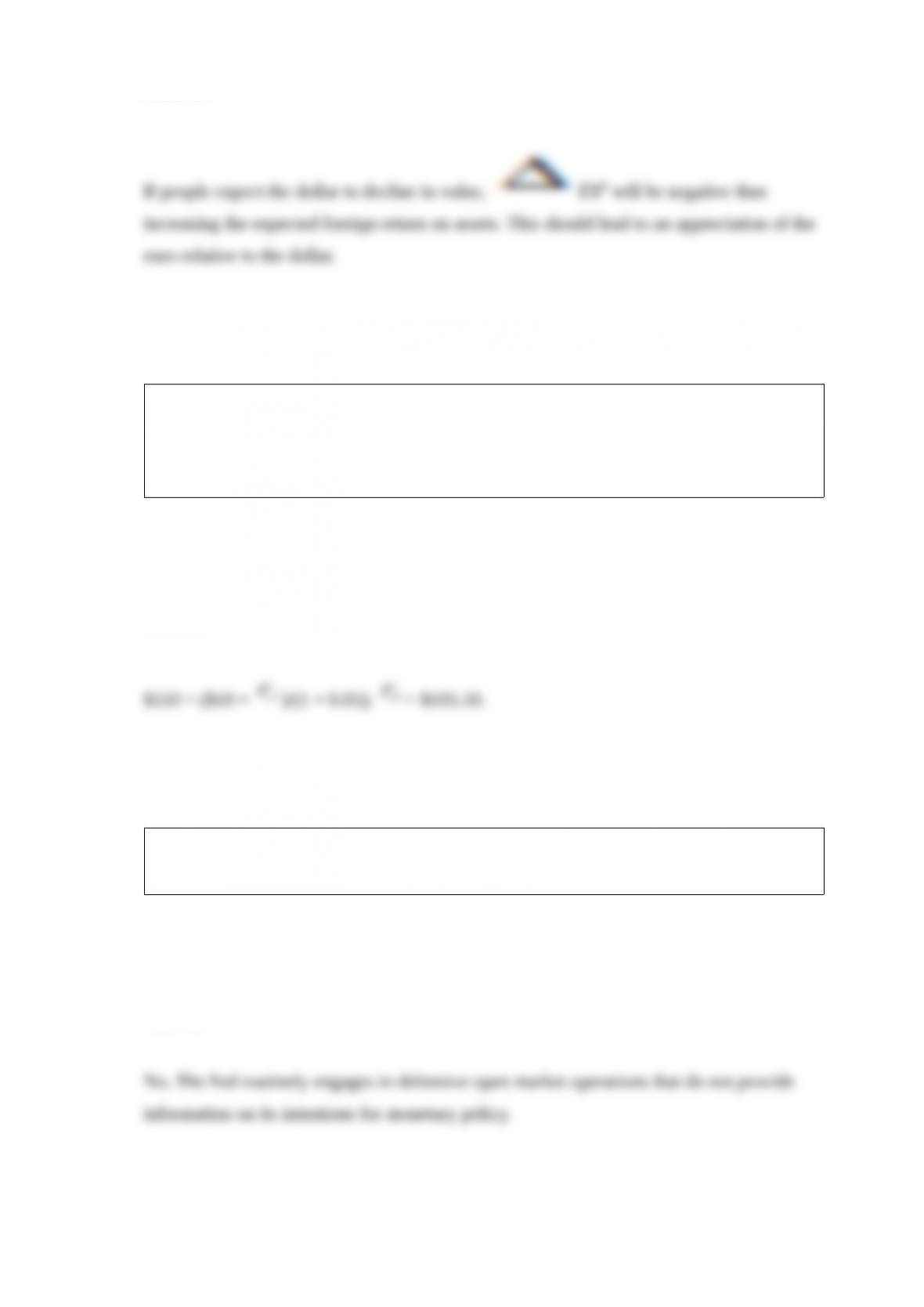
In late 2003, fears were growing that the dollar would experience a significant decline
in value. What are the likely implications for the euro-dollar exchange rate?
Answer:
Suppose a bond has a current market price of $110 one year from now, its coupon
payment during the year will be $10 and the interest rate, adjusted for the bond’s risk is
5%. If the bond market is efficient, what is the market price of the bond expected to be
in one year?
Answer:
Is it possible to deduce the Fed’s intentions for monetary policy from observing the
Fed’s trading activity?
Answer:

Analyze the following statement: “I know the fact that prices have started to rise rapidly
seems like bad news, but at least prices starting to go up means that output must be
starting to go up as well.”
Answer:
When a saver deposits funds in a bank, she may earn about 5% on the deposit. When
the bank lends these funds out, it may charge the borrower 9% on the loan. Why don’t
the saver and the borrower get together directly and avoid the bank? In that situation
wouldn’t the saver be able to earn more on her funds and the borrower have to pay less
to borrow these funds?
Answer:
In early 2001 consumer prices in Japan were declining. Why might this deflation have a
significant contractionary impact on the Japanese economy?
Answer:

Suppose that short-term real interest rates fall in Japan. Is this likely to be good news or
bad news for the tourism industry in Hawaii?
Answer:
Suppose that computer hackers are able to steal the credit card numbers of a large
number of people from the Internet. How is the LM curve likely to respond if the money
supply doesn’t change?
Answer:
Suppose that businesses in Japan reduce their spending on plant and equipment. What
will be the effect on spending on plant and equipment by businesses in the United
States?

Answer:
Why did the federal government until fairly recently put restrictions on interstate
banking? Did those restrictions increase the stability of the banking system?
Answer:
An investor makes the following remark: “I don’t understand the junk bond market.
Junk bonds have become more liquid. This should have made them more desirable and
increased the demand for them. The increased demand should have driven their yields
up, but in fact their yields have gone down. I guess investors just don’t value liquidity.”
Do you agree with the investor’s reasoning?

Answer:
In what sense had the structure of S&Ls become outmoded by the 1970s? In what sense
were the S&Ls uniquely vulnerable to an increase in inflation?
Answer:
Evaluate the following assertion: “The money supply always increases significantly a
few weeks before Christmas. Therefore, the increase in the money supply must be
causing Christmas to happen.”
Answer:

Suppose that the Fed is concerned that a decline in investment spending by businesses
is likely to take place. In order to offset the effects of the decline in investment
spending, the Fed increases the nominal money supply. If the decline in investment
spending does not take place, what will be the impact of the Fed’s action on the
economy in the short run? What will be the impact of the Fed’s action in the long run?
Answer:
Why are stories about movements in the money supply prominent in the news media?
Answer:
Why was international banking unimportant for U.S. banks, savers, and borrowers
before World War II? Is it likely that its importance may ever recede to a low level
again?
Answer: