
A debt security pays
A. a fixed level of income for the life of the owner.
B. a variable level of income for owners on a fixed income.
C. a fixed or variable income stream at the option of the owner.
D. a fixed stream of income or a stream of income that is determined according to a
specified formula for the life of the security.
The Treynor-Black model requires estimates of
A. alpha/beta.
B.alpha/beta/residual variance.
C. beta/residual variance.
D. alpha/residual variance.
Which statement about portfolio diversification is correct?
A. Proper diversification can eliminate systematic risk.
B. The risk-reducing benefits of diversification do not occur meaningfully until at least
50-60 individual securities
have been purchased.
C. Because diversification reduces a portfolio’s total risk, it necessarily reduces the
portfolio’s expected return.
D. Typically, as more securities are added to a portfolio, total risk would be expected to
decrease at a
decreasing rate.
E. None of the statements are correct.
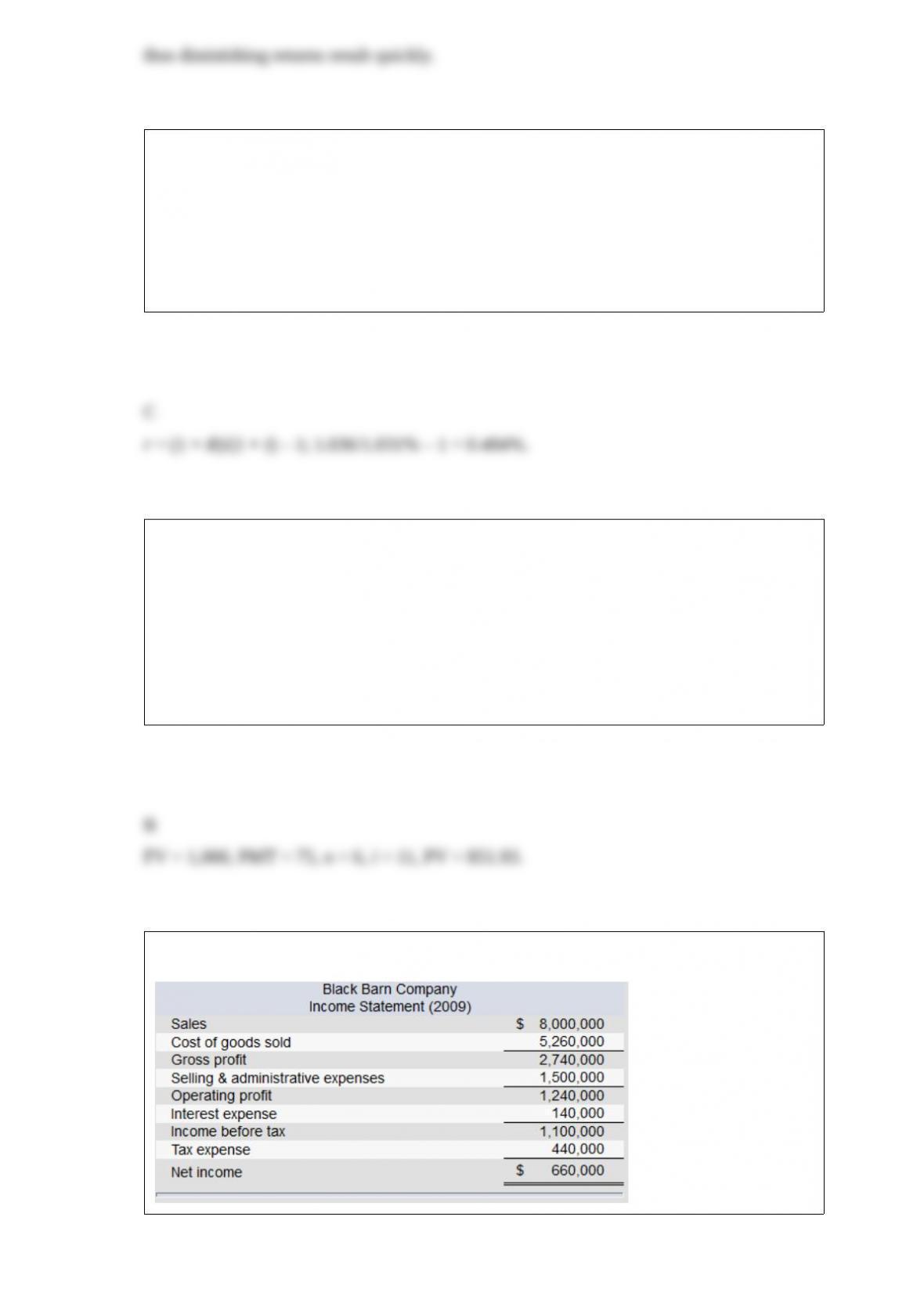
Over the past year, you earned a nominal rate of interest of 3.6% on your money. The
inflation rate was 3.1%
over the same period. The exact actual growth rate of your purchasing power was
A. 3.6%.
B. 3.1%.
C. 0.48%.
D. 6.7%.
A coupon bond that pays interest annually has a par value of $1,000, matures in six
years, and has a yield to maturity of 11%. The intrinsic value of the bond today will be
______ if the coupon rate is 7.5%.
A. $712.99
B. $851.93
C. $1,123.01
D. $886.28
E. $1,000.00
The financial statements of Black Barn Company are given below.
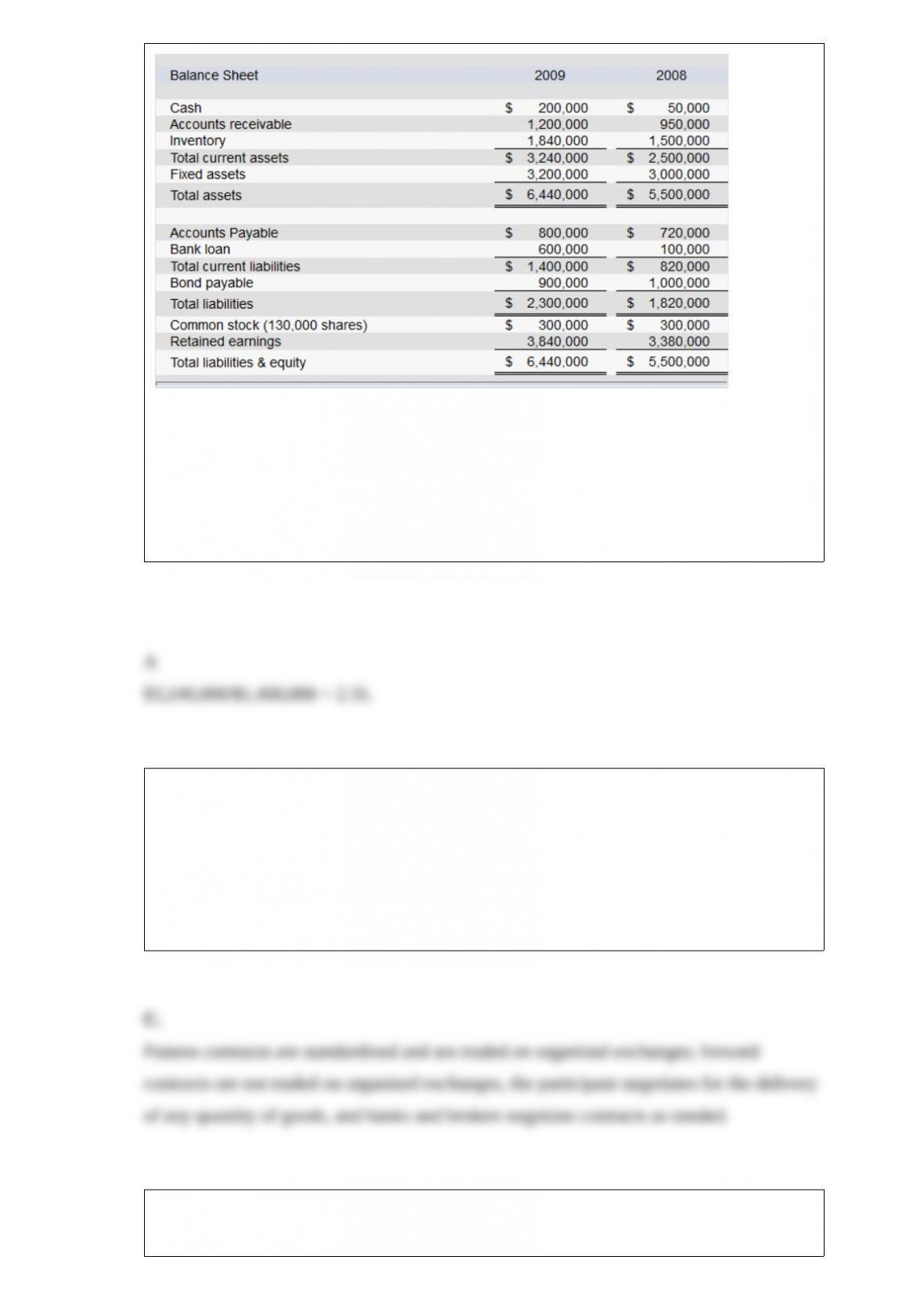
Note: The common shares are trading in the stock market for $40 each.
Refer to the financial statements of Black Barn Company. The firm’s current ratio for
2009 is
A. 2.31.
B.1.87.
C. 2.22.
D. 2.46.
The terms of futures contracts __________ standardized, and the terms of forward
contracts __________ standardized.
A. are; are
B. are not; are
C. are; are not
D. are not; are not
E. are; may or may not be
The following data are available relating to the performance of Seminole Fund and the
market portfolio:
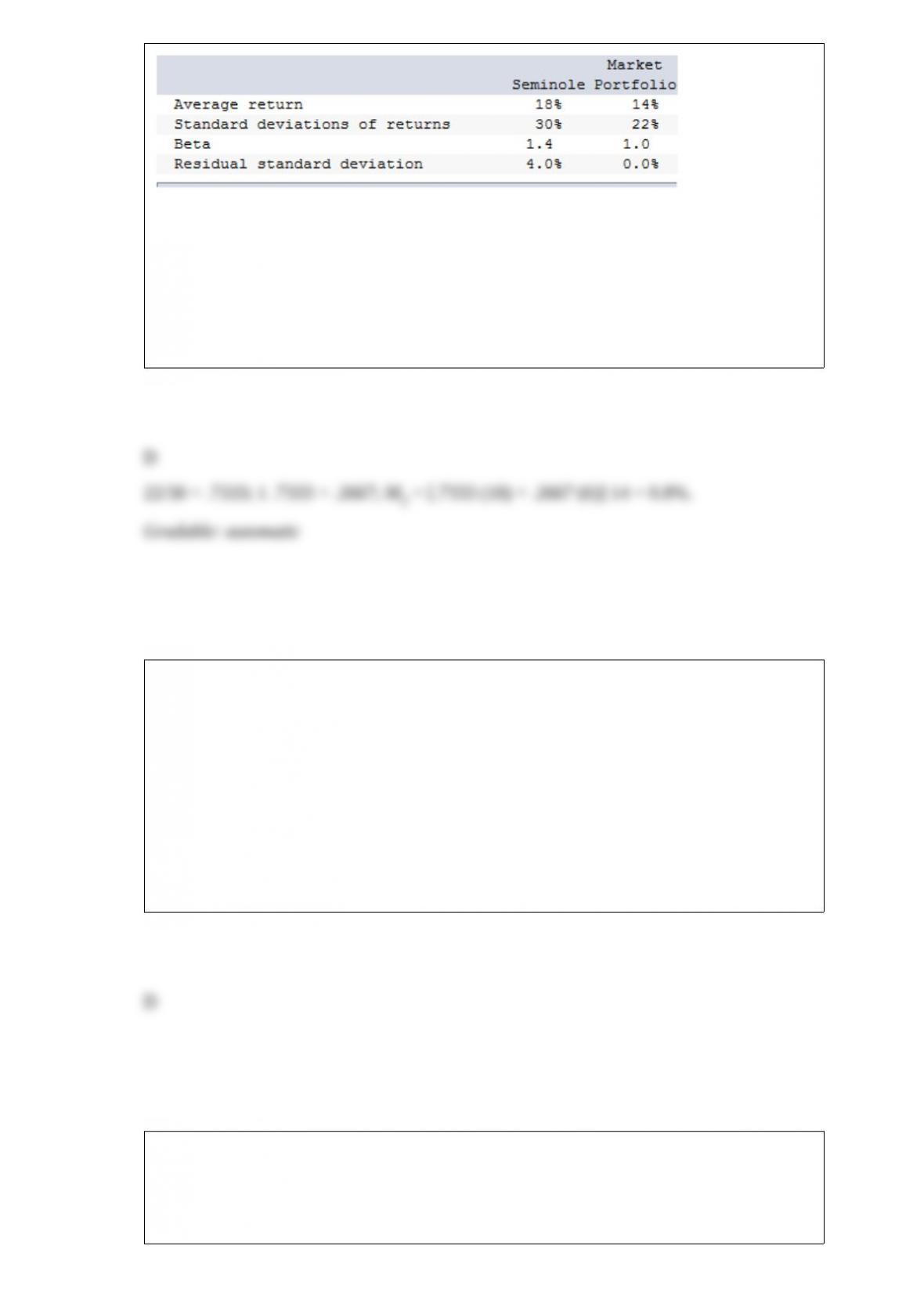
The risk-free return during the sample period was 6%.
Calculate the M2 measure for the Seminole Fund.
A. 4.0%
B. 20.0%
C. 2.86%
D. 0.8%
E. 40.0%
29. An investor invests 30% of his wealth in a risky asset with an expected rate of
return of 0.13 and a variance of
0.03 and 70% in a T-bill that pays 6%. His portfolio’s expected return and standard
deviation are __________
and __________, respectively.
A. 0.114; 0.128
B. 0.087; 0.063
C. 0.295; 0.125
D. 0.081; 0.052
Proponents of the EMH typically advocate
A. an active trading strategy.
B. investing in an index fund.
C. a passive investment strategy.

D. an active trading strategy and investing in an index fund.
E. investing in an index fund and a passive investment strategy.
According to PRS, in 2015, which country had the highest composite risk rating on a
scale of 0 (most risky) to 100 (least risky)?
A. Switzerland
B. Canada
C. Germany
D. U.S.
Professional financial planners should
A. assess their client’s riskandreturn requirements on a onetime basis.
B. explain the investment plan to the client.
C. inform the client about the outcome of the plan.
D. assess their client’s riskandreturn requirements on a onetime basis, explain the
investment plan to the client, and inform the client about the outcome of the plan.
E. explain the investment plan to the client and inform the client about the outcome of
the plan.
Given the yield on a 3-year zero-coupon bond is 7% and forward rates of 6% in year 1
and 6.5% in year 2, what must be the forward rate in year 3?
A. 7.2%

B. 8.6%
C. 8.5%
D. 6.9%
Your opinion is that CSCO has an expected rate of return of 0.15. It has a beta of 1.3.
The risk-free rate is 0.04
and the market expected rate of return is 0.115. According to the Capital Asset Pricing
Model, this security
is
A. underpriced.
B. overpriced.
C. fairly priced.
D. Cannot be determined from data provided.
E. None of the options are correct.
The capital market line
I) is a special case of the capital allocation line.
II) represents the opportunity set of a passive investment strategy.
III) has the one-month T-Bill rate as its intercept.
IV) uses a broad index of common stocks as its risky portfolio.
A. I, III, and IV
B. II, III, and IV
C. III and IV
D. I, II, and III
E. I, II, III, and IV

You wish to earn a return of 13% on each of two stocks, X and Y. Stock X is expected
to pay a dividend of $3 in the upcoming year while stock Y is expected to pay a
dividend of $4 in the upcoming year. The expected growth rate of dividends for both
stocks is 7%. The intrinsic value of stock X
A. will be greater than the intrinsic value of stock Y.
B. will be the same as the intrinsic value of stock Y.
C. will be less than the intrinsic value of stock Y.
D. will be the same or greater than the intrinsic value of stock Y.
E. None of the options are correct.
The execution phase of the CFA Institute’s investment management process
A. uses data about the client and capital market.
B. uses details of optimal asset allocation and security selection.
C. uses changes in expectations and objectives.
D. All of the options are correct.
E. None of the options are correct.
Which of the following are issues when dealing with the financial statements of
international firms?
I) Many countries allow firms to set aside larger contingency reserves than the amounts
allowed for U.S. firms.
II) Many firms outside the U.S. use accelerated depreciation methods for reporting
purposes, whereas most U.S. firms use straight-line depreciation for reporting purposes.
III) Intangibles, such as goodwill, may be amortized over different periods or may be
expensed rather than capitalized.

IV) There is no way to reconcile the financial statements of non-U.S. firms to GAAP.
A. I and II
B. II and IV
C. I, II, and III
D. I, III, and IV
E. I, II, III, and IV
The M2 measure was developed by
A. Merton and Miller.
B. Miller and Miller.
C. Modigliani and Miller.
D. Modigliani and Modigliani.
E. the M&M Mars Company.
Questionnaires and attitude surveys suggest that risk tolerance
A. increases with age.
B. decreases with age.
C. stays constant over the life cycle for most investors.
D. cannot be assessed.
E. None of the options are correct.

Initial margin requirements are determined by
A. the Securities and Exchange Commission.
B. the Federal Reserve System.
C. the New York Stock Exchange.
D. the Federal Reserve System and the New York Stock Exchange.
The geometric average rate of return is based on
A. the market’s volatility.
B. the concept of expected return.
C. the standard deviation of returns.
D. the CAPM.
E. the principle of compounding.
You purchased 1,000 shares of common stock on margin at $30 per share. Assume the
initial margin is 50%, and the stock pays no dividend. What would the maintenance
margin be if a margin call is made at a stock price of $24? Ignore interest on margin.
A. 0.33
B. 0.375
C. 0.20
D. 0.23
E. 0.25

The risk premium for common stocks
A. cannot be zero, for investors would be unwilling to invest in common stocks.
B. must always be positive, in theory.
C. is negative, as common stocks are risky.
D. cannot be zero, for investors would be unwilling to invest in common stocks and
must always be positive, in
theory.
E. cannot be zero, for investors would be unwilling to invest in common stocks and is
negative, as common
stocks are risky.
Studies of liquidity spreads in security markets have shown that
A. liquid stocks earn higher returns than illiquid stocks.
B. illiquid stocks earn higher returns than liquid stocks.
C. both liquid and illiquid stocks earn the same returns.
D. illiquid stocks are good investments for frequent, short-term traders.
_________ financial asset(s).
A. Buildings are
B. Land is a
C. Derivatives are
D. U.S. agency bonds are
E. Derivatives and U.S. agency bonds are

Even low-quality forecasts have proven to be valuable because R-squares of only
____________ inregressions of analysts’ forecasts can be used to substantially improve
portfolio performance.
A. 0.656
B. 0.452
C. 0.258
D. 0.153
E.0.001
If you purchased one S&P 500 Index futures contract at a price of 1,550 and closed
your position when the index futures was 1,547, you incurred
A. a loss of $1,500.
B. a gain of $1,500.
C. a loss of $750.
D. a gain of $750.
E. None of the options are correct.
Asset allocation may involve
A. the decision as to the allocation between a risk-free asset and a risky asset.
B. the decision as to the allocation among different risky assets.
C. considerable security analysis.
D. the decision as to the allocation between a risk-free asset and a risky asset and the
decision as to the
allocation among different risky assets.
E. the decision as to the allocation between a risk-free asset and a risky asset and
considerable security
analysis.

The index model has been estimated for stock A with the following results:
RA = 0.01 + 0.8RM + eA.
σM = 0.20; σ(eA) = 0.10.
The standard deviation of the return for stock A is
A. 0.0356.
B. 0.1887.
C. 0.1600.
D. 0.6400.
In the mean-standard deviation graph, an indifference curve has a ________ slope.
A. negative
B. zero
C. positive
D. vertical
E. Cannot be determined.