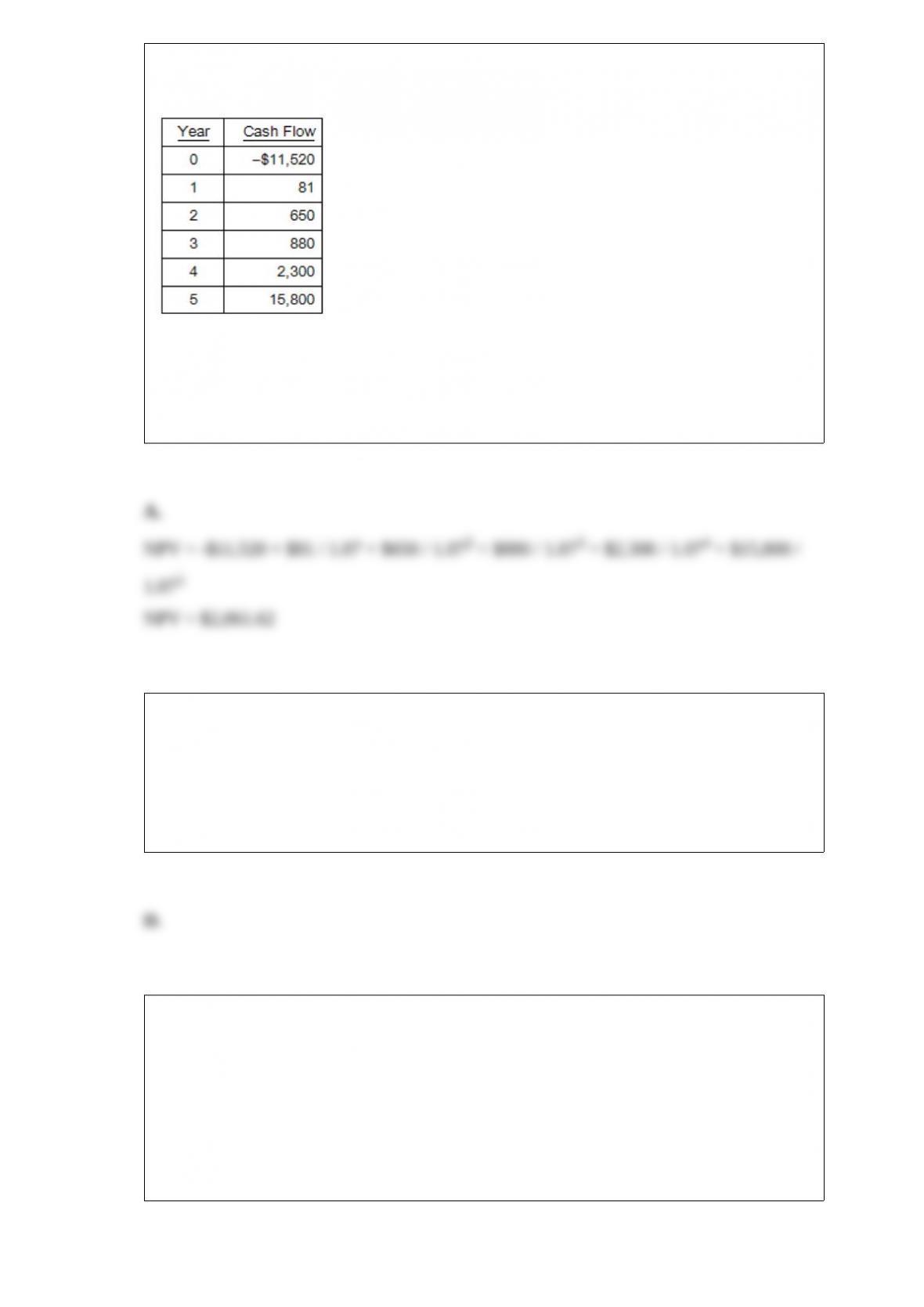
What is the net present value of the following cash flows if the relevant discount rate is
7 percent?
A. $2,861.62
B. $2,311.92
C. $2,900.15
D. $3,248.87
E. $3,545.60
Which one of these will increase the operating cycle?
A. Decreasing the days’ sales in inventory
B. Decreasing the accounts payable period
C. Increasing the accounts receivable turnover rate
D. Decreasing the inventory turnover rate
E. Decreasing the accounts payable turnover rate
KBJ has total assets of $613,000. There are 21,000 shares of stock outstanding with a
market value of $13 a share. The firm has a profit margin of 6.2 percent and a total asset
turnover of 1.08. What is the price-earnings ratio?
A. 6.38
B. 7.99
C. 6.65
D. 5.12
E. 7.41

Computing the present value of a growing perpetuity is most similar to computing the
current value of which one of the following?
A. Non-dividend-paying stock
B. Stock with a constant dividend
C. Stock with irregular dividends
D. Stock with a constant-growth dividend
E. Stock with growing dividends for a limited period of time
The interest rate used to compute the present value of a future cash flow is called the:
A. prime rate.
B. current rate.
C. discount rate.
D. compound rate.
E. simple rate.
Bama Entertainment has common stock with a beta of 1.22. The market risk premium is
8.1 percent and the risk-free rate is 3.9 percent. What is the expected return on this
stock?
A. 13.31 percent
B. 12.67 percent
C. 12.40 percent
D. 13.78 percent
E. 14.13 percent
The corporate tax structure in the U.S. is based on a:
A. maximum tax rate of 38 percent.
B. minimum tax rate of 10 percent.

C. flat rate of 34 percent for the highest income earners.
D. flat-rate tax.
E. modified flat-rate tax.
Which one of the following terms is inclusive of both direct and indirect bankruptcy
costs?
A. Financial distress costs
B. Capital structure costs
C. Financial leverage
D. Homemade leverage
E. Cost of capital
Stock A comprises 28 percent of Susan’s portfolio. Which one of the following terms
applies to the 28 percent?
A. Portfolio variance
B. Portfolio standard deviation
C. Portfolio weight
D. Portfolio expected return
E. Portfolio beta
You own a portfolio that is invested 43 percent in Stock A, 16 percent in Stock B, and
the remainder in Stock C. The expected returns on stocks A, B, and C are 9.1 percent,
16.7 percent, and 11.4 percent, respectively. What is the expected return on the
portfolio?
A. 10.55 percent
B. 11.02 percent
C. 11.67 percent
D. 11.26 percent
E. 11.33 percent

Electronics and More offers credit terms of 2/7, net 30. What is the effective annual rate
on a $4,500 purchase if you forgo the discount?
A. 41.83 percent
B. 38.59 percent
C. 44.99 percent
D. 37.80 percent
E. 32.58 percent
Assume the economy has a 12 percent chance of booming, a 4 percent chance of being
recessionary, and being normal the remainder of the time. A stock is expected to return
18.7 percent in a boom, 14.4 percent in a normal economy, and lose 12 percent in a
recession. What is the expected rate of return on this stock?
A. 8.78 percent
B. 9.43 percent
C. 9.97 percent
D. 13.86 percent
E. 11.48 percent
The Carpentry Shop has sales of $398,600, costs of $254,800, depreciation expense of
$26,400, interest expense of $1,600, and a tax rate of 34 percent. What is the net
income for this firm?
A. $61,930
B. $66,211
C. $67,516
D. $76,428
E. $83,219

A floating-rate bond frequently has a:
A. flexible deferred call period.
B. fixed yield to maturity but a flexible coupon payment.
C. government guarantee.
D. fixed-dollar obligation.
E. put provision.
As of Monday morning, the ledger balance and the available balance for a firm was
$2,100. During the day, the firm wrote three checks in the amounts of $674, $420, and
$236. The firm deposited a check for $387 and a check for $638. What is the amount of
the collection float as of the end of the day assuming none of these checks have
cleared?
A. $305
B. $1,330
C. $840
D. $1,025
E. $2,355
Of these choices, a risk-adverse investor who prefers to minimize interest rate risk is
most apt to invest in:
A. 5-year, 7 percent coupon bonds.
B. 20-year, 6 percent coupon bonds.
C. 20-year, zero coupon bonds.
D. 2-year, 7 percent coupon bonds.
E. 3-year, zero coupon bonds.
You purchased 400 shares of KNO stock five years ago and have earned annual returns

of 8.3 percent, 9.6 percent, 18.25 percent, -7.7 percent, and 1.8 percent, respectively.
What is your arithmetic average return?
A. 5.47 percent
B. 6.05 percent
C. 6.23 percent
D. 6.47 percent
E. 8.01 percent
Which one of the following is correct based on the static theory of capital structure?
A. A firm receives the greatest benefit from debt financing when its tax rate is relatively
low.
B. A debt-equity ratio of 1 is considered to be the optimal capital structure.
C. The costs of financial distress decrease the value of a firm.
D. The more debt a firm assumes, the greater the incentive to acquire even more debt
until such time as the firm is financed with 100 percent debt.
E. At the optimal level of debt a firm also optimizes its tax shield on debt.
Which statement is true?
A. The expected rate of return on any portfolio must be positive.
B. The arithmetic average of the betas for each security held in a portfolio must equal
1.0.
C. The beta of any portfolio must be 1.0.
D. The weights of the securities held in any portfolio must equal 1.0.
E. The standard deviation of any portfolio must equal 1.0.
The Tree House has a pretax cost of debt of 7.3 percent and a return on assets of 12.8
percent. The debt-equity ratio is .46. Ignore taxes. What is the cost of equity?
A. 14.50 percent
B. 14.82 percent
C. 15.47 percent
D. 14.98 percent
E. 15.33 percent

To value a non-dividend-paying firm, the terminal value used in the valuation
calculation will most likely be based on a(n):
A. subjective value determined by the firm’s senior managers.
B. salvage value of zero.
C. target ratio.
D. pure play rate of return.
E. expected book value of equity.
Zero coupon bonds:
A. are valued using simple interest.
B. are issued only by the U.S. Treasury.
C. create a tax deduction for the issuer only at maturity.
D. are issued at a premium.
E. create annual taxable income to individual bondholders.
Suppose the spot exchange rate for the Hungarian forint is HUF246. Interest rates in the
United States are 4.3 percent per year. They are 3.4 percent in Hungary. What do you
predict the exchange rate will be in four years?
A. HUF237.26
B. HUF236.90
C. HUF241.59
D. HUF254.98
E. HUF261.19
Assume you can exchange $1 for either €.8031 euro or £.6390. What is the cross-rate

between the pound and the euro?
A. £.7519/€1
B. £.8356/€1
C. £.7957/€1
D. £1.0852/€1
E. £1.5577/€1
Lookin’ Up earns $.094 in profit on every $1 of sales and has $1.21 in assets for every
$1 of sales. The firm pays out 45 percent of its profits to its shareholders. What is the
internal growth rate?
A. 6.37 percent
B. 2.76 percent
C. 3.82 percent
D. 4.46 percent
E. 2.65 percent
You are analyzing a project and have developed the following estimates: unit sales =
2,150, price per unit = $84, variable cost per unit = $57, fixed costs per year = $13,900.
The depreciation is $8,300 a year and the tax rate is 35 percent. What effect would an
increase of $1 in the selling price have on the operating cash flow?
A. $1,397.50
B. $1,249.65
C. $1,320.65
D. $3,773.25
E. $1,430.35

When is a firm insolvent from an accounting perspective?
A. When the firm is unable to meet its financial obligations in a timely manner
B. When the firm’s debt exceeds the value of the firm’s equity
C. When the firm has a negative net worth
D. When the firm’s revenues cease
E. When the market value of the firm’s equity equals zero
Which one of the following is an intended result of a lockup agreement?
A. Temporary support of the market price of IPO shares
B. Maximization of the return to a firm’s original owners from an initial spike in the
market price of IPO shares
C. Increase in the volume of trading for shares of a recent IPO
D. Limitation on the price volatility of recent IPO shares caused by day trading
E. Guarantee of a minimum number of sold shares for an IPO
Assume large-company stocks returned 12.1 percent on average over the past 88 years.
The risk premium on these stocks was 8.6 percent and the inflation rate was 3.0 percent.
What was the average nominal risk-free rate of return for those 88 years?
A. 3.5 percent
B. 9.1 percent
C. 4.6 percent
D. .5 percent
E. 6.5 percent
The recognition principle states that:
A. costs should be recorded on the income statement whenever those costs can be
reliably determined.
B. costs should be recorded when paid.
C. the costs of producing an item should be recorded when the sale of that item is
recorded as revenue.
D. sales should be recorded when the payment for that sale is received.
E. sales should be recorded when the earnings process is virtually completed and the

value of the sale can be determined.
The length of time a retailer owes its supplier for an inventory purchase is called the:
A. inventory period.
B. accounts receivable period.
C. accounts payable period.
D. operating cycle.
E. cash cycle.