
1) Which of the following conditions would cause absorption-costing income to be
lower than variable-costing income?
A.Units sold exceeded units produced
B.Units sold equaled units produced
C.Units sold were less than units produced
D.Sales prices decreased
E.Selling expenses increased
2) The systematic follow-up on a capital project to see how the project actually turns
out is commonly known as:
A.capital budgeting assessment (CBA)
B.apostaudit
C.control of capital expenditures (CCE)
D.overall cost performance
E.the cost evaluation phase
3) The difference between absorption manufacturing cost and total cost with respect to
product pricing is caused by:
A.variable manufacturing cost
B.applied fixed manufacturing cost
C.variable selling and administrative cost
D.allocated fixed selling and administrative cost
E.both variable selling and administrative cost and allocated fixed selling and
administrative cost
4) Ohio, Inc., which uses a process-cost accounting system, began operations on
January 1 of the current year. The company incurs conversion cost evenly throughout
manufacturing. If Ohio started work on 3,000 units during the period and these units
were 70% of the way through manufacturing, it would be correct to say that the
company has:
A.3,000 physical units in production
B.2,100 completed units
C.900 in-process units
D.900 equivalent units of production
E.3,000 equivalent units of production

5) Which of the following inventories would a discount retailer such as Wal-Mart report
as an asset?
A.Raw materials
B.Work in process
C.Finished goods
D.Merchandise inventory
E.All of the other answers are correct
6) A company’s sales forecast would likely consider all of the following factors except:
A.political and legal events
B.advertising and pricing policies
C.general economic and industry trends
D.top management’s attitude toward decentralized operating structures
E.competition
7) Which of the following is not an ethical standard of managerial accounting?
A.Competence
B.Confidentiality
C.Efficiency
D.Integrity
E.Credibility
8) Which of the following is not an example of a responsibility center?
A.Cost center
B.Revenue center
C.Profit center
D.Investment center
E.Contribution center
9) Alexis Company recently completed 10,600 units of its single product, consuming
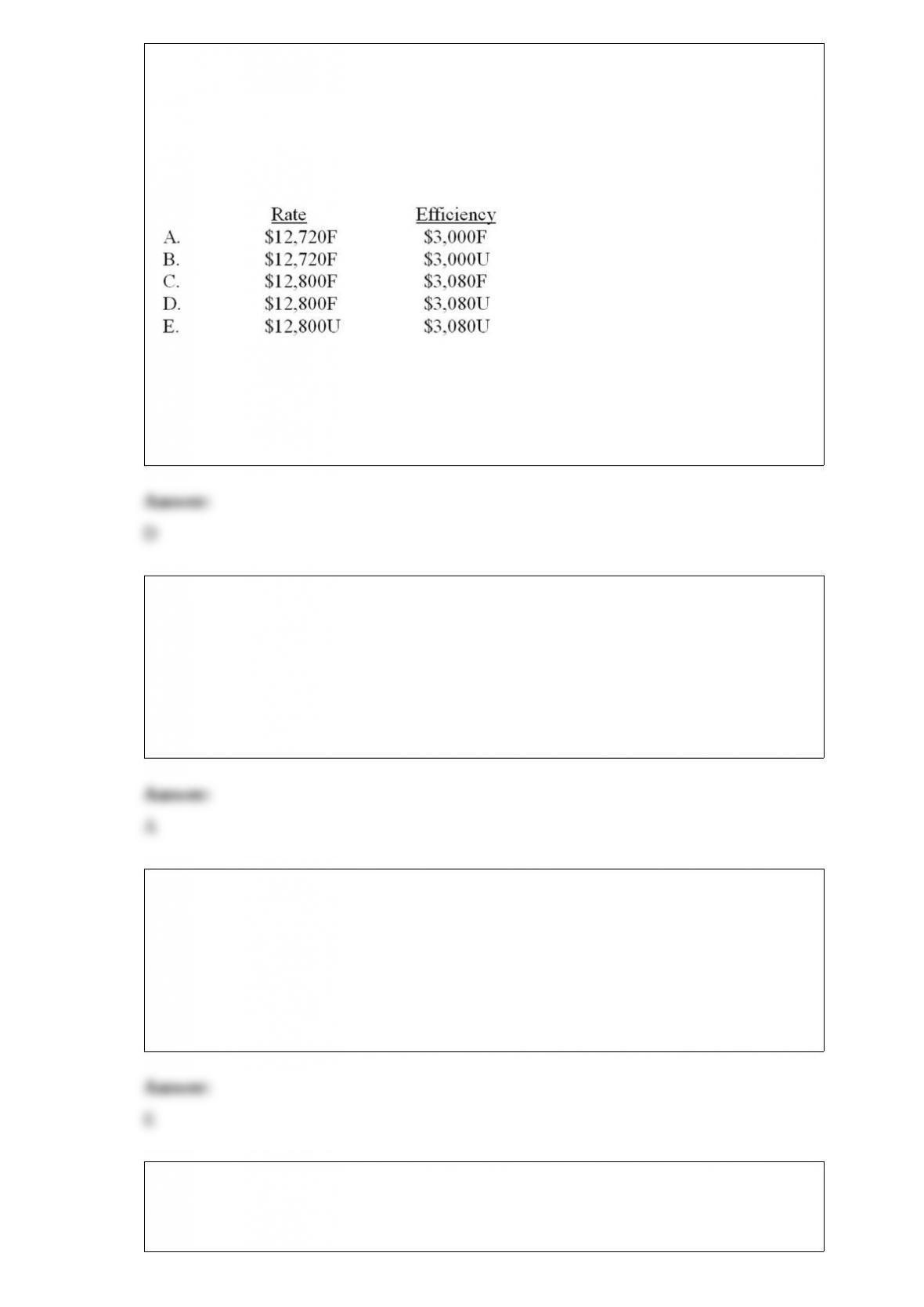
32,000 labor hours that cost the firm $480,000. According to manufacturing
specifications, each unit should have required 3 hours of labor time at $15.40 per hour.
On the basis of this information, determine Alexis’s labor rate variance and labor
efficiency variance.
A.Choice A
B.Choice B
C.Choice C
D.Choice D
E.Choice E
10) Total costs are $180,000 when 10,000 units are produced; of this amount, variable
costs are $64,000. What are the total costs when 13,000 units are produced?
A.$199,200
B.$214,800
C.$234,000
D.None of the other answers are correct
E.Total costs cannot be calculated based on the information presented
11) A factory that makes a part has significant idle capacity. The factory’s opportunity
cost of making this part is equal to:
A.the variable manufacturing cost per unit
B.the fixed manufacturing cost per unit
C.thesemivariable cost per unit
D.the total manufacturing cost per unit
E.zero
12) Which of the following would be considered if a company desires to establish a
series of practical manufacturing standards?
A.The productivity loss associated with a short-term worker slowdown
B.Normal defect rates in an assembly process
C.Highly unusual spoilage rates of direct materials
D.Quantity discounts associated with purchases of direct materials
E.Both normal defect rates in an assembly process and quantity discounts associated
with purchases of direct materials
13) Universal Manufacturing uses a weighted-average process-costing system. All
materials are introduced at the start of manufacturing, and conversion costs are incurred
evenly throughout the process. The company’s beginning and ending work-in-process
inventories totaled 10,000 units and 15,000 units, respectively, with the latter units
being 2/3 complete at the end of the period. Universal started 30,000 units into
production and completed 25,000 units. Manufacturing costs follow.
Beginning work in process: Materials, $60,000; conversion cost, $150,000
Current costs: Materials, $180,000; conversion cost, $480,000
Universal’s equivalent-unit cost for conversion cost is:
A.$13.71
B.$18.00
C.$21.00
D.$25.20
E.None of the answers is correct
14) Costs of determining whether defects exist are called:
A.appraisal costs
B.external failure costs
C.internal failure costs
D.prevention costs
E.defects costs
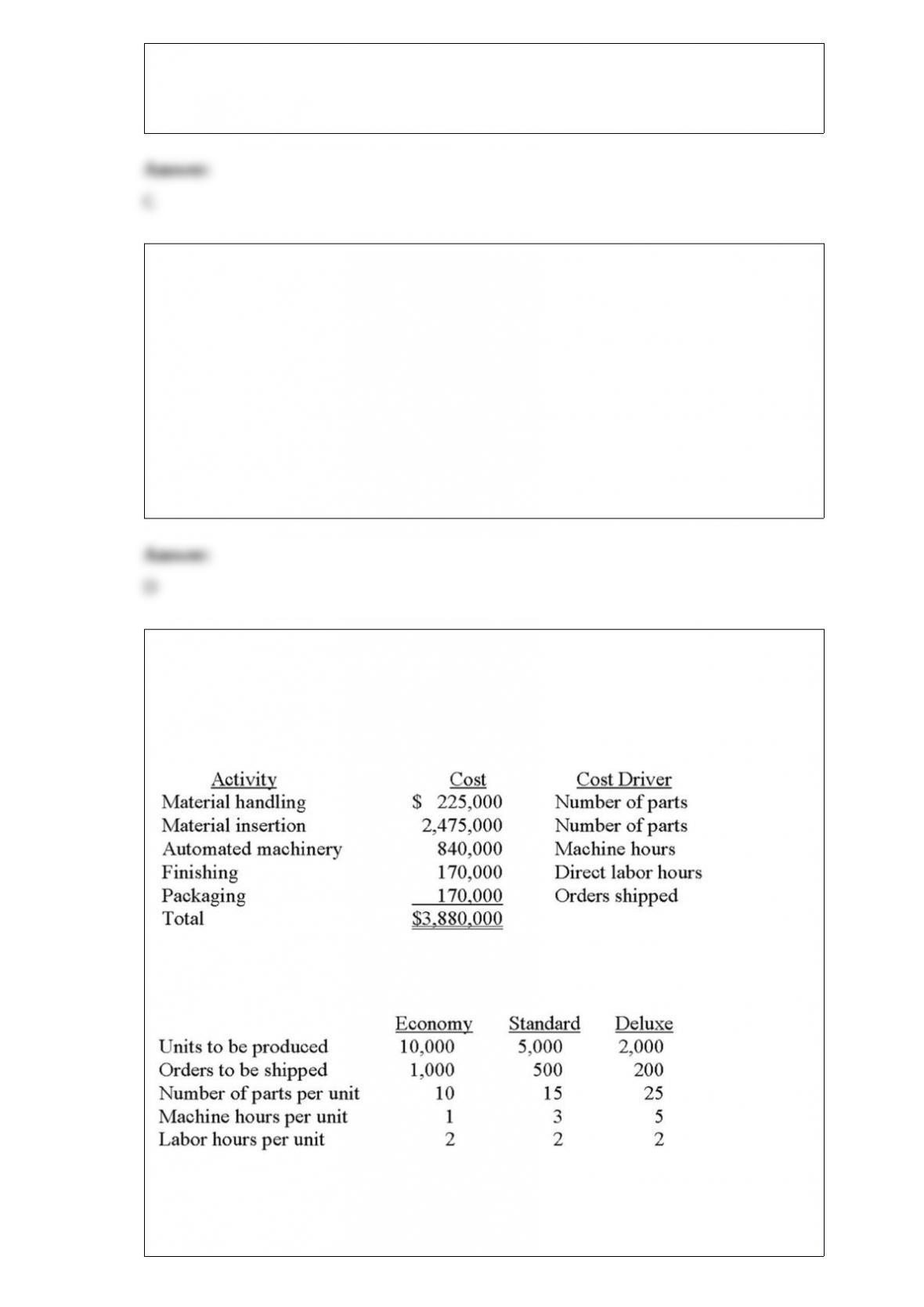
15)
If the cost of goods manufactured for the year was $385,000, what was the cost of
goods sold for the year?
A.$395,400
B.$385,000
C.$390,200
D.$400,600
E.None of the other answers are correct
16) Peach Company uses a weighted-average process-costing system. Company records
disclosed that the firm completed 40,000 units during the month and had 10,000 units in
process at month-end, 20% complete. Conversion costs associated with the beginning
work-in-process inventory amounted to $231,000, and amounts that relate to the current
month totaled $966,000. If conversion is incurred uniformly throughout manufacturing,
Peach’s equivalent-unit cost is:
A.$23.00
B.$23.94
C.$24.15
D.$28.50
E.None of the answers is correct
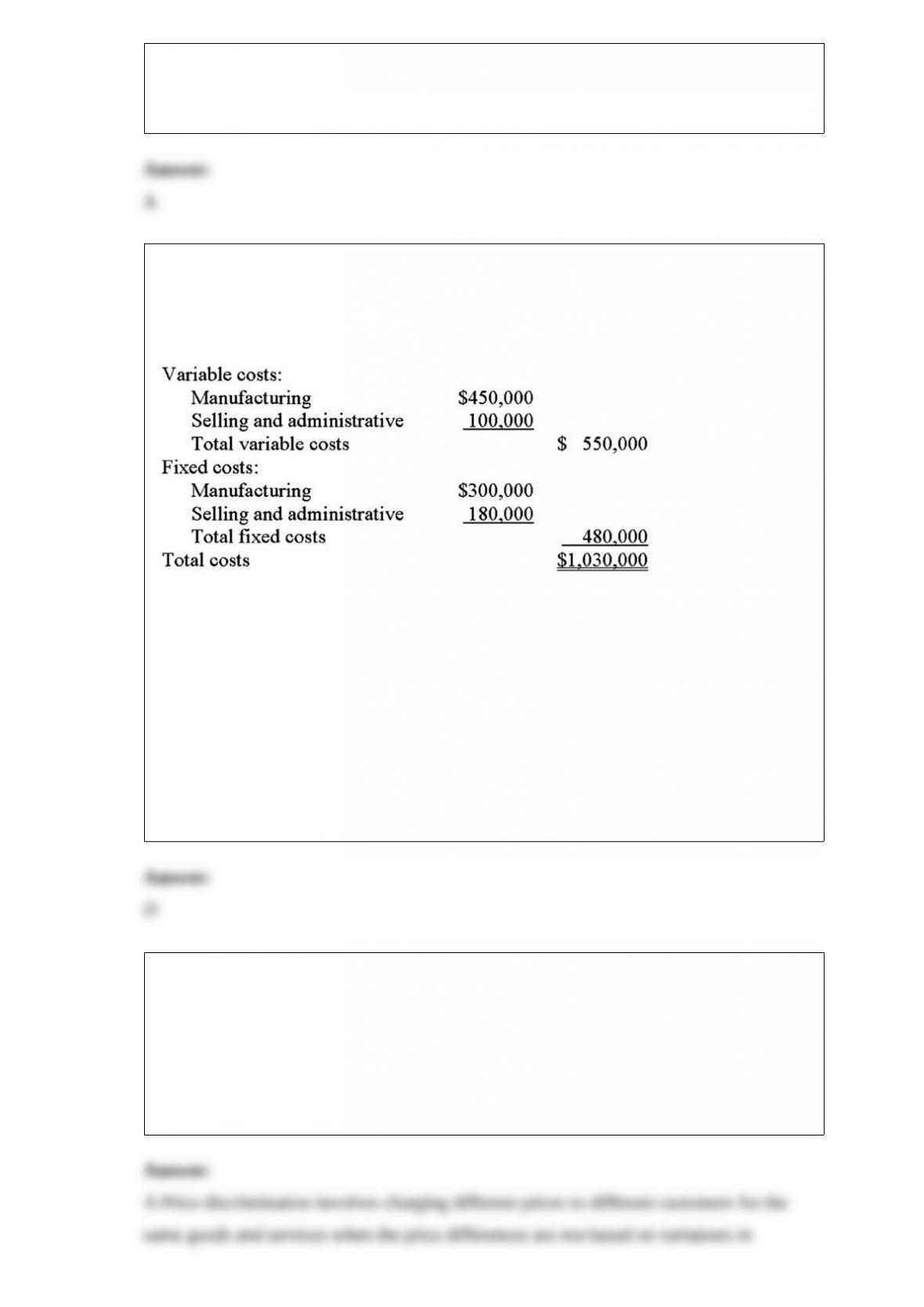
17) HiTech Products manufactures three types of remote-control devices: Economy,
Standard, and Deluxe. The company, which uses activity-based costing, has identified
five activities (and related cost drivers). Each activity, its budgeted cost, and related cost
driver is identified below.
The following information pertains to the three product lines for next year:
What is HiTech’s pool rate for the automated machinery activity?
A.$24.00 per machine hour
B.$24.50 per labor hour
C.$49.42 per unit
D.$50.00 per machine hour
E.None of the other answers is correct
18) Dexter, Inc. manufactures various lines of computer equipment and is planning to
introduce a new line of laptops. Current plans call for the production and sale of 1,000
units, with estimated costs as follows:
The average amount of capital invested in the laptop product line is $900,000 and
Dexter’s target return on investment is 18%.
If Dexter uses cost-plus pricing based on absorption cost, the markup percentage the
company must use would be:
A.15.72%
B.21.64%
C.29.56%
D.58.93%
E.none of the other answers are correct
19) A number of antitrust laws have been enacted that affect product pricing.
Required:
A. Define price discrimination and predatory pricing.
B. Assume that a company has been charged with price discrimination. What role can
cost information play in defending the firm’s pricing practices?
20) Orion recently reported sales revenues of $800,000, a total contribution margin of
$300,000, and fixed costs of $180,000. If sales volume amounted to 10,000 units, the
company’s variable cost per unit must have been:
A.$12
B.$32
C.$50
D.$92
E.None of the other answers is correct
21) Braselton Company plans to incur $190,000 of salaries expense and produce
$320,000 of additional sales revenue if a capital project is implemented. Assuming a
30% tax rate, these two items collectively should appear in a capital budgeting analysis
as:
A.a $39,000 inflow
B.a $39,000 outflow
C.a $91,000 inflow
D.a $91,000 outflow
E.None of the other answers are correct
22) Which of the following performance measures is(are) used to evaluate the general
financial success or failure of investment centers?
A.Residual income
B.Return on investment
C.Number of suppliers
D.Economic value added
E.All of these measures are used except number of suppliers
23) Which of the following statements is false?
A.In job-order costing, costs are accumulated by job order
B.In process costing, costs are accumulated by department
C.In process costing, the cost per unit in a department is found by spreading the period’s
manufacturing costs over the production activity
D.In process costing, the total cost of each unit is found by dividing the total factory
costs by the number of units completed
E.In job-order costing, the unit cost is found by dividing the job’s total cost by the job’s
total units
24) Roberts Corp., which began business at the start of the current year, had the
following data:
Planned and actual production: 40,000 units
Sales: 37,000 units at $15 per unit
Production costs:
Variable: $4 per unit
Fixed: $260,000
Selling and administrative costs:
Variable: $1 per unit
Fixed: $32,000
The gross margin that the company would disclose on an absorption-costing income
statement is:
A.$97,500
B.$147,000
C.$166,500
D.$370,000
E.None of the other answers are correct
25) HiTech manufactures two products: Regular and Super. The results of operations
for 20×1 follow.
Fixed manufacturing costs included in cost of goods sold amount to $3 per unit for
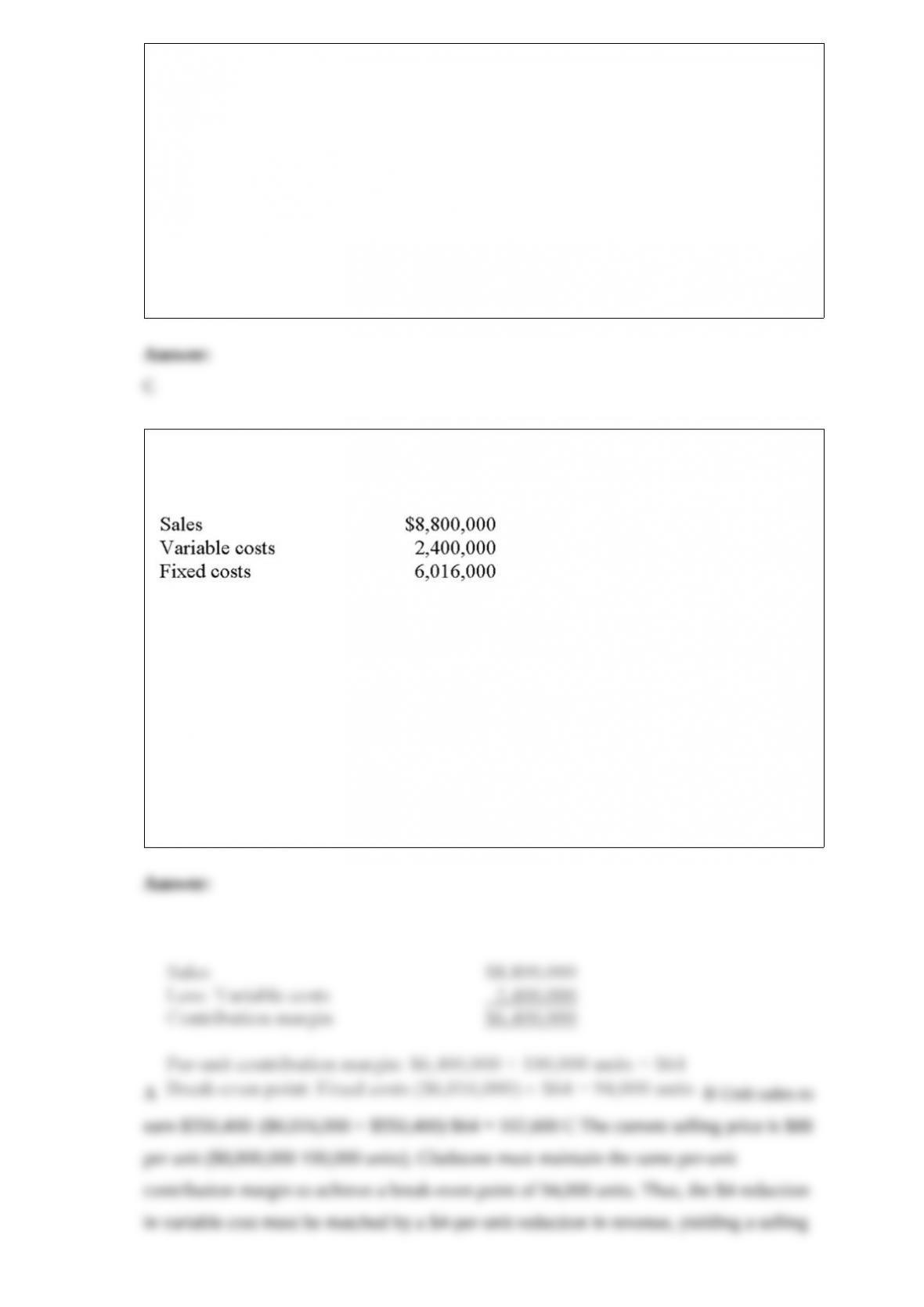
Regular and $20 per unit for Super. Variable selling expenses are $4 per unit for
Regular and $20 per unit for Super; remaining selling amounts are fixed.
Disregard the information in the previous question. If HiTech eliminates Regular and
uses the available capacity to produce and sell an additional 1,500 units of Super, what
would be the impact on operating income?
A.$28,000 increase
B.$45,000 increase
C.$55,000 increase
D.$85,000 increase
E.None of the other answers are correct
26) The information that follows was obtained from the accounting records of
Gladstone Manufacturing during a period when the company sold 100,000 units.
Required:
A. Compute the company’s per-unit contribution margin and break-even point in units.
B. How many units must Gladstone sell to produce a target profit of $550,400?
C. Assume that Gladstone was able to reduce the variable cost per unit by $4. What
selling price could management charge if it desired to maintain the current break-even
point?
D. Depreciation charges of $640,000 are included in the firm’s fixed costs of
$6,016,000. If these charges were to increase by 10%, what effect, if any, would this
cost increase have on the company’s contribution margin?
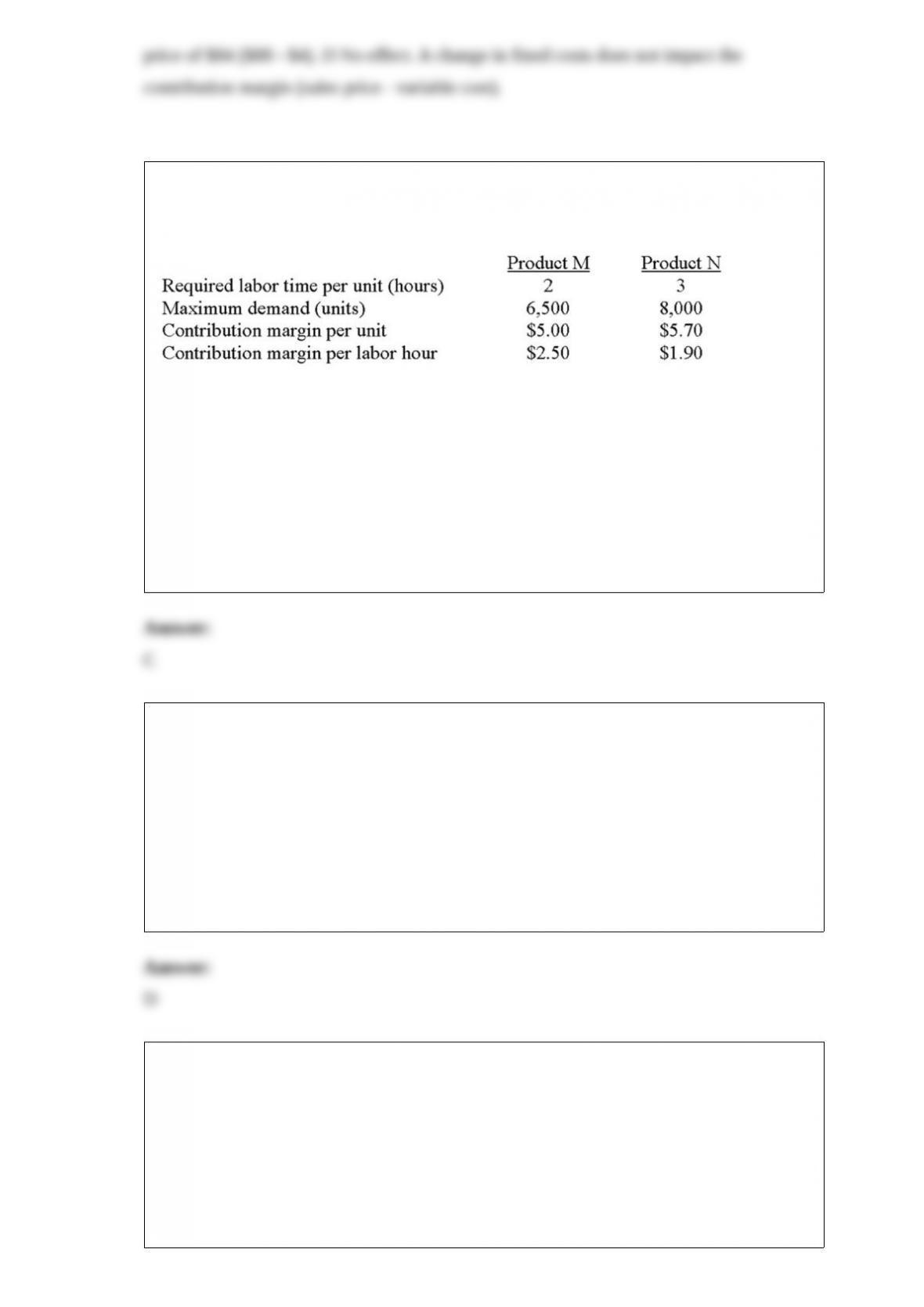
27) Buchnell Manufacturing has 31,000 labor hours available for producing M and N.
Consider the following information:
If Buchnell follows proper managerial accounting practices in terms of setting a
production schedule, how much contribution margin would the company expect to
generate?
A.$31,450
B.$63,100
C.$66,700
D.$78,100
E.None of the other answers are correct
28) Which of the following statements about the ethical climate of business is false?
A.Greedy corporate executives are, in part, to blame for the rash of corporate scandals
that occurred not too long ago
B.Unethical business behavior can have a negative impact on our economy
C.The Sarbanes-Oxley Act strives to improve the overall quality of corporate reporting
D.The Robinson-Patman Act strives to improve the overall quality of corporate
reporting
E.Corporate scandals have served as the accounting profession’s wake-up call to pay
increased attention to ethical issues in the conduct of business
29) Weston Enterprises uses a traditional-costing system to estimate quality-control
costs for its DEX product line. Costs are estimated at 32% of direct-labor cost, and
direct labor totaled $860,000 for the quarter just ended. Management is contemplating a
change to activity-based costing, and has established three cost pools: incoming
material inspection, in-process inspection, and final product certification. Number of
parts, number of units, and number of orders have been selected as the respective cost
drivers.
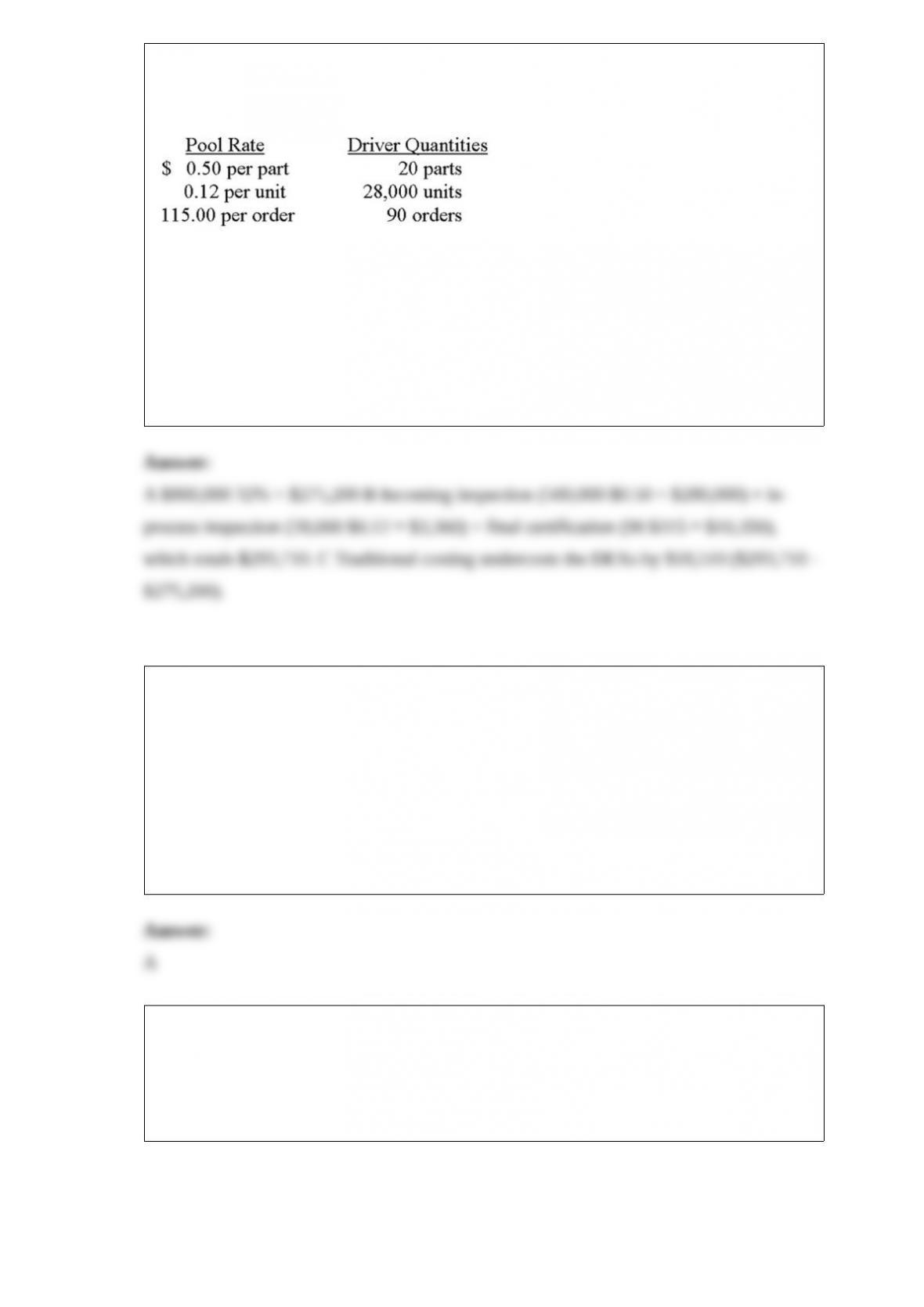
The following data show the pool rates that have been calculated by the company along
with the quantity of driver units for the DEXs:
Required:
A. Calculate the quarterly quality-control cost that is allocated to the DEX product line
under Weston’s traditional-costing system.
B. Calculate the quarterly quality-control cost that is allocated to the DEXs if
activity-based costing is used.
C. Does the traditional approach under- or overcost the product line? By what amount?
30) Parker Corporation observed that when 25,000 units were sold, a particular cost
amounted to $75,000, or $3.00 per unit. When volume increased by 10%, the cost
totaled $82,500 (i.e., $3.00 per unit). The cost that Parker is studying can best be
described as a:
A.variable cost
B.fixed cost
C.semivariable cost
D.discretionary fixed cost
E.step-fixed cost
31) HiTech Products manufactures three types of remote-control devices: Economy,
Standard, and Deluxe. The company, which uses activity-based costing, has identified
five activities (and related cost drivers). Each activity, its budgeted cost, and related cost
driver is identified below.
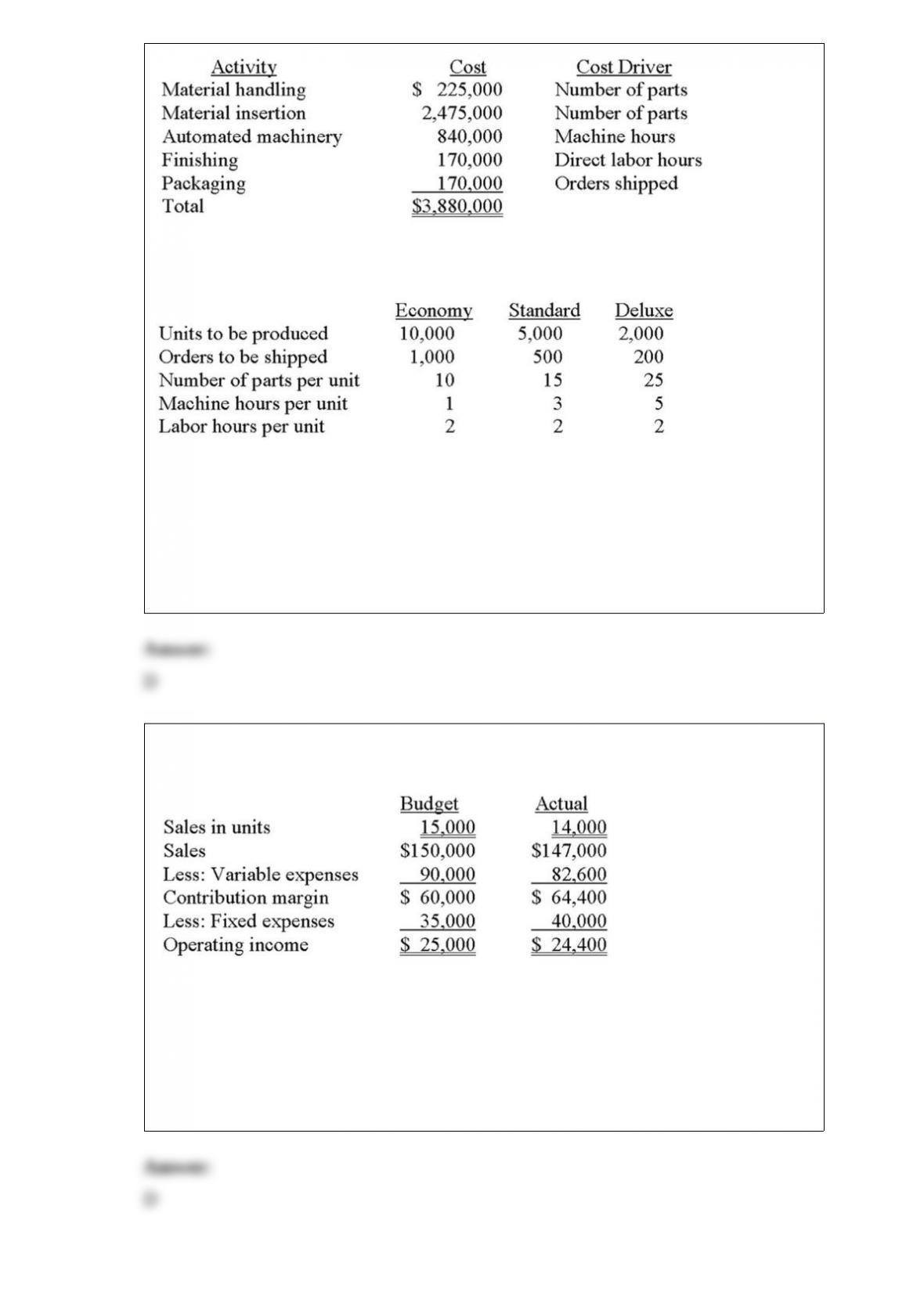
The following information pertains to the three product lines for next year:
What is HiTech’s pool rate for the packaging activity?
A.$4.86 per machine hour
B.$5.00 per labor hour
C.$10.00 per unit
D.$100.00 per order shipped
E.None of the other answers is correct
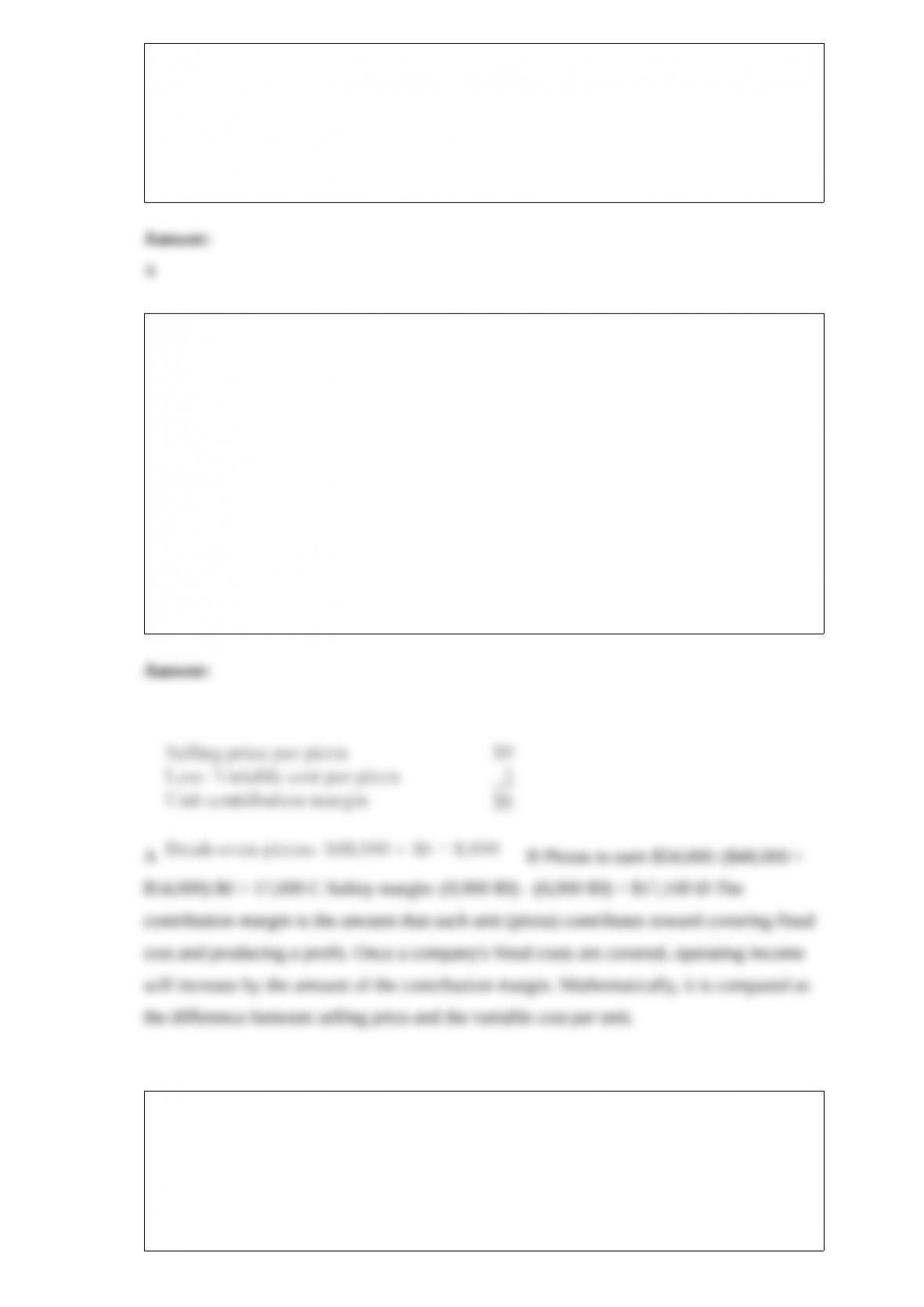
32) Master Products has the following information for the year just ended:
The company’s sales-volume variance is:
A.$3,000 unfavorable
B.$4,000 unfavorable
C.$4,400 favorable
D.$10,000 unfavorable
E.$10,000 favorable
33) Costs that can be easily traced to a specific department are called:
A.direct costs
B.indirect costs
C.product costs
D.manufacturing costs
E.processing costs
34) Vince’s Pizza delivers pizzas to dormitories and apartments near a major state
university. The company’s annual fixed costs are $48,000. The sales price averages $9,
and it costs the firm $3 to make and deliver each pizza.
Required:
A. How many pizzas must Vince’s sell to break even?
B. How many pizzas must the company sell to earn a target profit of $54,000?
C. If budgeted sales total 9,900 pizzas, how much is the company’s safety margin in
dollars?
D. Vince’s assistant manager, an accounting major, has suggested that the firm should
try to increase the contribution margin per pizza. Explain the meaning of “contribution
margin” in layman’s terms.
35) Which of the following statements about the use of direct labor as a cost driver is
false?
A.Direct labor is the most commonly used cost driver when calculating a predetermined
overhead rate
B.Direct labor is gaining importance in many manufacturing applications with respect
to being a significant cost driver
C.Direct labor is an inappropriate cost driver to use if a company is highly automated
D.If direct labor is a good cost driver, increases in direct labor are matched with
increases in manufacturing overhead
E.Companies can use either direct labor cost or direct labor hours as a cost driver
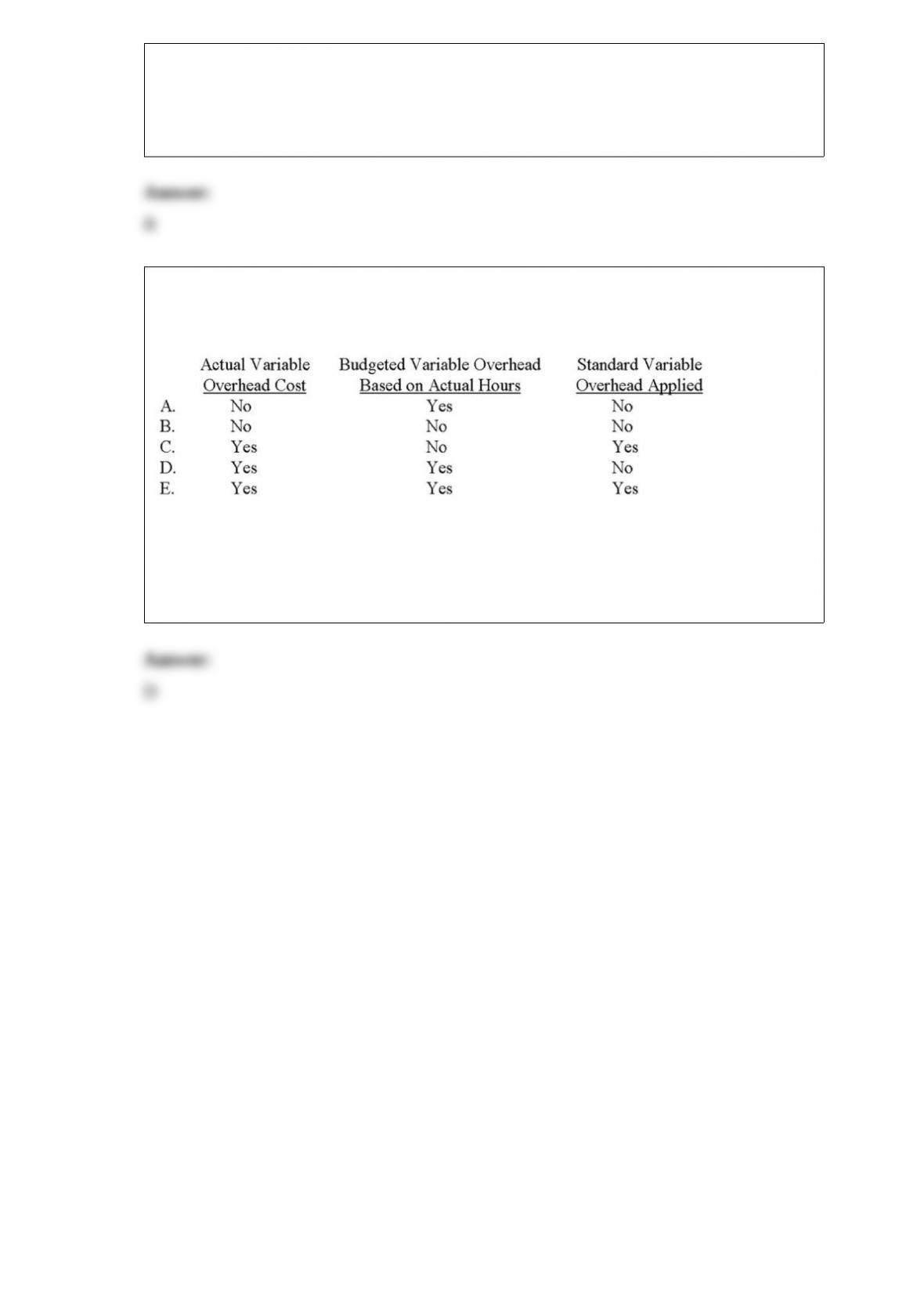
36) Which of the following is used in the computation of the variable-overhead
spending variance?
A.Choice A
B.Choice B
C.Choice C
D.Choice D
E.Choice E