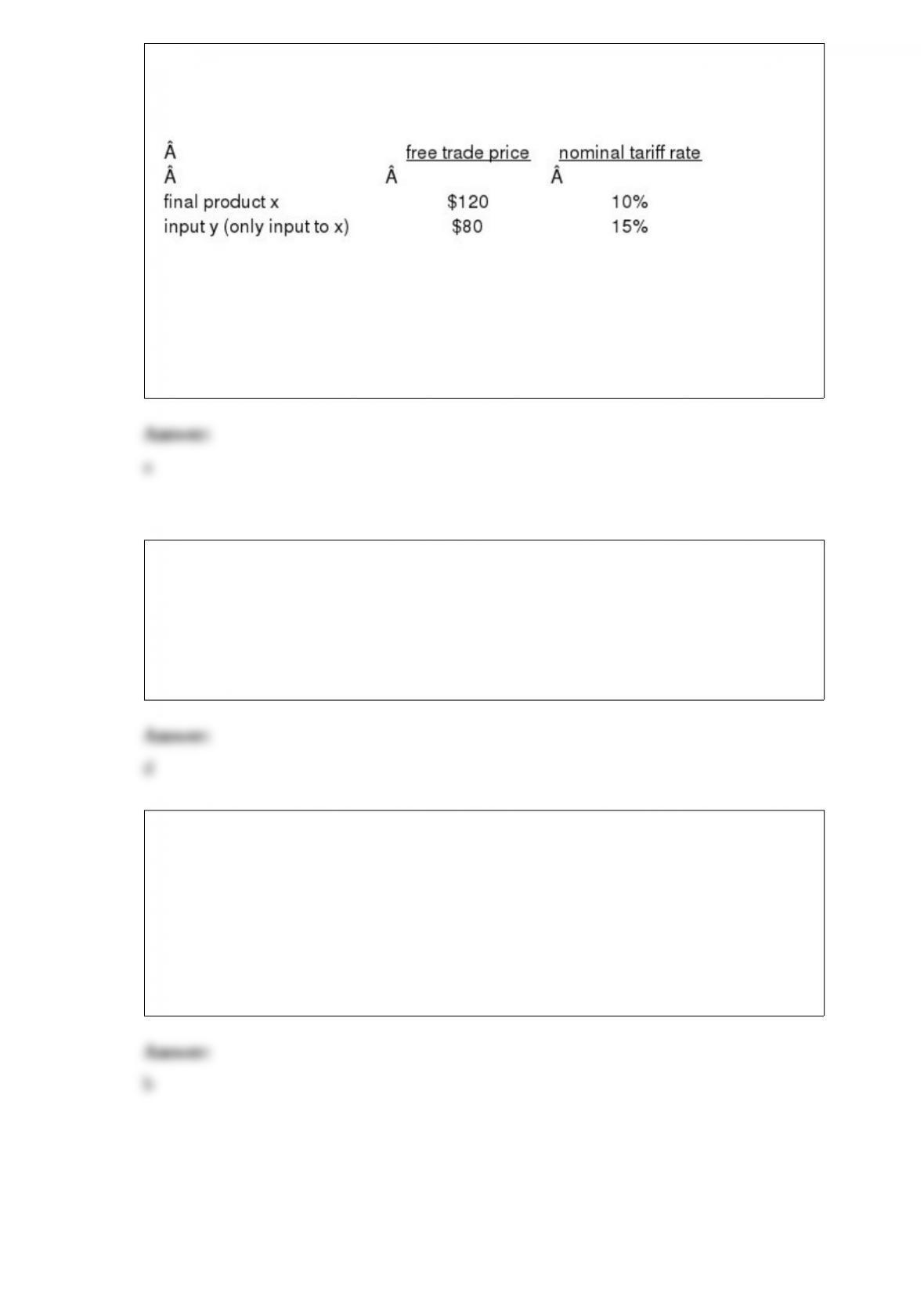
1) given the following information for industry x in country a, and assuming that input
y is imported, that one unit of y is required for each one unit of x, and that country a is a
small country:
the effective tariff rate or effective rate of protection (erp) for industry x in country a is
__________ percent.
a. 0
b. 10
c. 12.5
d. 25
2) which one of the following sets of countries contains only members of the european
union?
a. france, spain, switzerland, united kingdom
b. germany, italy, portugal, norway
c. denmark, greece, the netherlands, russia
d. belgium, greece, italy, portugal
3) in the 2x2x2 heckscher-ohlin analysis, if an relatively labor-abundant country is
opened to trade, then, as the movement to trade takes place, the capital/labor ratio used
in the countrys export industry will __________ and the capital/labor ratio used in the
countrys import-competing industry __________.
a. increase; will decrease
b. increase; also will increase
c. decrease; also will decrease
d. decrease; will increase
if, under the gold standard, the par value of the swiss franc in terms of the dollar is $0.80,
and if it costs $0.01 to move one francs worth of gold between the countries, then the gold
export point from the united states is at __________, and the gold import point into the

united states is at __________.
4) a. $0.80 = 1 swiss franc; $0.80 = 1 swiss franc
b. $0.79 = 1 swiss franc; $0.81 = 1 swiss franc
c. $0.81 = 1 swiss franc; $0.79 = 1 swiss franc
d. $0.82 = 1 swiss franc; $0.78 = 1 swiss franc
5) suppose that country as total exports are 10,000 units of good x at a price of $20 per
unit, meaning that country as export earnings or receipts are $200,000. suppose also
that the foreign price elasticity of demand for country as exports of good x is (-) 0.6. if
country as prices for all goods, including its exports, now rise by 10% because of a gold
inflow such as in the mercantilist model, then, other things equal, country as exports of
good x will fall by __________ and country as export earnings or receipts will become
__________.
a. 600 units; less than $200,000
b. 600 units; greater than $200,000
c. 1,000 units; less than $200,000
d. 1,000 units; greater than $200,000
6) in an open-economy keynesian income model of the sort used in chapter 24, at the
equilibrium level of income,
a. s + x + t = y + m + g
b. s + i + (t – g) = m – x
c. s + m + t = i + x + g
d. s + (g – t) – i = (x – m)
7) you are given the following dornbusch-fischer-samuelson (dfs) graph, where a1 = the
labor-time needed per unit of output in any given industry in the home country, a2 = the
labor-time needed per unit of output in any given industry in the foreign country, w1 =
the wage rate in the home country, and w2 = the wage rate in the foreign country. the
exchange rate e is assumed = 1.
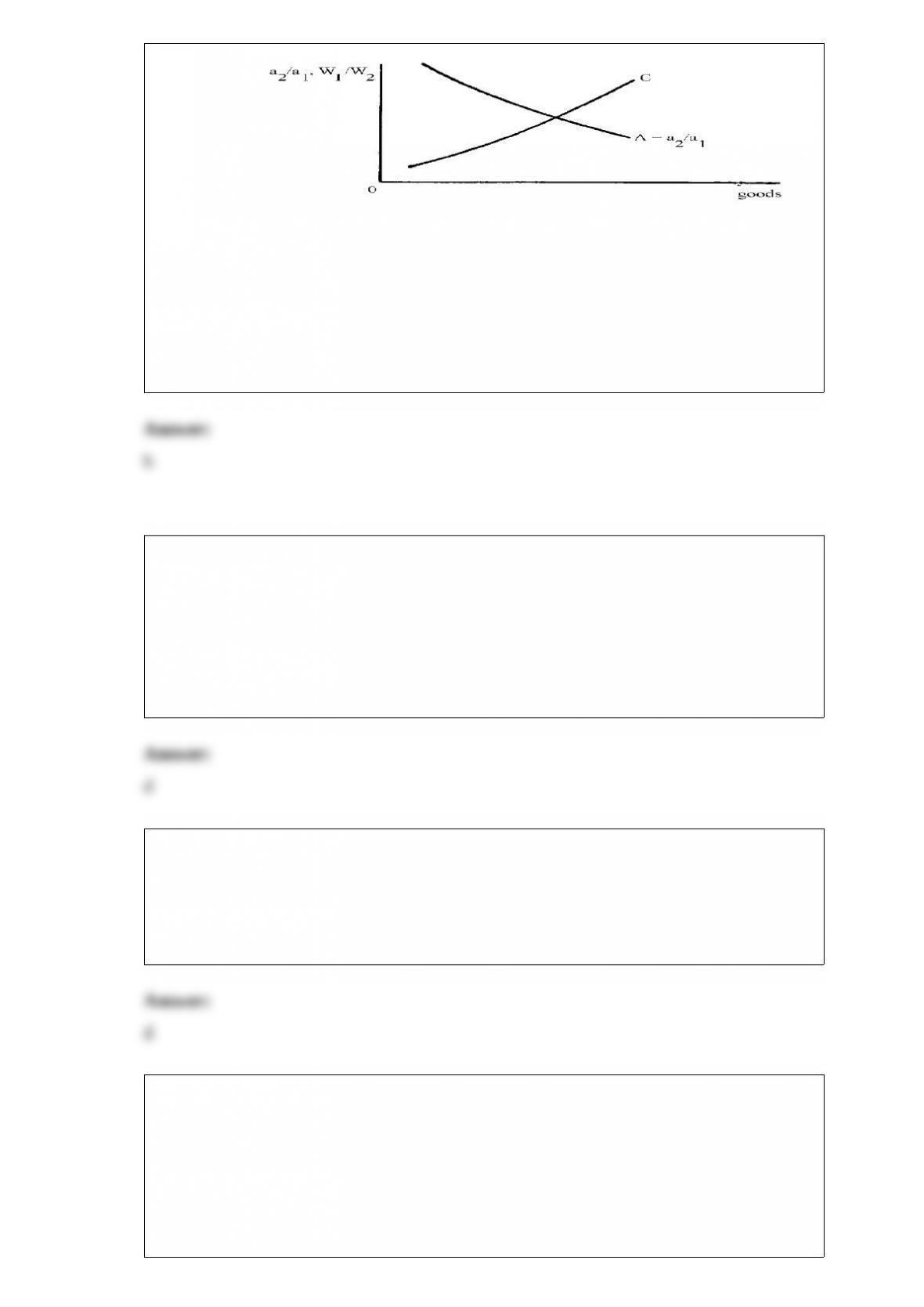
in the dornbusch-fischer-samuelson model, a rise in labor productivity in the home
country would cause real national income to __________ in the home country and
__________ in the foreign country.
a. increase; to decrease
b. increase; also to increase
c. decrease; to increase
d. decrease; also to decrease
8) in considering the slope of the open-economy aggregate demand curve (ad), a valid
general statement is that, other things equal, the open-economy ad __________.
a. will tend to be flatter with flexible rates than with fixed rates
b. will tend to be steeper with flexible rates than with fixed rates
c. will necessarily have the same slope with flexible rates as with fixed rates
d. will tend to be flatter or steeper, or will necessarily have the same slope, with flexible
rates as with fixed rates cannot be determined without more information
9) in the new endogenous growth models
a. growth can occur due to spillover effects of research and development
b. investment and growth are linked to acquisition of human capital
c. growth does not necessarily converge to that of the growth rate of population
d. all of the above
10) you are given the following classical-type table indicating the number of days of
labor input needed to make one unit of output of each of the five commodities in each
of the two countries. assume that the wage rate in england is £20 per day, that the wage
rate in portugal is 40 euros per day, and that the fixed exchange rate is £1 = 3 euros.
with the given information, what will be the trade pattern if the two countries engage in
trade?
a. england will export good a and import goods b, c, d, and e

b. england will export goods a and d and import goods b, c, and e
c. england will export goods a, b, and e and import goods c and d
d. england will export goods a, b, d, and e and import good c
in the analysis of the debt-relief laffer curve pertaining to the external debt of a developing
country,
11) a. the market value of the debt always equals the face value of the debt
b. the market value of the debt is sometimes greater than the face value of the debt
c. in one portion of the curve, forgiveness of debt can benefit both the debtor country and
the lenders to the country
d. in no portion of the curve can forgiveness of debt benefit both the debtor country and
the lenders to the country
12) which of the following is not an example of a nontariff barrier to the free flow of
goods and services in accordance with comparative advantage?
a. import quotas
b. government procurement provisions that favor home products
c. specific duty of $1.00 per unit on each imported item
d. voluntary export quotas (vers)
13) expansionary aggregate demand-oriented fiscal policy leads, ceteris paribus, to
a. a short-run fall in both income and the price level
b. a short-run rise in income and a fall in the price level
c. no change in the long-run equilibrium level of income and to an increase in the price
level
d. both an increase in the long-run equilibrium level of income and an increase in the
price level

14) the imposition of an export tax by a home country will lead to __________ in home
country consumer surplus and will __________ in home country producer surplus.
a. a decrease; also lead to a decrease
b. a decrease; lead to an increase
c. an increase; lead to a decrease
d. an increase; also lead to an increase
15) suppose that short-term interest rates rise in the united states and, consequently, u.k.
financial investors respond by sending funds to the united states (and cover those funds
against any exchange rate change that might occur between the time of the investment
and the time of returning the funds and interest to the united kingdom). in this situation,
which one of the following events will not occur?
a. a rise in short-term eurodollar interest rates in london
b. a fall in the dollar price of the british pound in the spot market
c. a fall in the pound price of the u.s. dollar in the forward market
d. a fall in short-term interest rates on pound deposits in london
16)
the imposition of an export tax on good x by country a, other things equal,
a. will improve the terms of trade of country a if a is a small country
b. will lead to a lower price of good x in country as home market if a is a large country but
will not affect the price of good x in as home market if a is a small country
c. will always lead to an improvement in country as welfare if a is a large country
d. will lead to an increase in consumer surplus in country a
17) if a small country produces 100 units of product x and consumes 140 units at a price
of $2 under free trade, but the imposition of a tariff leads to a situation where domestic
price is $2.20, domestic production is 120 units, and domestic consumption is 125 units,
then the gain in producer surplus in this country because of the tariff is __________.
a. $1.00
b. $22.00
c. $24.00
d. $26.50