
Which of the following statements is false?
A) The option buyer, also called the option holder, holds the right to exercise the option
and has a long position in the contract.
B) The market price of the option is also called the exercise price.
C) If the payoff from exercising an option immediately is positive, the option is said to
be in-the-money.
D) As with other financial assets, options can be bought and sold. Standard stock
options are traded on organized exchanges, while more specialized options are sold
through dealers.
Answer:
Use the information for the question(s) below.
You are purchasing a new home and need to borrow $250,000 from a mortgage lender.
The mortgage lender quotes you a rate of 6.25% APR for a 30-year fixed rate mortgage.
The mortgage lender also tells you that if you are willing to pay 2 points, they can offer
you a lower rate of 6.0% APR for a 30-year fixed rate mortgage. One point is equal to
1% of the loan value. So if you take the lower rate and pay the points you will need to
borrow an additional $5000 to cover points you are paying the lender.
Assuming you don’t pay the points and borrow from the mortgage lender at 6.25%, then
your monthly mortgage payment (with payments made at the end of the month) will be
closest to:
A) $694
B) $708
C) $1540
D) $1600

Answer:
Which of the following industries is likely to have the lowest costs of financial distress?
A) Airlines
B) Computer software
C) Biotechnology
D) Electric utilities
Answer:
Use the table for the question(s) below.
Consider the following yields to maturity on various one-year zero-coupon securities:

The price (expressed as a percentage of the face value) of a one-year, zero-coupon
corporate bond with a BBB rating is closest to:
A) 95.60
B) 94.16
C) 95.42
D) 94.70
Answer:
Which of the following statements is false?
A) If some security were not part of the efficient portfolio, then every investor would
want to own it, and demand for this security would increase causing its expected return
to fall until it is no longer an attractive investment.
B) The efficient portfolio, the portfolio that all investors should hold, must be the same
portfolio as the market portfolio of all risky securities.
C) Because every security is owned by someone, the sum of all investors’ portfolios
must equal the portfolio of all risky securities available in the market.
D) If all investors demand the efficient portfolio, and since the supply of securities is
the market portfolio, then two portfolios must coincide.

Answer:
Use the following information to answer the question(s) below.
Hammond Motors is considering an investment in the euro area. The expected free cash
flows, in Euros, are uncorrelated with the spot exchange rate and are as follows:
The new project, which Hammond is considering, has similar dollar risk to Hammond’s
other projects. Hammond knows that its overall dollar WACC is 10%, so it feels
comfortable using this WACC for the project. The risk-free interest rate on dollars is 4%
and the risk-free interest rate on Euros is 6%. Hammond is willing to assume that
capital markets in the United States and the Euro area are internationally integrated.
The NPV of this project in Euros is closest to:
A) €54 million
B) €57 million
C) €62 million
D) €65 million
Answer:

Suppose the term structure of risk-free interest rates is given as:
The present value of an investment that pays $2,000 in one year and $3,000 in three
years for certain is closest to:
A) $4,707
B) $4,685
C) $4,729
D) $5,000
Answer:
Consider the following equation:
The term βU in the equation is
A) the same as the beta of the firm’s assets.
B) the required return on the firm’s equity.
C) the proportion of the firm financed with equity.
D) equal to zero if the firm’s debt is riskless.
Answer:
Use the following information to answer the question(s) below.
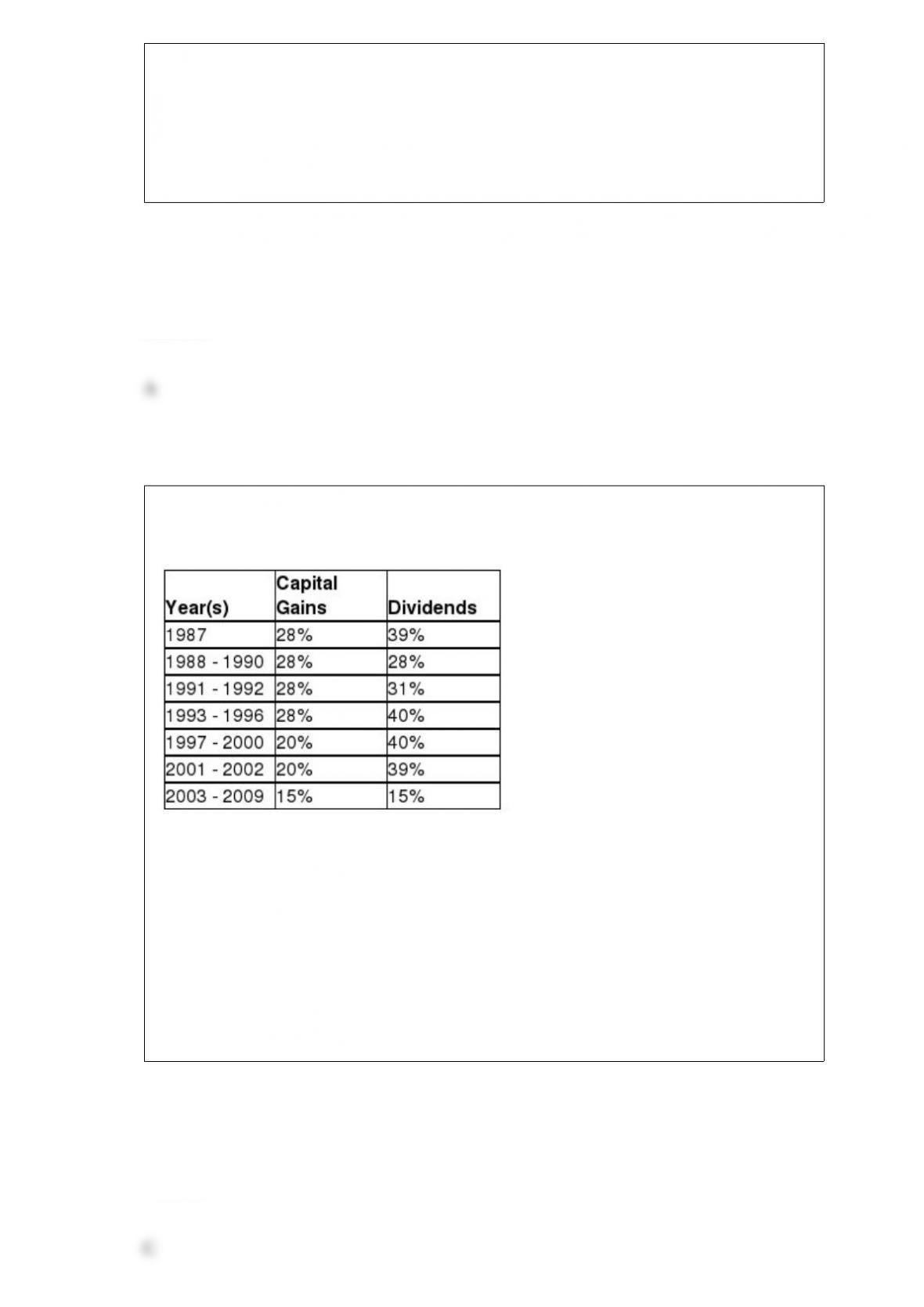
In which years were dividends tax disadvantaged?
A) 1987 – 2002
B) 1987, 1993 – 2002
C) 1987, 1991 – 2002
D) 1988 – 1990, 2003 – 2009
Answer:

Use the information for the question(s) below.
Electronic Gaming Incorporated (EGI) is a firm with no debt and its 20 million shares
are currently trading for $16 per share. Based on the prospects for EGI’s new hand held
video game, management feels the true value of the firm is $20 per share. Management
believes that the share price will reflect this higher value after the video game is
released next fall. EGI has already announced plans to raise $100 million from
investors to build a new factory.
Assume that EGI decides to wait until after the release of the new video game before
they raise the $100 million through the issuance of new shares. EGI’s share price
following the release of the new video game will be closest to:
A) $18.00
B) $20.00
C) $16.00
D) $19.00

Answer:
The idea that when a seller has private information about the value of good, buyers will
discount the price they are willing to pay due to adverse selection is known as the
A) pecking order hypothesis.
B) signaling theory of debt.
C) lemons principle.
D) credibility principle.
Answer:
Consider the following tax rates:

*The current tax rates are set to expire in 2008 unless Congress extends them. The tax
rates shown are for financial assets held for one year. For assets held less than one year,
capital gains are taxed at the ordinary income tax rate (currently 35% for the highest
bracket); the same is true for dividends if the assets are held for less than 61 days.
The effective tax disadvantage for retaining cash in 2002 is closest to:
A) 15.00%
B) 14.75%
C) 30.00%
D) 35.00%
Answer:
Which of the following statements is false?
A) Firms with high R&D costs and future growth opportunities typically maintain high
debt levels.
B) The tradeoff theory explains how firms should choose their capital structures to

maximize value to current shareholders.
C) With tangible assets, the financial distress costs of leverage are likely to be low, as
the assets can be liquidated for close to their full value.
D) Proponents of the management entrenchment theoryof capital structure believe that
managers choose a capital structure to avoid the discipline of debt and maintain their
own job security.
Answer:
Which of the following statements is false?
A) Creditors often place restrictions on the actions that the firm can take. Such
restrictions are referred to as debt covenants.
B) Covenants are often designed to prevent management from exploiting debt holders,
so they may help to reduce agency costs.
C) Agency costs are smallest for long-term debt.
D) Covenants may limit the firm’s ability to pay large dividends or the types of
investments that the firm can make.
Answer:
An independent film maker is considering producing a new movie. The initial cost for
making this movie will be $20 million today. Once the movie is completed, in one year,
the movie will be sold to a major studio for $25 million. Rather than paying for the $20
million investment entirely using its own cash, the film maker is considering raising
additional funds by issuing a security that will pay investors $11 million in one year.

Suppose the risk-free rate of interest is 10%.
Without issuing the new security, the npv for this project is closest to what amount?
Should the film maker make the investment?
A) $1.7 million; Yes
B) $1.7 million; No
C) $2.7 million; Yes
D) $2.7 million; No
Answer:
Which of the following questions is false?
A) Once the acquirer has completed the valuation process, it is in the position to make a
tender offerthat is, a public announcement of its intention to purchase a large block of
shares for a specified price.
B) If we view the pre-bid market capitalization as the stand-alone value of the target,
then from the bidder’s perspective, the takeover is a positive-NPV project only if the
synergies created do not exceed the premium it pays.
C) Purchasing a corporation usually constitutes a very large capital investment decision,
so it requires a more accurate estimate of value that includes careful analysis of both
operational aspects of the firm and the ultimate cash flows the deal will generate.
D) A stock-swap merger is a positive-NPV investment for the acquiring shareholders if
the share price of the merged firm (the acquirer’s share price after the takeover) exceeds
the premerger price of the acquiring firm.

Answer:
Use the information for the question(s) below.
Assume that Rose Corporation’s (RC) EBIT is not expected to grow in the future and
that all earnings are paid out as dividends. RC is currently an all equity firm. It expects
to generate earnings before interest and taxes (EBIT) of $6 million over the next year.
Currently RC has 5 million shares outstanding and its stock is trading for a price of
$12.00 per share. RC is considering borrowing $12 million at a rate of 6% and using the
proceeds to repurchase shares at the current price of $12.00.
Following the borrowing of $12 and subsequent share repurchase, the expected
earnings per share for RC is closest to:
A) $1.32
B) $1.44
C) $1.40
D) $1.20
Answer:

Which of the following statements is false?
A) Since the publication of their original paper, Modigliani and Miller’s ideas have
greatly influenced finance research and practice.
B) Proposition I was one of the first arguments to show that the Law of One Price could
have strong implications for security prices and firm values in a competitive market; it
marks the beginning of the modern theory of corporate finance.
C) The conservation of value principle extends far beyond questions of debt versus
equity
or even capital structure.
D) The conservation of value principle for financial markets states that with perfect
capital markets, financial transactions neither add nor destroy value, but instead
represent a repackaging of risk (and therefore return).
Answer:
The date on which the board authorizes the dividend is the
A) declaration date.
B) distribution date.
C) record date.
D) ex-dividend date.
Answer:

Which of the following firms is likely to have the highest short-term financing needs?
A) A pharmaceutical manufacturer
B) A grocery store
C) An electric utility
D) A toy store
Answer:
Which of the following statements is false?
A) When an investor chooses her optimal portfolio, she will do so by finding the
tangent line using the risk-free rate that corresponds to her investment horizon.
B) If the market portfolio is not efficient, savvy investors who recognize that the market
portfolio is not optimal will push prices and expected returns back into balance.
C) Even though different investors may research different stocks, their information will
not impact the market portfolio since there is no way to share this information with
other investors.
D) In the real world borrowers pay higher interest rates than savers receive.
Answer:

Which of the following organization forms has the most revenue?
A) “S” Corporation
B) Limited Partnership
C) “C” Corporation
D) Limited Liability Company
Answer:
In a world with taxes, which of the following is the rate we should use to evaluate a
project with the same risk and the same financing as the firm itself?
A) The weighted-average cost of capital
B) The pre-tax WACC
C) The cost of equity
D) The cost of debt
Answer:
Which of the following statements is false?
A) The expected return of a portfolio should correspond to the portfolio’s beta.
B) Graphically the line through the risk-free investment and the market portfolio is
called the capital market line (CML).

C) The beta of a portfolio is the weighted average beta of the securities in the portfolio.
D) By holding a negative beta security, an investor can reduce the overall market risk of
her portfolio.
Answer:
Which of the following will not increase the value of a put option?
A) An increase in the time to maturity
B) A decrease in the stock price
C) A decrease in the stocks volatility
D) An increase in the exercise price
Answer:
Which of the following statements is false?
A) When the CEO is also chairman of the board, the nominating letter offering a seat to
a new director comes from her. This process merely serves to reinforce the sense that
the outside directors owe their positions to the CEO and work for the CEO rather than
for the shareholders.
B) Over time, most of the independent directors will have been nominated by the CEO.
Even though they have no business ties to the firm, they are still likely to be friends or
at least acquaintances of the CEO.

C) Researchers have found the surprisingly robust result that larger boards are
associated with greater firm value and performance.
D) The CEO can be expected to stack the board with directors who are less likely to
challenge her.
Answer:
Which of the following statements regarding the balance sheet is incorrect?
A) The balance sheet provides a snapshots of the firm’s financial position at a given
point in time.
B) The balance sheet lists the firm’s assets and liabilities.
C) The balance sheet reports stockholders’ equity on the right-hand side.
D) The balance sheet reports liabilities on the left-hand side.
Answer:
Consider the following equation:
C = P + S – PV(K)– PV(Div)
In this equation the term K refers to
A) the value of the call option.

B) the strike price of the option.
C) the price of a zero coupon bond.
D) the stocks current price.
Answer:
Like most foreign exchange rates, the dollar/euro rate is a floating rate, which means it
changes constantly depending on the quantity supplied and demanded for each currency
in the market. The supply and demand for each currency is driven directly by all of the
following factors except
A) relative inflation.
B) firms trading goods.
C) investors trading securities.
D) the actions of central banks in each country.
Answer:
Rearden Metal can invest in a risk-free technology that requires an up-front investment
of $1 million. Rearden’s managers are hesitant to invest because of uncertainty over
future interest rates. Suppose that all interest rates will be either 8% or 4% in one year
and remain there forever. The risk-neutral probability that interest rates will drop to 4%
is 40%. The one-year risk-free interest rate is 5% and today’s rate on a risk-free
perpetual bond is 6%. The rate on an equivalent perpetual bond that is repayable at any
time (the callable annuity rate) is 7.65%.

Assuming that this project will provide Rearden with perpetual annual cash flows of
$55,000, the NPV of investing in the project next year is closest to:
A) -281,000
B) -83,000
C) +46,000
D) +83,000
E) +143,000
Answer:
Use the following information to answer the question(s) below:
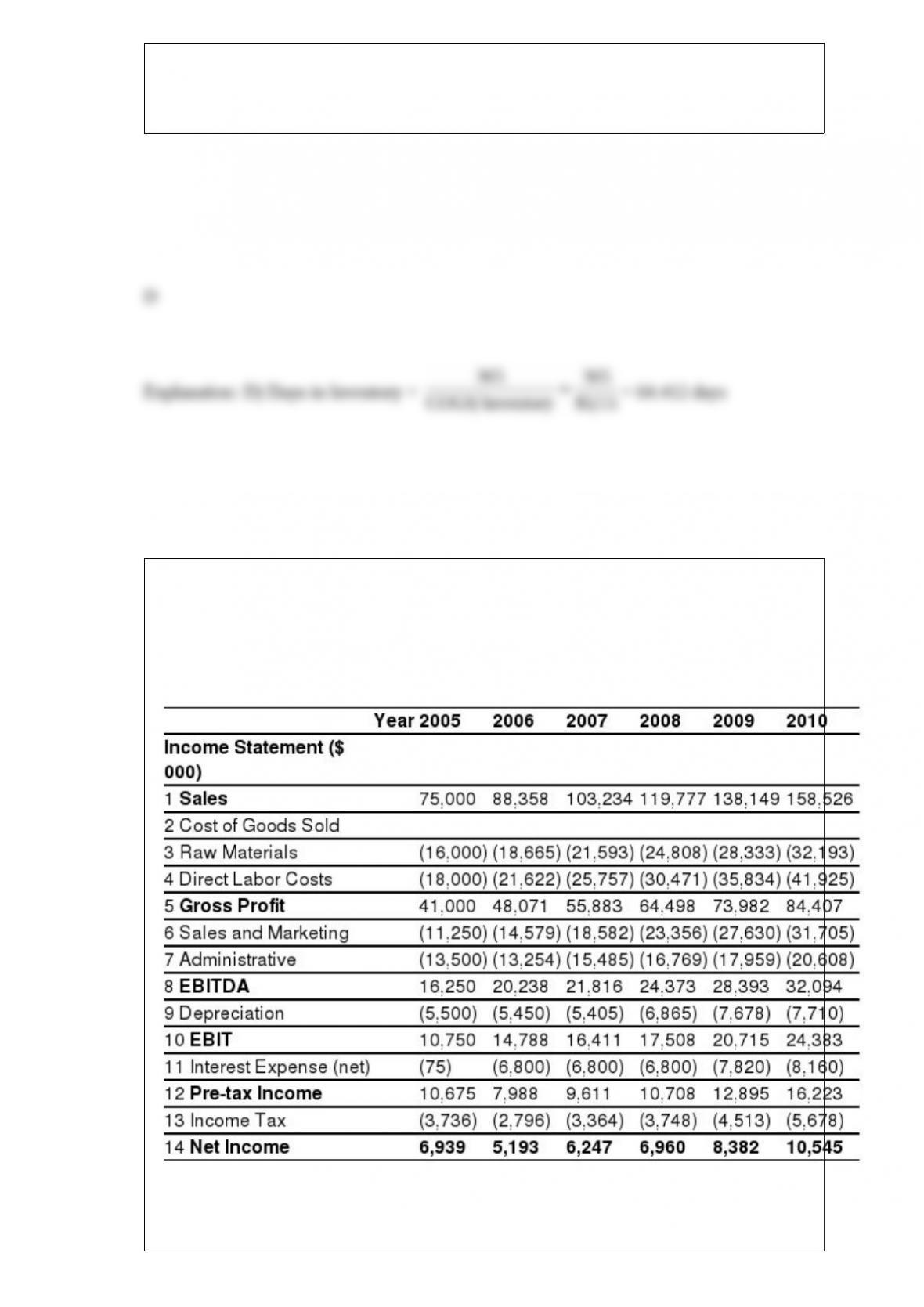
Rearden Metal (RM) had $120 million in sales in 2009. Its cost of goods sold was $85,
and its average inventory balance was $15 million.
The average number of inventory days outstanding for Rearden is closest to:
A) 6 days
B) 8 days
C) 37 days
D) 64 days
Answer:
Use the table for the question(s) below.
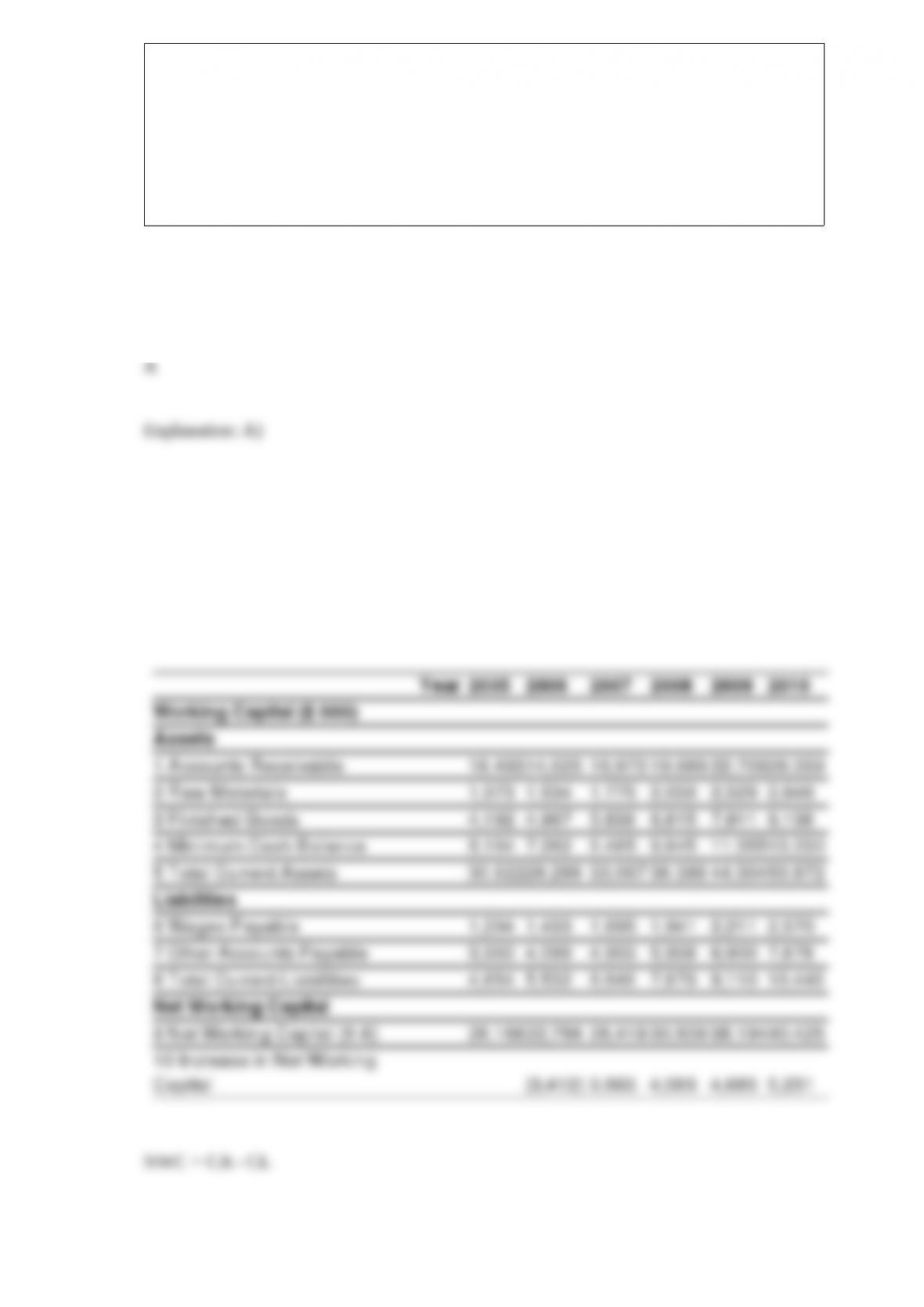
Pro Forma Income Statement for Ideko, 2005-2010
The amount of net working capital for Ideko in 2006 is closest to:
A) $22,750
B) $35,195
C) $30,510
D) $26,420
Answer:

Use the following information to answer the question(s) below.
Galt Industries is trading for $20 per share and has 25 million shares outstanding. Galt
Industries has a debt-equity ratio of 0.4 and its debt is zero coupon debt with a ten year
maturity and a yield to maturity of 8%.
In describing Galt’s equity as a call option, the maturity of this option is:
A) 5 years
B) 10 years
C) 20 years
D) infinite
Answer:
Directors who are not employees, former employees, or family members of employees
and who do not have existing or potential business relationships with the firm are called
A) monitoring directors.
B) independent directors.
C) gray directors.
D) inside directors.
Answer:

Use the information for the question(s) below.
LCMS Industries has $70 million in debt outstanding. The firm will pay only interest on
this debt (the debt is perpetual). LCMS’ marginal tax rate is 35% and the firm pays a
rate of 8% interest on its debt.
Assuming that the risk of the tax shield is only 6% even though the loan pays 8%, then
the present value of LCMS’ interest tax shield is closest to:
A) $24.5 million
B) $18 million
C) $33.0 million
D) $20.0 million
Answer: