
1) A corporation’s cost of common equity may be estimated using either a dividend
valuation model or the capital asset pricing model.
2) The mixture of financing sources used by a firm will vary from year to year, so many
firms use target capital structure proportions when calculating the firm’s weighted
average cost of capital.
3) Due to the dominance of Chinese companies in international trade, the Chinese yuan
is the most frequently traded currency.
4) The average cost of capital is the appropriate rate to use when evaluating new
investments, even though the new investments may be in a higher risk class.
5) Working capital management involves managing a firm’s liquidity.
6) A sinking-fund provision allows for the retirement of a portion of preferred stock
each year.
7) A bond rating of “BB” indicates that the company’s financial position is above
average and hence the default risk on the bonds is very low.

8) Investor A owns 10% of the common stock of IDE Corporation. After IDE completes
a 2-for-1 stock split, Investor A will own 20% of the common stock of the corporation.
9) Fixed costs per unit vary inversely with production output.
10) Marketing is crucial to capital budgeting success because the goal of a good capital
budgeting project is to maximize the company’s sales.
11) Variation in the rate of return of an investment is a measure of the riskiness of that
investment.
12) Assume that you expect to hold a $40,000 investment for one year. It is forecasted
to have a year end value of $42,000 with a 30% probability; a year end value of
$48,000 with a 45% probability; and a year end value of $60,000 with a 25%
probability. What is the expected holding period return for this investment?
A) 50%
B) 25%
C) 23%
D) 18%
13) Prices of securities that are traded in the Over-the-Counter Markets are determined
by
A) the Federal Trade Commission
B) a continuous modified auction process

C) the buyers of these securities
D) a “bid” and “ask” negotiation process of broker-dealers of these securities
14) Which of the following is NOT true for a limited partnership?
A) limited liability for its owners
B) One general partner must exist who has unlimited liability
C) Only the name of general partners can appear in the name of the firm
D) Limited partners may sell their interest in the company
15) The first step involved in predicting financing needs is
A) project the firm’s sales revenues and expenses over the planning period
B) estimating the levels of investment in current and fixed assets that are necessary to
support the projected sales
C) determining the firm’s financing needs throughout the planning period
D) estimating the cost of debt
16) Financial intermediaries
A) offer indirect securities
B) include the national and regional stock exchange
C) usually are underwriting syndicates
D) constitute the various secondary markets
17) Consider a project with the following information:
After-taxAfter-tax
AccountingCash Flow
YearProfits fromOperations
1$799$750
21501,000
32001,200
Initial outlay = $1,500
Compute the profitability index if the company’s discount rate is 10%.
A) 15.8
B) 1.61

C) 1.81
D) 0.62
18) The primary purpose of a cash budget is to
A) determine the level of investment in current and fixed assets
B) determine financing needs
C) provide a detailed plan of future cash flows
D) determine the estimated income tax for the year
19) Compute the discounted payback period for a project with the following cash flows
received uniformly within each year and with a required return of 8%:
Initial Outlay = $100
Cash Flows:Year 1 = $40
Year 2 = $50
Year 3 = $60
A) 2.10 years
B) 2.21 years
C) 2.33 years
D) 3.00 years
20) Anchor Incorporated has a beta of 1.0. If the expected return on the market is 15%,
what is the expected return on Anchor Incorporated’s stock?
A) 15%
B) 14%
C) 18%
D) cannot be determined without the risk free rate
21) An inventory turnover ratio of 7.2 compared to an industry average of 5.1 is likely
to indicate that
A) the firm has higher sales than the industry average
B) the firm is selling a product mix that includes more high margin items
C) the firm is managing its inventory inefficiently
D) the firm’s products are in inventory for fewer days before they are sold than is

average for the industry
22) The net present value always provides the correct decision provided that
A) cash flows are constant over the asset’s life
B) the required rate of return is greater than the internal rate of return
C) capital rationing is not imposed
D) the internal rate of return is positive
23) CraftCo, Inc.’s projected sales for the first six months of 2012 are given below:
Jan.$500,000April$490,000
Feb.$740,000May$740,000
Mar.$380,000June$610,000
40% of sales are collected in cash at time of sale, 50% are collected in the month
following the sale, and the remaining 10% are collected in the second month following
the sale. Cost of goods sold is 60% of sales. Purchases are made in the month prior to
the sales, and payments for purchases are made in the month of the sale. Total other
cash expenses are $40,000/month. The company’s cash balance as of February 28, 2012
will be $25,000. Excess cash will be used to retire short-term borrowing (if any).
CraftCo, Inc. has no short term borrowing as of February 28, 2012 Assume that the
interest rate on short-term borrowing is 1% per month. The company must have a
minimum cash balance of $15,000 at the beginning of each month. What is CraftCo,
Inc.’s total cash disbursements for April 2012?
A) $294,000
B) $334,000
C) $374,000
D) $414,000
24) Asset efficiency ratios for Fischer, Inc. are given in the table below. Based on this
information, Fischer, Inc.’s fixed asset turnover ratio is likely to be ________.
Fischer, Inc. Peer Group
Total Asset Turnover 1.58X 2.05X
Accounts Receivable Turnover 17.55X 14.35X
Inventory Turnover 6.34X 5.22X
Fixed Asset Turnover ????? 3.50X
A) equal to 3.50
B) less than 3.50
C) greater than 3.50
D) negative
25) Beauty Inc. plans to maintain its optimal capital structure of 40 percent debt, 10
percent preferred stock, and 50 percent common equity indefinitely. The required return
on each component source of capital is as follows: debt–8 percent; preferred stock–12
percent; common equity–16 percent. Assuming a 40 percent marginal tax rate, what
after-tax rate of return must the firm earn on its investments if the value of the firm is to
remain unchanged?
A) 12.40 percent
B) 12.00 percent
C) 11.12 percent
D) 10.64 percent
26) You have just purchased a share of preferred stock for $50.00. The preferred stock
pays an annual dividend of $5.50 per share forever. What is the rate of return on your
investment?
A) 0.055
B) 0.010
C) 0.110
D) 0.220
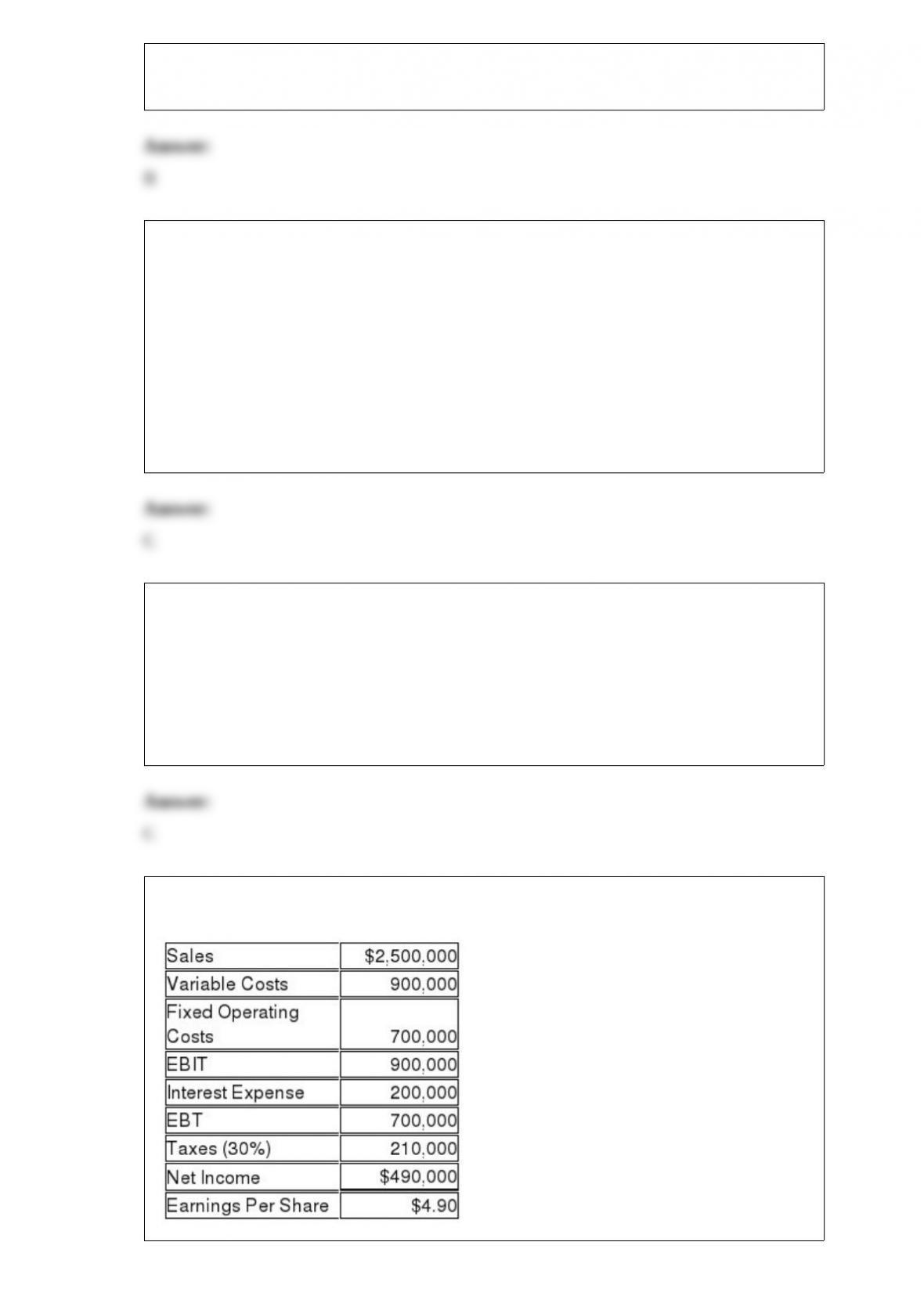
27) ACME, Inc. reported the following income statement for 2009:

If ACME’s sales next year increase by 20%, what will ACME’s earnings per share be?
A) $5.76
B) $6.45
C) $7.14
D) $7.58
28) Brown Inc. needs to borrow $250,000 for the next 6 months. The company has a
line of credit with a bank that allows the company to borrow funds with an 8% interest
rate subject to a 20% of loan compensating balance. Currently, Brown Inc. has no funds
on deposit with the bank and will need the loan to cover the compensating balance as
well as their other financing needs. What will be the annual percentage rate, or APR, for
this financing?
A) 10.00%
B) 12.12%
C) 10.67%
D) 13.33%
29) The CEO of JLI Corp. decided to expand into a new market in 2010. At the end of
2010, JLI’s stock price had decreased 5% since the beginning of the year. Which of the
following statements is MOST correct?
A) The CEO made a poor decision to expand because the stock price decreased during
the year
B) The CEO made a poor decision to expand because the company’s profits for the year
obviously decreased, causing the drop in stock price
C) The CEO’s decision may have been optimal, keeping the stock price from falling
more than 5% for the year
D) CEO decisions are irrelevant because the efficient market determines the value of a
company’s stock
30) Rogue Recreation, Inc. has normally distributed returns with an expected return of
15% and a standard deviation of 5%, while Lake Tours, Inc. has normally distributed
returns with an expected return of 15% and a standard deviation of 15%. Which of the
following is true?
A) Lake Tours’ investors are not being adequately compensated for relevant risk
B) Rogue Rec is likely to experience returns larger than those of Lake Tours
C) Lake Tours is more likely to have negative returns than Rogue Rec
D) Rational investors will prefer Lake Tours, Inc. over Rogue Recreation, Inc

31) According to the hedging principle, plant and equipment should be financed with
A) commercial paper
B) long-term funds
C) short-term bank loans
D) spontaneous financing
32) A corporate bond has a face value of $1,000 and a coupon rate of 9%. The bond
matures in 14 years and has a current market price of $946. If the corporation sells more
bonds it will incur flotation costs of $26 per bond. If the corporate tax rate is 35%, what
is the after-tax cost of debt capital?
A) 5.57%
B) 6.56%
C) 8.18%
D) 7.31%
33) The prices for the National Gasworks Corporation for the second quarter of 2012
are given below. The price of the stock on April 1, 2012 was $130. Find the holding
period return for an investor who purchased the stock on April 1, 2012 and sold it the
last day of June 2012.
Month EndPrice
April$125.00
May138.50
June132.75
A) -4.2%
B) -3.7%
C) 2.1%
D) 3.7%
34) What information does a firm’s statement of cash flows provide to the viewing
public?
A) a report of investments made and their cost for a specific period of time
B) a report documenting a firm’s cash inflows and cash outflows from operating,
financing, and investing activities for a defined period of time
C) a report of revenues and expenses for a defined period of time

D) an itemization of all of a firm’s assets, liabilities, and equity for a defined period of
time
35) Acme Incorporated has a debt ratio of .42, noncurrent liabilities of $20,000 and total
assets of $70,000. What is Acme’s level of current liabilities?
A) $8,400
B) $9,400
C) $12,348
D) $10,600
36) Which of the following securities will likely have the highest liquidity premium?
A) U.S. Treasury Bond maturing in 2027
B) BBB-rated corporate bond maturing in 2020 actively traded on a major exchange
C) AAA-rated corporate bond maturing in 2015 not actively traded
D) U.S. Treasury Bill
37) The stock market with the most stringent listing requirements is the
A) New York Stock Exchange (NYSE)
B) NASDAQ Stock Market
C) American Stock Exchange (AMEX)
D) All organized exchanges have the same listing requirements in order to make trading
fair for all investors
38) A retirement plan guarantees to pay you or your estate a fixed amount for 25 years.
At the time of retirement you will have $100,000 to your credit in the plan. The plan
anticipates earning 7% interest annually over the period you receive benefits. How
much will your annual benefits be assuming the first payment occurs one year from
your retirement date?
A) $6,182
B) $7,272
C) $8,101
D) $8,581

39) Cash management system objectives include
A) maintaining sufficient cash to meet disbursal needs
B) maintaining idle cash balances at “doomsday event” levels
C) maintaining accounts payable balances at zero by early bill payment
D) all of the above are objectives of the system
40) Which of the following is always a non-cash expense?
A) income taxes
B) salaries
C) depreciation
D) none of the above
41) In 2000 Jenson Inc. issued bonds with an 8 percent coupon rate and a $1,000 face
value. The bonds mature on March 1, 2025. If an investor purchased one of these bonds
on March 1, 2012, determine the yield to maturity if the investor paid $1,100 for the
bond.
A) 7%
B) The yield to maturity is $900 ($1,000 interest less $100 capital loss)
C) The yield to maturity must be greater than 8% because the price paid for the bond
exceeds the face value
D) 5.4%
42) A corporation has been paying out $1 million per year in dividends for the past
several years. This year, the company wants to pay the $1 million dividend, but can’t.
All of the following are reasons the company cannot continue its dividend payment
policy EXCEPT
A) the company’s net income this year is less than $1 million
B) the company’s retained earnings balance at the end of the year is less than $1 million
C) the company’s cash balance is less than $1 million
D) the company’s liabilities exceed its assets

43) Discretionary financing accounts include all of the following EXCEPT
A) long-term debt
B) notes payable
C) accrued liabilities
D) common stock
44) Which of the following factors determines the amount that a firm would have
invested in accounts receivable?
A) collection efforts
B) the percentage of credit sales to total sales
C) the volume of sales
D) the terms of sale
E) All of the above
45) Which of the following are included in the terminal cash flow?
A) the expected salvage value of the asset
B) any tax payments or receipts associated with the salvage value of the asset
C) recapture of any working capital increase included in the initial outlay
D) all of the above
46) Green Company stock has a beta of 2 and a required return of 23%, while Gold
Company stock has a beta of 1.0 and a required return of 14%. The standard deviation
of returns for Green Company is 10% more than the standard deviation for Gold
Company. The expected return on the market portfolio according to the CAPM is
A) 9%
B) 10%
C) 12%
D) 14%
47) Inflation affects the EOQ model in all of the following ways EXCEPT
A) changing the investment in accounts receivable
B) encourages anticipatory buying
C) increased carrying costs

D) encourages buying early to avoid price increases
48) Both investor A and investor B are considering the purchase of Corporation FJR
bonds. The bonds are selling at a price of $1,100 each. Investor A decides to buy the
bonds and Investor B does not buy the bonds.
A) Investor A must have a required return lower than the required return for Investor B
B) The yield to maturity for Investor A must be higher than the yield to maturity for
Investor B
C) The yield to maturity for Investor A must be less than the yield to maturity for
Investor B
D) The yield to maturity for this bond must be higher than the coupon rate
49) According to the hedging principle, which of the following assets should be
financed with permanent sources of financing?
A) seasonal expansions of inventory
B) seasonal increases in accounts receivable
C) levels of inventory and accounts receivable the firm maintains throughout the year
D) none of the above
50) Rogue Corp. has sales of $4,250,000; the firm’s cost of goods sold is $2,500,000;
and its total operating expenses are $600,000. The firm’s interest expense is $250,000,
and the corporate tax rate is 40%. What is Rogue’s tax liability?
A) $258,000
B) $260,000
C) $360,000
D) $600,000
51) The “bird-in-the-hand” dividend theory suggests that
A) high dividends increase stock value because shareholders believe they can earn a
higher return than the company
B) high dividends increase stock value because shareholders are more certain of the
dividend yield than of potential future capital gains
C) high dividends increase stock value because capital markets are inefficient and

dividends are the only sure way to get money from an equity investment
D) high dividends decrease stock value because dividend payments take money out of
the corporate “nest” and reduce the ability of the corporation to function effectively