
According to the Dodd-Frank Act, a bank merger can be stopped if the new bank would
hold more than ______percent of the nation’s deposits.
a. 20
b. 15
c. 10
d. 5
Answer:
If interest-rate parity holds and the interest rate in Japan is 3 percent while in France it
is 5 percent, then we would expect the yen per euro exchange rate to percent.
a. appreciate by 8
b. appreciate by 2
c. depreciate by 2
d. depreciate by 8
Answer:

If hours worked grew 1.5 percent last year and labor productivity grew 2.2 percent, then
by how much did output grow over the year?
a. −0.7 percent
b. 0.7 percent
c. 3.7 percent
d. 4.3 percent
Answer:
Expenditures of each Federal Reserve Bank are approved by
a. the U.S. Senate.
b. the President of the United States.
c. the U.S. Treasury Department.
d. the Federal Reserve Board of Governors.
Answer:
The Taylor rule is
a. an activist rule.

b. a nonactivist rule.
c. used to set optimal tax rates.
d. used to set the amount of government spending.
Answer:
A steady state is a situation in which the key variables in the model
a. are constant or else growing at a constant rate.
b. are growing at a decreasing rate.
c. are endogenous.
d. measure zero.
Answer:
The law that prohibited banks from engaging in investment banking was the
a. Gramm-Leach-Bliley Act.
b. Glass-Steagall Act.
c. McFadden Act.

d. Garn-St. Germain Act.
Answer:
The liquidity of a monetary asset is
a. the difference between the interest rate on the asset and the interest rate on short-term
government securities.
b. how quickly and easily it can be used to purchase goods and services.
c. its time to maturity.
d. also called its principal value.
Answer:
Suppose you buy an inflation-indexed bond that will adjust with inflation and thus pay
you $1,500 in real (inflation- adjusted) terms in one year. The real interest rate is 3
percent. What is the present value of the bond? (Round off your answer to the nearest
dollar and pick the answer closest to the one you calculate.)
a. $1,415
b. $1,456
c. $1,471

d. $1,530
Answer:
Which of the following statements is true?
a. If the Fed wants to decrease money supply, it buys government securities.
b. If the Fed wants to increase money supply, it buys government securities.
c. If the Fed wants to decrease money demand, it buys government securities.
d. If the Fed wants to increase money demand, it buys government securities.
Answer:
In the aggregate demand-aggregate supply model, everything else remaining
unchanged, an increase in taxes causes the curve to shift .
a. short-run aggregate-supply; right
b. short-run aggregate-supply; left
c. aggregate-demand; left
d. aggregate-demand; right

Answer:
One lesson learned from the financial crisis of 2008 was that
a. government regulators need to respond slowly when financial practices threaten the
economy.
b. unregulated financial firms need to be prevented from growing so large that their
failure would severely damage the economy.
c. the ease of owning a home has no relationship to the efficiency of the financial
system.
d. unregulated financial firms need to be prevented from growing so small that their
success would have no or little effect on the economy.
Answer:
A rise in the real interest rate, everything else remaining unchanged, will cause business
investment spending to
a. decline.
b. not change.
c. rise.
d. rise at first, then decline later.

Answer:
Banks earn profit by
a. borrowing from depositors at a lower interest rate, and lending those funds at a higher
interest rate.
b. reducing the service charges for safety vaults and ATM facilities.
c. lending more loans to non-risky business firms.
d. reducing the amount of transaction deposits.
Answer:
The inflation surprise is defined as
a. the sum of the natural rate of unemployment and the ideal inflation rate.
b. the difference between the actual inflation rate and the expected inflation rate.
c. the expected inflation rate in an economy multiplied by the population of the
economy.
d. the non-accelerating inflation rate of unemployment (NAIRU).

Answer:
In case of positive inflation rates,
a. both borrowers and lenders of fund lose out.
b. both borrowers and lenders of fund gain.
c. lenders of funds gain, while borrowers lose out.
d. borrowers of funds gain, while lenders lose out.
Answer:
According to the expectations theory of the term structure of interest rates, if the
interest rate on a one-year bond today is 3.0 percent, the expected interest rate on a
one-year bond one year from now is 4.0 percent, and the expected interest rate on a
one-year bond two years from now is 4.5 percent, then the interest rate on a two-year
bond today is
a. 3.00 percent.
b. 3.50 percent.
c. 3.83 percent.
d. 4.00 percent.
Answer:

Which of the following is NOT a financial intermediary?
a. A commercial bank.
b. A savings institution.
c. A government treasury.
d. A mutual fund.
Answer:
In the ATM model, if the cost of going to an ATM increases,
a. the number of days between visits to the ATM rises and the quantity of money
demanded falls.
b. the number of days between visits to the ATM falls and the quantity of money
demanded rises.
c. both the number of days between visits to the ATM and the quantity of money
demanded rises.
d. both the number of days between visits to the ATM and the quantity of money
demanded falls.
Answer:

Commercial banks, savings institutions, and mutual funds are all
a. financial intermediaries.
b. secondary market organizations.
c. owned by the government.
d. institutions that people use to engage in direct finance.
Answer:
When a country’s financial system is young, it usually relies more on____ finance.
a. micro
b. direct
c. nonintermediary
d. indirect
Answer:
The quantity demanded of a security is QD= 220 – 2b and the quantity supplied of it is
QS=100 + 2b. The equilibrium price of the security is______ .
a. $300
b. $280
c. $420
d. $500
Answer:
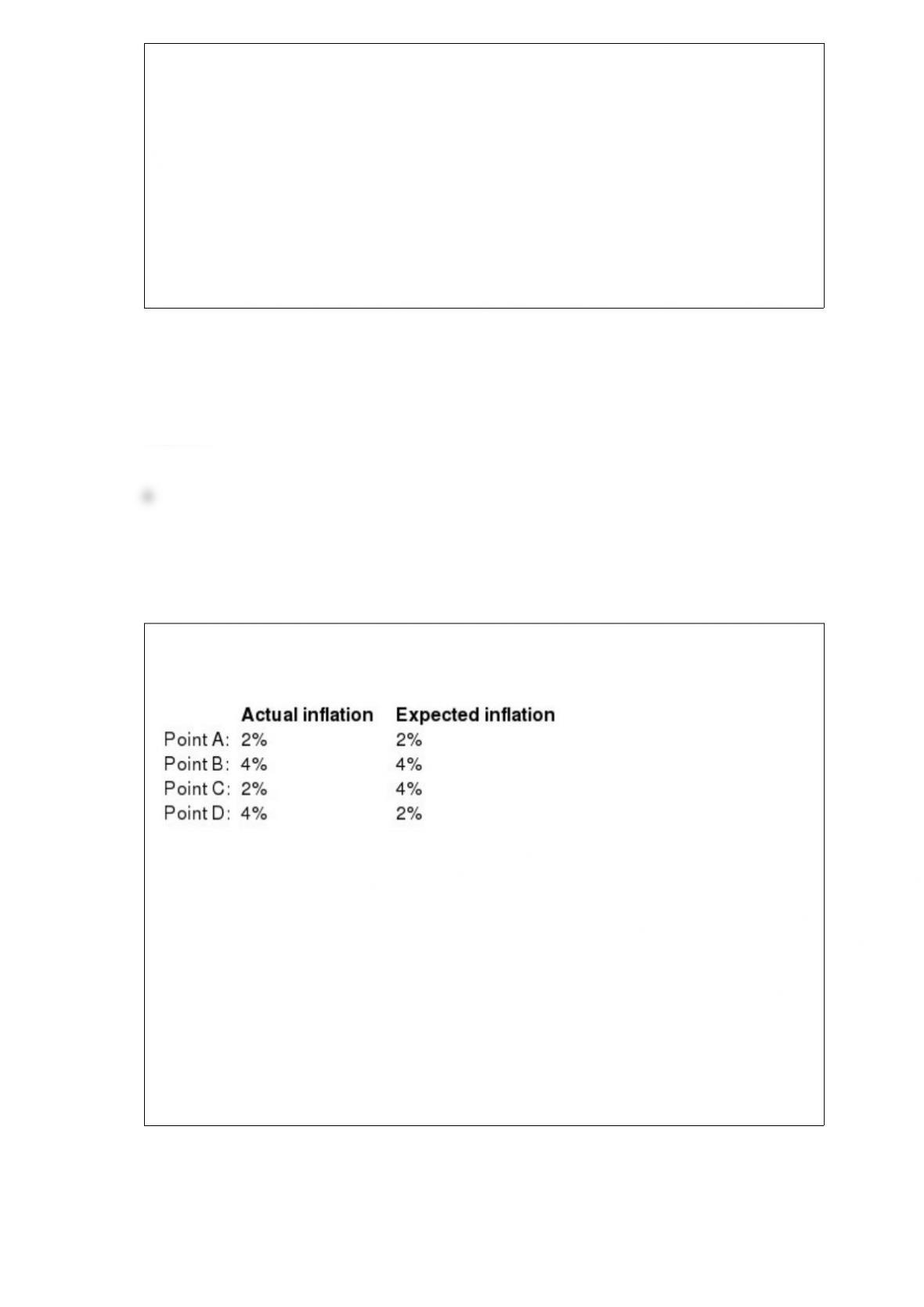
Answer the questions below on the basis of the following data.
a. Suppose the equation describing the Phillips curve is π = πe− 2(U− 5).
b. Based on the equation in part a, what is the numerical value of the natural rate of
unemployment?
Standard figure, similar to text figure. Draw it so that points D and B are at the same
actual inflation rate of 4 percent and points A and C are at the same actual inflation rate
of 2 percent. points A and D are on the same short-run Phillips curve, with an expected
inflation rate of 2 percent. points B and C are on the same short-run Phillips curve, with
an expected inflation rate of 4 percent.
Answer:

The lag that arises because it takes time for policymakers to choose a course of action is
referred to as the ______ lag.
a. implementation
b. recognition
c. effectiveness
d. decision
Answer:
The efficient market hypothesis assumes that
a. there are only a few buyers and sellers in a stock market and stocks are illiquid.
b. there are many buyers and sellers in a stock market and stocks are illiquid.
c. there are only a few buyers and sellers in a stock market and stocks are liquid.

d. there are many buyers and sellers in a stock market and stocks are liquid.
Answer:
In the United States, an investor who bought the average stock in 1929 and sold it in
1959 would have had a
a. negative or zero real capital gain on his stock.
b. 50 percent real capital gain on his stock.
c. 100 percent real capital gain on his stock.
d. 1000 percent real capital gain on his stock.
Answer:
A bank’s excess reserves equal its
a. vault cash plus deposits at the Federal Reserve.
b. total reserves minus required reserves.
c. reserve requirement times transactions deposits.
d. vault cash plus required reserves.

Answer:
The amount of debt and equity outstanding in the United States is more than____ times
the nation’s GDP.
a. 2
b. 3
c. 4
d. 5
Answer:
When savers invest through financial intermediaries, they are said to engage in
a. direct finance.
b. indirect finance.
c. a secondary market.
d. a tertiary market.
Answer:

Suppose that a change in the expected inflation rate leads supply and demand to adjust
so that the expected real interest rate is unchanged at 3.0 percent. The tax rate is 30
percent. Initially, the expected inflation rate is 3.0 percent. If the expected inflation rate
rises from 3 percent to 6 percent, the after-tax expected real interest rate
a. rises by 1.8 percent.
b. rises by 0.9 percent.
c. falls by 0.9 percent.
d. falls by 1.8 percent.
Answer:
Which of the following statements is true?
a. Dividend payments of firms are independent of how much profit the firm is making.
b. Stock prices of firms are independent of how much profit the firm is making.
c. A share of stock gives an investor complete ownership of the corporation that issued
the stock.
d. A share of stock gives an investor partial ownership of the corporation that issued the
stock.
Answer:

A credit crunch occurs when
a. banks do not lend as they ordinarily would, but rather have much higher requirements
for borrowers to qualify for loans than normal.
b. inflation rises, driving up interest rate near their legal ceiling, causing people to pull
their funds out of banks.
c. regulators pressure banks to increase loans to under-served groups in society.
d. government officials force banks to lend in areas where they wish to establish
branches.
Answer:
The growth rate of compensation per hour was slowest during the
a. long boom period.
b. economic liftoff period.
c. Great Depression.
d. reorganization period.
Answer: