
Firms typically invest in real assets such as plant and equipment because of the services
they provide.
The range of possible outcomes for a traditional investment in stock is from -100% to
+100%.
According to MM, in the absence of financial distress, the value of a firm increases
steadily with financial leverage if interest expense is tax-deductible.
Under the residual dividend theory, the firm first allots a portion of its earnings to the
payment of dividends and then uses the residual to fund capital budgeting projects.

Due to administrative costs, warehousing is an expensive source of financing.
The equivalent annual annuity method replaces each mutually exclusive project with its
own NPV, and then replaces that with an annuity having the same NPV. The project
with the lowest annuity payment is then preferred.
Leverage is the use of equity financing.
A firm’s financial plan represents a stage in a larger planning process.
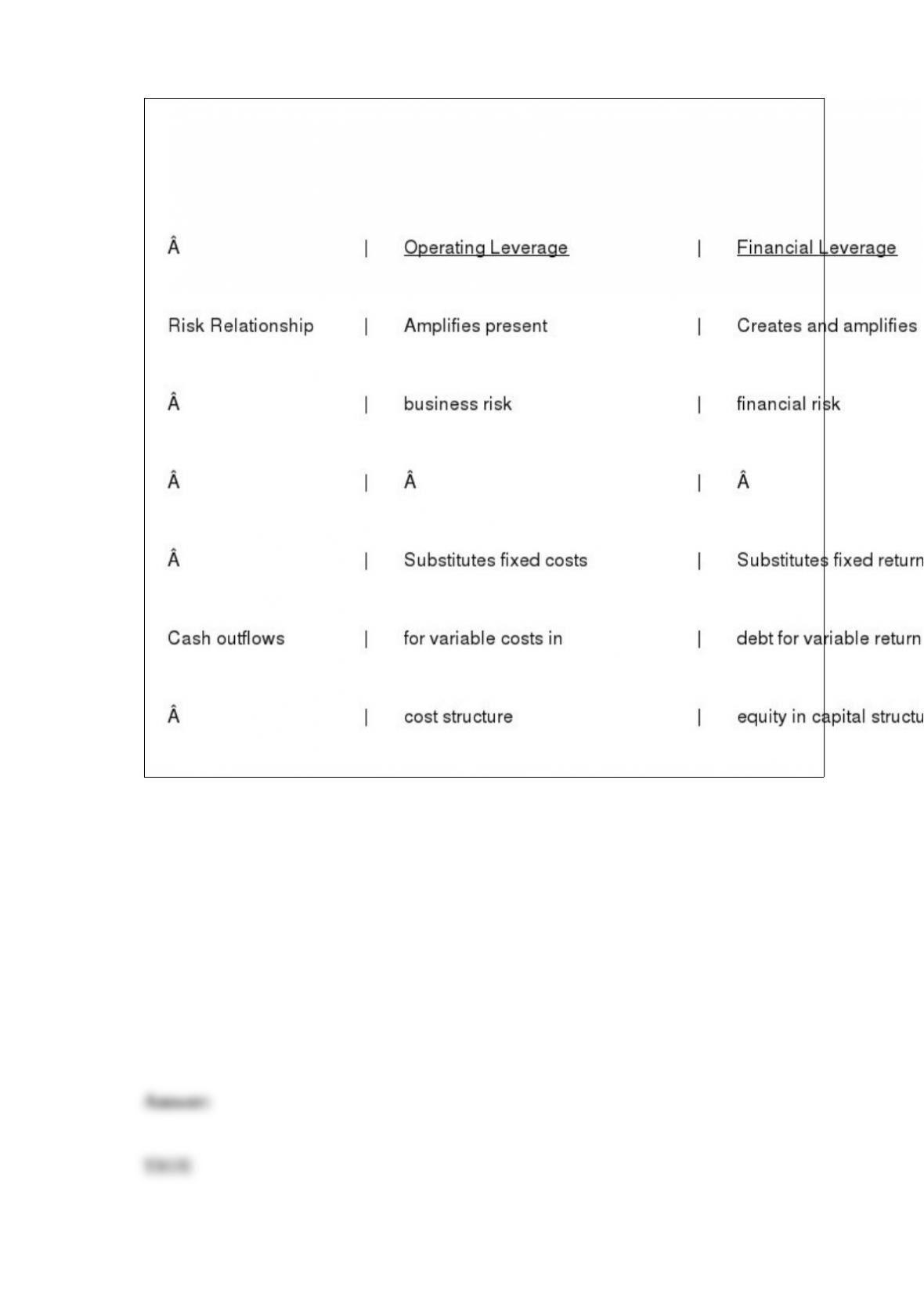
The following chart shows the similarities between operating leverage and financial
leverage:

Operating activitieshave to do with running the business on a day-to-day basis.
Last year’s dividend was $2.00 and is expected to grow indefinitely at 6%. The stock is
selling at $22. The dividend growth model estimates the cost of retained earnings at
15.6%.
Which of the following justifications for mergers is arguably for the benefit of
management rather than stockholders?
A.Synergies
B.External growth
C.Diversification to reduce risk
D.Economies of scale
E.Guaranteed sources and markets
Preferred stock is:
A.preferred over common stock with regard to its claim on assets if the firm fails.
B.preferred over common stock with regard to its claim on income for dividend
payment.
C.preferred over common stock with regard to voting rights.
D.a and b

The objectives of cash management include to:
A.earn a return.
B.hold cash to a minimum consistent with efficient operation.
C.ensure adequate liquidity.
D.Both b & c.
E.All of the above
Why might a portion of working capital be funded with long-term debt?
A.Because it is considered temporary working capital.
B.Because working capital encompasses some fixed assets which tend to be long-term
investments.
C.Because of beneficial tax breaks on the interest paid on long-term debt.
D.Because it is considered permanent working capital.
MACRS is:
A.a government program to assist small businesses in capital budgeting.
B.a system of accelerated depreciation that companies are free to use or not for
financial purposes.
C.a system of accelerated depreciation dictated by the government for tax purposes.

D.the Mandatory Accounting Credit and Reserve System.
If a share of preferred stock pays a quarterly dividend of $2.25, has a $60 par value and
investors require a return of 15%, the stock will sell for:
A.less than its par value.
B.its par value.
C.more than its par value.
D.whatever the market will bear.
The future value of an annuity:
A.is the end sum of all payments and all interest if each payment is deposited when
received.
B.is the beginning sum and future interest amortized over the life of the annuity.
C.allows for both the time interval and amounts to be different.
D.is the beginning sum and present value calculated into the future.
Certain expenditures associated with a project should not be included in capital
budgeting cash flows. Such expenditures, referred to as sunk costs, might include:
A.the cost of an existing resource that will no longer be available for other uses.
B.a costly market study previously undertaken to determine the viability of the project.

C.Both a and b
D.Neither a nor b
The theory that paying a dividend has very little to do with the price of a stock is
consistent with ____.
A.dividend preference theory
B.dividend aversion theory
C.dividend irrelevance theory
D.dividend controversy theory
What is the return on sales for TJX Inc. if the current ratio = 2; total asset turnover =
1.5; total assets = $100,000; and EBIT = $30,000? Assume the marginal tax rate for
TJX is 40% and that interest expenses are $10,000.
A.20%
B.8%
C.12%
D.6%