The value assigned to an asset such as inventory on the balance sheet determines the
amount eventually recognized as an expense on the income statement.
a.True
b.False
Match the terms with the descriptions related to merchandise sales and purchases.
a.Transportation-in
b.Perpetual inventory system
c.Net purchases
d.FOB Destination
e.Cost of goods available for sale
f.Periodic inventory system
g.FOB Shipping point
h.Delivery expense
Relies on a count of inventory on the last day of the year to determine amount on hand
Match the following bond and long-term liability related terms to the appropriate
definition.
a.Long-term liability
b.Face value
c.Debenture bonds
d.Serial bonds
e.Callable bonds
f.Face rate of interest
g.Market rate of interest
h.Bond issue price
i.Premium
j.Discount
k.Effective interest method of amortization
l.Carrying value
m.Gain or loss on redemption
The process of transferring a portion of premium or discount to interest expense. This
method transfers an amount resulting in a constant effective interest rate.
For each of the following items, indicate whether each would be treated as a
a.capital expenditure
b.revenue expenditure
Costs incurred after putting the asset into service which keep the asset in normal
operating condition.
For each of the following accounts, indicate whether it is a balance sheet account or an
income statement account.
a.Balance sheet account
b.Income statement account
Accounts Receivable
Select the correct revenue recognition principle for each of the following.
a.Recognize revenue over the passage of time.
b.Recognize revenue when the customer takes possession of the product.
c.Recognize revenue when cash is collected.
d.Recognize revenue when service is performed.
Interest
For the following items Questions 220-227, indicate whether each should be (a)
included or (b) excluded from the line item titled Cash and cash equivalents on the
balance sheet.
a.Included
b.Excluded
Certificate of deposit maturing in six months
Use the equation presented below to answer the question that follows:
Cash = CL + LTL + CS + RE – NCCA – LTA
where:
CL = Current liabilities LTL = Long-term liabilities CS = Common stock
RE = Retained earnings
NCCA = Noncash current assets LTA = Long-term assets
Which of the following activities results in a cash outflow?
a.Decreases in noncash current assets (NCCA)
b.Decreases in long-term assets (LTA)
c.Increases in long-term liabilities (LTL)
d.Decreases in retained earnings (RE)
Match the term with the statement that best defines it.
a.Accounting controls
b.Accounting system
c.Administrative controls
d.Audit committee
e.Board of directors
Controls that are focused more on efficient operation than with correct reporting of
information.
Which of the following statements about current liabilities is true?
a.The current ratio is defined as current assets divided by current liabilities.
b.The current liability section never contains any portion of long-term liabilities.
c.Current liabilities are listed in order of decreasing amounts in the current liability
section of the balance sheet.
d.The amount of current liabilities has little implication for a company’s liquidity.
A cancelled check would be a source document for which of the following?
a.Recording a purchase of inventory on credit
b.Recording cash received on an customer account
c.Recording accrued payroll
d.Recording a cash payment to a creditor
From the list of accounts below, determine whether the account would be a nominal
account or a real account.
a.nominal account
b.real account
Unearned Revenue
Match each of the following terms related to interest and time value of money
calculations to their appropriate definition.
a.Time value of money
b.Simple interest
c.Compound interest
d.Future value of a single amount
e.Present value of a single amount
f.Annuity
g.Future value of an annuity
h.Present value of an annuity
The present amount that is equivalent to an amount at a future time.
Current liabilities are defined as those liabilities which will be satisfied
a.within one year or within the operating cycle, whichever is shorter.
b.by the end of the operating cycle.
c.within one year.
d.within one year or within the operating cycle, whichever is longer.
All of the following statements are true except:
a.Under U.S. GAAP, a contingent item should be recorded as a liability if the loss or
outflow is probable and can be reasonably estimated.
b.IFRS requires a liability to be recorded as a present value amount.
c.The threshold for recording items as liabilities is a lower under U.S. GAAP than under
IFRS.
d.The threshold for recording items as liabilities is a lower under IFRS than under U.S.
GAAP.
Sales revenue is an inflow of assets.
a.True
b.False
Identify the classifications of the following accounts as either current or long-term
liabilities for the December 31, 2014 balance sheet.
a.Current liability
b.Long-term liability
An amount of money owed for years 2016 to 2020 to a creditor as annual installment
payments on a ten-year note, due June 30, 2020.
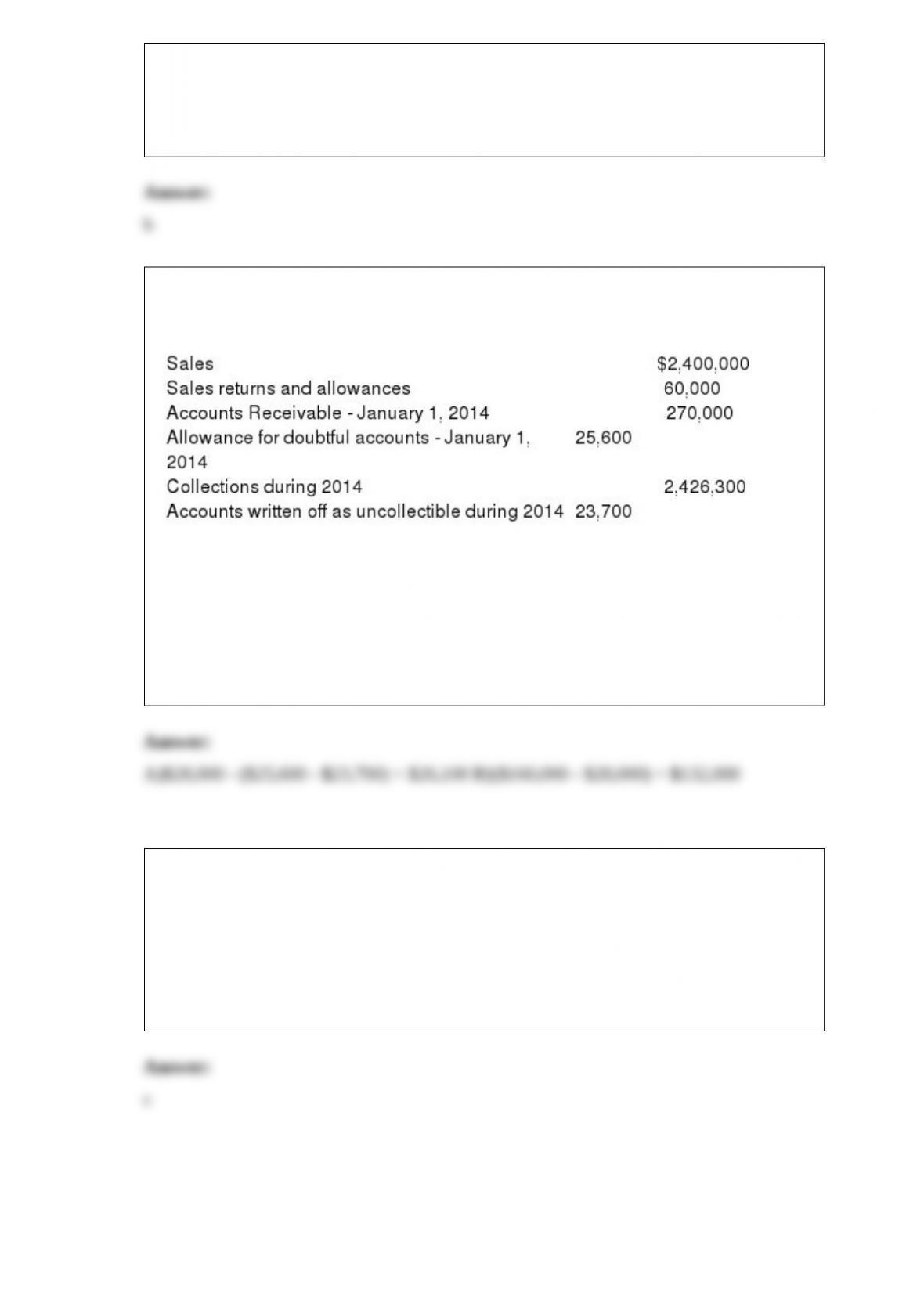
Beatrice Equipment sells merchandise only on credit. For the year ended December 31,
2014, the following data is available:
Refer to Beatrice Equipment.
Assume that Beatrice Equipment estimates bad debts on an aging analysis, and the
aging schedule indicates that
$28,000 of the December 31, 2014 accounts receivable will be uncollectible.
A)What amount will Beatrice Equipment recognize as bad debts expense for 2014?
B)How much is the net realizable value of the receivables to be reported on Beatrice
Equipment’s balance sheet at December 31, 2014?
Executive, Inc. has a weekly payroll of $10,000 for a 5-day workweek, Monday
through Friday. If December 31, the last day of the accounting year, falls on Thursday,
Executive would make an adjustment that would
a.decrease Wages Payable $2,000.
b.increase Wages Payable $2,000.
c.increase Wages Expense $8,000.
d.decrease Cash $8,000.