
1) The rate on commercial paper is generally higher than the prime rate.
A.True
B.False
2) Which of the following will not increase a present value?
A.Increase the interest rate
B.Decrease the number of periods
C.Increase the future value
D.None of these answers is correct
3) Future Value of Multiple Annuities Assume that you contribute $200 per month to a
retirement plan for 15 years. Then you are able to increase the contribution to $400 per
month for another 25 years. Given a 5 percent interest rate, what is the value of your
retirement plan after 40 years?
A.$424,305.97
B.$24,159.95
C.$28,475.66
D.$72,479.86
4) For most businesses, particularly smaller ones, the most common way to cover a
short-term financing need is to apply at a bank for which of the following?
A.commercial loan
B.line of credit
C.asset-based loan
D.inventory loan
5) Which of the following will impact the cost of equity component in the weighted

average cost of capital?
A.The risk-free rate
B.Beta
C.Expected return on the market
D.All of these
6) What is the amount of interest and repayment of principal balance in month 2 for a
loan of $10,000, paid monthly over 5 years at a 7% APR?
A.Interest = $101.32; Principal repayment = $57.51
B.Interest = $57.52; Principal repayment = $140.49
C.Interest = $157.52; Principal repayment = $40.49
D.Interest = $107.52; Principal repayment = $40.49
7) These investors earn returns from receiving dividends and from stock price
appreciation.
A.bondholders
B.stockholders
C.investment bankers
D.managers
8) Compounding with Different Interest Rates A deposit of $300 earns interest rates of 7
percent in the first year and 10 percent in the second year. What would be the second
year future value?
A.$351.00
B.$353.10
C.$602.17
D.$651.00

9) Which of the following statements is correct?
A.Performing cross-sectional ratio analysis refers to assessing how a firm performed
over a certain section of time
B.Performing cross-sectional analysis is easy since industries are usually clustered with
firms that are identical
C.Time-series analysis is useless in assessing improvement or deterioration of ratios
since the data is historical
D.To interpret financial ratios, users should analyze the performance of the firm over
time and the performance of the firm against one or more companies in the same
industry
10) Would it be worth it to incur a compensating balance of $10,000 in order to get a
1-percent-lower interest rate on a 1-year, pure discount loan of $500,000?
A.yes
B.no
C.not enough information is given to know
11) Dividend Growth Annual dividends of Pfizer, Inc. (PFE) grew from $0.38 in 2000
to $1.15 in 2007 . What was the annual growth rate?
A.2.02%
B.17.14%
C.28.95%
D.202.63%
12) Your firm needs a computerized machine tool lathe which costs $50,000, requires
$10,000 in installation, $5,000 in freight charges and another $12,000 in maintenance
for each year of its 3-year life. After 3 years, this machine will be replaced. The
machine falls into the MACRS 3-year class life category. Assume a tax rate of 30% and
a discount rate of 12%. Calculate the depreciation tax shield for this project in year 1 .
A.$6,499.35
B.$6,886.00
C.$5,999.40
D.$5,554.40
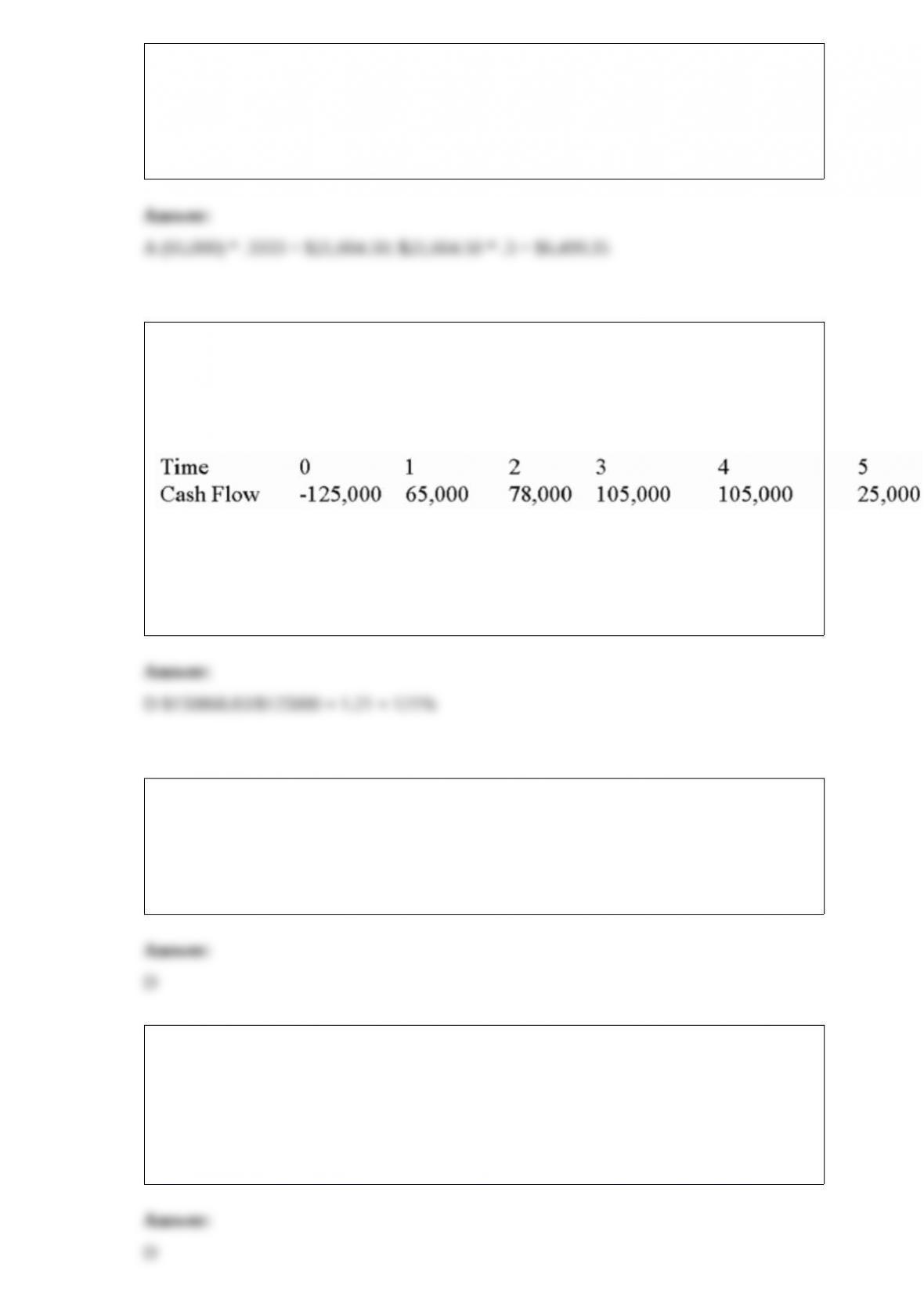
13) Suppose your firm is considering investing in a project with the cash flows shown
below, that the required rate of return on projects of this risk class is 12 percent, and
that the maximum allowable payback and discounted payback statistic for the project
are 2 and 2.5 years, respectively.
Use the PI decision rule to evaluate this project; should it be accepted or rejected?
A.-1.21%, reject
B.1.08%, accept
C.1.21%, accept
D.121%, accept
14) This is the dollar return characterized as a percentage of money invested.
A.average return
B.dollar return
C.market return
D.percentage return
15) Which of the following is NOT an example of how a company could hedge to
reduce currency risk?
A.buying futures contracts
B.buying options
C.currency swaps
D.fixed peg arrangements

16) If demand for a firm’s products suddenly increases so that inventory decreases while
sales increase, how will the firm’s needs for net working capital react?
A.Net working capital would increase
B.Net working capital would decrease
C.There would be no change in net working capital
D.Net working capital would first decrease, then increase slowly over time
17) Law of One Price If the price of copper in Europe is 2.22 per ounce, what is the
expected price of copper in the United States if the spot exchange rate is $1 = 0.7802?
A.$3.0002 per ounce
B.$3.514 per ounce
C.$1.7320 per ounce
D.$2.8454 per ounce
18) Which of these statements is true?
A.When people purchase a stock, they know exactly what their dollar and percent
return are going to be
B.Many people purchase stocks as they find comfort in the certainty for this safe form
of investing
C.When people purchase a stock, they know the short-term return, but not the long term
return
D.When people purchase a stock, they do not know what their return is going to be –
either short term or in the long run
19) A linear probability model you have developed finds there are two factors
influencing the past bankruptcy behavior of firms: the debt-to-equity ratio and the
sales-to-total assets ratio. Based on past bankruptcy experience, the linear probability
model is estimated as:
PDi = .52 (debt/equity) + .01 (sales/total assets)
A firm you are thinking of lending to has a sales-to-assets ratio of 2.0 and its expected
probability of default, or bankruptcy, is estimated to be 12 percent. Calculate the firm’s
debt ratio.
A.14.03%
B.14.92%
C.15.49%
D.15.97%

20) All capital budgeting techniques
A.render the same investment decision
B.use the same measurement units
C.include all crucial information
D.exclude some crucial information
21) A firm has retained earnings of $11 million, a common shares account of $2 million,
and additional paid-in-capital of $6 million, and the firm just paid a 15 percent stock
dividend. Assume that fair market value is reflected in the relative size of both the
common shares account and the additional paid-in-capital account. Which of the
following statements is correct?
A.Retained earnings will decrease by $1,200,000
B.Common shares will increase by $300,000
C.Additional paid-in-capital will increase by $900,000
D.All of these statements are correct
22) The main motive for a merger is _________________.
A.Product extension
B.Manager’s personal incentives
C.Synergies
D.None of these
23) Consider an asset that provides the same return no matter what economic state
occurs. What would be the standard deviation of this asset?

A.Unable to answer since there is no data to calculate the standard deviation
B.A very low number since it would have very low risk
C.1
D.0
24) To interpret financial ratios, managers, analysts, and investors use the follow type of
benchmarks:
A.competitive analysis
B.cross-industry analysis
C.time-industry analysis
D.time series analysis
25) Brady inherited 500 shares of LNM, Inc. The stock is selling in the market for $92
per share and the company is contemplating a 5-for-3 stock split. Given this
information, which of the following statements is correct?
A.Brady will have 300 shares and stock’s price will be near $153.33
B.Brady will have 300 shares and stock’s price will be near $55.20
C.Brady will have 833.33 shares and stock’s price will be near $55.20
D.Brady will have 833.33 shares and stock’s price will be near $153.33
26) You just bought a new home and have a 30-year mortgage with monthly payments.
Which statement regarding your mortgage is correct?
A.Your monthly payments will decrease over time
B.The dollar amount of interest expense you pay each year will remain the same each
year
C.The dollar amount of principal paid increases each month
D.All of these statements are correct
27) From 1950 to 2007, the average return in the stock market, as measured by the
S&P500, was 13.2% and a standard deviation of 17%. Given this information, which of
the following statements is correct?

A.With an average return this high, it is unlikely that an investor will lose money in the
stock market in the next year or two
B.With a standard deviation this high, it is likely that an investor will lose money in
some years over a 25-year investment period
C.This investment is not very good since the standard deviation is greater than the
average return
D.All of these statements are correct
28) Everything held constant, would you rather depreciate a project with straight-line
depreciation or with DDB?
29) What would prompt a firm like GE to start paying out a much higher percentage of
its earnings as dividends?
30) Which liabilities would tend to spontaneously increase with sales? Why?
31) What type of clientele would you expect to prefer dividends over capital gains?
Why?

32) Denote the impact that flotation costs have on capital budgeting decisions.