In 2007 the NYSE merged with _________________.
A.Nasdaq
B.Euronext
C.American Exchange
D.Chicago Mercantile Exchange
E.London Stock Exchange
The NASDAQ Composite Index provides a measure of the stock prices in the
over-the-counter market.
a.True
b.False
If the Fed is targeting interest rates and money demand increases, an appropriate policy
response would be to
A.increase reserve requirements.
B.increase the discount rate.
C.buy U.S. Treasury securities from government bond dealers.
D.increase government spending.
E.none of the options

The Fed funds rate is the rate that
A.banks charge for loans to corporate customers.
B.banks charge to lend foreign exchange to customers.
C.the Federal Reserve charges on emergency loans to commercial banks.
D.banks charge each other on loans of excess reserves.
E.banks charge securities dealers to finance their inventory.
Figure 9-1
Janice and Ronald have decided to finance their first home with First American Bank.
They are buying their home for $210,000 and making a 20 percent down payment. They
will also be paying $3,000 in closing costs. First American has offered them the
following mortgage alternatives:
Interest Rate
Loan Term# of
PointsMonthly
Payment
Caps
15.5 percent fixed30 years1 $953—–
25 percent fixed30 years2 $902—–
33.5 percent fixed15 years1 $1,201—–
44.75 percent ARM30 years2 $8761 percent/year,
5 percent total
54.75 percent ARM30 years2 $8760 first two years/2 percent per year
thereafter
Refer to Figure 9-1. How much would Janice and Ronald have to pay in points if they
chose loan 2?
a.$4,200
b.$3,360
c.$2,100
d.$1,680
A bank has interest income to total assets ratio of 5.45 percent and has noninterest
income of $45 million and total assets of $700 million. What is the bank’s asset
utilization ratio?
A.5.45 percent
B.6.43 percent
C.9.67 percent
D.15.02 percent
E.11.88 percent

Refer to Figure 14-1. What is the dividend payout ratio for Rosa’s?
Figure 14-1
Rosa’s is a small chain of Mexican food restaurants that features five delicious varieties
of salsa. The business has grown over the past ten years from a hobby to a small
corporation with 200,000 shares of common stock outstanding. The corporation has not
issued any preferred stock. The following is Rosa’s latest financial data:
NARREND
a.0.08
b.0.13
c.0.27
d.0.43
A firm is using cumulative voting and four director spots are up for election. There are
3.6 million shares outstanding. How many shares must a minority owner own or control
to ensure that he or she can gain control of one seat on the board of directors?
A.900,001
B.880,001
C.720,001
D.1,800,001
E.1,750,001
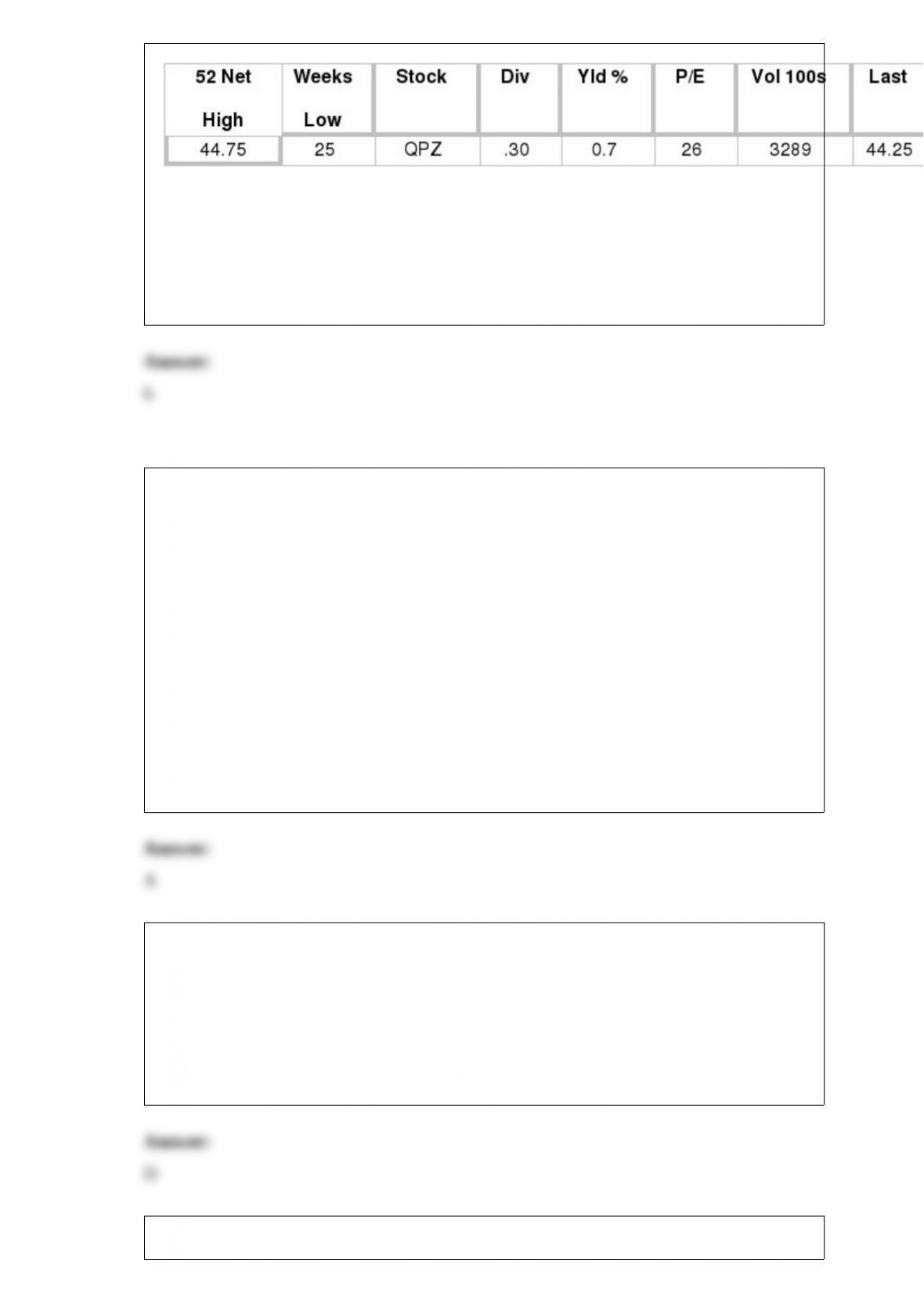
Refer to Figure 14-3. What was QPZ’s closing price on December 12?
Figure 14-3
Use the following stock listing for transactions on December 12 to answer the
questions:
[ED: the red colored cells must be merged and the word €net€ deleted]
NARREND
$25.00 per share
a.$44.75 per share
b.$44.25 per share
c.$43.38 per share
d.$25.00 per share
A bank has made a risky loan to a midsize consumer goods manufacturer. With the
weaker economy, the borrower is expected to have trouble repaying the loan. The bank
decides to purchase a digital default option. Which one of the following payout patterns
does a digital option provide?
A.The option seller pays a stated amount to the option buyer, usually the par on the loan
or bond, in the event of a default on the underlying credit.
B.The option seller pays the buyer if the default risk premium or yield spread on a
specified benchmark bond of the borrower increases above some exercise spread.
C.If the option buyer makes fixed periodic payments to the option seller, the seller will
pay the option buyer if a credit event occurs.
D.If the option buyer makes periodic payments to the seller and delivers the underlying
bond or loan, the seller pays the par value of the security.
E.If interest rates change, the option seller will begin making fixed-rate payments to the
option buyer.
The relationship between maturity and yield to maturity is called the
__________________.
A.Fisher effect
B.DRP structure
C.bond indenture
D.term structure
E.loan covenant
The monetary asset management service provided by a mutual fund is a

a.money market mutual fund accounts.
b.money market mutual fund accounts.
c.savings accounts.
d.All of these.
Financial literacy is your knowledge of facts, concepts, principles, and technological
tools that are fundamental to be smart about money.
a.True
b.False
A _____ is powerfully positioned champion who advocates on a job protégé’s behalf
and guides the protégé toward key players and assignments.
a.sponsor
b.mentor
c.internee
d.career coach
A borrower took out a 30-year fixed-rate mortgage of $2,250,000 at a 7.2 percent
annual rate. After five years, he wishes to pay off the remaining balance. Interest rates
have by then fallen to 7 percent. How much must he pay to retire the mortgage (to the
nearest dollar)?
A.$2,122,426
B.$2,225,330
C.$2,015,678
D.$2,212,041
E.$1,999,998
Reasons behind the drop in bank profitability in the second half of the previous decade

include
I. flattening of the yield curve.
II. increase in competitive pressures on asset pricing.
III. increases in foreclosures in the mortgage market.
IV. increases in net interest margin.
A.I only
B.II and III only
C.I, II, and III only
D.II, III, and IV only
E.III and IV only