
Basel III capital ratios will become fully effective in 2016.
Answer:
Market value at risk (VAR) is defined as the daily earnings at risk (DEAR) times the
number of days (N).
Answer:
Equipment leasing to customers is a function of business credit institution.
Answer:
One reason for the increasing proportion of total financial assets controlled by pension
funds and investment companies is that these intermediaries exploit the comparative
advantages of size and diversification.

Answer:
The payoffs on bond call options move symmetrically with changes in interest rates.
Answer:
Banks that are more exposed to rising interest rates than falling interest rates may seek
to finance a cap by selling a floor.
Answer:
Retail passbook savings accounts should be considered as part of rate sensitive
liabilities because the rates on these accounts rarely change.

Answer:
If the FI had contingent assets of $40 million and contingent liabilities of $160 million,
calculate the stockholder’s TRUE net worth (ignore the option mentioned in previous
question).A. -$60 million.
B. $60 million.
C. $70 million.
D. -$160 million.
E. $190 million.
Answer:
U.S. life insurance companies generally hold less than ten percent (10%) of their
portfolios in foreign securities.
Answer:

Unlike the banking industry, globalization of financial services is having little or no
effect on the insurance industry.
Answer:
A digital default option pays a stated amount in the event that a portion of the loan is
not paid.
Answer:
Floating-rate loan assignments typically occur on the loan repricing date as an effort to
minimize confusion regarding the calculation and transfer of accrued interest.
Answer:

If the credit risk of a foreign borrower is good, then the sovereign country risk is
irrelevant.
Answer:
In most countries, cash is required to be held in reserve against deposits.
Answer:
In the BIS framework, horizontal offsets within time zones are used to adjust residual
positions between zones.
Answer:

As compared to Basel I, the standardized approach of Basel III is designed to produce
capital ratios that are more in line with the actual economic risks that the DIs are
facing.
Answer:
The maturity structure of the assets of commercial banks tends to be shorter than the
maturity structure of liabilities.
Answer:
Which of the following is TRUE of commercial paper?A. It is a secured long-term debt
instrument issued by corporations.
B. It is always issued via an underwriter.
C. It may help a corporation to raise funds often at rates below those banks charge.
D. All corporations can tap the commercial paper market.
E. Total commercial paper outstanding in the US is smaller than total C&I loans.
Answer:

When a bank’s repricing gap is positive, net interest income is positively related to
changes in interest rates.
Answer:
The capital requirements for broker-dealers include a net worth market value to assets
ratio of at least 2 percent.
Answer:
Information transfer refers to the conflict of interest that occurs when banks have the
power to sell nonbank products.
Answer:

A finance company that lends money to high risk customers is known as a subprime
lender.
Answer:
In the U.S., commercial banks are the only issuers of standby letters of credit.
Answer:
Control of the future supply of funds available to a foreign country is one method to
ensure the repayment of an existing debt.
Answer:

Immunizing net worth from interest rate risk using duration matching requires that the
duration match must be realigned periodically as the maturity horizon approaches.
Answer:
A conversion factor often is used to determine the invoice price on a futures contract
when a bond other than the benchmark bond is delivered to the buyer.
Answer:
As currently structured, contributions to a state-sponsored guarantee fund are collected
only after the actual failure of an insurance company.
Answer:
Which of the following is TRUE of the prime lending rate?A. It is most commonly
used in pricing longer-term loans.

B. It is the lending rate charged to the FI’s lowest-risk customers.
C. It is also known as LIBOR.
D. It is the rate for interbank dollar loans of a given maturity in the Eurodollar market.
E. The best and largest borrowers commonly pay above this lending rate.
Answer:
Secondary securities are securities that serve as collateral for primary securities.
Answer:
Account reconciliation redirects funds from accounts in a large number of different
banks to a few centralized accounts at one bank.
Answer:

Since its inception, the FDIC deposit insurance fund has never fallen to a negative
balance.
Answer:
Duration is equal to maturity when at least some of the cash flows are received upon
maturity of the asset.
Answer:
The back simulation approach to estimating market risk exposure requires normally
distributed asset returns, but does not require correlations of asset returns.
Answer:

Holdings of U.S. Treasury securities are classified on a DI’s balance sheet as A. assets,
because U.S. Treasury securities are default risk-free.
B. liabilities, because the DI must pay cash in order to acquire the securities.
C. assets, because securities holdings represent a use of funds for investment.
D. liabilities, because the Treasury securities must be pledged as collateral against
discount window borrowing.
E. assets, because the market for U.S. Treasury securities is the most liquid in the
world.
Answer:
The largest liability category on the balance sheet of U.S. life insurance companies as of
2012 was A. net policy reserves.
B. policy claims.
C. premium and deposit funds.
D. commission, taxes and expenses.
E. capital surplus.
Answer:

What is the effect on the value of the FI’s equity if interest rates decrease by 1 percent?
A. Gain of $0.697 million.
B. Gain of $0.338 million.
C. Loss of $1.622 million.
D. No change in equity.
E. Loss of $0.605 million.
Answer:
How do you think the Department of Justice (DOJ) would characterize this market
before the merger and which merger is more likely to be approved?A. This is a
competitive market and either merger will be acceptable to the DOJ.
B. This is a concentrated market and neither merger will be acceptable to the DOJ.
C. This is a concentrated market, but the merger between Banks 1 and 3 is more likely
to be acceptable to the DOJ.
D. This is a competitive market, but the merger between Banks 1 and 2 is more likely
to be acceptable to the DOJ.
E. This is a moderately concentrated market, but the merger between Banks 1 and 3 is
more likely to be acceptable to the DOJ.

Answer:
Calculate the annual cash flows of a $500,000, 12-year fixed-payment annuity earning a
guaranteed 6 percent per year if annual payments are to begin at the end of the current
year. A. $59,638.51.
B. $56,262.75.
C. $29,819.26.
D. $83,841.52.
E. $28,131.37.
Answer:
An FI purchases a $9.982 million pool of commercial loans at par. The loans have an
interest rate of 8 percent, a maturity of five years, and annual payments of principal and
interest that will exactly amortize the loan at maturity. What is the duration of this
asset? A. 4.12 years.
B. 3.07 years.
C. 2.50 years.

D. 2.85 years.
E. 5.00 years.
Answer:
As DIs made a shift from an “originate-to-hold” banking model to an
“originate-to-distribute” model over the last decade,A. banks became more financially
stable.
B. it became easier to measure the riskiness of individual loans.
C. there was a dramatic increase in systematic risk of the financial system.
D. the Federal Reserve decreased the number of services that banks could provide.
E. it became more difficult for households to obtain credit.
Answer:

KKR issues a $10 million 18-month floating rate note priced at LIBOR plus 400 basis
points. What is KKR’s interest rate risk exposure and how can it be hedged? A. KKR is
exposed to interest rate increases; short hedge by buying put options.
B. KKR is exposed to interest rate increases; long hedge by buying call options.
C. KKR is exposed to interest rate decreases; long hedge by buying call options.
D. KKR is exposed to interest rate decreases; short hedge by buying put options.
E. KKR is exposed to interest rate increases; short hedge by buying call options.
Answer:
The larger the size of an FI, the larger the _________ from any given interest rate
shock. A. duration mismatch
B. immunization effect
C. net worth exposure
D. net interest income
E. risk of bankruptcy
Answer:

An insurance policy that often is the least expensive to the insured because of the policy
does not include a savings plan is calledA. term life.
B. universal life.
C. whole life.
D. endowment life.
E. variable life.
Answer:
What kind of interest rate swap (of liabilities) would an FI with a positive funding gap
utilize to hedge interest rate risk exposure? A. Swap floating-rate payments for
fixed-rate payments.
B. Swap floating-rate receipts for fixed-rate payments.
C. Swap fixed-rate receipts for floating-rate receipts.
D. Swap floating-rate receipts for fixed-rate receipts.
E. Swap floating-rate payments for fixed-rate receipts.
Answer:

The following information is about current spot rates for Second Duration Savings’
assets (loans) and liabilities (CDs). All interest rates are fixed and paid annually.
If the FI finances
a $500,000 2-year loan with a $400,000 1-year CD and equity, what is the leveraged
adjusted duration gap of this position? Use your answer to the previous question. A.
+1.25 years
B. +1.12 years
C. -1.12 years
D. +0.92 years
E. -1.25 years
Answer:
The balance sheet of XYZ Bank appears below. All figures in millions of US Dollars.
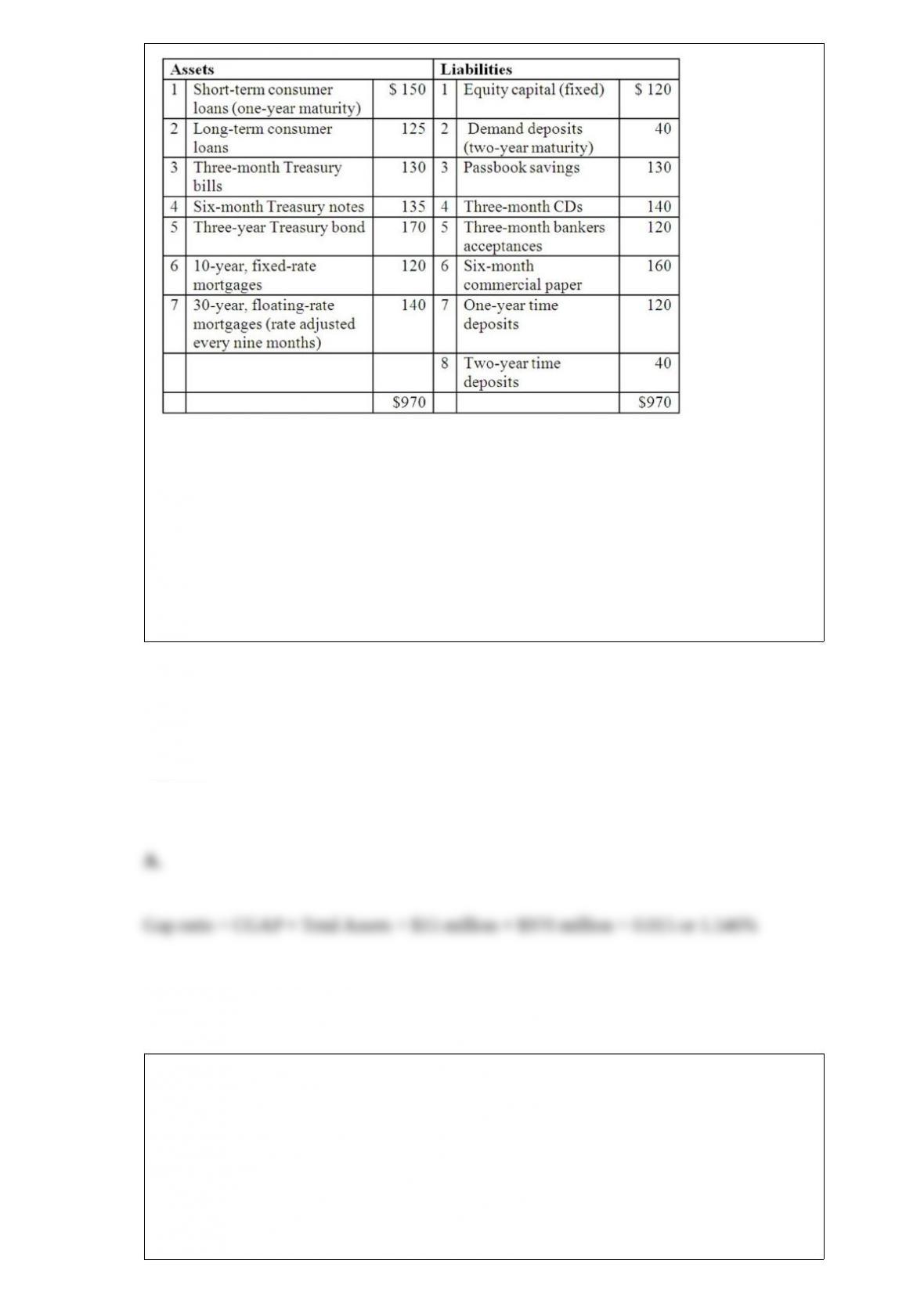
The gap ratio is
A. .015.
B. -.015.
C. .025.
D. -.144.
E. .154.
Answer:
The weighted return on the bank’s portfolio of investments would be A. 15%.
B. 12%.
C. 16%.
D. 13%.

E. 7%.
Answer:
A mutual fund has the following share characteristics: Shares are offered at the NAV
with no front-end load, a 12b-1 fee of 1 percent is charged, a back-end load of 1 percent
is charged only if the shares are sold by the investor within one year of purchase, and
the shares do not convert to any other class of shares. These shares would be classified
as A. Class A shares.
B. Class B shares.
C. Class C shares.
D. Class D shares.
E. either Class A or Class C shares.
Answer:

FX risk exposure of an FI essentially relates to which of the following activities? A.
Purchase and sale of foreign currencies to allow customers to participate in and
complete international commercial trade transactions.
B. Purchase and sale of foreign currencies to allow customers to take positions in
foreign real and financial investments.
C. Purchase and sale of foreign currencies for hedging purposes to offset customer
exposure in any given currency.
D. Purchase and sale of foreign currencies for speculative purposes through forecasting
or anticipating future movements in FX rates.
E. None of the above.
Answer:
How can the regulators reduce the effects of moral hazard in the absence of depositor
discipline?A. By allowing DIs to undertake high-risk high-return asset investments.
B. By basing deposit insurance premiums on a DI’s deposit size.
C. By charging explicit deposit insurance premiums and implicit premiums on DIs.
D. By exhibiting excessive capital forbearance.
E. By implementing prompt corrective action capital zones based on rules rather than
discretion.
Answer:

Futures contracts are standard in terms of all of the following EXCEPT A. contract
size.
B. delivery month.
C. specific asset to be delivered.
D. trading hours.
E. daily price limits.
Answer:
Suppose that the current spot exchange rate of U.S. dollars for Russian rubles is
$0.15/1ruble. The price of Russian-produced goods increases by 8 percent, and the U.S.
price index increases by 3 percent.
According to PPP, the 8 percent rise in the price of Russian goods relative to the 3
percent rise in the price of U.S. goods results in a(n) A. depreciation of the Russian
ruble by 5 percent.
B. depreciation of the Russian ruble by 6 percent.
C. appreciation of the Russian ruble by 5 percent.
D. appreciation of the Russian ruble by 6 percent.
E. depreciation of the Russian ruble by 7 percent.

Answer:
In the Moody’s Analytics portfolio model, the risk of a loan measures A. the product of
the estimated loss given default and risk-free rate on a security of equivalent maturity.
B. annual all-in-spread minus the loss given default.
C. annual all-in-spread minus the expected default frequency.
D. the product of the expected default frequency and the estimated loss given default.
E. the volatility of the loan’s default rate around its expected value times the amount
lost given default.
Answer:
An FI concerned that the risk on a loan will increase can A. purchase a credit spread
call option
B. sell a credit spread call option

C. sell a credit spread put option.
D. purchase a naked option.
E. sell a naked option.
Answer:
Which model involves estimating the systematic loan loss risk of a particular sector or
industry relative to the loan loss risk of an FI’s total loan portfolio? A. CreditMetrics.
B. Credit Risk +.
C. Loan loss ratio-based model.
D. KMV portfolio manager model.
E. Loan volume-based model.
Answer:
Bank of the Atlantic has liabilities of $4 million with an average maturity of two years
paying interest rates of 4.0 percent annually. It has assets of $5 million with an average
maturity of 5 years earning interest rates of 6.0 percent annually.

What is the bank’s net interest income in dollars in year 3, after it refinances all of its
liabilities at a rate of 6.0 percent? A. -$60,000.
B. -$140,000.
C. +$140,000.
D. +$60,000.
E. +$800,000.
Answer:
A type of FI that predominantly buys HLT loans because these loans require the kinds
of investment analysis skills used in other parts of the FI’s business is A. a bank loan
mutual fund.
B. a domestic bank.
C. a foreign bank.
D. an investment bank.
E. a vulture fund.
Answer:

Yen Bank wishes to invest in Yen loans at a rate of 10 percent. The bank will fund the
loans in the domestic CD market at a rate of 6.3 percent. This on-balance-sheet FX risk
will be hedged in the spot market at a forward rate of $0.62/×. The spot rate on yen is
$0.60/×.
What must be the forward exchange rate to eliminate the preference for the yen loans?
A. $0.6416/×.
B. $0.5798/×.
C. $0.6118/×.
D. $0.5991/×.
E. Insufficient information.
Answer:
The following information is for a collateralized mortgage obligation (CMO). Tranche
A has a face value of $50 million and pays 6 percent annually. Tranche B has a face

value of $50 million and pays 8 percent annually. All mortgages have maturities of 30
years.
What are the annual payments promised to Tranche A and Tranche B, respectively,
assuming no prepayments and non-amortization? A. $3,632,446; $4,000,000.
B. $4,000,000; $3,000,000.
C. $3,000,000; $4,000,000.
D. $3,632,446; $4,441,372.
E. $4,441,372; $3,632,446.
Answer:
What is a possible reason behind restricted supply of spot loans to borrowers during a
credit crunch? A. Expansionary monetary policy actions of the Federal Reserve.
B. FI’s increased aversion toward lending.
C. Shift to the right in the loan supply function at all interest rates.
D. Low aggregate demand from borrowers to take down loan commitments.
E. Decrease in cost of funds.
Answer:

If the fee income on this loan is 0.4 percent and the spread over the cost of funds to the
bank is 1 percent, what is the expected income on this loan for the current year? A.
$40,000.
B. $100,000.
C. $140,000.
D. $180,000.
E. $280,000.
Answer:
Regulators usually view tradable assets as those held for horizons of A. less than one
year.
B. greater than one year.
C. less than a quarter.
D. less than a week.

E. less than three years.
Answer:
The surrender value of an insurance policy is A. the expected payment commitment on
existing policy contracts.
B. a fund established and held separately from the company’s other assets.
C. the cash value paid to the policyholder if the policy is terminated before it matures.
D. the same as the endowment payout.
E. the price at which the company may repurchase the policy.
Answer: