
Which of the following are sources of a bond’s total return?
a. Coupon interest
b. Reinvestment income
c. Capital gains or losses realize at maturity
d. All of the above are sources of a bond’s total return
e. a. and c. only
Answer:
Municipal bonds whose primary source of repayment are the revenues from the
underlying financed project are known as:
a. general obligation bonds.
b. credit free bonds.
c. revenue bonds.
d. exempt bonds.
e. liquidity bonds.
Answer:

Earnings-at-risk:
a. considers only interest rate ‘shocks.”
b. is only an effective measure for 90 day intervals or less.
c. examines the change in asset composition, given a change in bank liabilities.
d. examines the variation in net interest income associated with various changes in
interest rates.
e. None of the above.
Answer:
What is the return on equity for a bank that has an equity multiplier of 12, an interest
expense ratio of 5%, and a return on assets of 1.1%?
a. 5.0%
b. 13.2%
c. 8.2%
d. 26.4%
e. 0.66%
Answer:

Interest on bonds issued by the ____________ are not exempt from state and local
taxes.
a. Farm Credit System
b. Federal Home Loan Banks
c. Government National Mortgage Association (Ginnie Mae)
d. United States Postal Service
e. Student Loan Marketing Association (Sallie Mae)
Answer:
BMW Bank is chartered by the:
a. state of Utah.
b. FDIC.
c. Federal Reserve.
d. Office of the Comptroller of the Currency.
e. National Credit Union Administration.
Answer:

The _________ gave regulatory responsibility over financial holding companies to the
Federal Reserve..
a. Riegle-Neal Interstate Banking and Branching Efficiency Act
b. Gramm-Leach-Bliley Act
c. Financial Institutions Reform, Recovery and Enforcement Act
d. Federal Deposit Insurance Corporation Improvement Act
e. Depository Institutions Deregulation and Monetary Control Act
Answer:
An interest rate collar consists of:
a. buying an interest rate cap and selling an interest rate floor.
b. buying an interest rate floor and selling an interest rate cap.
c. selling an interest rate floor and buying an interest rate cap.
d. buying a call option and selling a futures contract.
e. selling a put option and buying a futures contract.
Answer:

A firm’s mix of debt and equity is measured by:
a. liquidity ratios.
b. market value ratios.
c. profitability ratios.
d. activity ratios.
e. leverage ratios.
Answer:
A bank’s net balance sheet exposure to changes in the value of Euros is measured as:
a. the amount of assets denominated in U.S. dollars minus the amount of liabilities
denominated in Euros.
b. the amount of assets denominated in Euros minus the amount of liabilities
denominated in U.S. dollars.
c. the amount of liabilities denominated in Euros minus the amount of liabilities
denominated in U.S. dollars.
d. the amount of assets denominated in Euros minus the amount of assets denominated
in U.S. dollars.
e. the amount of assets denominated in Euros minus the amount of liabilities
denominated in Euros.
Answer:

Which of the following would a bank generally classify as a long-term investment?
a. Treasury bill
b. Vault cash
c. Cash items in process of collection
d. Municipal bond
e. Repurchase agreements
Answer:
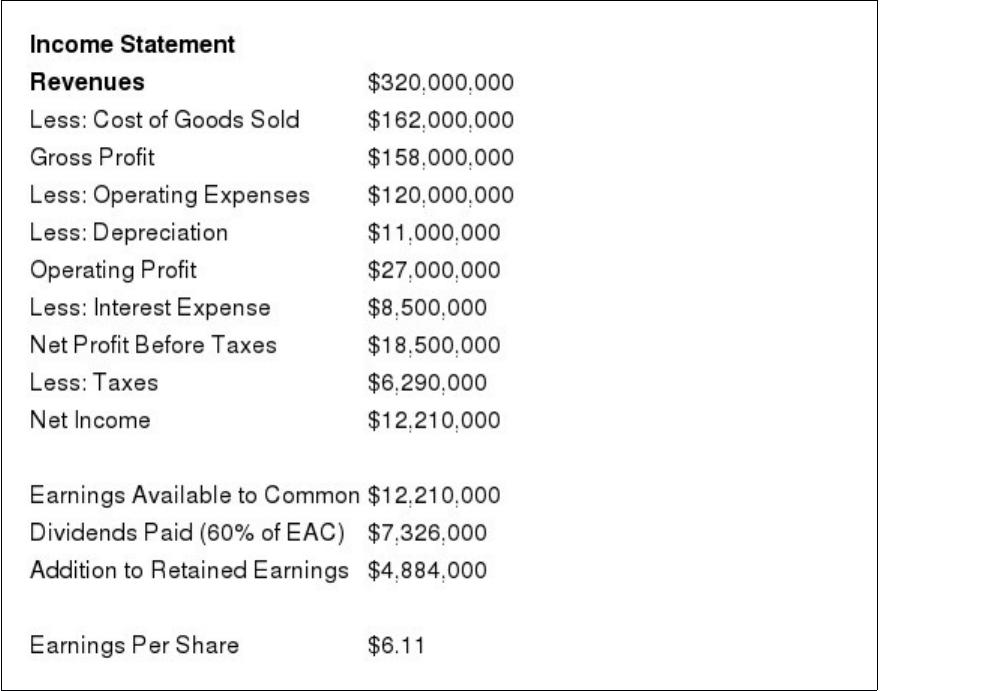
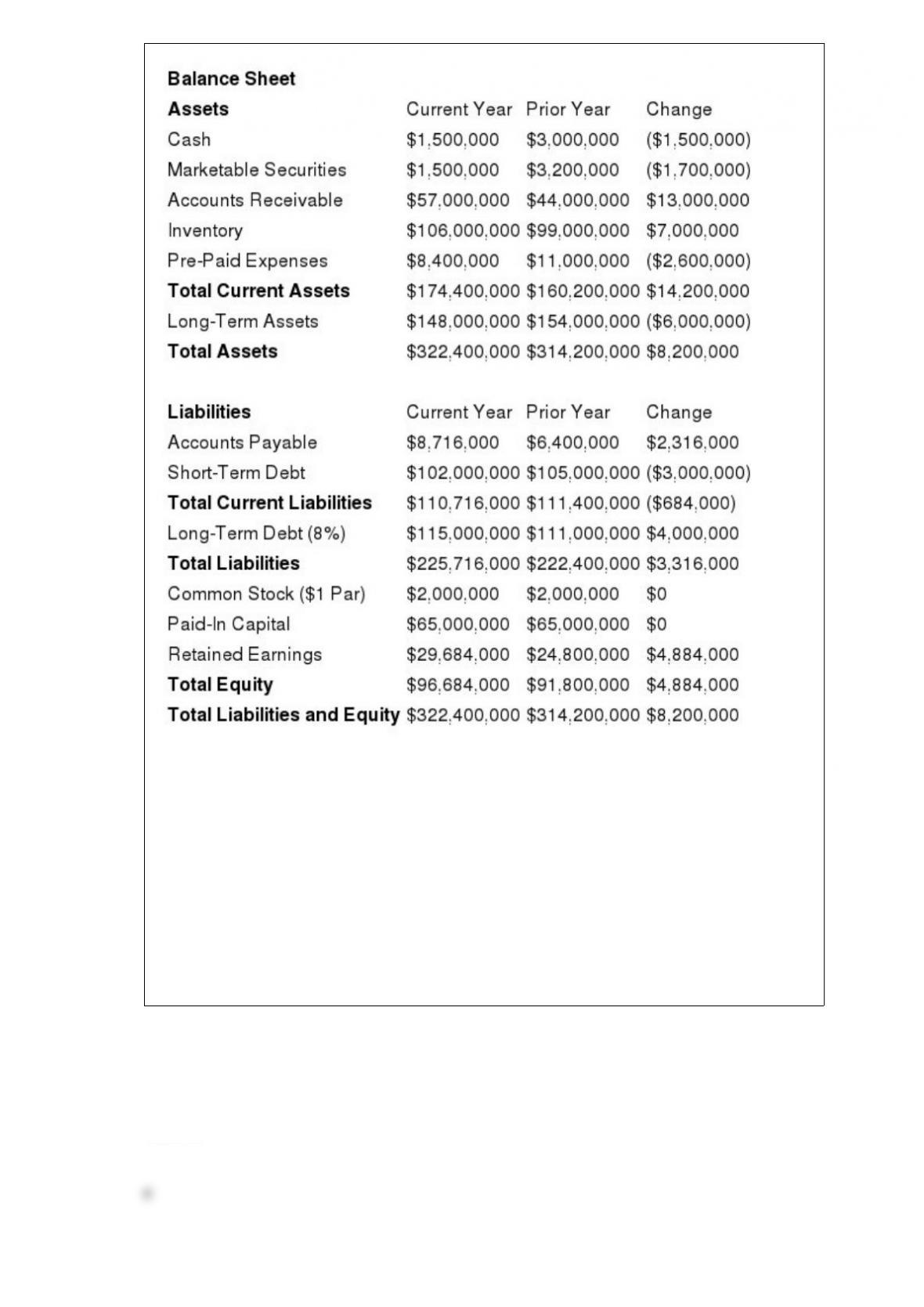
What is Dylan’s equity multiplier for the current year?
a. 0.30
b. 0.63
c. 1.52
d. 2.67
e. 3.33
Answer:

Under which category are dividends classified on the statement of cash flows?
a. Cash From Investing Activities
b. Cash From Operating Activities
c. Cash From Financing Activities
d. Cash From Profit Activities
e. None of the above
Answer:
The expense ratio is calculated as:
a. total revenue total operating expenses.
b. total revenue total operating expenses taxes.
c. interest expense ratio non-interest expense ratio provision for loan loss ratio.
d. asset utilization expense ratio tax ratio.
e. interest expense ratio + non-interest expense ratio + provision for loan loss ratio.
Answer:

A bank customer is granted credit for a $2,000 loan at 10% to be repaid in 12 equal
installments. If the loan quoted has an add-on rate, what are the net proceeds of the
loan?
a. $2,200
b. $2,100
c. $2,000
d. $1.800
e. Cannot be determined
Answer:
Put the following steps in duration gap analysis in the proper order.
I. Estimate the economic value of assets, liabilities and equity.
II. Forecast the change in the economic value of equity for various interest rates.
III. Forecast future interest rates.
IV. Estimate the duration of assets and liabilities.
a. III, I, IV, II
b. I, II, III, IV
c. III, IV, I, II
d. IV, I, II, III
e. II, IV, I, III

Answer:
A bank has $100 million in earning assets, a net interest margin of 5%, and a 1-year
cumulative GAP of $10 million. Interest rates are expected to increase by 2%. If the
bank does not want net interest income to fall by more than 25% during the next year,
how large can the cumulative GAP be to achieve the allowable change in net interest
income.
a. $2 million
b. $12 million
c. $15 million
d. $50 million
e. $62.5 million
Answer:

Income statement GAP considers:
a. changes in interest rates.
b. changes in the volume of rate-sensitive assets due to a change in interest rates.
c. changes in the volume of fix-rate liabilities due to a change in interest rates.
d. mortgage prepayments.
e. Income statement GAP considers all of the above.
Answer:
Which of the following is an example of a non-installment loan?
a. Credit card
b. 30-year mortgage
c. Bridge loan
d. 5-year auto loan
e. Home equity line of credit
Answer:

The purpose of the Truth in Lending Act of 1968 is to require lenders to quote:
a. home mortgage finance charges in a standardized manner.
b. rates on all certificates of deposit in a standardized manner.
c. payments with and without credit life insurance.
d. consumer loan finance charges in a standardized manner.
e. finance charges on loans over $100,000 in a standardized manner.
Answer:
If the economy is entering into a recessionary period, you would expect the yield curve
to be:
a. upward sloping.
b. flat.
c. inverted.
d. humped.
e. none of the above
Answer:

A bond has a Macaulay’s duration of 21 years. If rates rise from 5% to 5.5%, the bonds
price will:
a. increase by approximately 1%.
b. decrease by approximately 1%.
c. increase by approximately 10%.
d. decrease by approximately 10%.
e. Not enough information is given to answer the question.
Answer:
Which of the following investment banking services would be classified as Advisory
Services?
a. Managing investments for governments.
b. Designing an initial public offering
c. Acting as a broker that facilitates security trading
d. Running a hedge fund
e. Proprietary trading
Answer:

______________ represent amounts owed to Goldman Sachs by brokers, the firm’s
customers, and counter-parties to derivative contracts.
a. collateralized agreements
b. financial instruments
c. collateralized financings
d. receivables
e. payables
Answer:
A time draft for payment at a future date, often used in international trade is known as:
a. a reverse repurchase agreement.
b. a repurchase agreement.
c. a line of credit.
d. a letter of credit.
e. a bankers acceptance.
Answer:

___________ includes transaction accounts, MMDAs, savings accounts and small time
deposits.
a. Retail funding
b. Wholesale funding
c. Borrowed funding
d. Equity funding
e. Lockbox funding
Answer:
Which financial ratio measures a firm’s ability to pay current interest and lease
payments with current earnings?
a. Fixed charge coverage ratio
b. Return on equity
c. Current ratio
d. Inventory turnover
e. Debt to total assets ratio
Answer:

In which of the following ways can a bank acquire liquidity?
a. Selling Fed funds
b. Investing in repurchase agreements
c. Increasing the number of loans outstanding
d. Selling Treasury securities
e. Buying back outstanding bank stock
Answer:
Days Accruals 10
Days Cash 7
Days Inventory 33
Days Payables 21
Days Receivables 35
Average Daily COGS 15
What is the firm’s cash-to-cash asset cycle?
a. 31 days
b. 44 days
c. 65 days

d. 75 days
e. 121 days
Answer:
Commercial banks mostly specialize in:
a. mortgages.
b. mutual loans.
c. short-term business credit.
d. savings accounts.
e. share draft accounts.
Answer:
Individuals work out a court supervised repayment plan under:
a. Chapter 7
b. Chapter 9

c. Chapter 13
d. Chapter 17
e. Chapter 21
Answer:
Many insurance companies have formed __________ to operate banks as part of their
financial services efforts.
a. one-bank holding companies
b. multibank holding companies
c. retail subsidiaries
d. finance companies
e. financial holding companies
Answer:
When you wish to own the underlying security, your spot position is _______.
a. fat.

b. long.
c. short.
d. skinny.
e. a. and c.
Answer:
Under FASB 157, Level _______ assets valuation are based on management’s best
judgment of what the underlying asset is worth.
a. 1
b. 2
c. 3
d. 4
e. 5
Answer: