
Use the table for the question(s) below.
The following table summarizes prices of various default-free zero-coupon bonds
(expressed as a percentage of face value):
Based upon the information provided in the table above, you can conclude
A) that the yield curve is flat.
B) nothing about the shape of the yield curve.
C) that the yield curve is downward sloping.
D) that the yield curve is upward sloping.
Answer:
Consider a bond that pays annually an 8% coupon with 20 years to maturity. The
percentage change in the price of the bond if its yield to maturity increases from 5% to
7% is closest to:
A) 22%
B) 24%
C) -22%
D) -24%
Answer:

Use the information for the question(s) below.
Flagstaff Enterprises expected to have free cash flow in the coming year of $8 million,
and this free cash flow is expected to grow at a rate of 3% per year thereafter. Flagstaff
has an equity cost of capital of 13%, a debt cost of capital of 7%, and it is in the 35%
corporate tax bracket.
If Flagstaff currently maintains a .5 debt to equity ratio, then the value of Flagstaff as a
levered firm is closest to:
A) $114 million
B) $100 million
C) $111 million
D) $140 million

Answer:
Which of the following statements is false?
A) In some countries, especially in the developing world, all investors do not have
equal access to financial securities.
B) Firms may face differential access to markets if there is any kind of asymmetry with
respect to information about them.
C) In some cases, a country’s risk-free securities are internationally integrated but
markets for a specific firm’s securities are not.
D) When countries’ capital markets are not integrated we call them disintegrated capital
markets.
Answer:
The rate on a risk-free annuity that can be called at any time is known as the
A) callable annuity rate.
B) callable auction rate.
C) callable hurdle rate.
D) risk-free rate.
Answer:
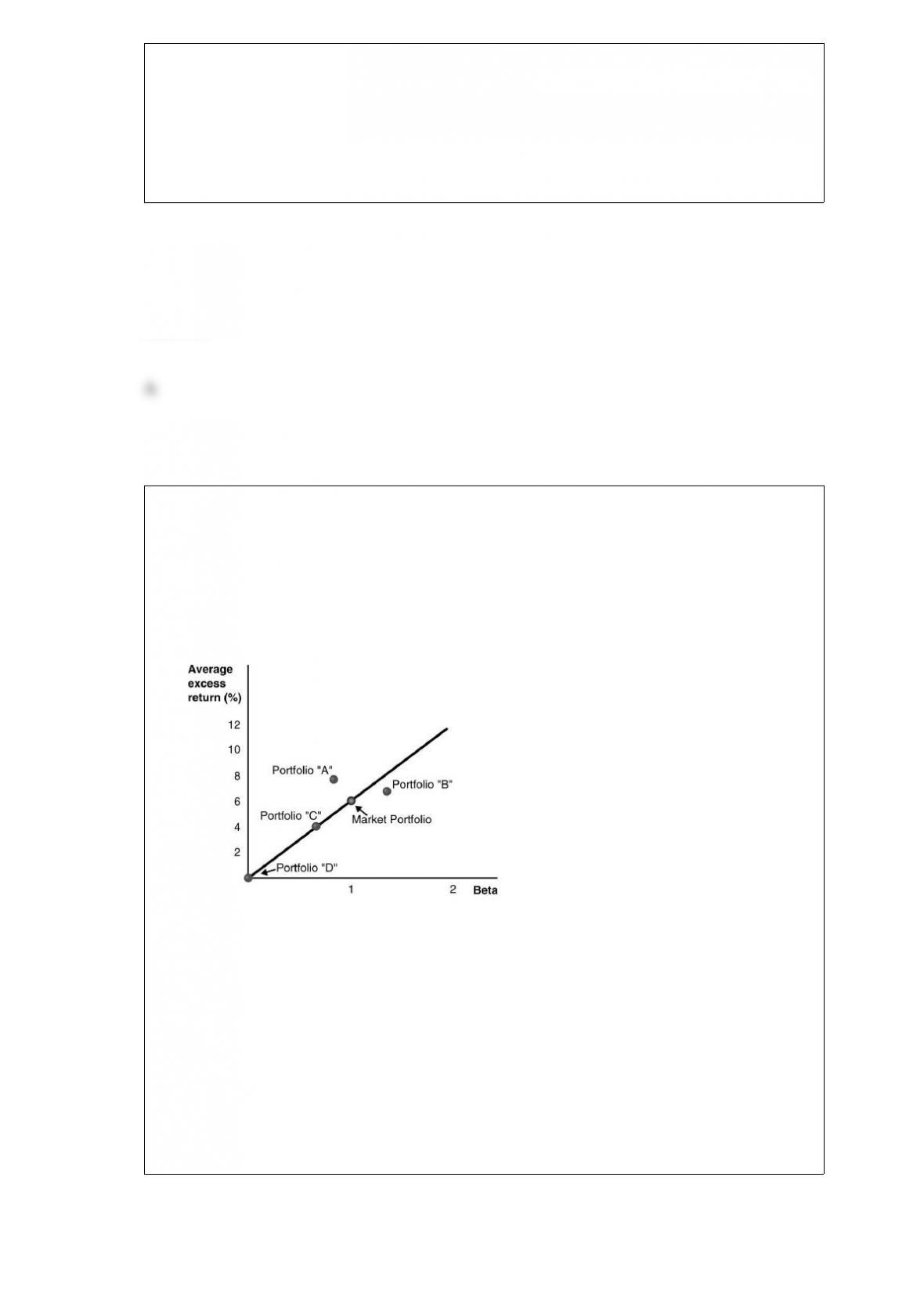
Use the figure for the question(s) below.
Consider the following graph of the security market line:
Portfolio “A”
A) has a relatively lower expected return than predicted.
B) has a positive alpha.
C) falls below the SML.
D) is overpriced.

Answer:
Which of the following statements is false?
A) On the other hand, by relying on short-term debt the firm exposes itself to funding
risk, which is the risk of incurring financial distress costs should the firm not be able to
refinance its debt in a timely manner or at a reasonable rate.
B) An ultra-conservative policy would involve financing even some of the plant,
property, and equipment with short-term sources of funds.
C) With a conservative financing policy, the firm would use short-term debt very
sparingly to meet its peak seasonal needs.
D) Short-term debt can have lower agency and lemons costs than long-term debt, and
an aggressive financing policy can benefit shareholders.
Answer:
Which of the following statements is false?
A) A firm must therefore balance the tax costs of holding cash with the potential
benefits of having to raise external funds in the future.
B) Paying out excess cash through dividends or share repurchases can boost the stock
price by reducing managers’ ability and temptation to waste resources.
C) If there is a reasonable likelihood that future earnings will be insufficient to fund
future positive-NPV investment opportunities, a firm may start accumulating cash to
make up the difference.

D) According to the managerial entrenchment theory of payout policy, managers pay
out cash only when pressured to do so by the firm’s investors.
Answer:
Use the information for the question(s) below.
Omicron Technologies has $50 million in excess cash and no debt. The firm expects to
generate additional free cash flows of $40 million per year in subsequent years and will
pay out these future free cash flows as regular dividends. Omicrons unlevered cost of
capital is 10% and there are 10 million shares outstanding. Omicron’s board is meeting
to decide whether to pay out its $50 million in excess cash as a special dividend or to
use it to repurchase shares of the firm’s stock.
Assume that Omicron uses the entire $50 million to repurchase shares. The amount of
the regular yearly dividends in the future is closest to:
A) $9.00
B) $5.00
C) $4.50
D) $4.00
Answer:

Which of the following statements is false?
A) The variance increases with the magnitude of the deviations from the mean.
B) The variance is the expected squared deviation from the mean.
C) Two common measures of the risk of a probability distribution are its variance and
standard deviation.
D) If the return is riskless and never deviates from its mean, the variance is equal to
one.
Answer:
Suppose that you are considering an investment that will pay you $4000 per year for the
next five years. The appropriate rate of interest is 5%. You want to know the present
value of the cash flows from this investment. To solve this problem in Microsoft Excel,

you would use which of the following excel formulas?
A) =PV(.05,5,4000,0,0)
B) =PV(.05,5,4000,0,1)
C) =PV(5,.05,4000,0)
D) =PV(5,5,4000,0)
Answer:
Which of the following balance sheet equations is incorrect?
A) Assets – Liabilities = Shareholders’ Equity
B) Assets = Liabilities + Shareholders’ Equity
C) Assets – Current Liabilities = Long Term Liabilities
D) Assets – Current Liabilities = Long Term Liabilities + Shareholders’ Equity
Answer:
Use the table for the question(s) below.
Consider the following expected returns, volatilities, and correlations:

The expected return of a portfolio that is consists of a long position of $10000 in
Wal-Mart and a short position of $2000 in Microsoft is closest to:
A) 21%
B) 12%
C) 27%
D) 18%
Answer:
The CAPM does not require investors have homogeneous expectations, but rather that
they have
A) rational biases.
B) no biases.
C) heterogenous expectations.
D) rational expectations.

Answer:
Use the information for the question(s) below.
You own a small manufacturing plant that currently generates revenues of $2 million
per year. Next year, based upon a decision on a long-term government contract, your
revenues will either increase by 20% or decrease by 25%, with equal probability, and
stay at that level as long as you operate the plant. Other costs run $1.6 million dollars
per year. You can sell the plant at any time to a large conglomerate for $5 million and
your cost of capital is 10%.
Assume that it will cost you $1 million to shut down the plant, but you are able to sell
the plant for $5 million at any time. The value of the option to sell the plant will be
closest to:
A) $3.0 million
B) $6.0 million
C) $5.0 million
D) $0.5 million
Answer:

The internal rate of return rule can result in the wrong decision if the projects being
compared have
A) differences in scale.
B) differences in timing.
C) differences in NPV.
D) A and B are correct.
Answer:
Which of the following statements is false?
A) Firm specific news is good or bad news about the company itself.
B) Firms are affected by both systematic and firm-specific risk.
C) When firms carry both types of risk, only the firm-specific risk will be diversified
when we combine many firms’ stocks into a portfolio.
D) The risk premium for a stock is affected by its idiosyncratic risk.
Answer:
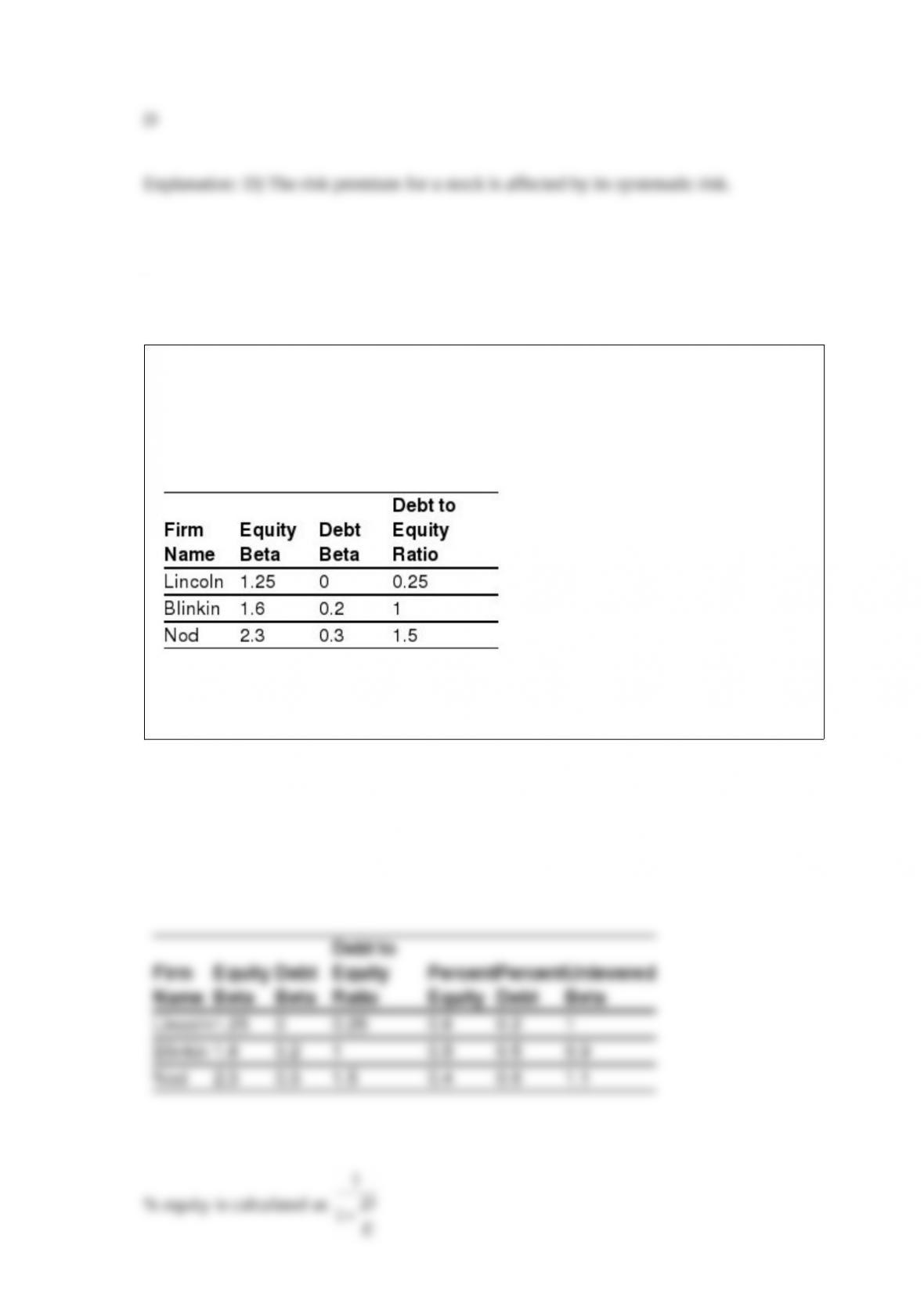
Use the information for the question(s) below.
You are evaluating a new project and need an estimate for your project’s beta. You have
identified the following information about three firms with comparable projects:
Based upon the three comparable firms, what asset beta would you recommend using
for your firm’s new project?
Answer:

Consider a growing perpetuity that will pay $100 in one year. Each year after that, you
will receive a payment on the anniversary of the last payment that is 6% larger than the
last payment. This pattern of payments will continue forever. If the interest rate is 11%,
then the value of this perpetuity is closest to:
A) $1,667
B) $588
C) $2,000
D) $909
Answer:

Your firm purchases goods from its supplier on terms of 1/10, net 30. The effective
annual cost to your firm if it chooses not to take advantage of the trade discount offered
is closest to:
A) 16.8%
B) 44.6%
C) 20.1%
D) 13.0%
Answer:
Use the information for the question(s) below.
Shepard Industries is evaluating a proposal to expand its current distribution facilities.
Management has projected the project will produce the following cash flows for the
first two years (in millions).

The incremental unlevered net income Shepard Industries in year one is closest to:
A) $510
B) $415
C) $600
D) $355
Answer:
Consider two mutually exclusive projects A & B. If you subtract the cash flows of
opportunity B from the cash flows of opportunity A, then you should
A) take opportunity A if the regular IRR exceeds the cost of capital.
B) take opportunity A if the incremental IRR exceeds the cost of capital.
C) take opportunity B if the regular IRR exceeds the cost of capital.
D) take opportunity B if the incremental IRR exceeds the cost of capital.

Answer:
Which of the following statements is false?
A) A stock’s return is perfectly positively correlated with itself.
B) When the covariance equals 0, the stocks have no tendency to move either together
or in opposition of one another.
C) The closer the correlation is to -1, the more the returns tend to move in opposite
directions.
D) The variance of a portfolio depends only on the variance of the individual stocks.
Answer:
Which of the following statements is false?
A) A combination of portfolios on the efficient frontier of risky investments is also on
the efficient frontier of risky investments.
B) The conclusion of the CAPM that investors should hold the market portfolio
combined with the risk-free investment depends on the quality of an investor’s
information.
C) The SML holds with some rate r* between rs and rb in place of rf, where r* depends
on the proportion of savers and borrowers in the economy.
D) In reality, investors have different information and spend varying amounts of effort
on research for assorted stocks.

Answer:
Which of the following statements is false?
A) The yield curve changes over time.
B) The formulas for computing present values of annuities and perpetuities cannot be
used in situations in which cash flows need to be discounted at different rates.
C) We can use the term structure to compute the present and future values of a risk-free
cash flow over different investment horizons.
D) The yield curve tends to be inverted as the economy comes out of a recession.
Answer:
Use the information for the question(s) below.
The Sisyphean Corporation is considering investing in a new cane manufacturing
machine that has an estimated life of three years. The cost of the machine is $30,000
and the machine will be depreciated straight line over its three-year life to a residual
value of $0.
The cane manufacturing machine will result in sales of 2,000 canes in year 1. Sales are
estimated to grow by 10% per year each year through year three. The price per cane that
Sisyphean will charge its customers is $18 each and is to remain constant. The canes
have a cost per unit to manufacture of $9 each.
Installation of the machine and the resulting increase in manufacturing capacity will
require an increase in various net working capital accounts. It is estimated that the
Sisyphean Corporation needs to hold 2% of its annual sales in cash, 4% of its annual
sales in accounts receivable, 9% of its annual sales in inventory, and 6% of its annual
sales in accounts payable. The firm is in the 35% tax bracket, and has a cost of capital
of 10%.
The amount of incremental income taxes that the Sisyphean Company will pay in the
first year on this new project is closest to:
A) $6,300
B) $5,200
C) $3,500
D) $2,800
Answer:

Which of the following statements is false?
A) Currency options allow firms to lock in a future exchange rate; currency forward
contracts allow firms to insure themselves against the exchange rate moving beyond a
certain level.
B) Generally speaking, cash-and-carry strategies are used primarily by large banks,
which can borrow easily and face low transaction costs.
C) Currency options, like the stock options, give the holder the right”but not the
obligation”to exchange currency at a given exchange rate.
D) Many managers want the firm to benefit if the exchange rate moves in their favor,
rather than being stuck paying an above-market rate.
Answer:
Use the following information to answer the question(s) below.
Sarah Palin reportedly was paid a $11 million advance to write her book Going Rogue.
The book took one year to write. In the time she spent writing, Palin could have been
paid to give speeches and appear on TV news as a political commentator. Given her
popularity, assume that she could have earned $8 million over the year (paid at the end
of the year) she spent writing the book. Assume that she was able to write the book
while simultaneously fulfilling her media commitments of appearing on TV news as a
political commentator and give speeches.
Assume that once her book is finished, it is expected to generate royalties of $5 million
in the first year (paid at the end of the year) and these royalties are expected to decrease
by 40% per year in perpetuity. Assuming that Palin’s cost of capital is 10% and given
these royalties payments, the NPV of Palin’s book deal is closest to:
A) $3.75 million
B) $12.20 million

C) $13.00 million
D) $13.75 million
Answer:
Use the following information to answer the question(s) below.
(Include the MACRS Table from the Appendix.)
Casa Grande Farms is considering purchasing multiple tractors for a total purchase
price of $540,000. These tractors are expected to generate EBITDA of $250,000 for
each of the next three years. Casa Grande Farms has a 35% tax rate and has a cost of
capital of 10%.
Assuming that Casa Grande Farms depreciates these tractors using MACRS
depreciation method for three-year property starting immediately, then the NPV of
buying the tractors is closest to:
A) 20,785
B) 36,225
C) 81,715
D) 513,235
E) 560,785
Answer:

Which of the following statements is false?
A) Aside from taxes, another important difference between debt and equity financing is
that debt payments must be made to avoid bankruptcy, whereas firms have no similar
obligation to pay dividends or realize capital gains.
B) Increasing the level of debt increases the probability of bankruptcy.
C) A firm receives a tax benefit only if it is paying taxes in the first place.
D) To the extent that a firm has other tax shields, its taxable earnings will be increased
and it will rely more heavily on the interest tax shield.
Answer:
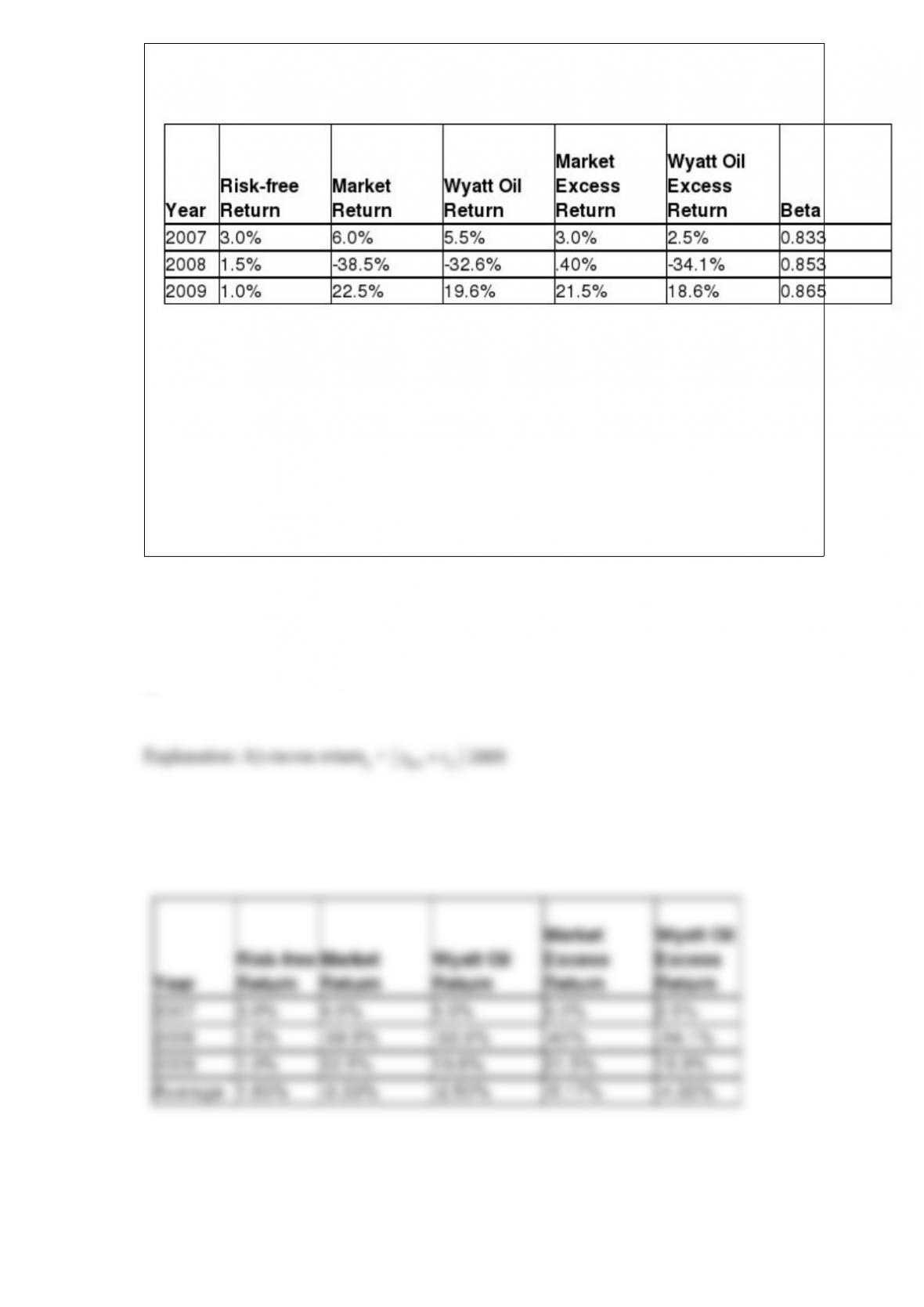
Use the following information to answer the question(s) below.
Wyatt Oil’s excess return for 2009 is closest to:
A) 18.6%
B) 19.6%
C) 20.0%
D) 21.5%
Answer:

Which of the following statements is false?
A) Many projects use a resource that the company already owns.
B) When evaluating a capital budgeting decision, we generally include interest expense.
C) Only include as incremental expenses in your capital budgeting analysis the
additional overhead expenses that arise because of the decision to take on the project.
D) As a practical matter, to derive the forecasted cash flows of a project, financial
managers often begin by forecasting earnings.
Answer:
If a firm’s excess cash holdings are greater than its debt, using net debt as the measure
of leverage will result in
A) its unlevered beta and cost of capital equalling zero.
B) its unlevered beta and cost of capital being greater than its equity beta and cost of
capital.
C) the risk of the firm’s equity being increased by its cash holdings in excess of its
operating needs.
D) the risk of the firm’s debt being increased by its cash holdings in excess of its
operating needs.
Answer:

Use the equation for the question(s) below.
Consider the following factor model:
E[Rs] – rf =
(E[RMkt] – rf) + E[RSMB] + E[RHML] + E[RPR1 YR]
The term measures the sensitivity of the securities returns to
A) size.
B) book to market.
C) momentum.
D) the overall market.
Answer: