
1) The security agreement is an agreement between the borrower and the lender that
specifies the collateral held against a secured loan.
2) Changes in risk aversion, and therefore shifts in the SML, result from changing tastes
and preferences of investors, which generally result from various economic, political,
and social events.
3) Beta coefficient is an index of the degree of movement of an asset’s return in
response to a change in the risk-free asset.
4) The residual theory of dividends suggests that the dividend paid by a firm should be
viewed as a residual, the amount left over after all acceptable investment opportunities
have been undertaken.
5) If a firm has unlimited funds, it is able to accept all independent projects that provide
an acceptable return.
6) Comparison of the degree of operating leverage of two firms is valid only when the
base level of sales used for each firm is the same.
7) Acquisitions are especially attractive when a target firm’s stock price is high, because
fewer shares must be exchanged to acquire the firm.
8) A merger transaction endorsed by a target firm’s management, approved by its
stockholders, and easily consummated is called a friendly merger.
9) By efficiently managing a firm’s operating and cash conversion cycles, the financial
manager can maintain a high level of cash investment and thereby contribute toward
maximization of share value.
10) A normal probability distribution is an asymmetrical distribution whose shape
resembles a pyramid.
11) 2/15 net 45 translates as 2 percent of the balance is due in 15 days; the remaining
balance is due in 45 days.
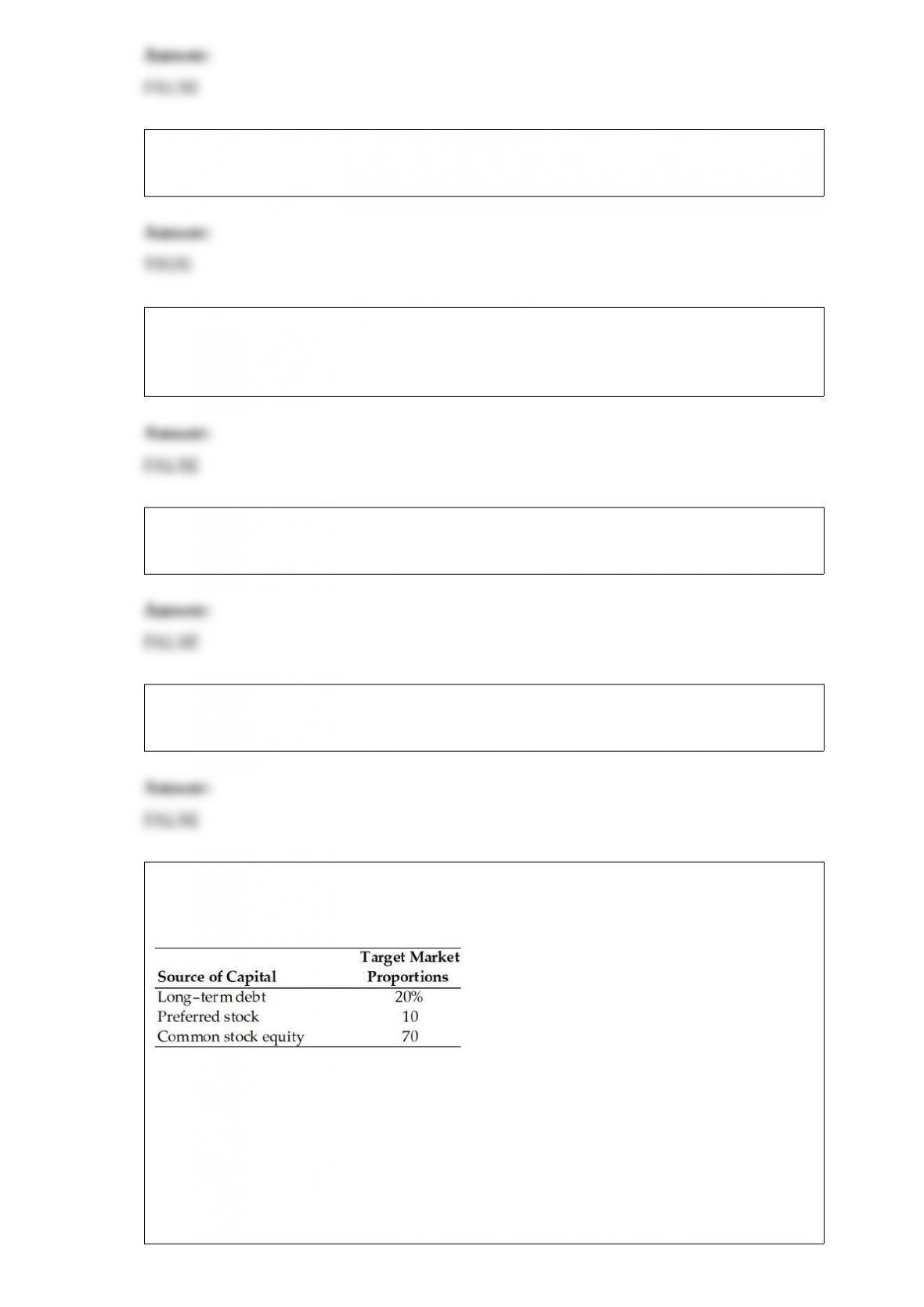
12) Table 9.1
A firm has determined its optimal capital structure which is composed of the following
sources and target market value proportions.
Debt: The firm can sell a 12-year, $1,000 par value, 7 percent bond for $960. A
flotation cost of
2 percent of the face value would be required in addition to the discount of $40.
Preferred Stock: The firm has determined it can issue preferred stock at $75 per share
par value. The stock will pay a $10 annual dividend. The cost of issuing and selling the
stock is $3 per share.
Common Stock: A firm’s common stock is currently selling for $18 per share. The
dividend expected to be paid at the end of the coming year is $1.74. Its dividend

payments have been growing at a constant rate for the last four years. Four years ago,
the dividend was $1.50. It is expected that to sell, a new common stock issue must be
underpriced $1 per share in floatation costs. Additionally, the firm’s marginal tax rate is
40 percent.
The firm’s cost of a new issue of common stock is ________. (See Table 9.1)
A) 7 percent
B) 9.08 percent
C) 14.2 percent
D) 13.4 percent
13) According to the residual theory of dividends, if a firm’s equity need exceeds the
amount of retained earnings, the firm would ________.
A) borrow to pay the cash dividend
B) sell additional stock to pay the cash dividend
C) pay no cash dividends
D) pay less dividends
14) The ________ is an inventory technique that takes into account various operating
and financial costs to determine the order quantity for a specific inventory item.
A) JIT system
B) ABC system
C) EOQ model
D) LIFO model
15) Table 9.2
A firm has determined its optimal structure which is composed of the following sources
and target market value proportions.
Debt: The firm can sell a 15-year, $1,000 par value, 8 percent bond for $1,050. A
flotation cost of 2 percent of the face value would be required in addition to the
premium of $50.
Common Stock: A firm’s common stock is currently selling for $75 per share. The
dividend expected to be paid at the end of the coming year is $5. Its dividend payments
have been growing at a constant rate for the last five years. Five years ago, the dividend
was $3.10. It is expected that to sell, a new common stock issue must be underpriced $2

per share and the firm must pay $1 per share in flotation costs. Additionally, the firm
has a marginal tax rate of 40 percent.
The weighted average cost of capital up to the point when retained earnings are
exhausted is ________. (See Table 9.2)
A) 6.8 percent
B) 7.7 percent
C) 9.44 percent
D) 11.29 percent
16) As a foreign exchange hedging tool, options ________.
A) provide the right to buy or sell an amount of foreign currency
B) allow the trading of one interest rate stream for another
C) permit firms to change the interest rate structure of their assets/liabilities
D) represent an obligation to buy or sell an amount of foreign currency
17) Which of the following acts regulates the primary market in which securities are
originally issued to the public?
A) The Securities Act of 1933
B) The Gramm-Leach-Bliley Act
C) The Securities Exchange Act of 1934
D) The Glass-Steagall Act
18) ABC Corp. extends credit terms of 45 days to its customers. Its credit collection
would likely be considered poor if its average collection period was ________.
A) 30 days
B) 36 days
C) 44 days
D) 57 days
19) Table 3.2
Dana Dairy Products Key Ratios
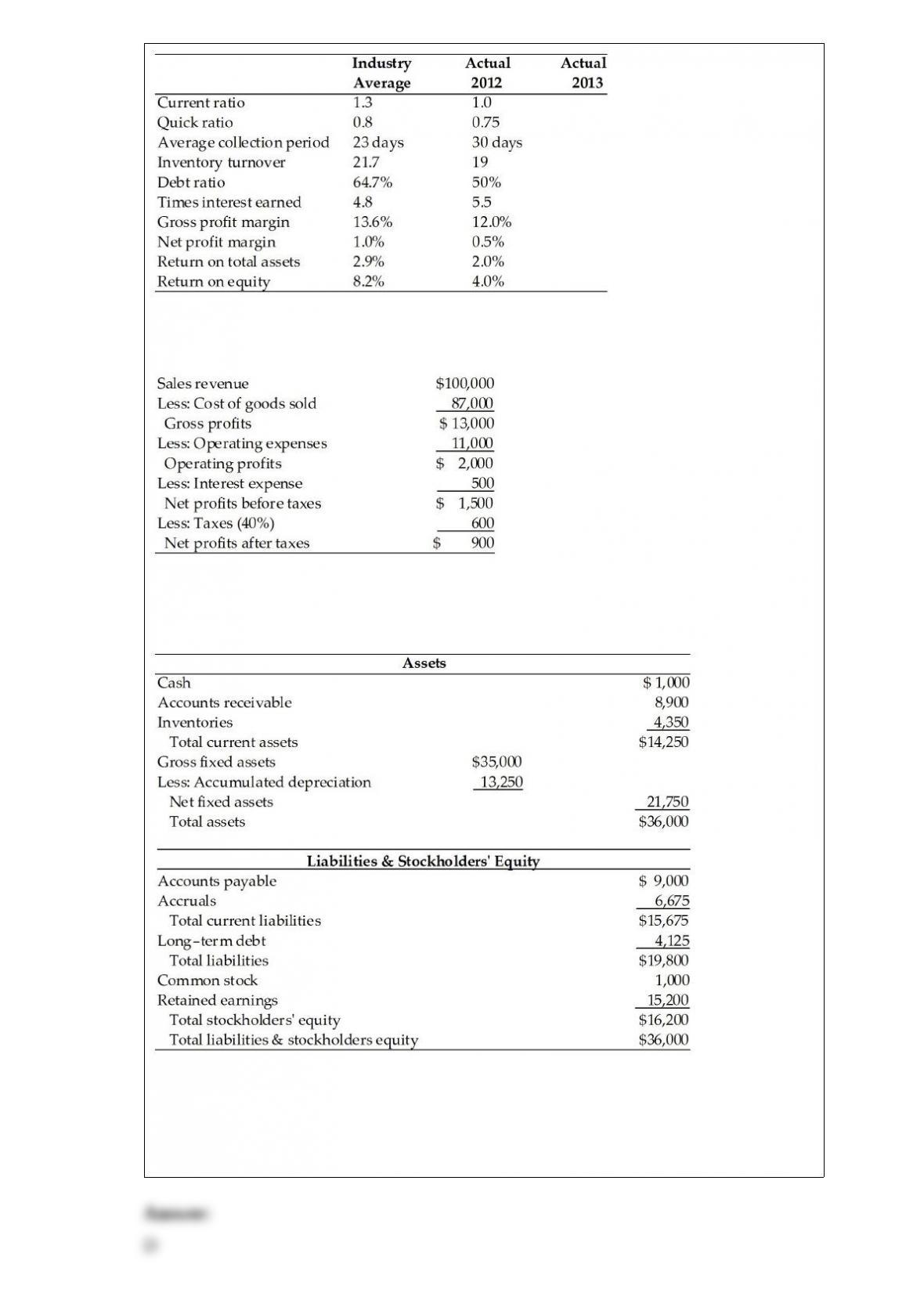
Income Statement
Dana Dairy Products
For the Year Ended December 31, 2013
Balance Sheet
Dana Dairy Products
December 31, 2013
The current ratio for Dana Dairy Products in 2013 was ________. (See Table 3.2)
A) 1.58
B) 0.63
C) 1.10
D) 0.91

20) A leveraged buyout needs to be carried out through ________.
A) a hostile takeover
B) a friendly merger
C) a vertical merger or a hostile takeover
D) a conglomerate merger
21) A partnership under which the participants have contractually agreed to contribute
specified amounts of money and expertise in exchange for stated proportions of
ownership and profit is called a(n) ________.
A) S corporation
B) GmbH
C) S.A.R.L
D) joint venture
22) The implementation of a pro-active ethics program is expected to result in
________.
A) a positive corporate image and increased respect, but is not expected to affect cash
flows
B) an increased share price resulting from a decrease in risk, but is not expected to
affect cash flows
C) a positive corporate image and increased respect, but is not expected to affect share
price
D) a positive corporate image and increased respect, a reduction in risk, and enhanced
cash flow resulting in an increase in share price
23) The value of any asset is the ________.
A) sum of all future cash flows it is expected to provide over the relevant time period
B) sum of the present values of all future cash flows it is expected to provide over the
relevant time period
C) present value of the sum of all future cash flows it is expected to provide over the
relevant time period
D) sum of all compounded future cash flows it is expected to provide over the relevant
time period

24) The ________ feature permits the issuer to repurchase bonds at a stated price prior
to maturity.
A) call
B) conversion
C) put
D) swap
25) At the end of 2015, Long Life Light Bulb Corporation announced a gross profit of
$1 million. The company has also established that over the course of this year that it has
incurred $345,000 in operating expenses and $125,000 in interest expenses. The
company is subject to a 30% tax rate and has declared $57,000 of total preferred stock
dividends.
(a)Calculate the earnings available for common stockholders?
(b)Compute the increased retained earnings for 2015 if the company were to declare a
$4.25 common stock dividend. The company has 15,000 shares of common stock
outstanding.
26) A firm’s year-end retained earnings balances are $670,000 and $560,000, for 2014
and 2015 respectively. The firm paid $10,000 in dividends in 2015. The firm’s net profit
after taxes in 2015 was ________.
A) -$100,000
B) -$110,000
C) $100,000
D) $110,000
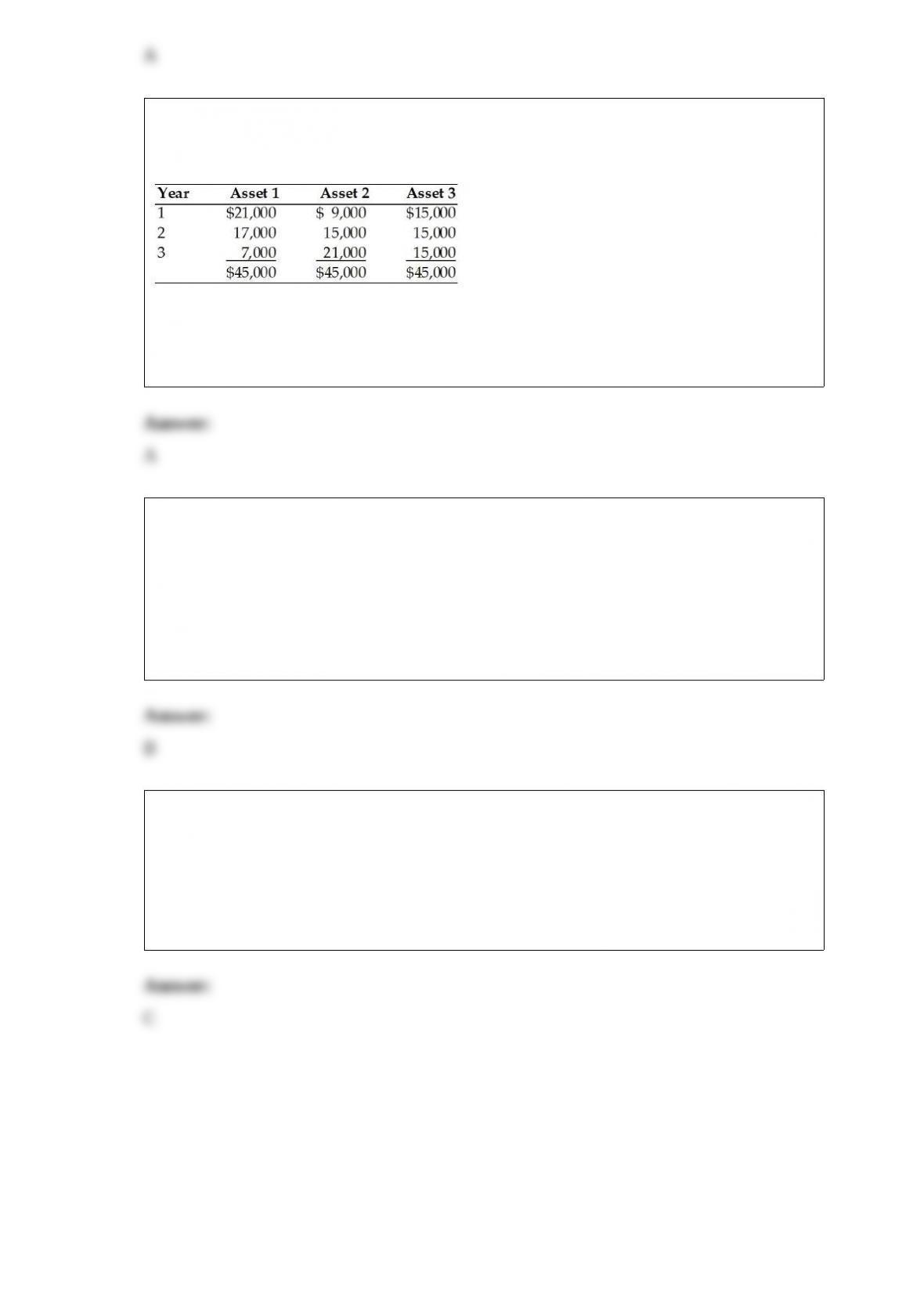
27) A financial manager must choose between three alternative investments. Each asset
is expected to provide earnings over a three-year period as described below. Based on
the wealth maximization goal, the financial manager would ________.
A) choose Asset 1
B) choose Asset 2
C) choose Asset 3
D) be indifferent between Asset 1 and Asset 2
28) Assume the following returns and yields: U.S. T-bill = 8%, 5-year U.S. T-note =
7%, IBM common stock = 15%, IBM AAA Corporate Bond = 12% and 10-year U.S.
T-bond = 6%. Based on this information, the shape of the yield curve is ________.
A) upward sloping
B) downward sloping
C) flat
D) normal
29) The financial leverage multiplier is an indicator of how much ________ a
corporation is utilizing.
A) operating leverage
B) long-term debt
C) total debt
D) total assets