
The financial system consists of
a. all the securities, intermediaries, and markets that exist to match savers and
borrowers.
b. all transactions occurring in the goods market during a financial year.
c. all markets that exist to match the buyers and suppliers of various factors of
production.
d. all transactions involving the government.
Answer:
Economic policy affects
a. only the amount of money in the economy.
b. only the lending policy of financial intermediaries.
c. the entire financial system.
d. how financial securities are traded and no other part of the financial system.
Answer:
Which of the following is NOT a financial policymaker?

a. Securities and Exchange Commission (SEC)
b. Federal Deposit Insurance Corporation (FDIC)
c. Consumer Financial Protection Bureau (CFPB)
d. Federal Reserve System (the Fed)
Answer:
Which policymaking institution determines the money supply, sets the rules for how
checks are cleared and how banks obtain new currency, and determines what activities
banks may or may not engage in?
a. Treasury Department.
b. Commerce Department.
c. Securities and Exchange Commission.
d. Federal Reserve System.
Answer:
Earning interest on past interest is referred to as

a. present value.
b. super interest.
c. compounding.
d. discounting.
Answer:
Which of the following will be included in the financial system of a country?
a. Labor Unions
b. Banks
c. Factor markets
d. Markets for raw materials
Answer:
In the financial system, savers transfer funds to borrowers in exchange for
a. cash.
b. gold.
c. financial securities.
d. derivative securities.
Answer:
Suppose you are an investor with a choice between three investments in debt securities
that are identical in every way except in terms of their interest rates and taxability.
Investment A: Interest rate 10 percent, tax rate 40 percent of interest income
Investment B: Interest rate 8 percent, tax rate 30 percent of interest income
Investment C: Interest rate 6.5 percent, tax rate 0 percent
Which investment provides the highest after-tax return? Show your work.
Answer:
When people use money by trading it for goods and services, money is serving the role
of a
a. medium of exchange.
b. unit of account.

c. store of value.
d. standard of deferred payment.
Answer:
As a medium of exchange, money makes exchanges easier by reducing
a. inflation.
b. transactions costs.
c. production costs of goods.
d. legal costs in negotiating loan contracts.
Answer:
Costs of trading are referred to as ………… costs.
a. trading
b. menu
c. shoe-leather
d. transactions

Answer:
The amount of money invested in a financial security or deposited into a financial
intermediary is referred to as the
a. principal.
b. interest.
c. yield.
d. capital-gain.
Answer:
The amount of money that you would need to invest today to yield a given future
amount is called the
a. future value.
b. present value.
c. rate of discount.
d. discount factor.

Answer:
If the principal invested in a bank at an annual interest rate of 6% is $3,000, the interest
that will accumulate on the principal after a year will equal
a. $180.
b. $300.
c. $500.
d. $700.
Answer:
On February 1, 2013, Janet buys a bond for $10,000 that makes coupon payments of
$600 after each of the following two years and returns its principal of $10,000 at the
end of the second year. In other words, it is a standard coupon bond with a 6 percent
annual interest rate making payments once each year.
On February 1, 2014, Janet receives her first coupon payment of $600. At that time, the
market interest rate on bonds like hers has fallen to 4 percent. She sells her bond to
Justin at that time, for a price equal to the present value of the bond’s payments.
a. How much does Justin pay Janet for the bond? Both Janet and Justin have tax rates of
30 percent on interest income and 20 percent on capital gains. (Note that if someone has
a capital loss, you may assume that he or she can reduce taxes by the amount of the
capital loss times the tax rate of 20 percent.)
b.Calculate Janet’s after-tax rate of return for the past year (from Feb.1,2013, to Feb.1, 2
014).
Justin holds onto the bond from February 1, 2014, to February 1, 2015, so it matures
and he receives the second coupon payment and the principal.
c. What is Justin’s after-tax rate of return for the year from Feb. 1, 2014, to Feb. 1,
2015?
Explain and show all your work for each part. You may assume, of course, that the
market works and does not malfunction.
Answer:
Which of the following is a security in which a saver buys the security for a given time
to maturity, earning interest at the specified rate?
a. Commercial paper

b. Debenture
c. Government bond
d. Certificates of deposit
Answer:
The process of turning assets such as mortgages into bonds sold to investors is
a. default.
b. standard deviation.
c. standardization.
d. securitization.
Answer:
A debt security sold by large corporations to raise shortterm funds is known as a(n)
a. commercial paper.
b. treasury bill.
c. debenture.

d. bond.
Answer:
Which of the following statements is true?
a. A short-term bond and a long-term bond provides the same premium.
b. Investors in short-term bonds earn higher premiums than investors in long-term
bonds.
c. A change in the interest rates of bonds affect the prices of long-term bonds more than
the prices of short- term bonds.
d. A change in the interest rates of bonds affect the prices of short-term bonds more than
the prices of long- term bonds.
Answer:
Which of the following statements is true?
a. The prices of debt securities fall during recessions.
b. Interest rates on neither the short-term securities nor the long-term securities fall in
recession.
c. Interest rates on long-term securities fall more than the interest rates on short-term

securities in recession.
d. Interest rates on short-term securities fall more than the interest rates on long-term
securities in recession.
Answer:
The amount of interest paid on a debt security in dollar terms as a percent of the
principal is referred to as the
a. expected real interest rate.
b. realized real interest rate.
c. after-tax real interest rate.
d. nominal interest rate.
Answer:
The real interest rate is the nominal interest rate adjusted for expected or actual
a. unemployment.
b. production.
c. income growth.

d. inflation.
Answer:
The real interest rate is the nominal interest rate adjusted for expected or actual
a. unemployment.
b. production.
c. income growth.
d. inflation.
Answer:
The nominal interest rate adjusted for expected inflation is the
a. expected real interest rate.
b. realized real interest rate.
c. after-tax real interest rate.
d. yield curve.

Answer:
The nominal interest rate adjusted for actual inflation is the
a. expected real interest rate.
b. realized real interest rate.
c. after-tax real interest rate.
d. yield curve.
Answer:
Shareholders are also called
a. bondholders.
b. brokers.
c. stockholders.
d. debt-holders.
Answer:

Which of the following statements is true?
a. Stockholders benefit when the price of the stocks they hold rises and lose when the
price of the stocks they hold falls.
b. Stockholders benefit when the price of the stocks they hold falls and lose when the
price of the stocks they hold rises.
c. Stockholders have the right to participate in the decision making of a company but
are not entitled to dividend payments.
d. Stockholders are entitled to dividend payments but do not have the right to
participate in the decision making of a company.
Answer:
A place where people buy or sell stocks is known as a stock
a. exchange.
b. index.
c. fund.
d. holding.
Answer:

Write a formula for the equity premium.
Answer:
A financial intermediary that accepts deposits from savers, and makes loans to
borrowers is a
a. stock exchange.
b. bond market.
c. bank.
d. finance company.
Answer:
When one party to a transaction knows more than another, the situation is one of
a. rational expectations.
b. imperfect credibility.
c. opportunity cost.

d. asymmetric information.
Answer:
Borrowers know more about their abilities to repay loans than the banks do. This is a
situation of
a. adverse selection.
b. rational behavior.
c. credit crunch.
d. bank run.
Answer:
The main problems caused by asymmetric information are
a. irrational expectations and moral hazard.
b. imperfect credibility and adverse selection.
c. adverse selection and irrational expectations.
d. adverse selection and moral hazard.

Answer:
In which period was the rate of output growth the fastest in the U.S. economy?
a. 1929−1949
b. 1949−1970
c. 1970−1982
d. 1982−2010
Answer:
The labor force consists of
a. those employed plus those on temporary layoff.
b. those employed plus those unemployed.
c. the working-age population minus those who are in the military or institutionalized.
d. the working-age population plus those who are in the military or institutionalized.

Answer:
15 million people in a country are employed and 2.5 million are unemployed while 1
million are retired workers. The size of the country’s labor force is
a. 15 million.
b. 18.5 million
c. 17.5 million
d. 11.5 million.
Answer:
Y= A×Ka×L1−a.
If a= 0.3, and over the past year total factor productivity grew 2.3 percent, capital grew
2 percent, and labor grew 3 percent, what was the growth rate of output?
a. 0 percent
b. 5 percent
c. 2 percent
d. 7 percent

Answer:
Y= A×Ka×L1−a.
If a= 0.4, and over the past year total factor productivity (TFP) grew 2.6 percent, capital
grew 2 percent, and labor grew 1 percent, what was the growth rate of output over the
year?
a. 2 percent
b. 3 percent
c. 4 percent
d. 5 percent
Answer:
In the ATM model of money, the opportunity cost of holding money is determined by
a. the rate of inflation.
b. the cost of going to an ATM.
c. the charges levied on every ATM transaction.
d. the nominal interest rate and the possibility of having her money stolen.

Answer:
What is the average cash holdings of someone who visits the ATM once every 8 days
and spends $25 on a daily basis?
a. $12.50
b. $25
c. $100
d. $200
Answer:
How much is someone who visits the ATM once every 7 days and has an average cash
balance of $70 expected to spend daily?
a. $5
b. $10
c. $15
d. $20
Answer:
Suppose, the money-demand equation is given by MD = P × [(0.25 × Y) − (15 × i)],
where P is the price level, Y is the level of output in billions, and i is the interest rate in
percentage points. Initially, P = 2, Y = $500, and i = 3. If Y rises to $600 and the price
level does not change, by how much should the Fed change the money supply if it
wants to keep the nominal interest rate unchanged? Should the money supply rise or
fall, and by how much? Use the liquidity-preference framework and show a diagram of
this situation.
Answer:
A model in which actions that occur at one time affect what happens at other times is
known as
a. a dynamic model.
b. a static model.
c. a general-equilibrium model.

d. a partial-equilibrium model.
Answer:
A model that focuses on what is happening at just one point in time is known as
a. a dynamic model.
b. a static model.
c. a general-equilibrium model.
d. a partial-equilibrium model.
Answer:
A model that is based on the decisions of economic agents is known as
a. a rational-expectations model.
b. a decision-theoretic model.
c. a model with microeconomic foundations.
d. a fully compatible real business cycle model.

Answer:
Which of the following is an advantage of using dynamic models?
a. They help us understand how people form expectations about future economic
variables.
b. They help us understand the consumption decision of economic agents at a given
point in time.
c. They help us understand the production decisions of firms at a given point in time.
d. They help us understand the movements in the business cycle.
Answer:
An unexpected change in an exogenous variable is known as
a. a shock.
b. a fluctuation.
c. an anachronism.
d. a calibration.
Answer:

Which of the following statements is true?
a. A shock affects all countries to the same extent.
b. Some shocks are positive and some are negative.
c. Some shocks benefit one country and harm others.
d. The same shock cannot affect more than one country at once.
Answer:
In the late 1980s and the 1990s, the correlation between output growth in the
a. United States and Europe rose while the correlation between output growth between
the United States and Japan fell.
b. United States and Europe fell while the correlation between output growth between
the United States and Japan rose.
c. United States and Europe and the United States and Japan, both fell.
d. United States and Europe and the United States and Japan, both rose.
Answer:

A country’s net foriegn investment is equal to the amount?
a. the domestic country invests in other countries, minus what other countries invest in
the domestic country.
b. Other countries invest in the domestic country, minus what the domestic country
invests in other countries.
c. of the current-account balance plus the capital-account balance.
d. of portfolio investment made by the domestic country in other countries, minus the
amount of portfolio investment other countries make in the domestic country.
Answer:
A country’s net foriegn investment is equal to the amount?
a. the domestic country invests in other countries, minus what other countries invest in
the domestic country.
b. Other countries invest in the domestic country, minus what the domestic country
invests in other countries.
c. of the current-account balance plus the capital-account balance.
d. of portfolio investment made by the domestic country in other countries, minus the
amount of portfolio investment other countries make in the domestic country.
Answer:
In 2005, exchange rates were 1.74 U.S. dollars per British pound, 112 Japanese yen per
U.S. dollar, and 1.20 dollars per euro. In 2000, the exchange rates were 1.62 U.S.
dollars per British pound, 102 Japanese yen per U.S. dollar, and 0.94 dollars per euro.
For each currency, explain whether it appreciated or depreciated from 2000 to 2005
versus the other two currencies.
Answer:
There are Federal Reserve Banks located around the United States.
a. seven
b. ten
c. twelve
d. fifteen
Answer:

In which of the following cities is a Federal Reserve Bank NOT located
a. Richmond.
b. Denver.
c. Kansas City.
d. St. Louis.
Answer:
Which of the following Federal Reserve Banks performs the role of buying or selling
currencies in the foreign exchange market?
a. The Federal Reserve Bank of Minneapolis
b. The Federal Reserve Bank of Boston
c. The Federal Reserve Bank of New York
d. The Federal Reserve Bank of San Francisco
Answer:
The money supply in an economy equals

a. monetary base plus money multiplier.
b. monetary base divided by money multiplier.
c. money multiplier divided by monetary base.
d. money multiplier multiplied by monetary base.
Answer:
The money supply in an economy equals
a. monetary base plus money multiplier.
b. monetary base divided by money multiplier.
c. money multiplier divided by monetary base.
d. money multiplier multiplied by monetary base.
Answer:
The main asset on the Federal Reserve’s balance sheet is
a. discount loans.
b. securities.

c. monetary base.
d. capital.
Answer:
The main liability on the Federal Reserve’s balance sheet is
a. discount loans.
b. securities.
c. the monetary base.
d. capital.
Answer:
Currency held by the nonbank public plus banks’ vault cash plus banks’ deposits at the
Fed equals
a. the Fed’s capital stock.
b. discount loans.
c. the monetary base.
d. required clearing balances.
Answer:
Discuss the effectiveness of a monetary policy in an economy in which banks are
indifferent between holding bonds and holding cash as reserves.
Answer:
An increase in the money supply is an example of a(n) policy.
a. countercyclical
b. procyclical
c. contractionary
d. expansionary
Answer:
The Fed uses_____monetary policy to cause the economy to grow faster in the short
run. A(n)___in the money supply is an example of such a policy.
a. expansionary; decrease
b. expansionary; increase
c. contractionary; increase
d. contractionary; decrease
Answer:
A decrease in the money supply is an example of a(n) policy.
a. countercyclical
b. procyclical
c. contractionary
d. expansionary

Answer:
The systematic setting of policy according to a formula is known as
a. credibility.
b. an expectations trap.
c. discretionary policy.
d. a rule for monetary policy.
Answer:
If monetary policy is not set by a rule, it is said to be set by
a. randomization.
b. discretion.
c. credibility.

d. destabilization.
Answer:
When a central bank increases money growth, the bank is said to policy.
a. restrict
b. tighten
c. destabilize
d. ease
Answer:
The Fed eases policy when it
a. decreases both the money growth and the federal funds rate.
b. decreases the money growth and increases the federal funds rate.
c. increases both the money growth and the federal funds rate.
d. increases the money growth and decreases the federal funds rate.
Answer:
a. Write down the equation for the Taylor rule for monetary policy. Explain what each
term in the equation means, in one sentence.
b.Suppose the Fed is following the Taylor rule. Suppose the growth rate of potential
output is 4 percent, the output gap is 3 percent, the weights on the output gap and
inflation gap are each1/2, the Fed’s inflation target is 2 percent, the Fed believes the
equilibrium real federal funds rate is 2 percent, and inflation has been 3 percent over the
past year. At what rate does the Fed set the federal funds rate?
c.Suppose the Fed thinks that the equilibrium federal funds rate is 2 percent, as in part
b above, but in fact the equilibrium real fed funds rate is 3 percent. What do you think
will happen to the inflation rate in the long run?
Answer:
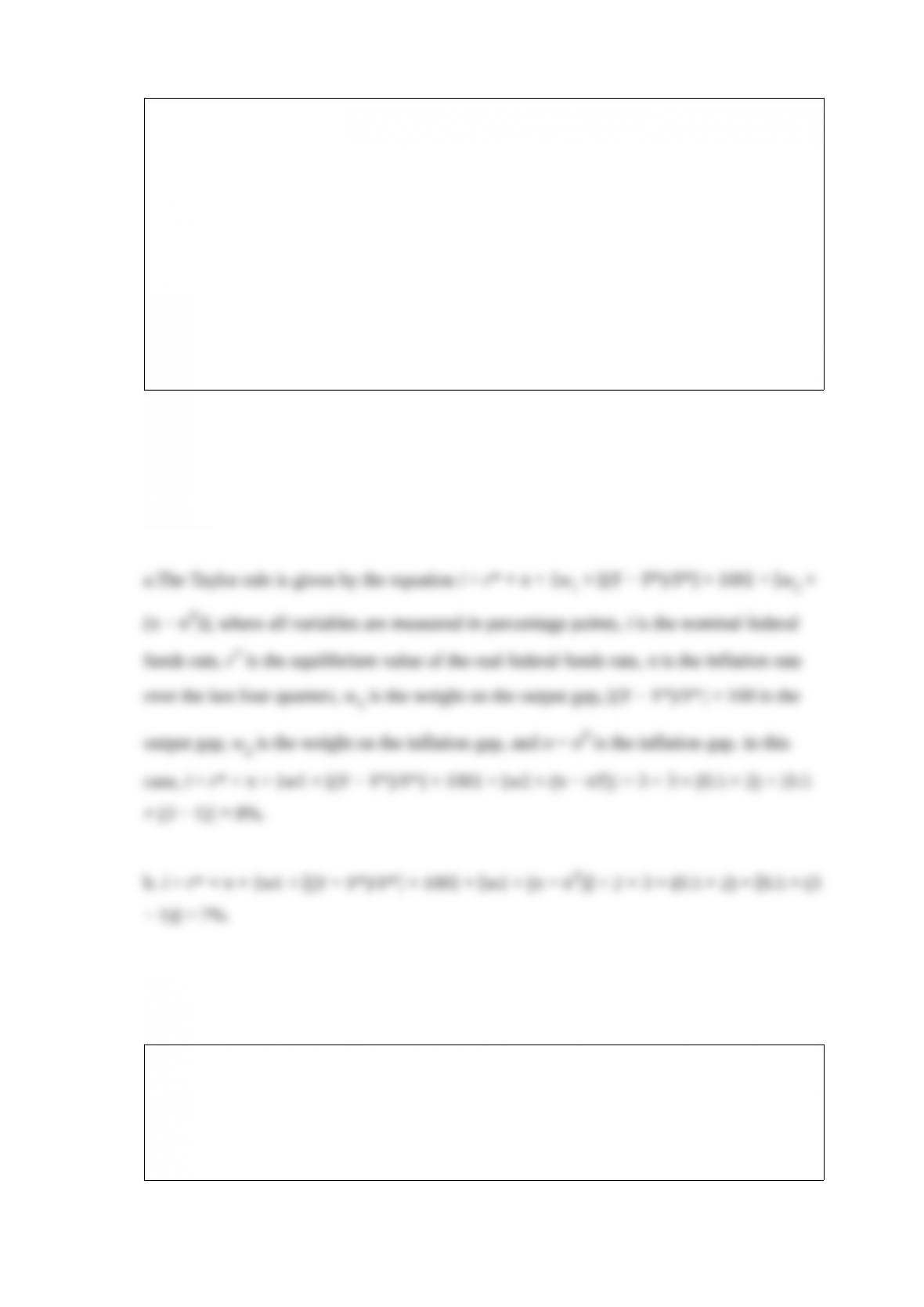
Suppose (real) output is thought to be 2 percent above potential with an inflation rate of
3
a. percent over the past year. The weights on the output gap and inflation gap are each
1/2. The inflation target is 1 percent. If you are sure that the equilibrium real federal
funds rate is
3 percent, what is the Fed’s setting for the federal funds rate, according to the Taylor rul
e?
b. If you are sure that the equilibrium real federal funds rate is 2 percent, what is the
Fed’s setting for the federal funds rate, according to the Taylor rule?
Answer:
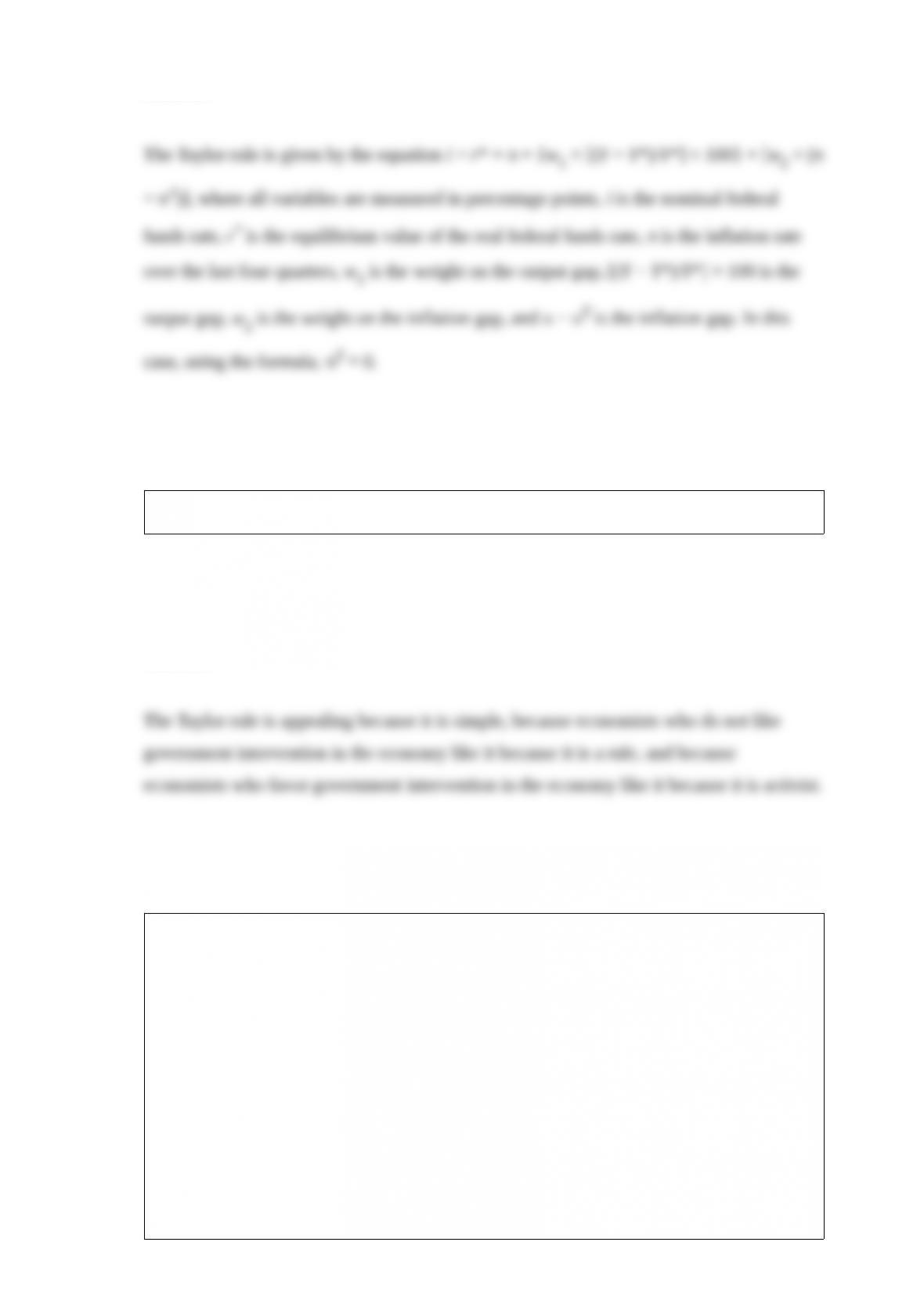
Suppose the federal funds rate is 4.4 percent and you know that the Fed is following the
Taylor rule. You don’t know the Fed’s inflation target, but the equilibrium real interest
rate is 4 percent, the inflation rate is 3 percent, the weight on the GDP gap is 0.4, the
weight on the inflation gap is 0.6 and nominal GDP is 2 percent points below its target.
Calculate the Fed’s inflation target from this information.
Answer:
Why does the Taylor rule have such wide appeal?
Answer:
a.You are negotiating a book deal for your newest novel in which an economist
single-handedly saves the world. The publisher offers to pay you an advance of $1
million today plus $500,000 at the end of each of the next three years. What is the
present value of these payments, given the annual rate of discount is 5percent?
Show your work.
b.You counter the publisher’s offer with a counteroffer that will pay you $1.5 million
today plus $5 per book sold in each of the next three years. You think you will sell
80,000 books each year in the next three years, but the publisher thinks you will only
sell 40,000 books each year.
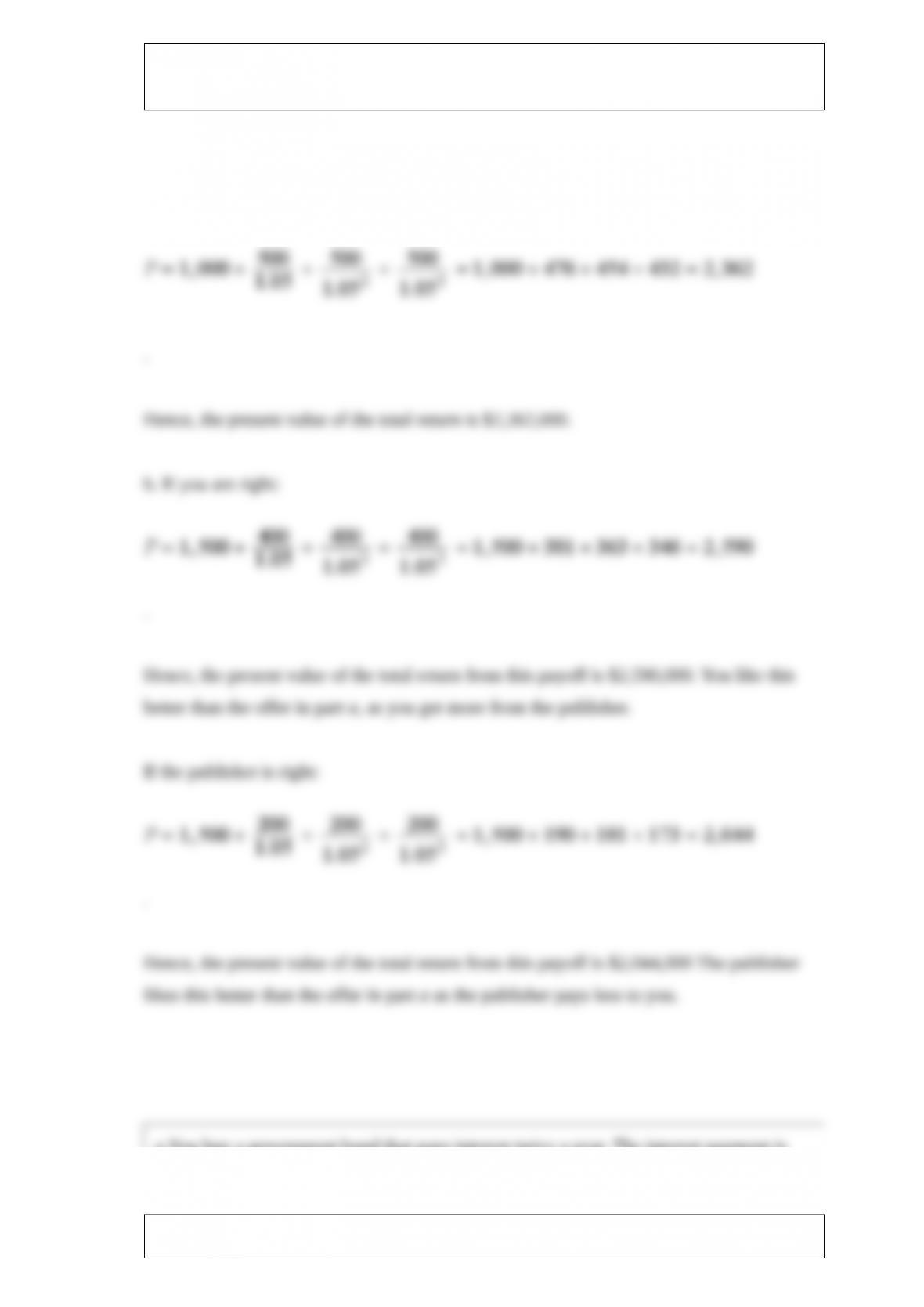
Explain why both you and the publisher like this counteroffer better than the deal in
part a. Show your work.
Answer:
a.You buy a government bond that pays interest twice a year. The interest payment is
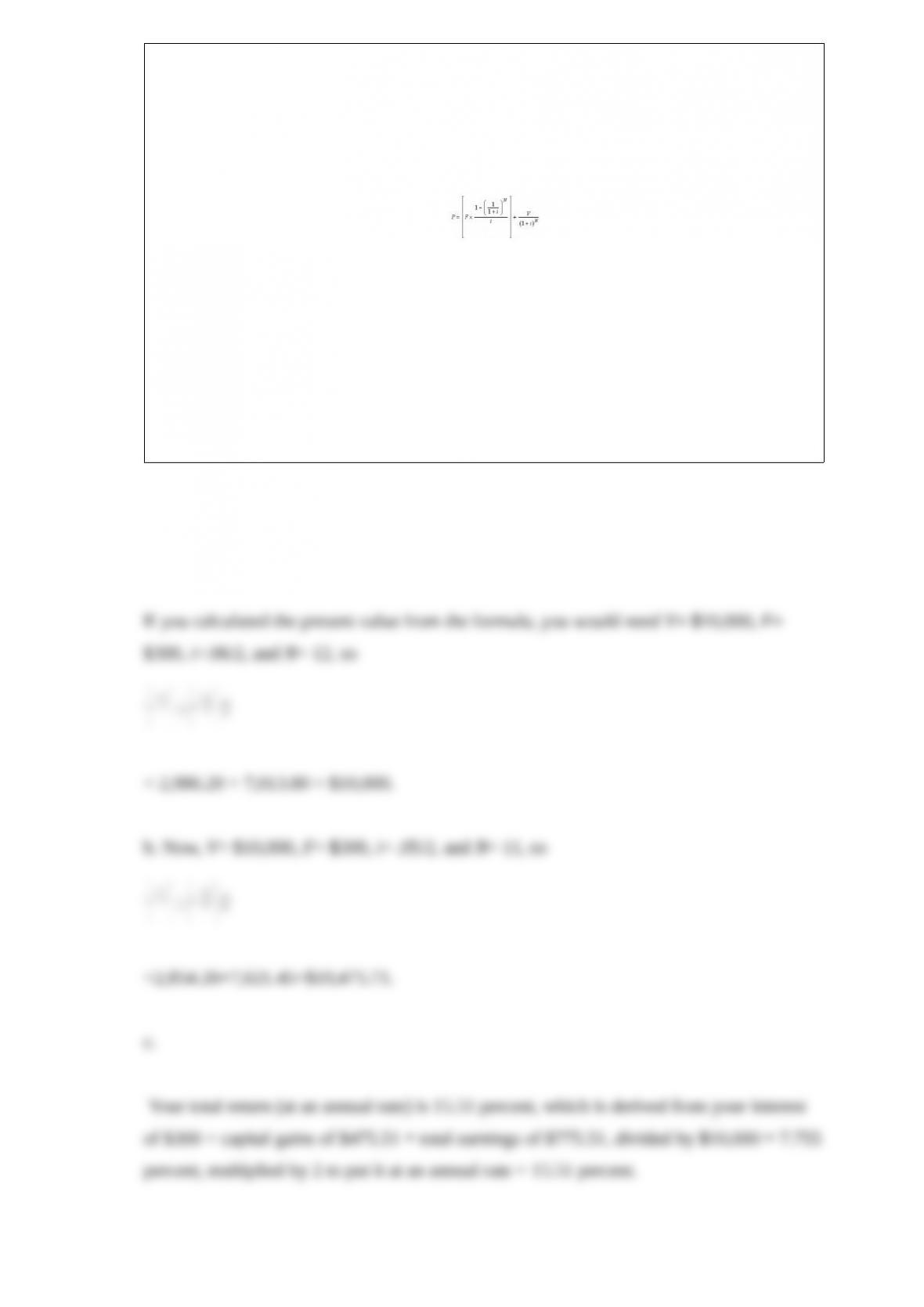
$300 each six months. The bond matures in six years. The face value of the bond is
$10,000. The annual market interest rate is 6 percent. What is the present value of the
bond? Show your
work.
A formula that may be useful to you is:
.
b.After six months go by, you receive the first interest payment of $300. The annual
market b. interest rate has declined to 5 percent and you decide to sell the bond. What is
the bond’s present value when you sell it? Show your work.
c. What is your total return from owning the bond for six months (expressed at an
annual rate, in percentage points, with two decimals)? Show your work.
Answer:

Which of the following is NOT a reason for the government to regulate banks?
a. To reduce the externalities caused by bank problems
b. To stabilize the money supply
c. To prevent bank runs
d. To keep banks large
Answer:
Which of the following is a reason for the government to regulate banks?
a. To prevent bank runs
b. To prevent the situation of contagion
c. To help a bank grow in size
d. To allow for the situation of a bank run
Answer:

When many depositors go to a bank at the same time to withdraw their money, there is
said to be
a. contagion.
b. a loss of depositor’s credibility.
c. a loss of reserves.
d. a bank run.
Answer:
When a bank run spreads from one bank to another, it is said to be
a. contagion.
b. a loss of depositor’s credibility.
c. a loss of reserves.
d. an over-run.
Answer:
Aggregate demand tells us
a. the amount of goods and services being purchased in an economy.

b. the amount of goods and services being produced in an economy.
c. the total demand for labor in an economy.
d. the total demand for capital in an economy.
Answer:
Aggregate supply tells us
a. the amount of goods and services being purchased in an economy.
b. the amount of goods and services being produced in an economy.
c. the total amount of physical capital in an economy.
d. the total amount of investments in an economy.
Answer:
The largest component of aggregate demand is
a. net exports.
b. government spending.
c. investment.

d. consumption.
Answer:
Purchases of new houses are part of
a. net exports.
b. government spending.
c. investment.
d. consumption.
Answer:
Which of the following statements is true?
a. A short-term bond and a long-term bond provides the same premium.
b. Investors in short-term bonds earn higher premiums than investors in long-term
bonds.

c. A change in the interest rates of bonds affect the prices of long-term bonds more than
the prices of short- term bonds.
d. A change in the interest rates of bonds affect the prices of short-term bonds more than
the prices of long- term bonds.
Answer:
Which of the following statements is true?
a. The prices of debt securities fall during recessions.
b. Interest rates on neither the short-term securities nor the long-term securities fall in
recession.
c. Interest rates on long-term securities fall more than the interest rates on short-term
securities in recession. d. Interest rates on short-term securities fall more than the
interest rates on long-term securities in recession.
Answer:
Suppose you buy an inflation-indexed bond that will adjust with inflation and thus pay
you $1,500 in real (inflation- adjusted) terms in one year. The nominal interest rate is 4
percent and the expected inflation rate is 2 percent. What is the present value of the
bond? (Round off your answer to the nearest dollar and pick the answer closest to the
one you calculate.)
a. $1,415

b. $1,442
c. $1,471
d. $1,530
Answer:
Consider the following production function
Y= A×Ka×L1−a.
If a = 0.4, and over the past year total factor productivity (TFP) grew 2.6 percent,
capital grew 2 percent, and labor grew 1 percent, what was the growth rate of output
over the year?
a. 2 percent
b. 3 percent
c. 4 percent
d. 5 percent
Answer:
Consider the following production function
Y= A×Ka×L1−a.

If a = 0.3, and over the past year total factor productivity grew 2.3 percent, capital grew
2 percent, and labor grew 3 percent, what was the growth rate of output?
a. 0 percent
b. 5 percent
c. 2 percent
d. 7 percent
Answer:
In the ATM model of money, the opportunity cost of holding money is determined by
a. the rate of inflation.
b. the cost of going to an ATM.
c. the charges levied on every ATM transaction.
d. the nominal interest rate and the possibility of having her money stolen.
Answer:
What is the average cash holdings of someone who visits the ATM once every 8 days
and spends $25 on a daily basis?

a. $12.50
b. $25
c. $100
d. $200
Answer:
How much is someone who visits the ATM once every 7 days and has an average cash
balance of $70 expected to spend daily?
a. $5
b. $10
c. $15
d. $20
Answer:
Researchers who support the RBC model found out that an RBC model could account
for as much as____of the fluctuations in output growth.
a. 70 percent

b. 60 percent
c. 50 percent
d. 75 percent
Answer:
Critics of RBC models argue that
a. they cannot be solved analytically.
b. are subject to measurement errors.
c. it is not possible to replicate the models.
d. the models are estimated imprecisely.
Answer:
In RBC models, the government
a. is the main source of business cycles.
b. plays little role in the business cycle.
c. can affect the business cycle through predictable fiscal policy.
d. can affect the business cycle through predictable monetary policy.
Answer:
Which of the following is an advantage of using dynamic models?
a. They help us understand how people form expectations about future economic
variables.
b. They help us understand the consumption decision of economic agents at a given
point in time.
c. They help us understand the production decisions of firms at a given point in time.
d. They help us understand the movements in the business cycle.
Answer:
During the 2008-2009 financial crisis, the dollar_______in real terms. After the crisis
ended, the dollar____in real terms.
a. appreciated slightly; appreciated
b. depreciated slightly; depreciated
c. appreciated sharply; depreciated
d. depreciated sharply; appreciated
Answer:
A measure of the flow of goods and services out of a country into other countries or
other items that cause payments to flow into the country is
a. the national savings account balance.
b. the balance on current account.
c. the capital account balance.
d. the capital and financial account balance.
Answer:
An unexpected change in an exogenous variable is known as
a. a shock.
b. a fluctuation.
c. an anachronism.
d. a calibration.
Answer:
Which of the following statements is true?
a. A shock affects all countries to the same extent.
b. Some shocks are positive and some are negative.
c. Some shocks benefit one country and harm others.
d. The same shock cannot affect more than one country at once.
Answer:
In the late 1980s and the 1990s, the correlation between output growth in the
a. United States and Europe rose while the correlation between output growth between
the United States and
Japan fell.
b. United States and Europe fell while the correlation between output growth between
the United States and
Japan rose.
c. United States and Europe and the United States and Japan, both fell.
d. United States and Europe and the United States and Japan, both rose.
Answer:
Shocks are transmitted internationally by all of the following mechanisms EXCEPT by
a. trade effects.
b. interest-rate effects.
c. exchange-rate effects.
d. expected-inflation effects.
Answer:
Interest-rate parity is best described by the equation
a.
b.
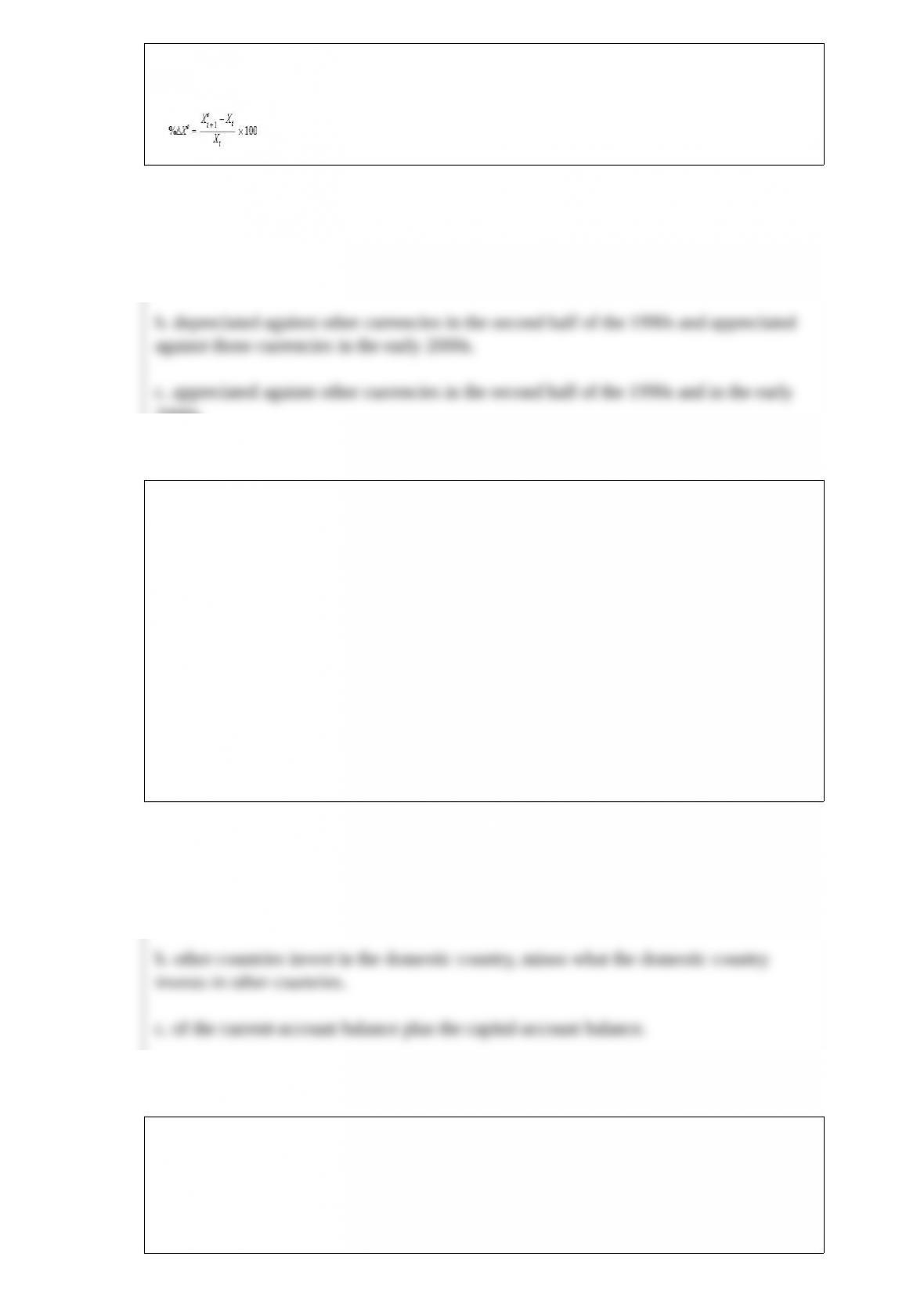
c.%ΔX = %Δx + πF − π.
d.
Answer:
In broad real terms, the dollar
a. depreciated against other currencies in the second half of the 1990s and in the early
2000s.
b. depreciated against other currencies in the second half of the 1990s and appreciated
against those currencies in the early 2000s.
c. appreciated against other currencies in the second half of the 1990s and in the early
2000s.
d. appreciated against other currencies in the second half of the 1990s and depreciated
against those currencies in the early 2000s.
Answer:
A country’s net foreign investment is equal to the amount
a. the domestic country invests in other countries, minus what other countries invest in
the domestic country.

b. other countries invest in the domestic country, minus what the domestic country
invests in other countries.
c. of the current-account balance plus the capital-account balance.
d. of portfolio investment made by the domestic country in other countries, minus the
amount of portfolio investment other countries make in the domestic country.
Answer:
There are Federal Reserve Banks located around the United States.
a. seven
b. ten
c. twelve
d. fifteen
Answer:
In which of the following cities is a Federal Reserve Bank NOT located
a. Richmond.
b. Denver.

c. Kansas City.
d. St. Louis.
Answer:
Which of the following Federal Reserve Banks performs the role of buying or selling
currencies in the foreign exchange market?
a. The Federal Reserve Bank of Minneapolis
b. The Federal Reserve Bank of Boston
c. The Federal Reserve Bank of New York
d. The Federal Reserve Bank of San Francisco
Answer:
A transaction in which the Fed agrees to buy a security one day and sell it back the next
day is referred to as a(n)
a. overnight securitization operation.
b. repurchase agreement.
c. legal tender.

d. rebate sale.
Answer:
The money supply in an economy equals
a. monetary base plus money multiplier.
b. monetary base divided by money multiplier.
c. money multiplier divided by monetary base.
d. money multiplier multiplied by monetary base.
Answer:
The main asset on the Federal Reserve’s balance sheet is
a. discount loans.
b. securities.
c. monetary base.
d. capital.

Answer:
The main liability on the Federal Reserve’s balance sheet is
a. discount loans.
b. securities.
c. the monetary base.
d. capital.
Answer:
Currency held by the nonbank public plus banks’ vault cash plus banks’ deposits at the
Fed equals
a. the Fed’s capital stock.
b. discount loans.
c. the monetary base.
d. required clearing balances.
Answer:
A secondary credit discount loan has an interest rate that is a primary credit discount
loan.
a. 1/4
b. 1/2
c. 1
d. 2
Answer:
The supply curve of reserves in an economy is horizontal when
a. the federal funds rate is greater than the seasonal credit discount rate.
b. the federal funds rate is less than the secondary credit discount rate.
c. the federal funds rate equals the primary credit discount rate.
d. the federal funds rate is less than the primary credit discount rate.
Answer:

An increase in the amount of discount loans by the Fed
a. increases the money supply by an amount equal to the increase in the loans times the
multiplier.
b. decreases the money supply by an amount equal to the increase in the loans times the
multiplier.
c. decreases the money supply by an amount greater than the increase in the loans times
the multiplier.
d. increases the money supply by an amount lower than the increase in the loans times
the multiplier.
Answer:
Which of the following is true of an economy in a liquity trap?
a. The money supply in the economy increases rapidly as additions are made to the
monetary base.
b. The economy’s nominal short-term interest rates become close to zero.
c. The banks in the economy do not hold any reserves.
d. The economy’s interest rates decline when there is an increase in the monetary base.
Answer:

The Fed uses_____monetary policy to cause the economy to grow faster in the short
run. A(n)_____in the money supply is an example of such a policy.
a. expansionary; decrease
b. expansionary; increase
c. contractionary; increase
d. contractionary; decrease
Answer:
A decrease in the money supply is an example of a(n) policy.
a. countercyclical
b. procyclical
c. contractionary
d. expansionary
Answer:
In comparison to when monetary policy is not expansionary, under an expansionary
monetary policy, the unemployment rate is and the inflation rate is over time.
a. higher; higher
b. higher; lower
c. lower; lower
d. lower; higher
Answer:
In comparison to when monetary policy is not contractionary, under a contractionary
monetary policy, the unemployment rate is and the inflation rate is over time.
a. higher; higher
b. higher; lower
c. lower; lower
d. lower; higher
Answer:
If the mortgage-tilt problem does not exist in an economy, it implies that the ____rate in
the economy is zero percent.
a. inflation
b. unemployment
c. interest
d. average tax
Answer:
Typically, the ideal inflation rate is taken to be
a. increasing over time.
b. decreasing over time.
c. positive and constant over time.

d. zero percent.
Answer:
The ideal inflation rate is also referred to as the
a. steady state inflation rate.
b. NAIRU.
c. inflation target.
d. minimal inflation rate.
Answer:
The systematic setting of policy according to a formula is known as
a. credibility.
b. an expectations trap.

c. discretionary policy.
d. a rule for monetary policy.
Answer:
If monetary policy is not set by a rule, it is said to be set by
a. randomization.
b. discretion.
c. credibility.
d. destabilization.
Answer:
When a central bank increases money growth, the bank is said to policy.
a. restrict
b. tighten
c. destabilize
d. ease
Answer:
The Fed eases policy when it
a. decreases both the money growth and the federal funds rate.
b. decreases the money growth and increases the federal funds rate.
c. increases both the money growth and the federal funds rate.
d. increases the money growth and decreases the federal funds rate.
Answer:
The Taylor rule implies that the nominal federal funds rate should be increased if there
is a______output gap or a_____inflation gap.
a. positive; positive
b. positive; negative
c. negative; positive
d. negative; negative
Answer:
The central bank of a country follows the Taylor rule to set its interest rate. If the
equilibrium real interest rate rises by 1 percentage point, all other variables remaining
unchanged,
a. the central bank should raise the nominal interest rate by 1 percentage point.
b. the central bank should lower the nominal interest rate by 1 percentage point.
c. the central bank should raise the nominal interest rate by 0.5 percentage points.
d. the central bank should lower the nominal interest rate by 0.5 percentage points.
Answer:

Economic policy affects
a. only the amount of money in the economy.
b. only the lending policy of financial intermediaries.
c. the entire financial system.
d. how financial securities are traded and no other part of the financial system.
Answer:
Which of the following is NOT a financial policymaker?
a. Securities and Exchange Commission (SEC)
b. Federal Deposit Insurance Corporation (FDIC)
c. Consumer Financial Protection Bureau (CFPB)
d. Federal Reserve System (the Fed)
Answer:
Which policymaking institution determines the money supply, sets the rules for how
checks are cleared and how banks obtain new currency, and determines what activities
banks may or may not engage in?
a. Treasury Department.
b. Commerce Department.
c. Securities and Exchange Commission.
d. Federal Reserve System.
Answer:
The financial system consists of
a. all the securities, intermediaries, and markets that exist to match savers and
borrowers.
b. all transactions occurring in the goods market during a financial year.
c. all markets that exist to match the buyers and suppliers of various factors of
production.
d. all transactions involving the government.
Answer:
Which of the following will be included in the financial system of a country?

a. Labor Unions
b. Banks
c. Factor markets
d. Markets for raw materials
Answer:
In the financial system, savers transfer funds to borrowers in exchange for
a. cash.
b. gold.
c. financial securities.
d. derivative securities.
Answer:
When people use money by trading it for goods and services, money is serving the role
of
a a. medium of exchange.
b. unit of account.

c. store of value.
d. standard of deferred payment.
Answer:
As a medium of exchange, money makes exchanges easier by reducing
a. inflation.
b. transactions costs.
c. production costs of goods.
d. legal costs in negotiating loan contracts.
Answer:
Costs of trading are referred to as_______costs.
a. trading
b. menu
c. shoe-leather
d. transactions

Answer:
The amount of money invested in a financial security or deposited into a financial
intermediary is referred to as the
a. principal.
b. interest.
c. yield.
d. capital-gain.
Answer:
The amount of money that you would need to invest today to yield a given future
amount is called the
a. future value.
b. present value.
c. rate of discount.
d. discount factor.

Answer:
If the principal invested in a bank at an annual interest rate of 6% is $3,000, the interest
that will accumulate on the principal after a year will equal
a. $180.
b. $300.
c. $500.
d. $700.
Answer:
Which of the following is a security in which a saver buys the security for a given time
to maturity, earning interest at the specified rate?
a. Commercial paper
b. Debenture
c. Government bond
d. Certificates of deposit
Answer:

The process of turning assets such as mortgages into bonds sold to investors is
a. default.
b. standard deviation.
c. standardization.
d. securitization.
Answer:
A debt security sold by large corporations to raise shortterm funds is known as a(n)
a. commercial paper.
b. treasury bill.
c. debenture.
d. bond.
Answer:

The amount of interest paid on a debt security in dollar terms as a percent of the
principal is referred to as the
a. expected real interest rate.
b. realized real interest rate.
c. after-tax real interest rate.
d. nominal interest rate.
Answer:
The real interest rate is the nominal interest rate adjusted for expected or actual
a. unemployment.
b. production.
c. income growth.
d. inflation.
Answer:
The nominal interest rate adjusted for expected inflation is the
a. expected real interest rate.

b. realized real interest rate.
c. after-tax real interest rate.
d. yield curve.
Answer:
The nominal interest rate adjusted for actual inflation is the
a. expected real interest rate.
b. realized real interest rate.
c. after-tax real interest rate.
d. yield curve.
Answer:
Shareholders are also called
a. bondholders.
b. brokers.
c. stockholders.

d. debt-holders.
Answer:
Which of the following statements is true?
a. Stockholders benefit when the price of the stocks they hold rises and lose when the
price of the stocks they
hold falls.
b. Stockholders benefit when the price of the stocks they hold falls and lose when the
price of the stocks they
hold rises.
c. Stockholders have the right to participate in the decision making of a company but
are not entitled to dividend
payments.
d. Stockholders are entitled to dividend payments but do not have the right to
participate in the decision making
of a company.
Answer:

A place where people buy or sell stocks is known as a stock
a. exchange.
b. index.
c. fund.
d. holding.
Answer:
A financial intermediary that accepts deposits from savers, and makes loans to
borrowers is a
a. stock exchange.
b. bond market.
c. bank.
d. finance company.
Answer:
When one party to a transaction knows more than another, the situation is one of
a. rational expectations.

b. imperfect credibility.
c. opportunity cost.
d. asymmetric information.
Answer:
Borrowers know more about their abilities to repay loans than the banks do. This is a
situation of
a. adverse selection.
b. rational behavior.
c. credit crunch.
d. bank run.
Answer:
The main problems caused by asymmetric information are
a. irrational expectations and moral hazard.
b. imperfect credibility and adverse selection.

c. adverse selection and irrational expectations.
d. adverse selection and moral hazard.
Answer:
Which of the following is NOT a reason for the government to regulate banks?
a. To reduce the externalities caused by bank problems
b. To stabilize the money supply
c. To prevent bank runs
d. To keep banks large
Answer:
Which of the following is a reason for the government to regulate banks?
a. To prevent bank runs
b. To prevent the situation of contagion
c. To help a bank grow in size
d. To allow for the situation of a bank run

Answer:
When many depositors go to a bank at the same time to withdraw their money, there is
said to be
a. contagion.
b. a loss of depositor’s credibility.
c. a loss of reserves.
d. a bank run.
Answer:
When a bank run spreads from one bank to another, it is said to be
a. contagion.
b. a loss of depositor’s credibility.
c. a loss of reserves.
d. an over-run.
Answer:

In which period was the rate of output growth the fastest in the U.S. economy?
a. 1929−1949
b. 1949−1970
c. 1970−1982
d. 1982−2010
Answer:
The labor force consists of
a. those employed plus those on temporary layoff.
b. those employed plus those unemployed.
c. the working-age population minus those who are in the military or institutionalized.
d. the working-age population plus those who are in the military or institutionalized.
Answer:

15 million people in a country are employed and 2.5 million are unemployed while 1
million are retired workers. The size of the country’s labor force is
a. 15 million.
b. 18.5 million
c. 17.5 million
d. 11.5 million.
Answer:
In the ATM model of money, the opportunity cost of holding money is determined by
a. the rate of inflation.
b. the cost of going to an ATM.
c. the charges levied on every ATM transaction.
d. the nominal interest rate and the possibility of having her money stolen.
Answer:
What is the average cash holdings of someone who visits the ATM once every 8 days

and spends $25 on a daily basis?
a. $12.50
b. $25
c. $100
d. $200
Answer:
How much is someone who visits the ATM once every 7 days and has an average cash
balance of $70 expected to spend daily?
a. $5
b. $10
c. $15
d. $20
Answer:
In the CAPM, systematic risk
a. is also known as idiosyncratic risk.

b. can be diversified away.
c. is also known as market risk.
d. is the risk to a stock’s return that is not attributable to the fluctuations in the overall
stock market.
Answer:
The present value of a perpetuity that pays $F every year when the annual rate of
discount is i is
a. F/(1 + i).
b. F×i.
c. F/i.
d. F + i.
Answer:
In the CAMELS rating system, the letter L stands for
a. liquidity.
b. losses.
c. legal environment.
d. loan documentation.
Answer:
The document that a bank must fill out quarterly, reporting its assets, liabilities, and
profits to the government, is called a
a. balance-sheet analysis.
b. P&L statement.
c. white paper.
d. call report.
Answer:
Suppose the Fed’s Open-Market Desk thinks the downward-sloping portion of the
demand for reserves is given by the equation
D= 28 − (3 × i),where iis the federal funds rate in percent and D is expressed in billions
of dollars. Suppose the Fed is currently supplying $26.5 billion in nonborrowed
reserves. There are no secondary or seasonal credit discount loans. The primary credit
discount rate is currently set at 2 percent and the interest rate on reserves is 30 percent.
The Fed’s target for the federal funds rate is 1 percent.
a. Does the Desk need to change the supply of reserves in the market? How much does
it need to add or withdraw from the market? After carrying out its daily actions, what
will be the equilibrium amount of reserves and discount loans?
b. Suppose the demand curve for reserves shifts to D= 35 − (3 × i).
The Fed does not realize that the demand curve has shifted, so it keeps the supply of
nonborrowed reserves at the level you determined in part a. Calculate the equilibrium
federal funds rate, reserves, and the amount of primary credit discount loans.
Answer:

A basis point equals
a. one hundredth of a percentage point.
b. one tenth of a percentage point.
c. one half of a percentage point.
d. ten percentage points.
Answer:
If the actual inflation rate in an economy is 6% and the ideal inflation rate is 4%, the
inflation gap in the economy is
a. 2%.
b. 4%.
c. 2%.
d. 6%.
Answer:
A disadvantage of univariate time-series models and VARs is
a. they cannot be used easily to analyze the effects of monetary policy.

b. they are based on classical, rather than Keynesian, economic theory.
c. they provide poor forecasts.
d. they are not based on data.
Answer:
With the price level measured on the vertical axis and output measured on the
horizontal axis, the long-run aggregate-supply curve
a. is vertical.
b. is upward-sloping.
c. is horizontal.
d. is downward-sloping.
Answer:
If the ratio of currency to transaction accounts is 2, the ratio of nontransaction accounts
to transaction accounts is 5, the ratio of retail money-market funds to transaction
accounts is 1, the ratio of required reserves to transaction accounts is 0.08, and the ratio
of excess reserves to transaction accounts is 0.02, the M1 multiplier is about
a. 1.42.

b. 2.12.
c. 2.81.
d. 4.24.
Answer:
An on-the-run ten-year Treasury security is
a. a ten-year government bond that is in greatest demand by investors who want to hold
it until it matures.
b. a ten-year government bond that can be used to pay estate taxes, also known as a
flower bond.
c. a non-taxable ten-year government bond.
d. a ten-year government bond that was the most recently issued.
Answer:
In which of the following periods was total factor productivity growth the fastest in the
U.S. economy?
a. Long boom

b. Economic liftoff period
c. Great Depression
d. Reorganization period
Answer:
Risk that can be eliminated by diversification is
a. idiosyncratic risk.
b. market risk.
c. default risk.
d. interest-rate risk.
Answer:
A function that summarizes the relationship between the real demand for money, real
income, and the nominal interest rate is called the ________ function.
a. real money-demand
b. nominal money-demand
c. interest-income

d. real income-demand
Answer:
The periodic payments on debt securities are called
a. interest payments.
b. dividends.
c. debt swaps.
d. subordinations.
Answer:
The interest rate on short-term loans between banks is known as the
a. primary credit discount rate.
b. federal funds rate.
c. commercial paper rate.
d. T-bill rate.

Answer:
Since 1960, in which of the following years was the output gap highest in the U.S.?
a. 1970.
b. 1975.
c. 1982.
d. 2001.
Answer:
A national bank that is not in a financial holding company or a bank holding company
is mainly supervised by the
a. Federal Deposit Insurance Corporation.
b. Federal Reserve.
c. Office of the Comptroller of the Currency.
d. National Credit Union Administration.
Answer:
Suppose an investor purchased 100 shares of JDSU stock at a price of $50 per share on
December 31, 2011. On December 31, 2012, JDSU paid dividends of $1.50 per share,
and the investor received the dividends, then sold the stock at a price of $65 per share.
a. If there were no taxes or inflation, what was the total return?
b. If there were no taxes, but inflation was 5 percent, what was the real return?
c. If the tax rate was 15 percent on dividends and capital gains, what was the after-tax
real return?
Answer:

The Federal Reserve publication that discusses forecasts for the economy is known as
the
a. Redbook.
b. Beigebook.
c. Bluebook.
d. Greenbook.
Answer:
If the population of a country is 320 million, the working-age population is 215 million,
the labor force is 145 million, and the number of people who are employed is 137
million, then the unemployment rate is
a. 3.7 percent.
b. 5.5 percent.
c. 63.7 percent.
d. 94.5 percent.

Answer:
In the aggregate demand-aggregate supply model, everything else remaining
unchanged, a decrease in government spending shifts the curve to the .
a. aggregate demand; right
b. aggregate demand; left
c. aggregate supply; right
d. aggregate supply; left
Answer:
If people have rational expectations,
a. the stock market may be overvalued
b. the stock market may be undervalued.
c. stock prices are nonvolatile.
d. stock prices always equal their fundamental value.
Answer:

A bank offers credit cards with a 25 percent interest rate, when its competitors’ cards
have just a 15 percent interest rate. Despite the high rate, the bank finds itself losing
money because many of its customers fail to repay the balances on their cards. The
bank’s losses are most likely to have occurred because of
a. bad management.
b. the lock-in effect.
c. redlining.
d. adverse selection.
Answer:
If there is a significant drop in business optimism in an economy
a. the economy’s long-run aggregate supply curve shifts to the right.
b. the economy’s aggregate demand curve shifts to the left.
c. the labor supply in the economy increases in the long run.
d. the capital stock in the economy increases in the long run.
Answer:

When monetary policy eases before elections to favor incumbent politicians, it is
referred to as
a. a liquidity trap.
b. an expectations trap.
c. political creative destruction.
d. a political business cycle.
Answer:
Primary credit discount loans for profit will be zero when
a. primary credit discount rate is equal to secondary credit discount rate.
b. primary credit discount rate is greater than federal funds rate.
c. primary credit discount rate is lesser than federal funds rate.
d. primary credit discount rate is equal to nominal short-term interest rate.
Answer:
The income an investor receives in some period divided by the value of the security at

the beginning of that period is known as______ yield.
a. capital-gains
b. expected
c. current
d. realized
Answer:
The argument that a change in policy systematically alters the structure of econometric
models is known as the
a. Keynesian cross.
b. cross-equation restriction.
c. Lucas critique.
d. endogeneity principle.
Answer:
The main advisors of the Chairman of the Federal Reserve Board of Governors are
a. private economists hired as consultants.

b. the Council of Economic Advisors.
c. the U.S. Treasury Department.
d. the directors of the three staff divisions of the Board.
Answer:
Which of the following is NOT included in the call report filed by a commercial bank?
a. A report on a bank’s assets
b. A report on a bank’s liabilities
c. A report on a bank’s compliance with the Fair Lending Act
d. A report on a bank’s profits
Answer:
Which size category of banks generally has the smallest spread?
a. The 10 smallest banks
b. The 100 smallest banks
c. Medium-sized banks

d. Large banks
Answer:
The demand for U.S. currency increased in the early 1990s mainly because
a. banks began charging higher ATM fees.
b. demand increased from Eastern Europe.
c. people began hoarding coins.
d. interest rates declined, reducing the opportunity cost of holding cash.
Answer:
Why is it difficult for policymakers to set policy based on the value of the
unemployment rate relative to the natural rate of unemployment?
Answer:
Suppose the following version of the APT is a good model of risk in the stock market.
There are three factors: (1)
the stock market’s excess return, in percentage points; (2) the unemployment rate minus
its natural rate (the level the unemployment rate would be if the economy were at full
employment), in percentagepoints; and (3) the real federal funds rate minus its long-run
equilibrium value. Suppose the natural rate of unemployment is 5 percent and the
long-run equilibrium value of the real federal funds rate is 0 percent. Each of the
following stocks has the beta coefficients shown in the table below:
β1i β2i β3i
Royal Dutch Shell 3 −3 4
Merck 2 6 0
Wachovia 1 −3 −8
a.If your forecast for next year is that the risk-free interest rate next year will be 0
percent,the overall stock market will return 0 percent, the unemployment rate will be 0
percent, and the real federal funds rate will be 0 percent, what is the expected return (in
percent,with two decimals)to each of the three stocks?Show your calculations.
b.If your forecast for next year is that the risk-free interest rate next year will be 0
percent, the overall stock market will return 0 percent, the unemployment rate will be 0
percent, and the real federal funds rate will be 0 percent, what is the expected return (in
percent,with two decimals)to each of the threes tocks?Show your calculations.
Answer:
Consider the bond market to be in equilibrium according to our complete theory of the
term structure of interest rates. The current interest rate on one-year bonds is 2 percent,
and you believe, as does everyone in the market, that in one year the interest rate on
one-year bonds will be 3 percent, and in two years, the interest rate on one-year bonds
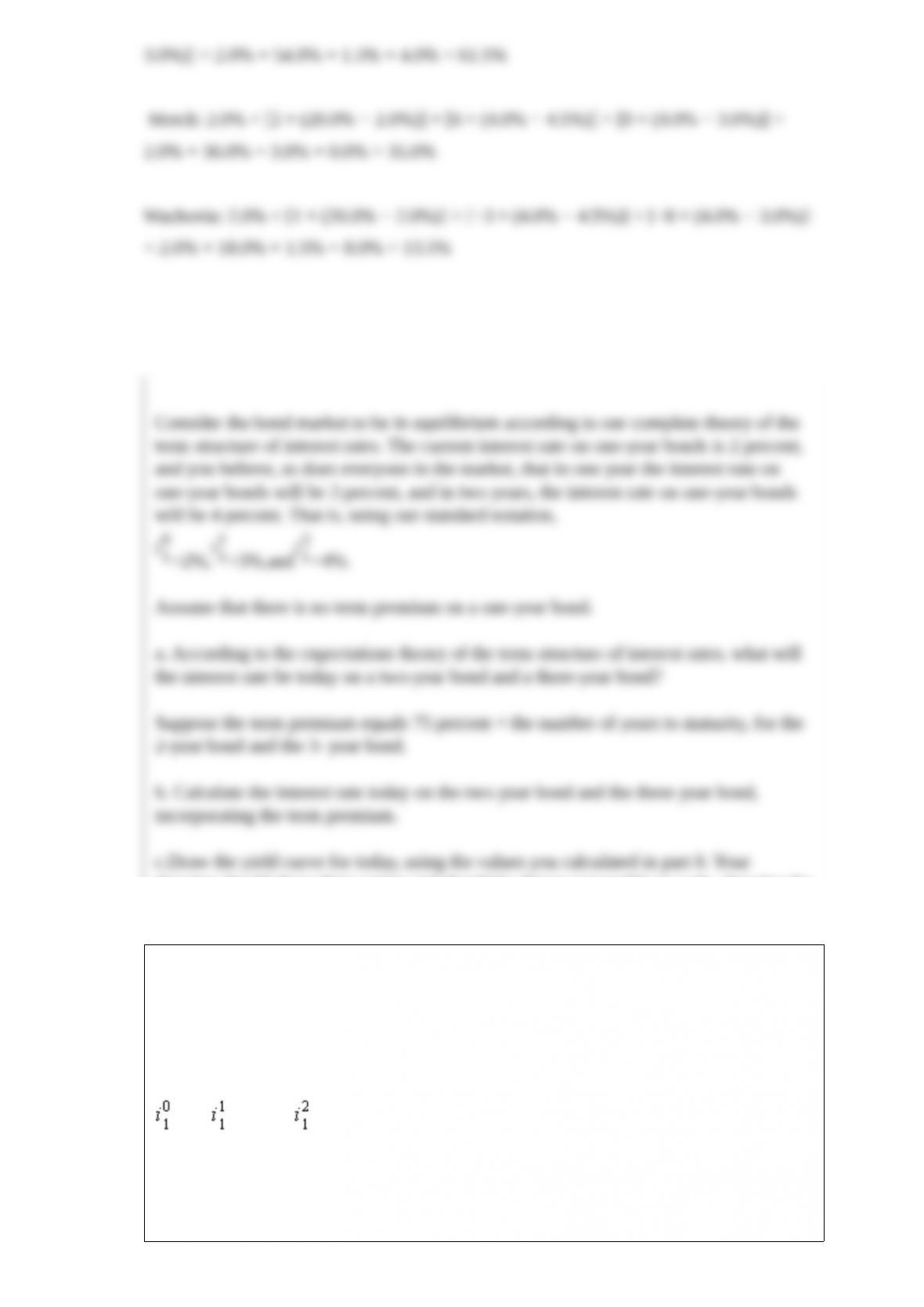
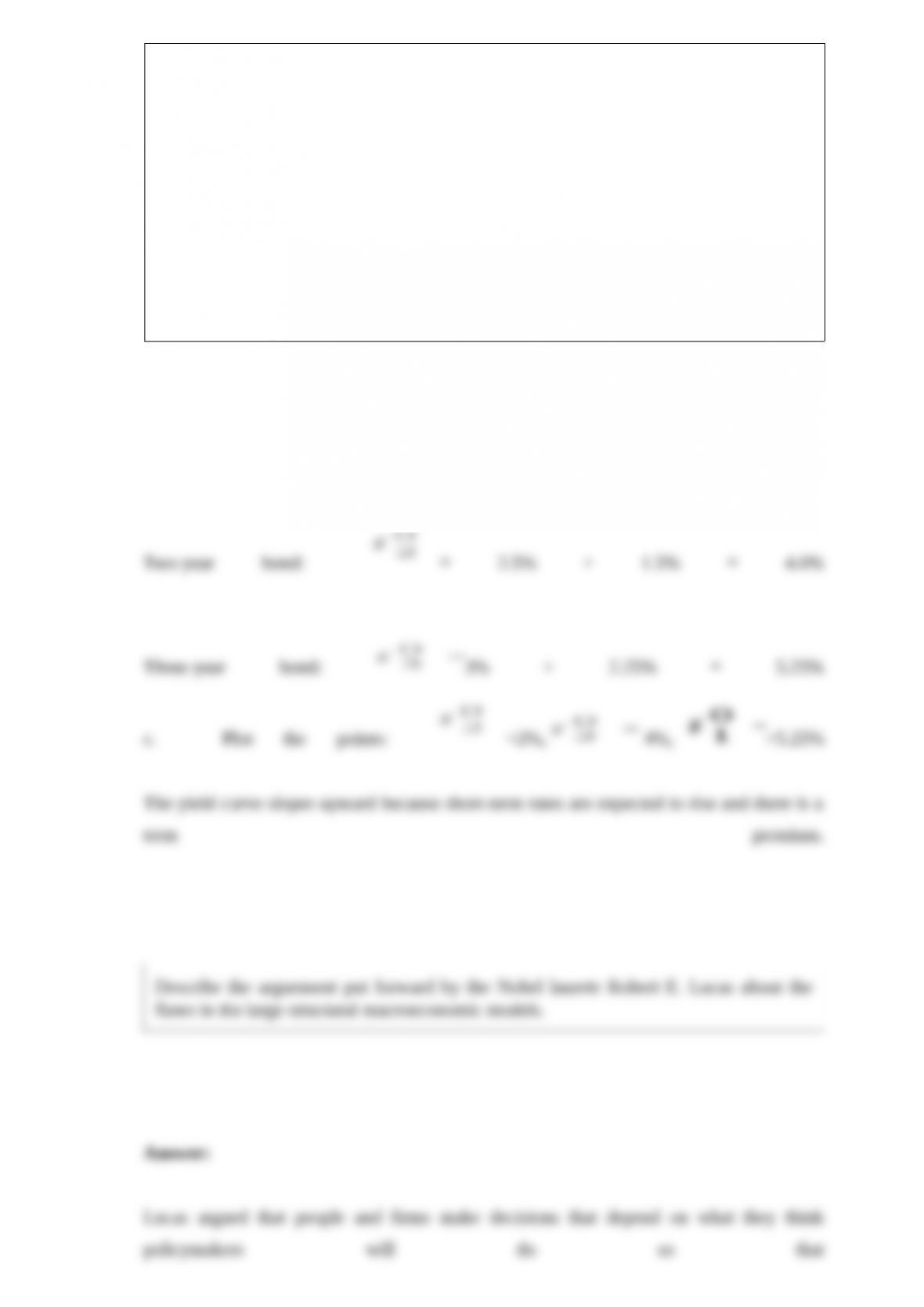
will be 4 percent. That is, using our standard notation,
=2%, =3%,and =4%.
Assume that there is no term premium on a one-year bond.
a. According to the expectations theory of the term structure of interest rates, what will
the interest rate be today on a two-year bond and a three-year bond?
Suppose the term premium equals 75 percent × the number of years to maturity, for the
2-year bond and the 3- year bond.
b. Calculate the interest rate today on the two-year bond and the three-year bond,
incorporating the term premium.
c.Draw the yield curve for today, using the values you calculated in part b. Your
drawing should show three points and should be drawn reasonably to scale, showing the
values on each axis of each point plotted. Explain briefly (in one or two sentences) why
the yield curve has the shape it does.
Answer:
Describe the arguement put forward by the Nobel laurete Robert E. Lucas about the
flaws in the large structural macroeconomic models.
Answer:
Lucas argued that people and firms make decisions that depend on what they think
policymakers will do so that
that any change in policy will systematically alter the structure of econometric models.
If the cost of going to the ATM in an economy is $1 and the nominal interest rate is 5
percent, someone who spends $10 each day and has the total cost of holding cash =
(365/T) + T, has a____ probability of having his cash lost or stolen. Assume that the
individual visits the ATM once in every T days.
a. 5 percent
b. 10 percent
c. 15 percent
d. 20 percen
Answer:
c
Describe the general procedures followed by DSGE researchers creating a new model.
Answer:
1. Pose the question to be answered.
2. Develop a model containing the major elements needed to answer the question.
Analyze the decisions that each economic agent must face.
3. Match the model up with economic data, using statistical techniques to calculate the
sizes of shocks that occur.
4. Simulate the model and compare the statistical properties of the model with those of
the data.
Answer the questions below.
a. Suppose the economy is initially in long-run equilibrium in the AD-ASmodel. Draw a
diagram showing long-run equilibrium, including the AD, LRAS, and SRAS curves.
b.Now suppose stock prices decline sharply. Draw a new diagram showing the
AD,LRAS,and b. SRAScurves. How have the level of output and the price level
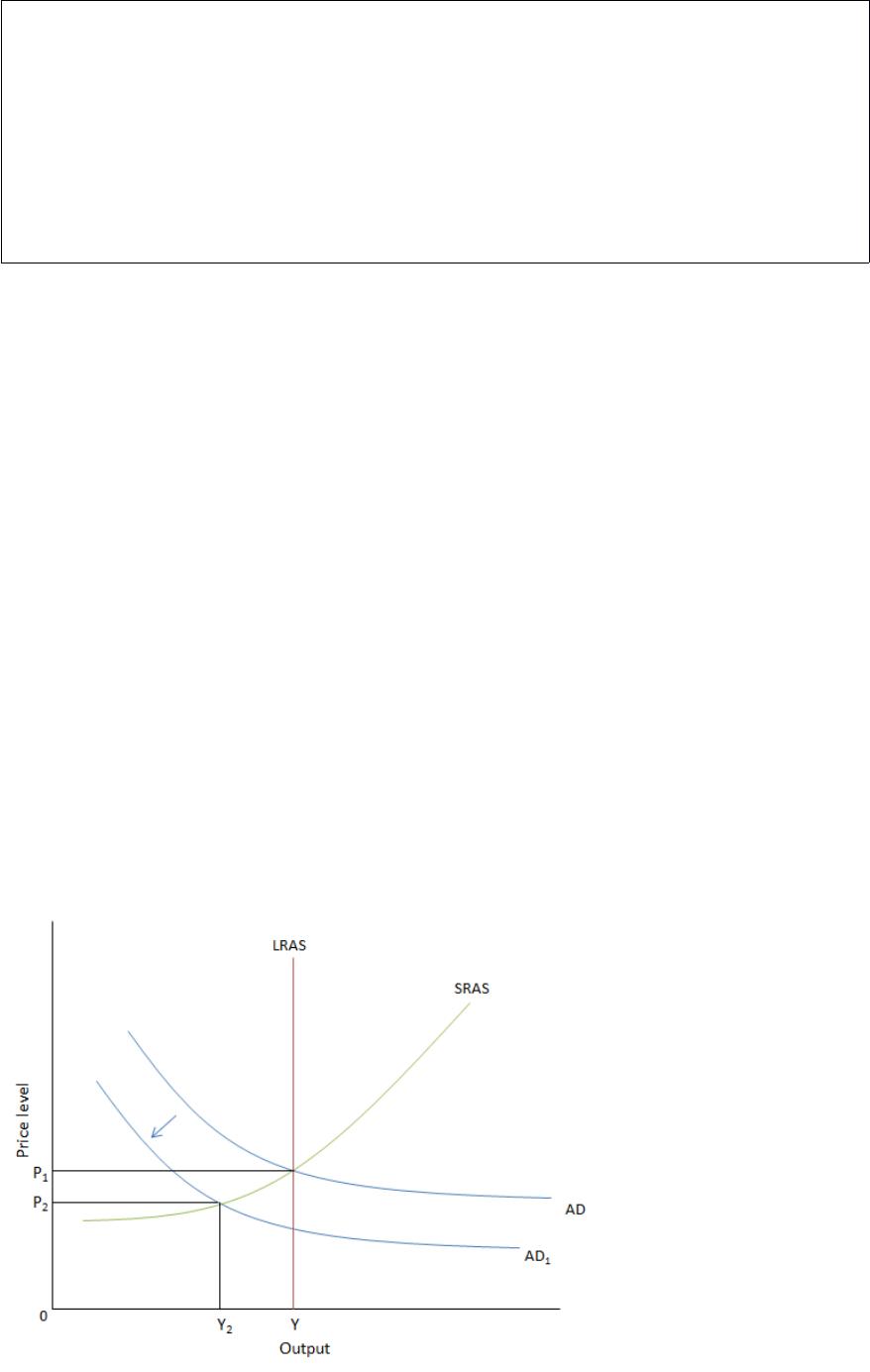
changed? What happens to consumption spending and investment spending?
c.Redraw your diagram from part b, then draw new lines to show what would happen if
the Fed changed monetary policy to return the economy to full-employment
equilibrium. Does the money supply increase or decrease? Which curve (AD, LRAS, or
SRAS) shifts as a result of the Fed’s policy change? What happens to the price level and
level of output compared withwhat they were in part b? What happens to consumption
spending and investment spending compared with what they were in part b?
Answer:
a. Standard diagram from the text book.
b.The decline in the stock market shifts the AD curve to the left, so output and price level
both decline. The decline in output reduces both consumption spending and investment
spending. Standard diagram.
c.When the Fed increases the money supply, the long-run equilibrium is restored by
shifting the AD curve to the right. The price level and level of output are higher than they
were in part b; as a result, consumption and investment are also higher. Standard diagram
from the textbook.
A thrift institution_____have Federal Deposit Insurance Corporation insurance and, in
general,_____own or be owned by a commercial firm. a. must; cannot
b. is not required to; cannot
c. must; can
d. is not required to; can
Answer:
c
If the federal funds rate is below its target, the Fed is likely to_____securities in the
open market, which will cause the federal funds rate to_____ .
a. buy; increase
b. buy; decrease
c. sell; decrease
d. sell; increase
Answer:
d
Assume that the only good traded between Mexico, the U.S., and Canada is chicken,
which is produced by all three countries. If the cost of producing a pound of chicken is
5 pesos in Mexico, 1 U.S. dollar in the U.S., and 2 Canadian dollars in Canada, and if
the law of one price holds, what are each of the exchange rates between the three
countries?
Answer:
Because chicken is the only traded good and the law of one price holds, then 5 pesos = 1
U.S. dollar = 2 Canadian dollars, so the exchange rates are 5 pesos per U.S. dollar or 0.2
U.S. dollars per peso; 2 Canadian dollars per U.S. dollar or 0.50 U.S. dollars per Canadian
dollar; and 2.5 pesos per Canadian dollar or 0.4 Canadian dollars per peso.
The___ appoint one of the members of the Federal Reserve Board of Governors as
chairman of the Board of Governors for a _____ ,___term.
a. President of the United States; non-renewable; fourteen-year
b. Board of Directors; renewable; five-year
c. U.S. Senate; non-renewable; seven-year
d. President of the United States; renewable; four-year
Answer:
d
What are the advantages and disadvantages of VAR models?
Answer:
The advantages of VAR models are that all the variables in the model are endogenous, the
impact of a shock to one variable can be examined to see how it affects all the other
variables, and you can see how important one variable is for explaining the movements in
other variables. Disadvantages are that they are difficult to use for interpreting historical
events and for analyzing the effects of shocks, especially shocks to monetary or fiscal
policy.
What is the Basel III Accord?
Answer:
The 2010 Basel III agreement imposed higher capital requirements on banks around the
world. The current accord reversed the movement toward granting banks more freedom
from regulatory control.
Describe the effect of expansionary monetary policy in a recession. Contrast the results
with no monetary policy action.
Answer:
The ADcurve increases. Output quickly returns to full employment and the price levels
rises. If there is no monetary policy change, the SRAScurve gradually increases. Full
employment is eventually reached and the price level drops.
Suppose the exchange rate adjusts so that interest-rate parity holds. Also assume that
the interest rate on a one-year Canadian bond is 3 percent and the interest rate on a
one-year U.S. bond is 5 percent.
a. If the exchange rate today is 1.40 Canadian dollars per U.S. dollar, what do you
expect the exchange rate to be one year from now?
b. Suppose relative purchasing-power parity holds, and the inflation rate in Canada is
expected to be 1 percent over the next year. What is the expected inflation rate in the
United States?
Answer:
iC= 3%; iUS= 5%. Interest-rate parity implies iUS= iC− %ΔXe; note that the equation must
be written this way because the exchange rate is written in Canadian dollars per U.S.
dollar.
a. By the interest-rate parity equation:
iUS= iC− %ΔXe.
So, 5% = 3% − %ΔXe. So, %ΔXe= −2%.
By definition: .
If the exchange rate today is 1.4 Canadiandollars/U.S.dollars,then
So,
So,
b.
If relative purchasing-power parity holds, then %ΔX = πC − πUS.
Since %ΔXe = −2% = 1% − πUS, then πUS = 3%.
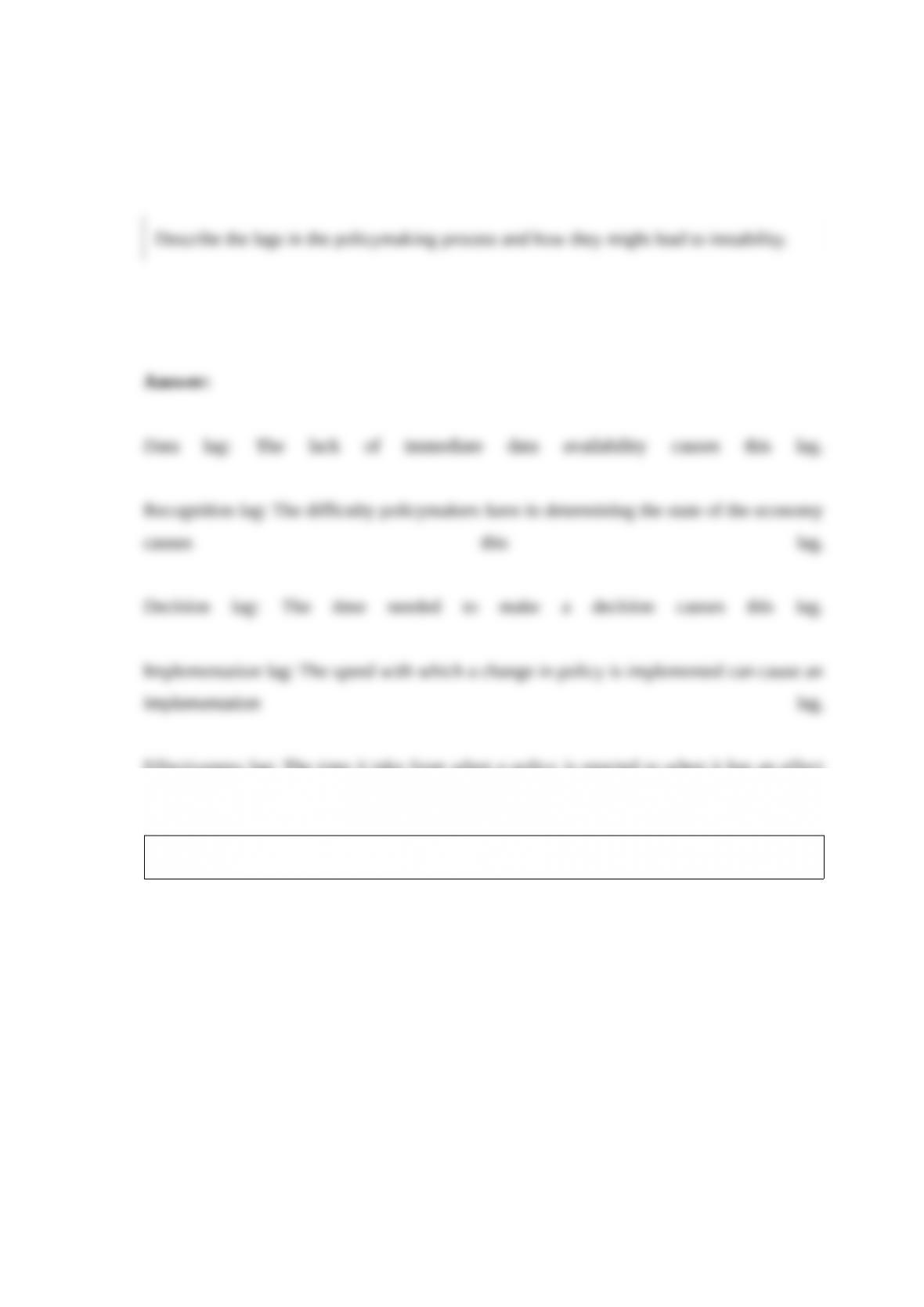
Describe the lags in the policymaking process and how they might lead to instability.
Answer:
Data lag: The lack of immediate data availability causes this lag.
Recognition lag: The difficulty policymakers have in determining the state of the economy
causes this lag.
Decision lag: The time needed to make a decision causes this lag.
Implementation lag: The speed with which a change in policy is implemented can cause an
implementation lag.
Effectiveness lag: The time it take from when a policy is enacted to when it has an effect
on the economy can also have a lag.
If these lags are long enough, policymakers may be putting the wrong policy in place at the
wrong time, making the business cycle worse instead of better.
What is seignorage revenue and how does it apply to U.S. coins?
Answer:
Under the fiat money system, the government makes a profit, known as
seignoragerevenue,on every coin that is issued.This is because fiat money is worth more in
exchange of goods and services than the value of the materials of which it is made. Since,
coins act as fiat money in the United States, the government earns some revenue on every
coin issued.
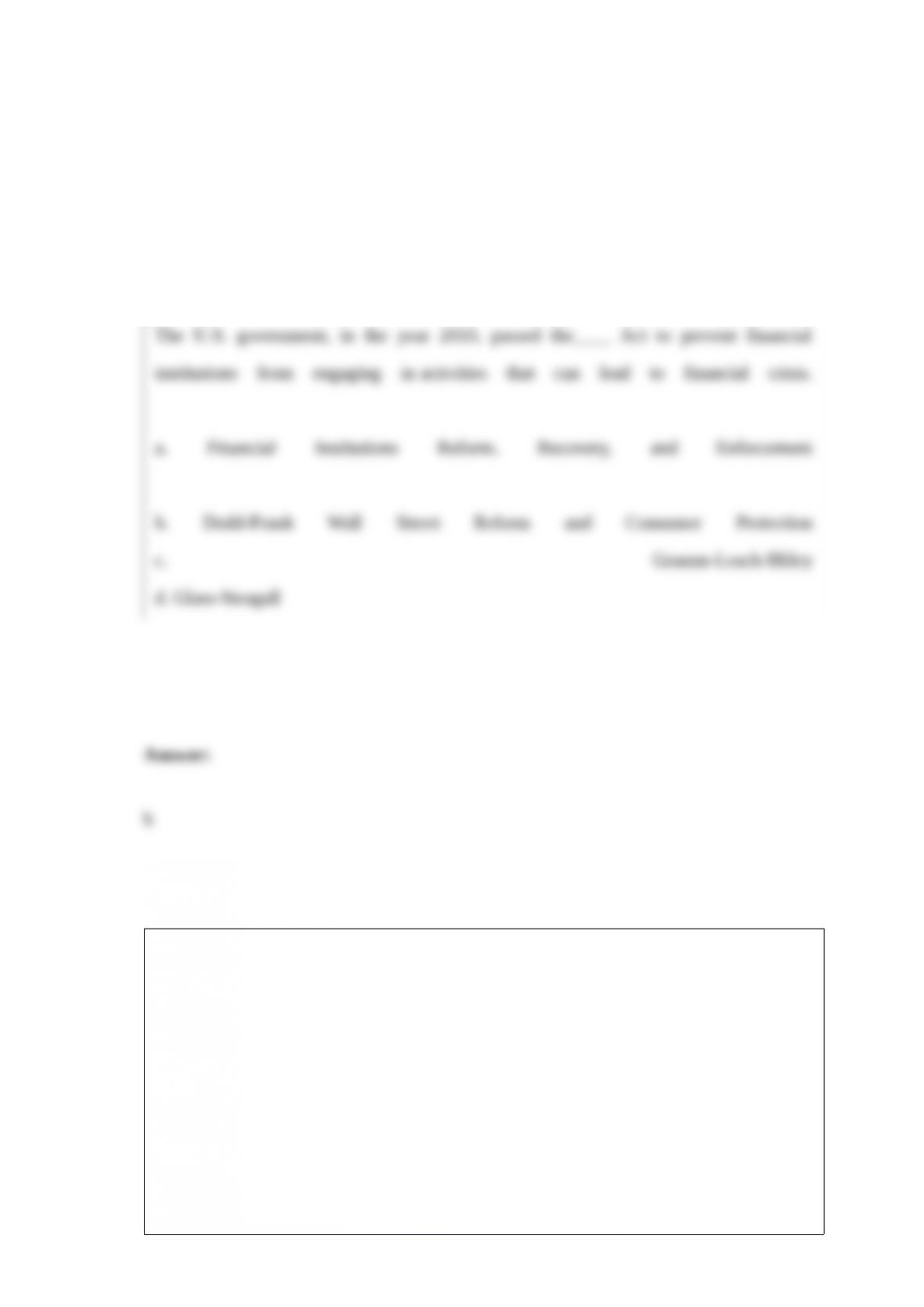
The U.S. government, in the year 2010, passed the____ Act to prevent financial
institutions from engaging in activities that can lead to financial crisis.
a. Financial Institutions Reform, Recovery, and Enforcement
b. Dodd-Frank Wall Street Reform and Consumer Protection
c. Gramm-Leach-Bliley
d. Glass-Steagall
Answer:
b
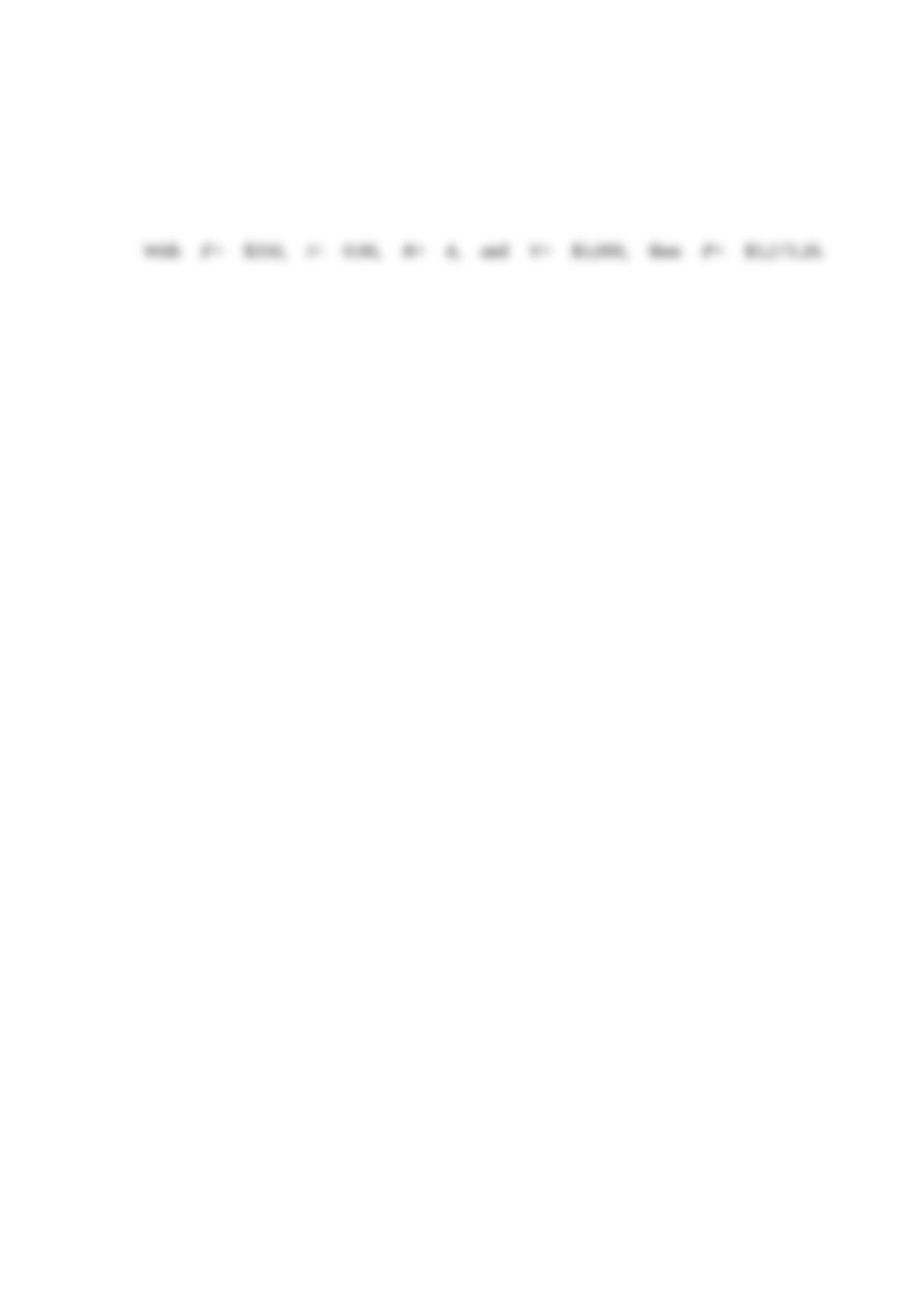
Consider a coupon bond that pays $350 every year and repays its principal amount of
$5,000 at the end of four years. If the annual rate of discount is 6 percent, what is the
present value of the bond?
Answer:
Use the equation .
With F= $350, i= 0.06, N= 4, and V= $5,000, then P= $5,173.26.