1) Exhibit 14.4
USE THE INFORMATION BELOW FOR THE FOLLOWING PROBLEM(S)
The Valentine Company currently has a 14% annual growth rate while the market
average is 4 percent. The market multiple is 15.
Determine the justified P/E ratio for the Valentine Company assuming Valentine can
maintain its superior growth rate for the next 10 years.
a. 3.0
b. 9.2
c. 16.6
d. 28.6
e. 37.6
2) A technical analyst would consider the following a strong buy signal:
a. A graph of declining prices ends in a trough followed by an upward trend that breaks
through the declining trend channel.
b. A graph of increasing prices ends in a peak followed by a downward trend that
breaks through the rising trend channel.
c. A graph begins to trade in a flat trend after it breaks out of its rising trend channel
d. A graph begins to trade in a declining trend after it breaks out of its flat trend channel
e. None of the above
3) An advantage of convertible bonds is
a. Investors get the upside potential of a bond.
b. Investors get the upside potential of a stock.
c. Issuing firms can get a lower rate of interest on its debt.
d. a and b.
e. b and c.

4) The slope of the utility curves for a strongly risk-averse investor, relative to the slope
of the utility curves for a less risk-averse investor, will
a. Be steeper.
b. Be flatter.
c. Be vertical.
d. Be horizontal.
e. None of the above.
5) Which of the following statements is true?
a.Except for tax-exempt investors and tax-deferred accounts, annual tax payments
increase investment returns.
b.The only way to maintain purchasing power over time is to invest in bonds.
c.After adjusting for taxes, long-term bonds consistently outperform stocks.
d.An asset allocation decision for a taxable portfolio that does not include a substantial
commitment to common stocks may make it difficult for the portfolio to maintain real
value over time.
e.None of the above
6) Suppose the premium on a three year, four percent floor is equal to the premium on a
three year, eight percent cap. This combination is referred to as
a. Zero-cost warrant
b. Zero-premium strap
c. Zero-cost collar
d. Zero-premium swap
e. Zero-cost FRA
7) Between 1986 and 1996, the standard deviation of the returns for the NYSE and the
DJIA indexes were 0.10 and 0.09, respectively, and the covariance of these index
returns was 0.0009. What was the correlation coefficient between the two market
indicators?
a. .1000
b. .1100
c. .1258
d. .1322
e. .1164
8) When an investor borrows part of the investment cost it is known as
a.A short sale.
b.A fill or kill order.
c.A margin transaction.
d.A limit order.
e.Going long.
9) You purchase a 8 1/2s February $10,000 par Treasury Note at 105:16 and hold it for
exactly one year at which time you sell it. What is your rate of return if your selling
price is 105:16?
a. 8.00%
b. 8.06%
c. 8.22%
d. 8.50%
e. 8.47%
10) The policy statement may include a ____ against which a portfolio’s or portfolio
manager’s performance can be measured.
a.Milestone
b.Benchmark
c.Landmark
d.Reference point
e.Market pair
11) Exhibit 5.7
USE THE INFORMATION BELOW FOR THE FOLLOWING PROBLEM(S)
Refer to Exhibit 5.7. What would be the total percentage change in an equally weighted
portfolio of ABC?
a.13.33%
b.18.67%
c.23.41%
d.26.67%
e.36.83%
12) Which of the following statements are true?
a. Futures contracts have less liquidity risk and credit risk than forward contracts.
b. Futures contract prices are strongly linked to the prevailing level of the underlying
spot index.
c. Futures contract decrease in price, the further forward in time the delivery date is set.
d. All of the above.
e. None of the above.
13) In the presence of transactions costs, the SML will be
a. A single straight line.
b. A kinked line.
c. A set of lines rather than a single straight line.
d. A curve rather than a single straight line.
e. Impossible to determine.
14) Exhibit 10.8
USE THE INFORMATION BELOW FOR THE FOLLOWING PROBLEM(S)
Zeco Company has the following financial statements for year ending 12/31/2008.
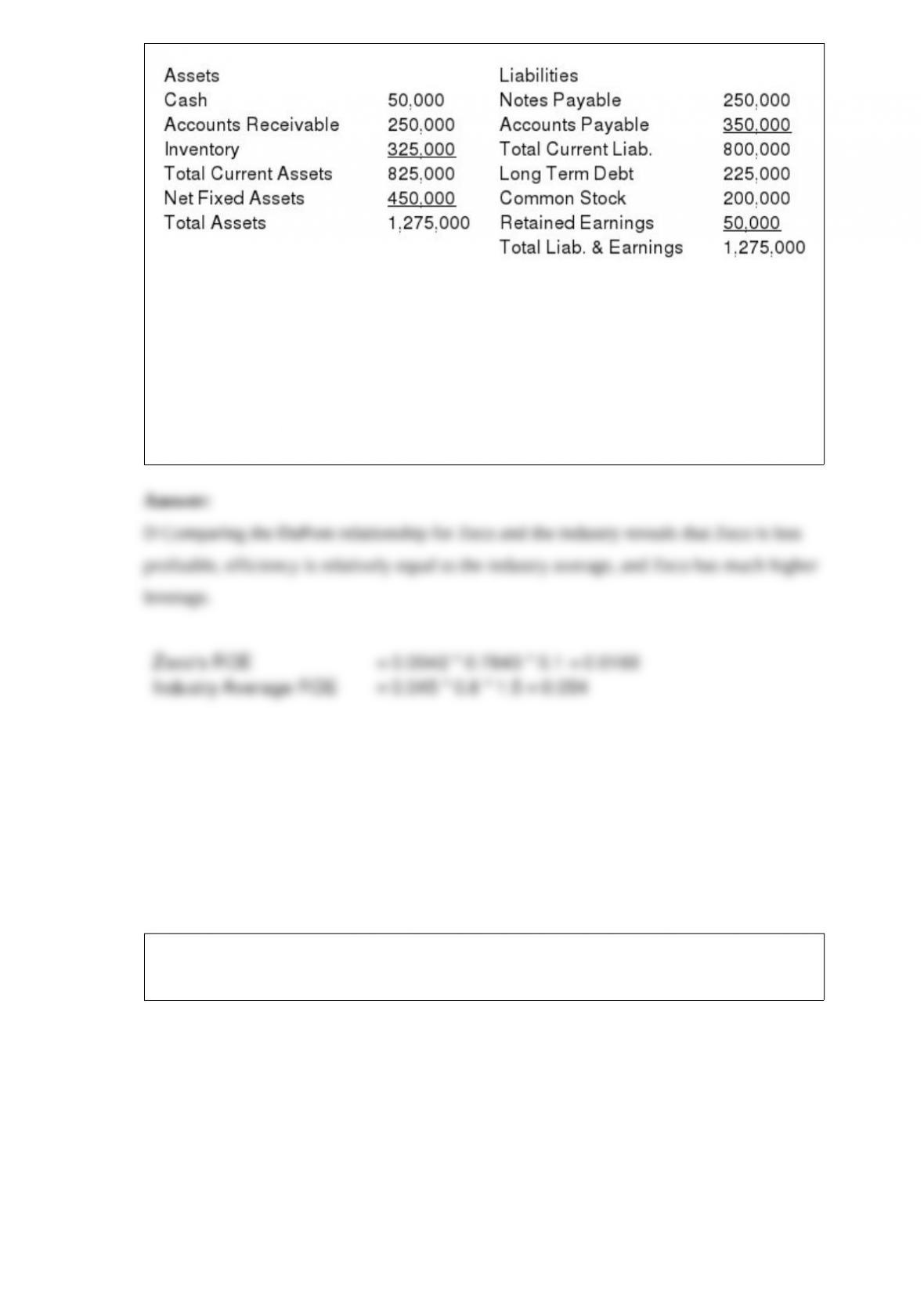
The Zeco Company’s industry averages are as follows:
Net Profit Margin = 4.5%; Total Asset Turnover = 0.8; Total Assets/Equity = 1.5
Based on this information what are the strengths and concerns of Zeco Company?
a. Zeco needs to lower its leverage and improve profitability and efficiency.
b. Zeco needs to increase its leverage and improve efficiency.
c. Zeco needs to lower its leverage and improve efficiency.
d. Zeco needs to lower its leverage and improve profitability.
e. Zeco needs to increase its leverage and improve profitability.
15) Exhibit 10.1
USE THE INFORMATION BELOW FOR THE FOLLOWING PROBLEM(S)
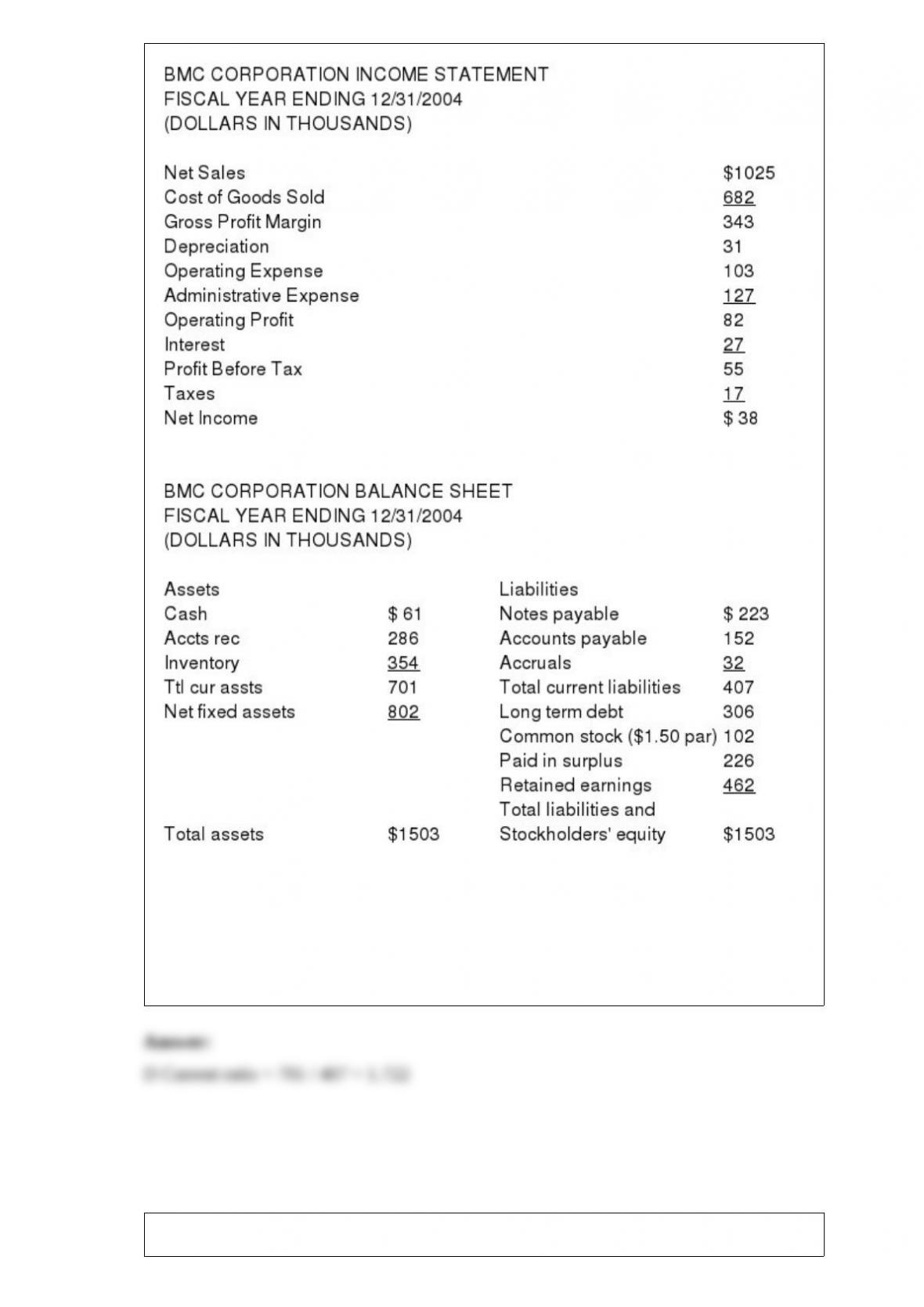
What was BMC’S current ratio at year-end 2004?
a. 0.852
b. 1.000
c. 1.368
d. 1.722
e. 1.943
16) A major difference between a call option and a warrant is that call options are
issued by the company so that any proceeds from the sale of stock go to the issuing
firm.
17) Building permits for new private housing units are listed as a leading indicator by
the National Bureau of Economic Research (NBER).
18) An open-end investment company differs from a closed-end investment company
by the way they operate after the initial public offering.
19) All features of a forward contract are standardized, except for price and number of
contracts.
20) The correlations among the U.S. investment-grade-bond series were very high
because all rates of return for investment-grade bonds over time are impacted by
common macroeconomic variables.
21) An example of a unique need in an investment policy statement is related to the
legal responsibilities of a fiduciary or trustee.
22) In the APT model, the identity of all the factors is known.
23) Underpriced stocks can be ranked using the excess return ratio which is calculated
as the Market price/Risk free rate.
24) It is reasonable to expect corporate sales to be closely related to GNP.
25) A peer group comparison collects the returns produced by a representative universe
of investors over a specific period of time and displays them in a simple boxplot format.