
1) The Black-Scholes and Merton pathbreaking papers on stock option pricing were
published in (circle one)
a. 1983
b. 1984
c. 1974
d. 1973
2) A portfolio of ten companies is formed. In a third-to-default swap (Circle one)
a. There is a payoff when the third default on the portfolio happens
b. There is a payoff when the first, second and third companies defaults happen
c. There is a payoff when the third, fourth, fifthtenth companies defaults happen
d. None of the above
3) The risk-free rate is 5% and the dividend yield on the S&P 500 index is 2%. Which
of the following is correct when a futures option on the index is being valued.(circle
one)
a. The futures price of the S&P 500 can be treated like a stock paying a dividend yield
of 5%
b. The futures price of the S&P 500 can be treated like a stock paying a dividend yield
of 2%
c. The futures price of the S&P 500 can be treated like a stock paying a dividend yield
of 3%
d. The futures price of the S&P 500 can be treated like a non-dividend-paying stock
4) A financial institution trades swaps where 12 month LIBOR is exchanged for a fixed
rate of interest. Payments are made once a year. The one-year swap rate (i.e., the rate
that would be exchanged for 12 month LIBOR in a new one-year swap) is 6 percent.
Similarly the two-year swap rate is 6.5 percent.
a. Use this swap data to calculate the one and two year LIBOR zero rates, expressing
the rates with continuous compounding.
b. What is the value of an existing swap with a notional principal of $10 million that has
two years to go and is such that financial institution pays 7 percent and receives 12
month LIBOR? Payments are made once a year.
c. What is the value of a forward rate agreement where a rate of 8 percent will be
received on a principal of $1 million for the period between one year and two years?
Note: All rates given in this question are expressed with annual compounding.
5) Which of the following are true of employee stock options (Circle three)
a. They are never exercised early if the company does not pay a dividend
b. They are commonly valued as though they are regular American options
c. They are commonly valued as though they are regular American options, but with a
reduced life
d. They are commonly valued as though they are regular European options but with a
reduced life
e. They are never worth more than regular American options with the same strike price
and time to maturity
f. There was a period of time during which their value had to be reported, but was not
included on the income statement
6) A bank has just sold a call option on 500,000 shares of a stock. The strike price is 40;
the stock price is 40; the risk-free rate is 5%; the volatility is 30%; and the time to
maturity is 3 months.
a) What position should the company take in the stock for delta neutrality?
b) Suppose that the bank does set up a delta neutral position as soon as the option has
been sold and the stock price jumps to 42 within the first hour of trading. What trade is
necessary to maintain delta neutrality? Explain whether the bank has gained or lost
money in this situation. (You do not need to calculate the exact amount gained or lost.)
c) Repeat part b) on the assumption that the stock jumps to 38 instead of 42
7) A European call and European put have the same strike price and time to maturity
Which two of the following are true (circle two)
a. The gamma of a call is the same as the gamma of a put
b. The delta of a call is the same as the delta of a put
c. The vega of a call is the same as the vega of a put
d. The theta of a call is the same as the theta of a put
8) Who initiates delivery in a corn futures contract (circle one)
a. The party with the long position
b. The party with the short position
c. Either party
d.The exchange
9) Which of the following is true (circle one)
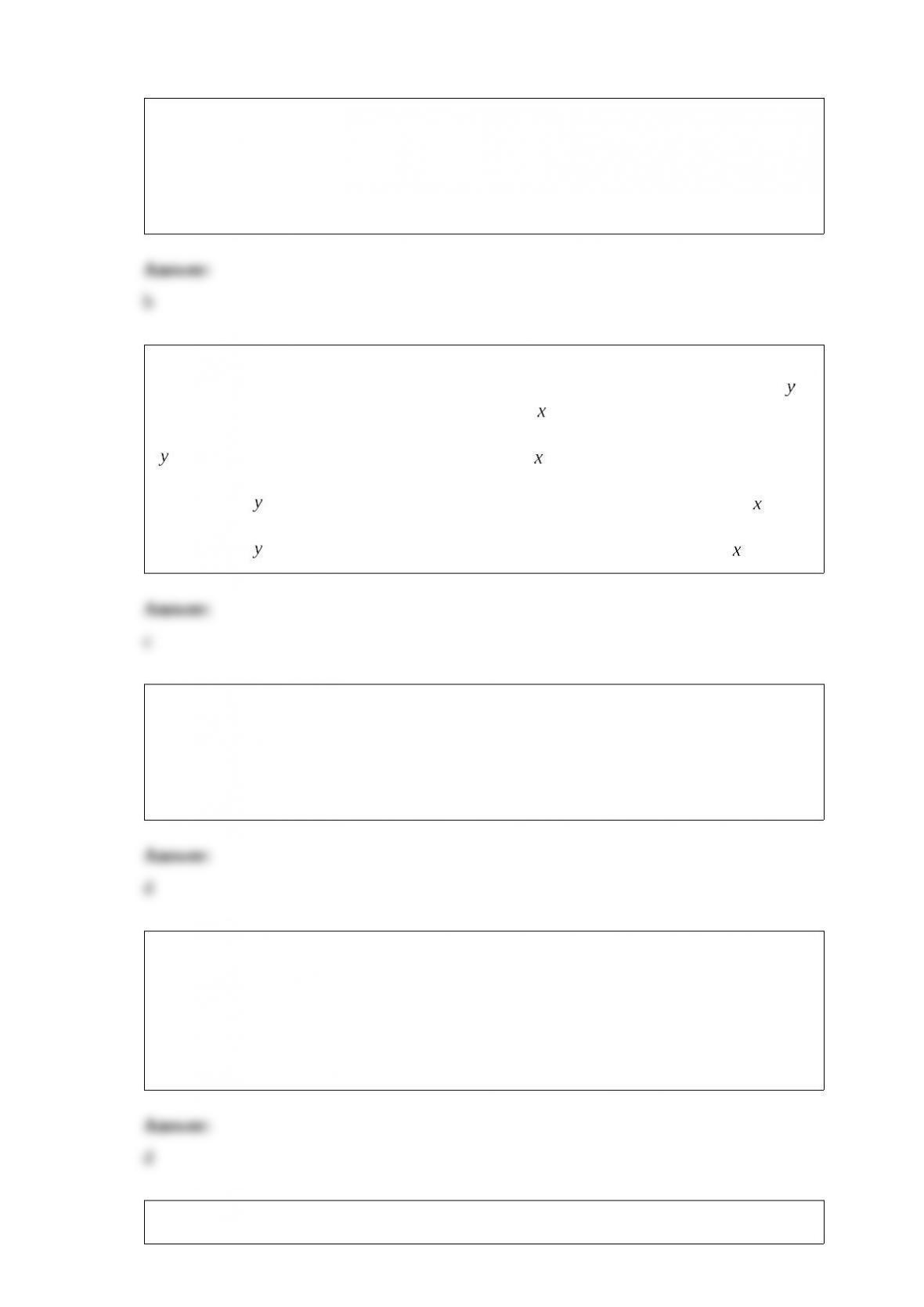
a. The optimal hedge ratio is the slope of the best fit line when the spot price (on the
-axis) is regressed against the futures price (on the -axis)
b. The optimal hedge ratio is the slope of the best fit line when the futures price (on the
-axis) is regressed against the spot price (on the -axis)
c. The optimal hedge ratio is the slope of the best fit line when the change in the spot
price (on the -axis) is regressed against the change in the futures price (on the -axis)
d. The optimal hedge ratio is the slope of the best fit line when the change in the futures
price (on the -axis) is regressed against the change in the spot price (on the -axis)
10) The number of companies underlying the CDX NA IG index is (Circle one)
a. 50
b. 75
c. 100
d. 125
11) Which of the following is not an option open to the party with a short position in
the Treasury bond futures contract (circle one)
a. The ability to deliver any of a number of different bonds
b. The wild card play
c. The fact that delivery can be made any time during the delivery month
d. The interest rate used in the calculation of the conversion factor
12) Which of the following are true of employee stock options. (Circle three)

a. They are popular with start up companies
b. They currently have to be expensed on the income statement
c. It was not illegal to backdate stock option grants until recently
d. They usually reward executives in a bear market
e. Traditionally they have been at the money at the time of issuance
f. They are used by Microsoft today
13) To create a range forward contract in order to hedge foreign currency that will be
received a company should (Circle one)
a. Buy a put and sell a call on the currency with the strike price of the put higher than
that of the call
b. Buy a put and sell a call on the currency with the strike price of the put lower than
that of the call
c. Buy a call and sell a put on the currency with the strike price of the put higher than
that of the call
d. Buy a call and sell a put on the currency with the strike price of the put lower than
that of the call
14) The Black-Scholes-Merton model assumes (circle one)
a. The return from the stock in a short period of time is lognormal
b. The stock price at a future time is lognormal
c. The stock price at a future time is normal
d. None of the above
15) There are two types of regular options (calls and puts). How many types of
compound options are there (Circle one)
a. Two
b. Four
c. Six
d. Eight
16) The risk-neutral probability of a regular put option closing in the money is, with our
usual notation (Circle one)
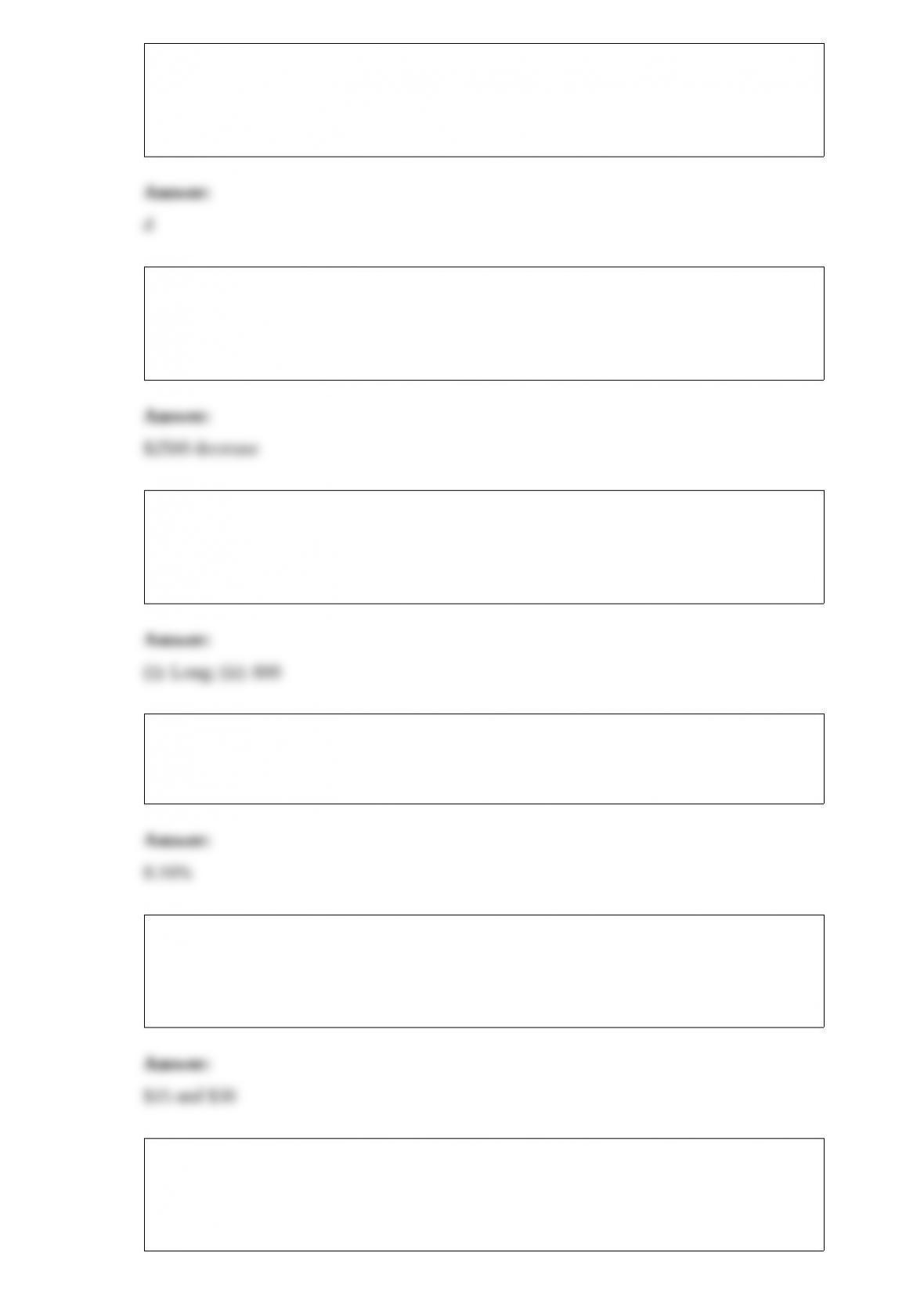
a. N(d1)
b. N(d2)
c. N(d1)
d. N(d2)
17) The modified duration of a bond portfolio worth $1 million is 5 years. By
approximately how much does the value of the portfolio change if all yields increase by
5 basis points? Indicate whether the dollar amount you calculate is an increase or a
decrease
18) A call option on an asset has a delta of 0.4. A trader has sold 2000 options and wants
to create a delta-neutral position
i. Should the trader take a long or short position in the asset
ii. How many units of the asset should be bought or sold
19) An interest rate is 8% per annum when expressed with continuous compounding.
What is the equivalent rate with semiannual compounding? Answer as a percent with
two decimal place accuracy
20) A three-month call with a strike price of $25 costs $2. A three-month put with a
strike price of $20 and costs $ A trader uses the options to create a strangle. For what
two values of the stock price in three monthsdoes the trader breakeven with a profit of
zero?
21) A speculator takes a long position in an oil futures contract on November 1, 2009 to
hedge an exposure on March 1, 2010 . The initial futures price is $60. On December 31,
1999 the futures price is $61. On March 1, 2010 it is $64. The contract is closed out on
March 1, 2010 . What gain is recognized in the accounting year January 1 to December
31, 2010? Each contract is on 1000 barrels of oil.
22) Use a three step tree to value a three month American put option on wheat futures.
The current futures price is is 380 cents, the strike price is 370 cents, the risk-free rate is
5% per annum, and the volatility is 25% per annum. Explain carefully what happens if
the investor exercises the option after two months. Suppose that the futures price at the
time of exercise is 362 and the most recent settlement price is 360 .
23) Stock A has a daily volatility of 1.2% and stock B has a daily volatility of 1.8%.
The correlation between the two stock price returns is 0.
i. What is the standard deviation of the return from stock A over 4 days?
ii. What is the standard deviation of the return from stock B over 4 days?
iii. What is the standard deviation (to the nearest $000) of the 4-day change in the value
of a portfolio consisting of a $1 million investment in stock A and a $1 million
investment in stock B?
24) A company enters into a long futures contract to buy 1,000 barrels of oil for $60 per
barrel. The initial margin is $6,000 and the maintenance margin is $4,000. What oil
futures price will allow $2,000 to be withdrawn from the margin account?
25) The price of a European call option on a non-dividend-paying stock with a strike
price of $50 is $ The stock price is $51, the continuously compounded risk-free rate (all
maturities) is 6% and the time to maturity is one year. What, to the nearest cent, is the
price of a one-year European put option on the stock with a strike price of $50?