
1) A project’s annual free cash flow is the change in operating cash flow less any change
in net working capital and less any change in capital spending.
2) The primary source of spontaneous financing is accrued taxes.
3) Purchasing supplies on credit and paying for them 45 days later is an example of
discretionary financing.
4) The best financial structure is determined by finding the debt and equity mix that
maximizes the firm’s cost of capital.
5) Financial forecasting is the process of attempting to estimate a firm’s future financing
requirements.
6) Spot exchange markets provide the potential for arbitrage opportunities.
7) The goal of the firm’s financial managers should be the maximization of the total
value of the firm’s stock.

8) Cumulative voting is advantageous to minority shareholders because it may allow
them to elect a member of the board of directors.
9) On the basis of number of shares traded, more stocks are traded over the counter than
on organized exchanges.
10) NPV assumes reinvestment of intermediate free cash flows at the cost of capital,
while IRR assumes reinvestment of intermediate free cash flows at the IRR.
11) Because only the largest and most creditworthy companies are able to use
commercial paper, the interest rate on commercial paper is generally lower than the
prime rate.
12) Your company is considering the replacement of an old delivery van with a new one
that is more efficient. The old van cost $40,000 when it was purchased 5 years ago. The
old van is being depreciated using the simplified straight-line method over a useful life
of 8 years. The old van could be sold today for $7,000. The new van has an invoice
price of $80,000, and it will cost $6,000 to modify the van to carry the company’s
products. Cost savings from use of the new van are expected to be $28,000 per year for
5 years, at which time the van will be sold for its estimated salvage value of $18,000.
The new van will be depreciated using the simplified straight-line method over its
5-year useful life. The company’s tax rate is 35%. Working capital is expected to
increase by $5,000 at the inception of the project, but this amount will be recaptured at
the end of year five. What is the terminal cash flow?
A) $23,000
B) $18,000
C) $17,250
D) $16,700

13) Idaho Mining, Inc borrows at prime plus 1.5% on its line of credit. The line requires
a 15% compensating balance. If prime rate is 9%, what is the nominal APR of the line
of credit?
A) 9.0%
B) 6.0%
C) 10.6%
D) 12.4%
14) In addition to those risks faced by domestic corporations, multinational
corporations face
A) political risk
B) exchange risk
C) Both A and B are correct
D) All domestic and multinational corporations face similar risk profiles
15) Mix Sweet Shop bakes and sells pies. Mix has annual fixed costs of $880,000 and a
variable cost per pie of $7.50. Each pie sells for $15.50 each. The firm expects to sell
500,000 pies annually. What is the break-even point in pies?
A) 190,440
B) 280,000
C) 200,000
D) 110,000
16) Which of the following dividend policies will cause dividends per share to fluctuate
the most?
A) constant dividend payout ratio
B) stable dollar dividend
C) small, low, regular dividend plus a year-end extra
D) no difference between the various dividend policies
17) An investor is considering two equally risky investments. Investment A is expected
to return $1,000 per year for the next 5 years. Investment B is expected to return $6,000
at the end of 5 years. Which of the following statements is MOST correct if both

investments A and B have the same cost?
A) A risk averse investor will select investment B because it is expected to provide the
most cash ($6,000 > $5,000)
B) A risk averse investor will select investment A because it provides cash earlier than
investment B
C) The investor will select investment A only if the cost is less than $1,000
D) The investor may select investment A or investment B depending on the opportunity
cost of money
18) In August 2004, Google first sold its common stock to the public at $85 per share
and raised $1.76 billion. This is an examples of
A) a primary market transaction
B) a secondary market transaction
C) a venture capital firm transaction
D) a money market transaction
19) Which of the following is true if dividend policy is irrelevant?
A) Perfect capital markets exist
B) The clientele effect exists
C) The information effect exists
D) Tax deferral on capital gains exists
20) The accuracy of the percent of sales forecast method is impaired if
A) scale economies are present for assets
B) assets must be purchased in discrete quantities
C) asset needs are independent of sales level
D) all of the above impair the accuracy of the percent of sales forecast method
21) Investment A has an expected return of 14% with a standard deviation of 4%, while
investment B has an expected return of 20% with a standard deviation of 9%. Therefore
A) a risk averse investor will definitely select investment A because the standard
deviation is lower
B) a rational investor will pick investment B because the return adjusted for risk (20% –

9%) is higher than the return adjusted for risk for investment A ($14% – 4%)
C) it is irrational for a risk-averse investor to select investment B because its standard
deviation is more than twice as big as investment A’s, but the return is not twice as big
D) rational investors could pick either A or B, depending on their level of risk aversion
22) Suppose the 360-day forward exchange rate is 1.657 dollars per British Pound, and
the current spot rate is 1.625 dollars per British Pound. If the 360-day interest rate in the
United States is 5% and the 360-day interest rate in Great Britain is 3%, is the market in
equilibrium according to the interest rate parity theory?
A) Yes, because the forward premium on the pound (2%) is exactly offset by the lower
interest rate in Great Britain
B) No, because the higher interest rate in the United States (2%) implies that the
forward exchange rate should be 2% lower than the current spot rate
C) No, because the forward premium on the pound is 2% while the interest rate in the
U.S is 67% higher than the interest rate in Great Britain
D) Cannot be determined without knowing the amount of money being exchanged
23) A six-year project for Little Egypt, Inc. results in additional accounts receivable of
$150,000, additional inventory of $50,000, and additional accounts payable of $80,000
today. What is the change in the NPV of a project solely due to the additional net
working capital (NWC) needs? Assume a 14% discount rate, and the recovery of net
working capital at the end of the project.
A) a decrease of $34,606
B) a decrease of $42,670
C) a decrease of $120,000
D) a decrease of $58,689
24) If you were a treasurer for a Fortune 1,000 corporation who has responsibility for
investing “excess cash balances,” which of the following alternatives would you be
least likely to select?
A) commercial paper
B) common stock
C) bankers’ acceptances
D) U.S. Treasury bills

25) Marble Corp. has a beta of 2.5 and a standard deviation of returns of 20%. The
return on the market portfolio is 15% and the risk free rate is 4%. According to CAPM,
what is the required rate of return on Collectible’s stock?
A) 37.5%
B) 31.5%
C) 26.5%
D) 23.5%
26) Which of the following would be an example of the “precautionary motive” for a
firm holding cash balances?
A) purchase of inventory
B) anticipating a strike
C) purchase fixed assets
D) make dividend payments
27) All the following variables are used in computing the cost of debt EXCEPT
A) maturity value of the debt
B) market price of the debt
C) number of years to maturity
D) risk-free rate
28) In an efficient securities market the market value of a security is equal to
A) its liquidation value
B) its book value
C) its intrinsic value
D) par value
29) Table 3-1
Jones Company
Financial Information
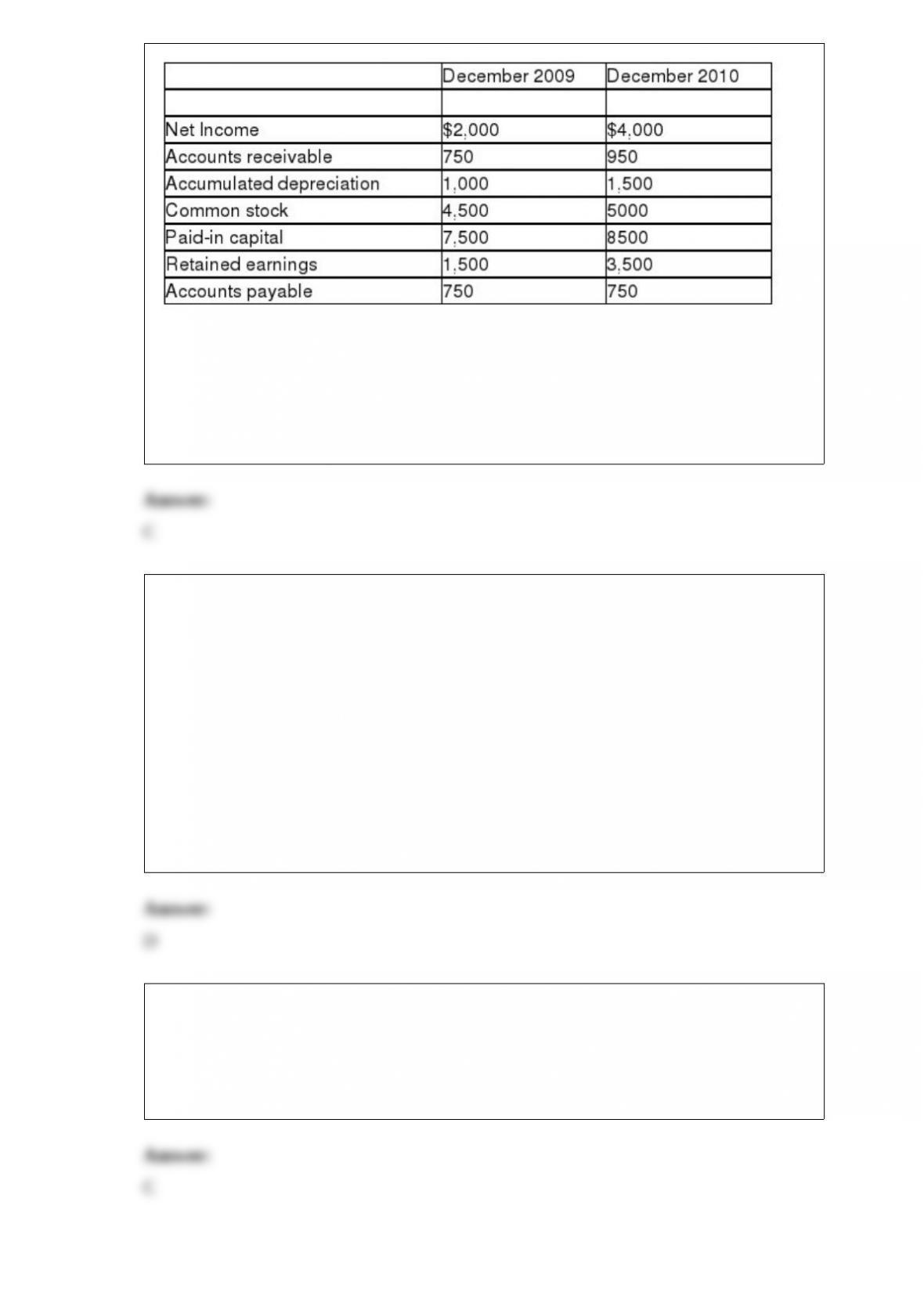
Based on the information in Table 3-1, the change in cash for 2010 is
A) $4,000
B) $4,950
C) $5,800
D) $5,500
30) Alloy Corp. is considering the acquisition of a new processing line. The processor
can be purchased for $3,750,000; it will have a 10-year useful life. It will cost $165,000
to ship and $85,250 to install the processor. A recently completed feasibility study that
was performed at a cost of $65,000 indicated that the processor would produce a
positive NPV. The processor will be depreciated using the straight-line method to zero
expected salvage value. Studies have shown that employee-training expenses will be
$125,000. What will be the annual depreciation expense of the processing line for
capital budgeting purposes?
A) $375,000
B) $419,025
C) $390,000
D) $400,025
31) Who bears the greatest risk of loss of value if a firm should fail?
A) bondholders
B) preferred stockholders
C) common stockholders
D) All of the above bear equal risk of loss
32) The costs associated with issuing securities to the public can be high. Some types of
securities have greater expenses associated with them than others. Which of the
following is the most costly security to issue?
A) common stock
B) corporate bonds
C) preferred stock
D) all of the above
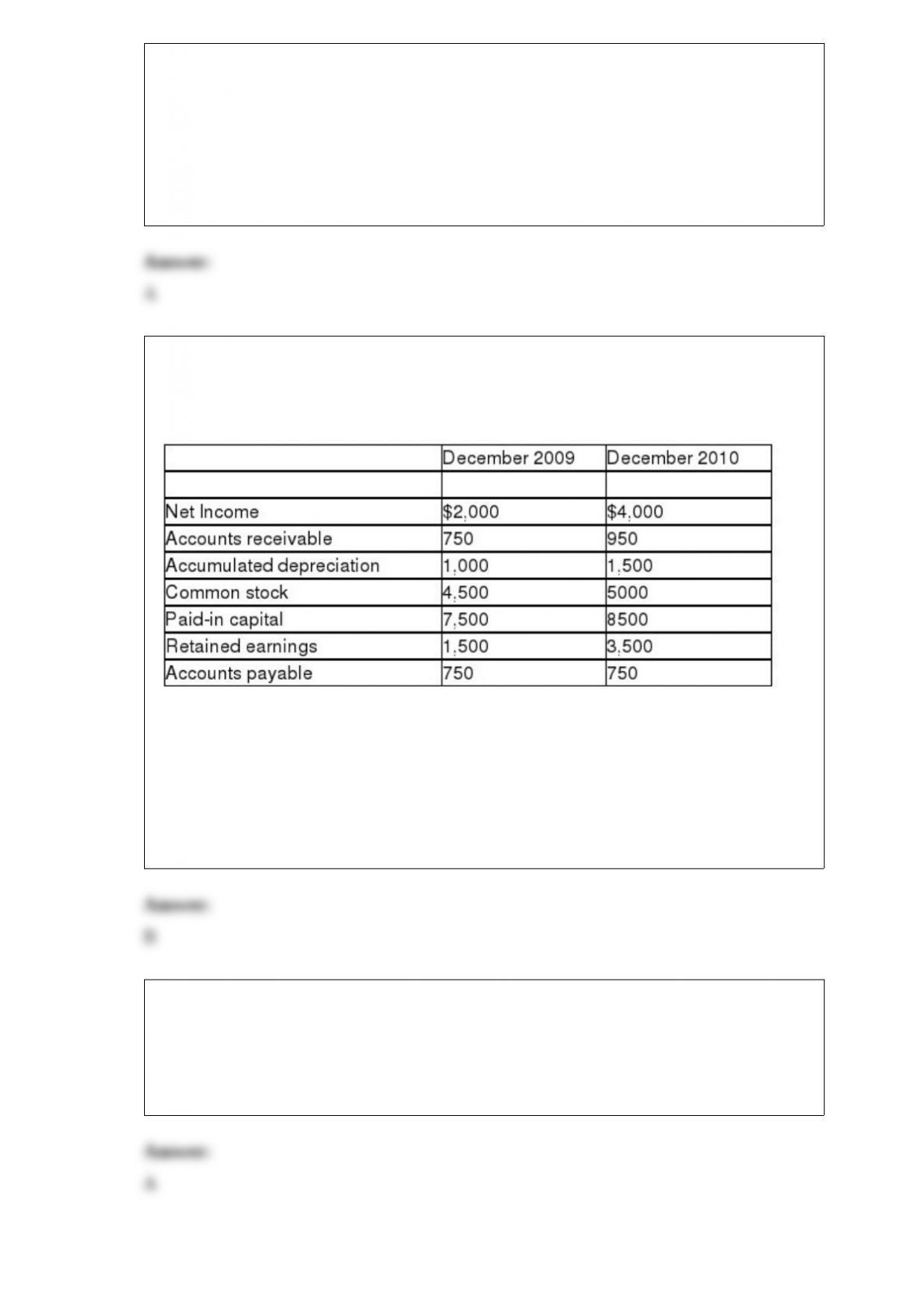
33) Table 3-1
Jones Company
Financial Information
Based on the information in Table 3-1, assuming that no assets were disposed of during
2010, the amount of depreciation expense was
A) $375
B) $500
C) $2,500
D) $3,500
34) A firm’s credit and collection policies usually include
A) terms of sale, quality of customers, and collection of credit sales
B) average collection period, dollar value of aged receivables, and terms of sale
C) terms of sale and collection of credit sales
D) terms of sale, level of credit sales, and collection of credit sales

35) MDX Sales Corp. is expecting a 10% increase in sales next year. MDX has an
inventory balance of $1,000,000 and uses the percent of sales forecasting method.
Which of the following could explain why the inventory forecast of $1,100,000 might
be too high?
A) The current inventory balance of $1,000,000 is lower than usual because of a
one-time end of year fire sale
B) The company is going to change its depreciation method in the coming year
C) The growth in sales could be as high as 15%
D) A fixed amount of inventory is required to do business, so inventory doesn’t increase
proportionally with sales
36) Rogue Industries reported the following items for the current year: Sales =
$3,000,000; Cost of Goods Sold = $1,500,000; Depreciation Expense = $170,000;
Administrative Expenses = $150,000; Interest Expense = $30,000; Marketing Expenses
= $80,000; and Taxes = $300,000. Rogue’s net profit margin is equal to
A) 25.67%
B) 35.67%
C) 36.67%
D) 50.00%
37) Table 4-3
Emery Corporation
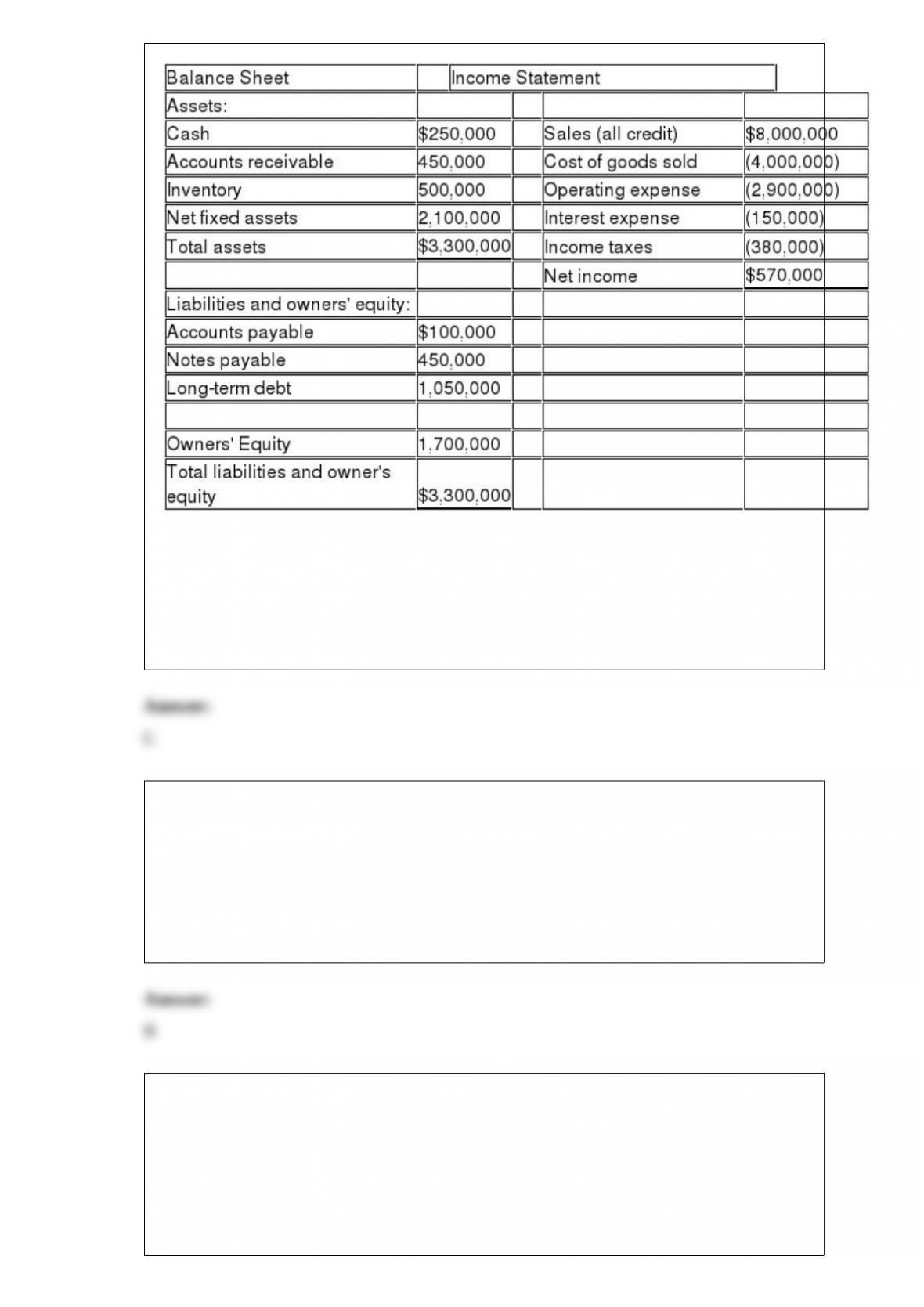
Based on the information in Table 4-3, the debt ratio is
A) 18.38%
B) 40.24%
C) 48.48%
D) 53.43%
38) XYZ Corporation has a P/E ratio of 20 and EFG Corporation has a P/E ratio of 10.
It is likely that
A) XYZ’s earnings per share are twice the earnings per share of EFG
B) investors expect XYZ’s earnings to grow faster than EFG’s earnings
C) investors believe that for the same level of earnings growth, XYZ is a higher risk
company
D) investors believe XYZ stock is overvalued
39) The 30-day forward exchange rate is .01073033 dollars per yen. If this forward rate
represents a per year discount of 2.5% from the current spot rate, what is the current
spot exchange rate?
A) .01073033 dollars per yen
B) .01257754 dollars per yen
C) .01329684 dollars per yen
D) .01093833 dollars per yen

40) A high degree of variability in a firm’s earnings before interest and taxes refers to
A) business risk
B) financial risk
C) financial leverage
D) operating leverage
41) The capital asset pricing model
A) provides a risk-return trade off in which risk is measured in terms of the market
volatility
B) provides a risk-return trade off in which risk is measured in terms of beta
C) measures risk as the coefficient of variation between security and market rates of
return
D) depicts the total risk of a security
42) Dividend policy is influenced by
A) a company’s investment opportunities
B) a firm’s capital structure mix
C) a company’s availability of internally generated funds
D) all of the above
43) All of the following are typically advantages of private placements EXCEPT
A) speed
B) reduced flotation costs
C) financial flexibility
D) the possibility of future SEC registration
44) Assume that an investment is forecasted to produce the following returns: a 30%
probability of a 12% return; a 50% probability of a 16% return; and a 20% probability
of a 19% return. What is the expected percentage return this investment will produce?
A) 33.3%
B) 16.1%
C) 9.5%
D) 15.4%
45) What was the average annual rate of return on long-term government bonds
(30-Year Treasury Bonds) during the period 1987 to 2011?
A) 4.14%
B) 5.88%
C) 6.14%
D) 7.82%
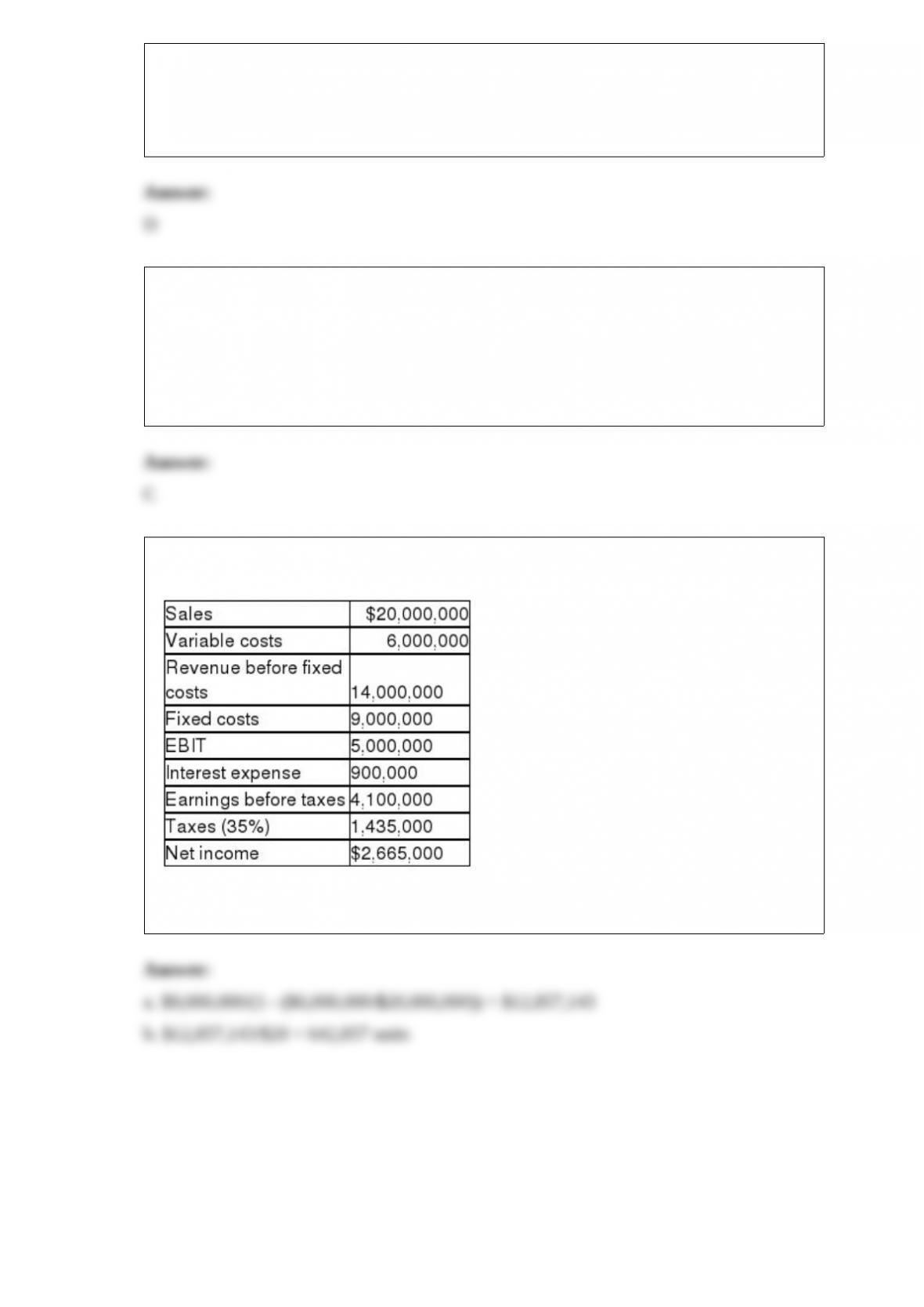
46) ABC Corp. has estimated the following income statement for its next fiscal year.
a.What is the break-even point in sales dollars for the firm?
b.If the average unit cost is $20, what is the break even point in units?