
Sly’s just arranged a three-year direct business loan. Which one of the following terms
matches this loan arrangement?
A. Term loan
B. Private placement
C. Rights offer
D. Seasoned offer
E. Shelf offer
Answer:
You are making a $120,000 investment and feel that a 20 percent rate of return is
reasonable given the nature of the risks involved. You feel you will receive $48,000 in
the first year, $54,000 in the second year, and $56,000 in the third year. You expect to
pay out $12,000 as an additional investment in the fourth year. What is the net present
value of this investment given your expectations?
A. -$15,879.63
B. -$4,305.56
C. $15,879.63
D. $16,233.33
E. $18,534.25
Answer:

The term structure of interest rates is affected by which of the following?
I. Interest rate risk premium
II. Real rate of interest
III. Default risk premium
IV. Inflation premium
A. I and II only
B. II and III only
C. I, III, and IV only
D. I, II, and IV only
E. I, II, III, and IV
Answer:
Which one of the following defines the internal rate of return for a project?
A. Discount rate that creates a zero cash flow from assets
B. Discount rate that results in a zero net present value for the project

C. Discount rate that results in a net present value equal to the project’s initial cost
D. Rate of return required by the project’s investors
E. The project’s current market rate of return
Answer:
A 4-year annuity of eight $6,200 semiannual payments will begin 6 years from now,
with the first payment coming 6.5 years from now. If the discount rate is 7 percent
compounded semiannually, what is the value of this annuity 4 years from now?
A. $37,139.58
B. $38,399.20
C. $40,687.14
D. $41,811.67
E. $42,618.52
Answer:
Goshen Industrial Sales has sales of $828,900, total equity of $539,200, a profit margin
of 4.6 percent, and a debt-equity ratio of 0.55. What is the return on assets?
A. 3.89 percent
B. 4.56 percent
C. 6.67 percent
D. 12.86 percent
E. 13.33 percent
Answer:
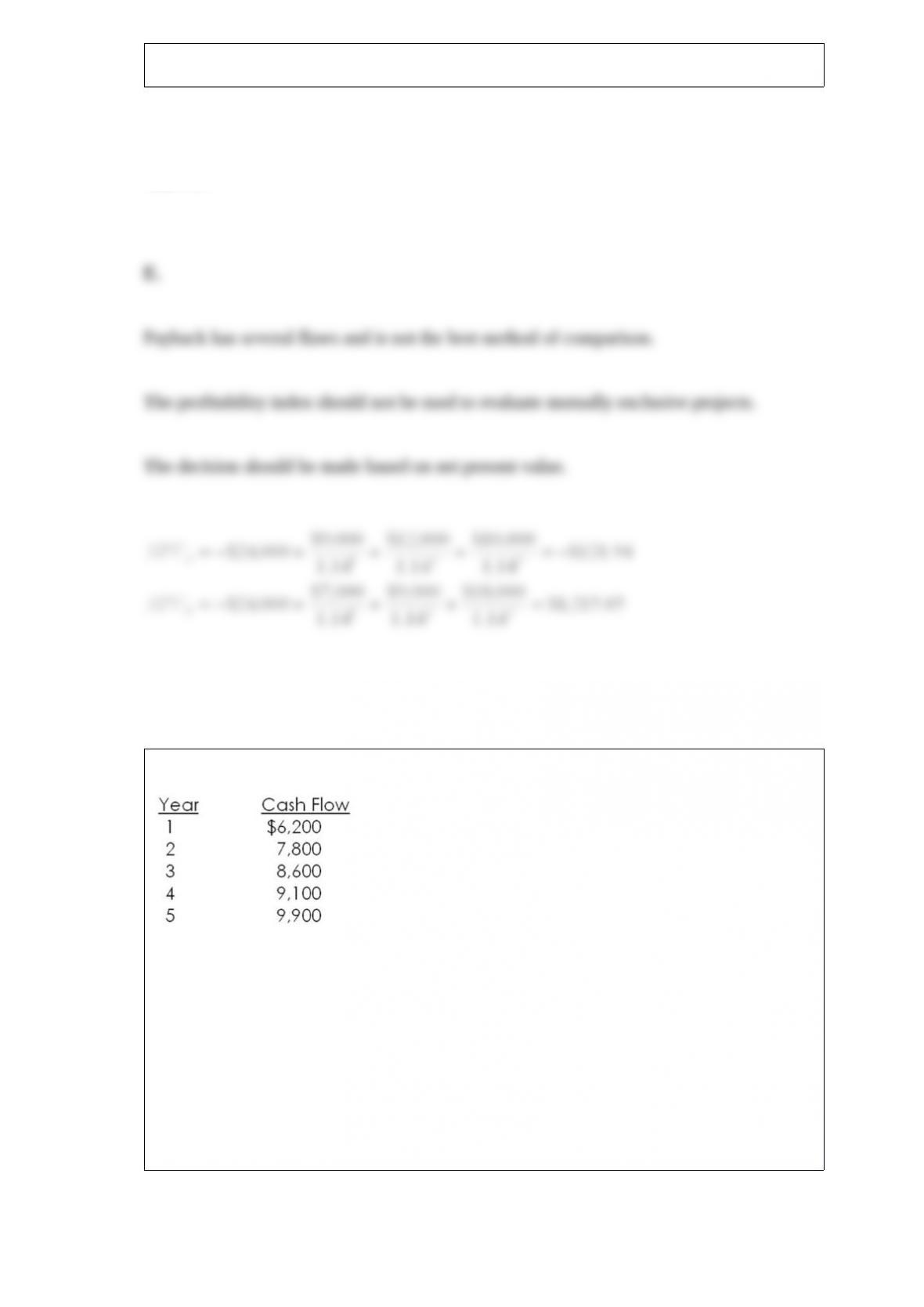
You are considering the following two mutually exclusive projects. The required return
on each project is 14 percent. Which project should you accept and what is the best
reason for that decision?
A. Project A, because it pays back faster
B. Project A, because it has the higher profitability index
C. Project B, because it has the higher profitability index
D. Project A, because it has the higher net present value
E. Project B, because it has the higher net present value
Answer:
What is the payback period for a $28,500 investment with the following cash flows?
A. 3.65 years
B. 3.89 years
C. 4.22 years
D. 4.44 years
E. The project never pays back.

Answer:
Weston Steel purchased a new coal furnace six years ago at a cost of $2.2 million. Last
year, the government changed the emission requirements and this furnace cannot meet
those standards. Thus, Weston can no longer use the furnace, nor has it been able to
locate anyone willing to purchase the furnace. Given the current situation, the furnace is
best described as which type of cost?
A. Erosion
B. Book
C. Sunk
D. Market
E. Opportunity
Answer:
Chestnut Tree Farms has identified the following two mutually exclusive projects:
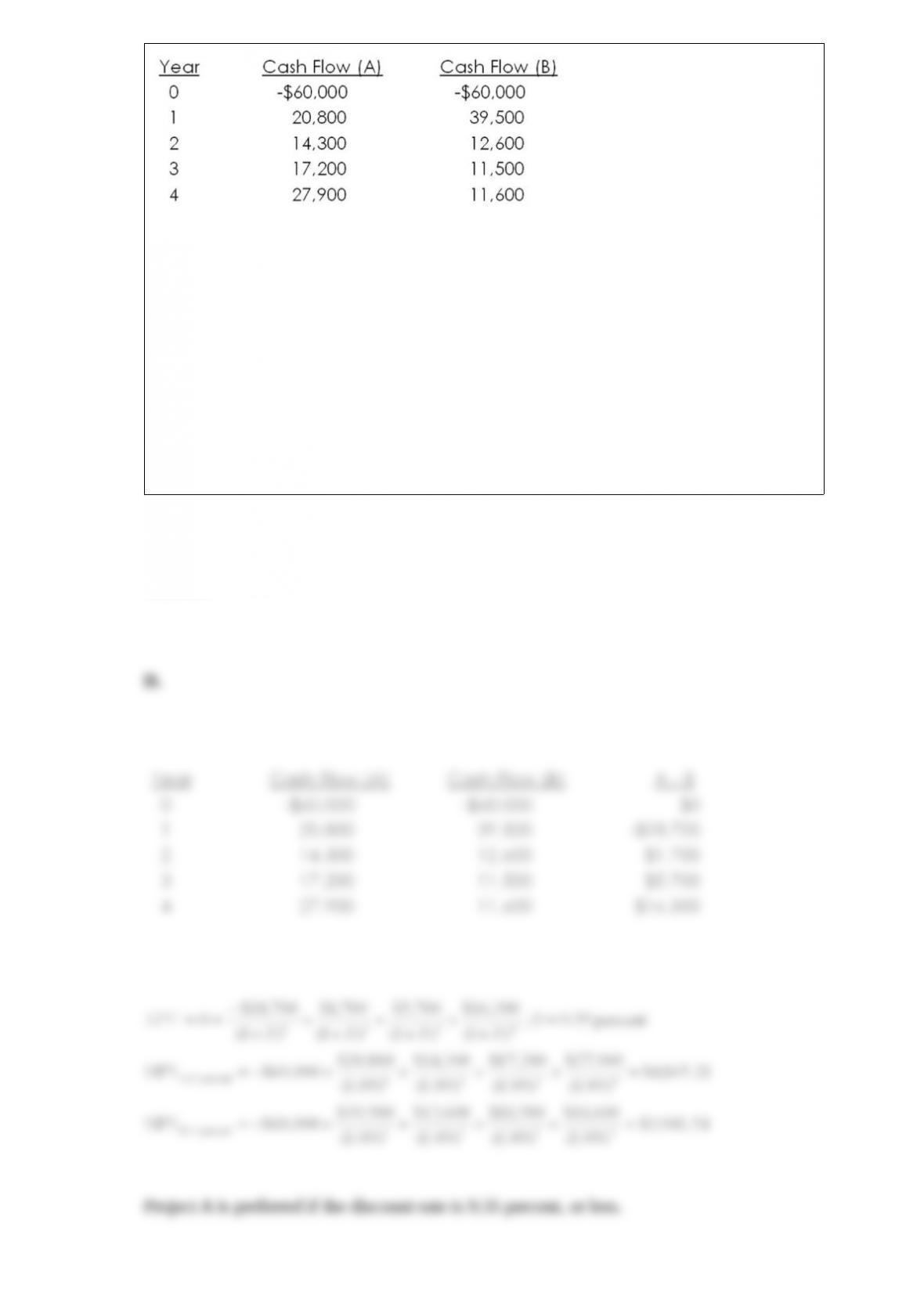
Over what range of discount rates would you choose Project A?
A. 8.28 percent or less
B. 8.28 percent or more
C. 9.33 percent or more
D. 9.55 percent or less
E. 9.55 percent or more
Answer:

Which one of the following terms is defined as having international operations in a
world where relative currency values change?
A. Political risk
B. Relative purchasing power parity
C. Interest rate parity
D. Absolute purchasing power parity
E. Exchange rate risk
Answer:
The Dairy Delight wants to raise $1.0 million by selling some coupon bonds at par.
Comparable bonds in the market have a 6.5 percent annual coupon, 15 years to
maturity, and are selling at 98 percent of par. What coupon rate should The Dairy
Delight set on its bonds?
A. 6.25 percent
B. 6.48 percent
C. 6.50 percent
D. 6.67 percent
E. 6.72 percent
Answer:

Which one of the following is an implication of M&M Proposition II, without taxes?
A. A firm’s optimal capital structure is 100 percent debt.
B. WACC is unaffected by the capital structure of a firm.
C. WACC decreases as the debt-equity ratio increases.
D. A firm’s capital structure is irrelevant.
E. The risk of equity depends on both the degree of financial leverage and the riskiness
of the firm’s operations.
Answer:
Which one of the following qualifies as an annuity?
A. Weekly grocery bill
B. Clothing purchases

C. Car repairs
D. Auto loan payment
E. Medical bills
Answer:
Diversifying a portfolio across various sectors and industries might do more than one of
the following. However, this diversification must do which one of the following?
A. Increase the expected risk premium
B. Reduce the beta of the portfolio to zero
C. Increase the security’s risk premium
D. Reduce the portfolio’s systematic risk level
E. Reduce the portfolio’s unique risks
Answer:

You want to invest an amount of money today and receive back twice that amount in
the future. You expect to earn 6 percent interest. Approximately how long must you
wait for your investment to double in value?
A. 6 years
B. 7 years
C. 8 years
D. 12 years
E. 14 years
Answer:
Mary owns a risky stock and anticipates earning 16.5 percent on her investment in that
stock. Which one of the following best describes the 16.5 percent rate?
A. Expected return
B. Real return
C. Market rate
D. Systematic return
E. Risk premium
Answer: