
1) Break-even analysis is a short-term concept because, in the long run, all costs are
variable.
2) Accounts payable and accrued expenses are known as discretionary sources of
financing.
3) Commercial paper is much more liquid than money-market mutual funds because
commercial paper is available to only the most creditworthy corporations.
4) The implicit cost of debt takes into consideration the change in the cost of common
equity brought on by using additional debt.
5) A major disadvantage of the discounted payback period is the arbitrariness of the
process used to select the maximum desired payback period.
6) A firm’s cost of capital is not affected by the composition of the right-hand side of the
firm’s balance sheet, but rather is determined by the firm’s mix of assets.
7) Commercial centers for foreign exchange exist only in New York and London in
order to make it possible for arbitrage to work.

8) Toyota’s capital budgeting analysis for the Prius, a gas-electric hybrid, was faulty
because the car line has not made a profit to date.
9) The investment banking business is dominated by a few very large, stand-alone
investment banking firms.
10) If a company’s inventory turnover increases from 8 to 10, then its cash conversion
cycle will also increase, i.e., get longer.
11) The price of a computer today is $400 and inflation is 5% per year. Therefore, in
two years the price of the computer is expected to be $440.
12) The cost of trade credit varies directly with the size of the cash discount and
inversely with the length of time between the end of the discount period and the final
due date.
13) You are ready to retire. A glance at your 401(k) statement indicates that you have
$750,000. If the funds remain in an account earning 9.0%, how much could you
withdraw at the beginning of each year for the next 25 years?
A) $55,620
B) $70,050
C) $35,830
D) $2,500

14) Mutually exclusive projects occur when
A) projects have uneven cash flows
B) more than one firm can use the projects
C) a set of investment proposals perform essentially the same task
D) projects are independent
15) Which of the following transactions will lower a company’s financial leverage?
A) A mortgage loan is obtained and the proceeds are used to pay off existing short-term
debt
B) Preferred stock is sold and the proceeds are used to pay off existing short-term debt
C) Common stock is sold and the proceeds are used to pay off existing short-term debt
D) Short-term debt is obtained to get the company through a period of negative net
income and cash flow
16) AFB, Inc. had earnings per share of $4 per share last year and paid a dividend of $1
per share. For the current year, AFB, Inc. generated earnings per share of $6 and paid a
dividend of $1 per share. This is an example of what type of dividend policy?
A) constant dividend payout ratio
B) stable dollar dividend per share
C) small, regular dividend plus a year-end extra
D) payout ratio equal to zero
17) The Johnson Corporation issues a bond which has a coupon rate of 10.20%, a yield
to maturity of 10.55%, a face value of $1,000, and a market price of $850. Therefore,
the annual interest payment is
A) $101.75
B) $102
C) $105.50
D) $120.0

18) Using the weighted average cost of capital as the required rate of return for every
project will
A) cause a firm to reject projects that should have been accepted
B) cause a firm to accept projects that were too risky
C) result in maximization of shareholder wealth
D) A and B above
19) Crawley, Inc. has a line of credit with HNC Bank that allows the company to
borrow up to $800,000 at an interest rate of 12 percent. However, Crawley, Inc. must
keep a compensating balance of 18 percent of any amount borrowed on deposit at the
bank. Crawley, Inc. does not normally keep a cash balance account with HNC Bank.
What is the effective annual cost of credit?
A) 12.40%
B) 12.83%
C) 14.63%
D) 15.47%
20) Rural Hydroponics has total equity of $560,000; sales of $2,250,000; current assets
of $700,000; and total liabilities of $435,000. What is Rural Hydroponics’ total asset
turnover?
A) 4.02
B) 3.21
C) 2.26
D) 5.51
21) The yield to maturity on a bond is the rate of return that equates the present value of
the bond’s future cash flows with the bond’s
A) face value
B) market value
C) liquidation value
D) book value
22) Which of the following should be excluded in an analysis of a new project’s cash
flows?
A) additional investment in fixed assets
B) additional investment in accounts receivable
C) additional investment in inventory
D) additional interest expenses on debt financing
23) Advantages of the corporate form of business organization include
A) easier transfer of ownership
B) double taxation
C) minimal legal requirements
D) none of the above
24) Pentrax Corp issued 25 year bonds in 2002 with a coupon rate of 6% and a face
value of $1,000. The bonds sold for face value when issued. Since 2002, interest rates
have increased, so the going rate on similar bonds is now 9%. Which of the following
statements is most accurate?
A) An investor who purchased an Pentrax bond in 2002 and plans to keep the bond until
it matures expects to earn 6% per year over the life of the bond
B) Pentrax Corp must now pay bondholders interest payments of $90 per year due to
the increase in interest rates
C) An investor who purchased an Pentrax bond in 2002 and plans to keep the bond until
it matures expects an increase in return from 6% per year to 9% per year
D) The price of an Pentrax Corp bond should be higher than $1,000 due to the increase
in rates
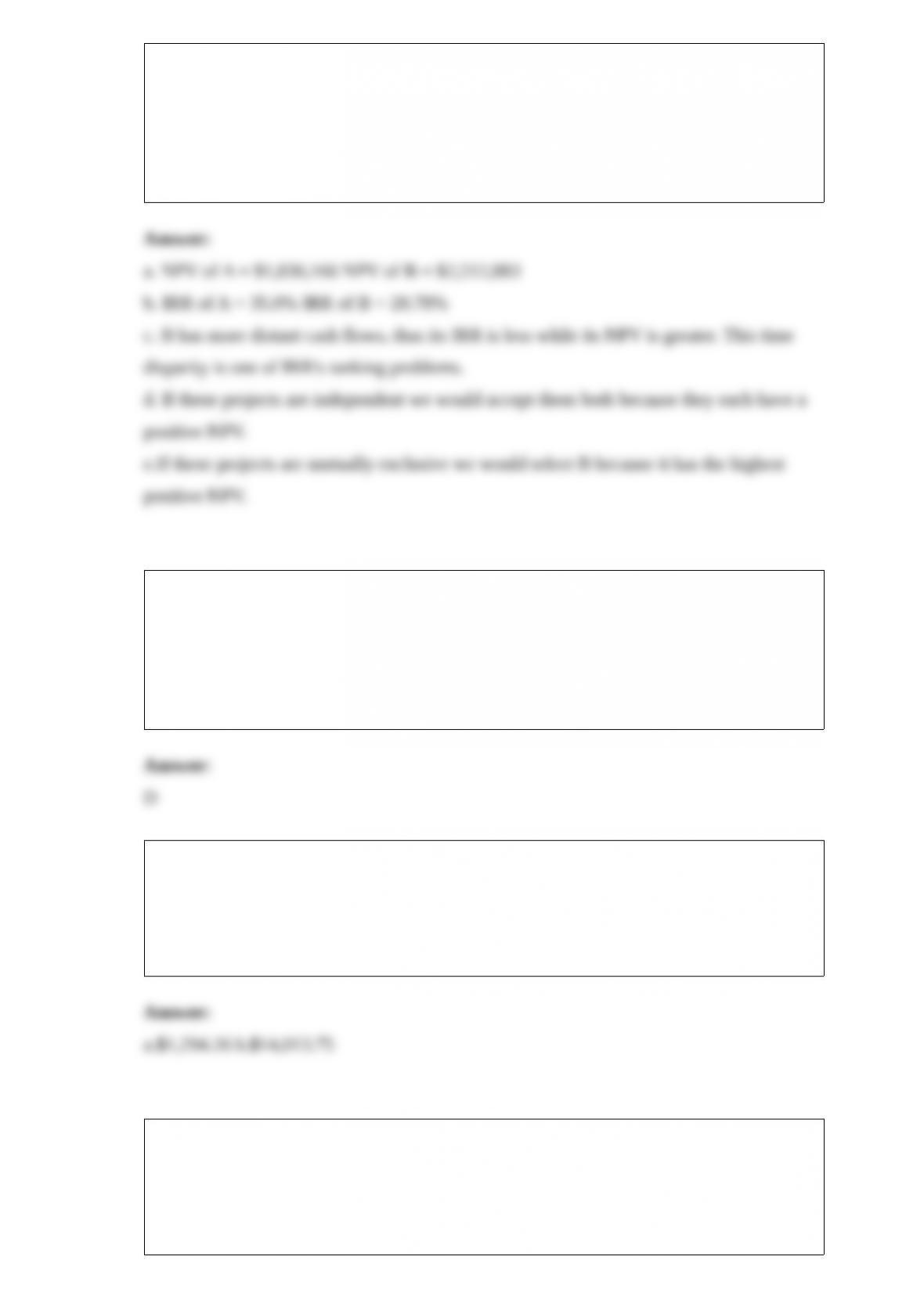
25) Consider the following two projects:
a.Calculate the net present value of each of the above projects, assuming a 14 percent
discount rate.
b.What is the internal rate of return for each of the above projects?
c.Compare and explain the conflicting rankings of the NPVs and IRRs obtained in parts
a and b above.
d.If 14 percent is the required rate of return, and these projects are independent, what
decision should be made?
e.If 14 percent is the required rate of return, and the projects are mutually exclusive,
what decision should be made?
26) If depreciation expense in year one of a project increases for a highly profitable
company
A) net income decreases and incremental free cash flow decreases
B) net income increases and incremental free cash flow increases
C) the book value of the depreciating asset increases at the end of year one
D) net income decreases and incremental free cash flow increases
27) In order to send your first child to Law School when the time comes, you want to
accumulate $40,000 at the end of 18 years. Assuming that your savings account will
pay 6% compounded annually, how much would you have to deposit if:
a.You want to deposit an equal amount at the end of each year?
b.You want to deposit one large lump sum today?
28) Of the following different types of securities, which is typically considered most
risky?
A) long-term corporate bonds
B) long-term government bonds
C) common stocks of large companies

D) common stocks of small companies
29) Lithium, Inc. is considering two mutually exclusive projects, A and B. Project A
costs $95,000 and is expected to generate $65,000 in year one and $75,000 in year two.
Project B costs $120,000 and is expected to generate $64,000 in year one, $67,000 in
year two, $56,000 in year three, and $45,000 in year four. Lithium, Inc.’s required rate
of return for these projects is 10%. The profitability index for Project A is
A) 1.27
B) 1.22
C) 1.17
D) 1.12
30) The “threat hypothesis”
A) reduces management’s tendency to spend freely
B) encourages management to use debt to further their own interests
C) increases the agency problem
D) increases agency monitoring costs
31) What is the present value of $11,463 to be received 7 years from today? Assume a
discount rate of 3.5% compounded annually and round to the nearest $1.
A) $5,790
B) $6,508
C) $7,210
D) $9,010
32) The percent of sales method can be used to forecast
A) expenses
B) assets
C) liabilities
D) all of the above

33) Due to changes in regulatory requirements, the transactions costs associated with
selling corporate securities increased by $1 per share. This change will
A) cause the cost of capital to decrease
B) cause the cost of capital to increase
C) have no effect on the cost of capital because transactions costs are expensed
immediately
D) cause the cost of capital to decrease only if investors may be billed for part of the
increase in transactions costs
34) A corporate bond has a coupon rate of 9%, a face value of $1,000, and matures in
15 years. Which of the following statements is MOST correct?
A) An investor with a required return of 10% will value the bond at more than $1,000
B) An investor who buys the bond for $900 and holds the bond until maturity will have
a capital loss
C) An investor who buys the bond for $900 will have a yield to maturity on the bond
greater than 9%
D) If the bond’s market price is $900, then the annual interest payments on the bond
will be $81
35) Low dividends may increase stock value according to the
A) bird-in-the-hand theory
B) information effect
C) impact of agency costs
D) tax bias in favor of capital gains
36) Stock A has the following returns for various states of the economy:
State of
the EconomyProbabilityStock A’s Return
Recession10%-30%
Below Average20%-2%
Average40%10%
Above Average20%18%
Boom10%40%
Stock A’s expected return is
A) 5.4%

B) 7.2%
C) 8.2%
D) 9.6%
37) Assume that Plavor Brands, Inc. has 10,000,000 common shares outstanding that
have a par value of $2 per share. The stock is currently trading for $30 per share. The
firm reported a net profit after-tax of $25,000,000. All else equal, what will happen to
earnings per share if the company issues a 10% stock dividend?
A) Earnings per share will remain the same since a stock dividend does not create an
expense
B) Earnings per share will increase because the dividend increases the value of the
company
C) Earnings per share will decrease because the number of shares outstanding will go
up
D) The impact cannot be determined without additional information on the new price
per share
38) A firm that wants to know if it has enough cash to meet its bills would be most
likely to use which kind of ratio?
A) liquidity
B) leverage
C) efficiency
D) profitability
39) Bryant Inc. just issued $1,000 par 30-year bonds. The bonds sold for $1,107.20 and
pay interest semiannually. Investors require a rate of 7.75% on the bonds. What is the
bonds’ coupon rate?
A) 9.333%
B) 7.750%
C) 4.125%
D) 8.675%
40) In the EOQ model, carrying costs of inventory include

A) the required rate of return on inventory
B) wages for warehouse workers
C) costs associated with inventory shrinkage
D) B and C
E) all of the above
41) Bevel Building Products, Inc., whose common stock is currently selling for $12 per
share, is expected to pay a $1.80 dividend, and sell for $14.40 one year from now. What
are the dividend yield, growth rate, and total rate of return, respectively?
A) 15%20%35%
B) 10%5%15%
C) 15%12%27%
D) 20%15%35%
42) During the past year the growth corporation increased its sales from $1,000,000 to
$2,000,000 and its EBIT from $250,000 to $400,000. The result of this growth will be
A) a higher operating profit margin and higher net income
B) a lower operating profit margin and lower net income
C) a lower operating profit margin and higher net income
D) a higher P/E ratio
43) The market risk premium remains constant over time because the risk free rate of
return moves inversely with beta.
44) Standard Inc. has an annual interest expense of $40,000. If Standard’s
times-interest-earned ratio is 3.0, what is Standard’s Earnings Before Taxes (EBT)?
A) $47,000
B) $80,000
C) $120,000
D) $160,000

45) LPD Logistics, Inc.’s projected sales for the first six months of 2010 are given
below.
Jan.$300,000April$350,000
Feb.$350,000May$500,000
Mar.$475,000June$400,000
20% of sales are collected in the month of the sale, 75% are collected in the month
following the sale, and 5% are written off as uncollectible. Cost of goods sold is 80% of
sales. Purchases are made the month prior to the sales and are paid during the month the
purchases are made (i.e. goods sold in March are bought and paid for in February).
Total other cash expenses are $35,000/month. The company’s cash balance as of
February 1, 2010 will be $30,000. Excess cash will be used to retire short-term
borrowing (if any). LPD has no short term borrowing as of February 28, 2010. Assume
that the interest rate on short-term borrowing is 1% per month. The company must have
a minimum cash balance of $20,000 at the beginning of each month. What is LPD’s
projected cumulative borrowing as of March 1, 2010?
A) $110,000
B) $90,000
C) $70,000
D) -0-
46) Examine the securities below and identify the security with the highest liquidity
premium, the highest default risk premium, and the highest maturity premium.
a.30-Year U.S. Government Treasury Bond maturing in 2025
b.25-Year BBB-rated Corporate Bond maturing in 2030, actively traded on the New
York Exchange
c.10-Year AAA-rated Corporate Bond maturing in 2020, thinly traded on a regional
exchange
d.3-Month U.S. Treasury Bill
47) Plato Industries’ projected sales for the first six months of 2012 are given below:
Jan.$250,000April$300,000

Feb.$340,000May$350,000
Mar.$280,000June$380,000
20% of sales are collected in cash at time of sale, 50% are collected in the month
following the sale, and the remaining 30% are collected in the second month following
the sale. Cost of goods sold is 85% of sales. Purchases are made in the month prior to
the sales, and payments for purchases are made in the month of the sale. Total other
cash expenses are $70,000/month. The company’s cash balance as of February 28, 2012
will be $10,000. Excess cash will be used to retire short-term borrowing (if any). Plato
has no short term borrowing as of February 28, 2012. Ignore any interest on short-term
borrowing. The company must have a minimum cash balance of $40,000 at the
beginning of each month. What is Plato Industries’ total cash receipts for April 2012?
A) $340,000
B) $326,000
C) $302,000
D) $300,000
48) Stock A has a beta of 1.2 and a standard deviation of returns of 18%. Stock B has a
beta of 1.8 and a standard deviation of returns of 18%. If the market risk premium
increases, then
A) the required return on stock B will increase more than the required return on stock A
B) the required returns on stocks A and B will both increase by the same amount
C) the required returns on stocks A and B will remain the same
D) the required return on stock A will increase more than the required return on stock B
49) Which of the following is NOT a motive for a corporation to hold cash balances?
A) transactions
B) float
C) precautionary
D) speculative