
1) international markets for goods and services are often imperfect. which is the most
common and most important?
a.acts of governments
b.natural barriers like distance
c.cultural barriers
d.lack of knowledge
2) suppose that you are the treasurer of ibm with an extra u.s. $1,000,000 to invest for
six months. you are considering the purchase of u.s. t-bills that yield 1.810% (that’s a
six month rate, not an annual rate by the way) and have a maturity of 26 weeks. the spot
exchange rate is $1.00 = ¥100, and the six month forward rate is $1.00 = ¥110. what
must the interest rate in japan (on an investment of comparable risk) be before you are
willing to consider investing there for six months?
a.11.991%
b.1.12%
c.7.45%
d.-7.45%
3) stock in daimler ag, the famous german automobile manufacturer trades on both the
frankfurt stock exchange in germany and on the new york stock exchange. on the
frankfurt bourse, daimler closed at a price of 54.34 on wednesday, march 5, 2008. on
the same day, daimler closed in new york at $83.55 per share. to prevent arbitrage
trading between the two exchanges, the shares should trade at the same price when
adjusted for the exchange rate. the $/ exchange rate on march 5 was $1.5203/1.00. thus,
54.34 $1.5203/ = $82.61, while the closing price in new york was $83.55. the difference
is easily explainable by the fact that
a.transactions costs exceeded the price difference, so no arbitrage was possible even for
market makers
b.no one noticed the arbitrage that day, but in a day or so the opening price will adjust
c.the new york market closes several hours after the frankfurt exchange, and thus
market prices or exchange rates had changed slightly
d.none of the above

4) the emergence of global financial markets is due in no small part to
a.advances in computer and telecommunications technology
b.enforcement of the soviet system of state ownership of resources of production
c.government regulation and protection of infant industries
d.none of the above
5) with regard to clearing procedures for bond transactions
a.it is a system for transferring ownership of bonds
b.it is a system for ensuring payment from buyers to sellers
c.most eurobond trades clear through two major clearing systems
d.all of the above
6) under the bretton woods system
a.there was an explicit set of rules about the conduct of international monetary policies
b.each country was responsible for maintaining its exchange rate within 1 percent of the
adopted par value by buying or selling foreign exchanges as necessary
c.the u.s. dollar was the only currency that was fully convertible to gold
d.all of the above
7) foreign banks that establish subsidiary and affiliate banks in the u.s.
a.tend to locate in states that are major centers of financial activity
b.tend to locate in the highly populous states of new york, california, illinois, florida,
georgia, and texas
c.can underwrite securities, but not accept dollar-denominated deposits
d.both a and b
8) with a centralized cash depository
a.there is less chance for an mnc’s funds to be denominated in the wrong currency
b.the central cash manager has a global view of the mnc’s overall cash position
c.there is less chance of mislocated funds
d.all of the above
9) which of the following are true statements?
a.since translation exposure does not have an immediate direct effect on operating cash
flows, its control is relatively unimportant in comparison to transaction exposure, which
involves potential real cash flow losses
b.since it is generally not possible to eliminate both translation exposure and transaction
exposure, it is more logical to effectively manage transaction exposure
c.two ways to control translation risk are: a balance sheet hedge and a derivatives
“hedge.”
d.all of the above are true statements
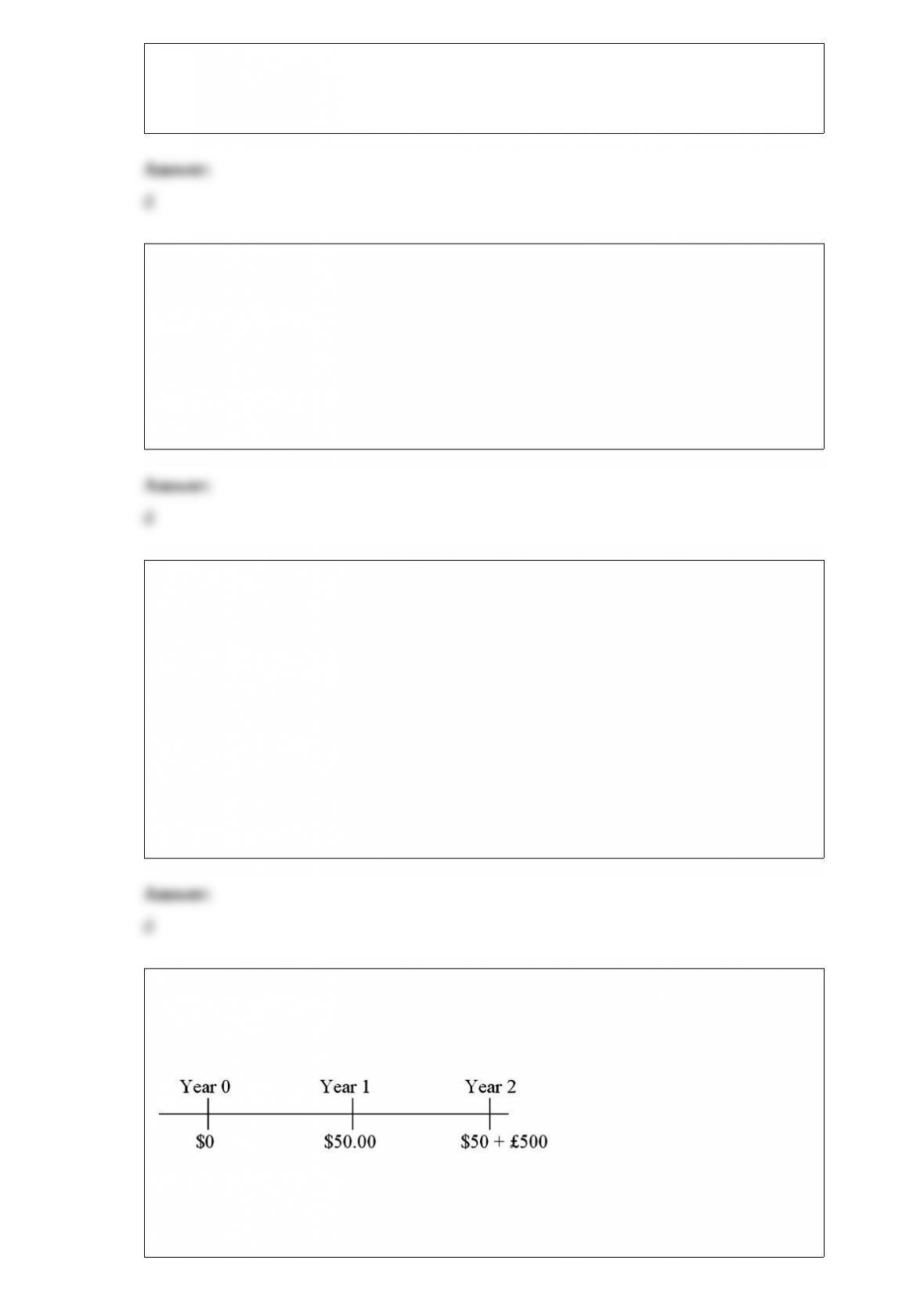
10) find the value today of a 2-year dual currency bond with annual coupons (paid in
u.s. dollars at a 5 percent coupon rate) that pays £500 per $1,000 par value at maturity.
the cash flows of the bond are:
the dollar-based yield to maturity is i$ = 3%; the spot exchange rate is $1.80 = £1.00;
expected inflation over the next three years is $ = 2% in the u.s. and £ = 3% in the u.k.
a.$927.62

b.$941.30
c.$965.06
d.$599.00
11) an income tax is defined by your textbook as
a.is a direct tax
b.is an indirect tax
c.is collected with a withholding tax
d.none of the above
12) severe imperfections in the labor market arise from immobility of workers due to
immigration barriers. as a response, firms should consider
a.moving to the workers
b.moving to countries where labor services are the lowest in absolute terms
c.moving to countries where labor services are underpriced relative to productivity
d.hiring illegal immigrants
13) the aud/$ spot exchange rate is aud1.60/$ and the sf/$ is sf1.25/$. the aud/sf cross
exchange rate is _____.
a.0.7813
b.2.0000
c.1.2800
d.0.3500
14) to avoid buying a stock at a price higher than you intend, you need to place
________ rather than a market order.
a.a stop-loss order
b.a day order
c.a good-til-cancelled order
d.a limit order
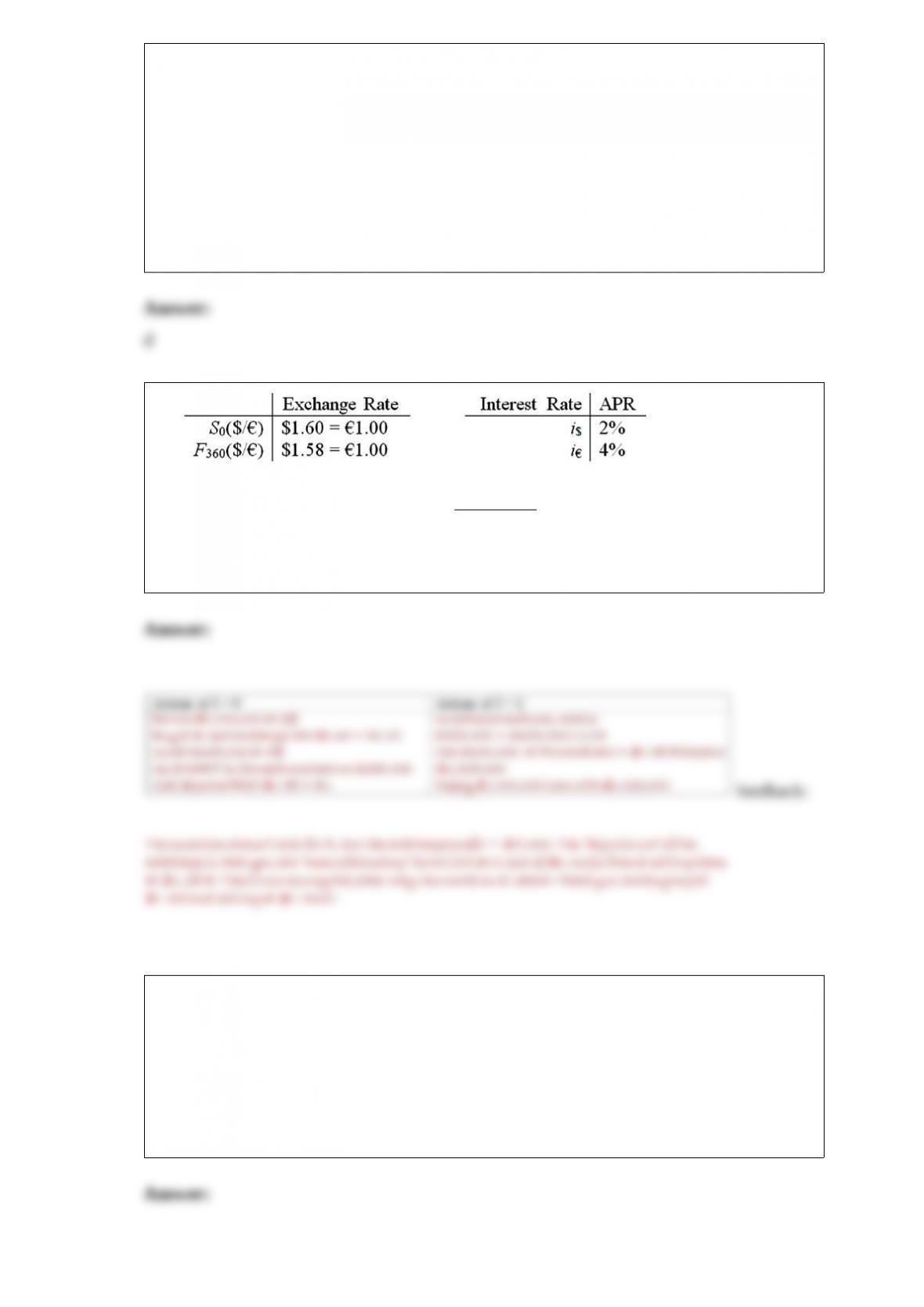
15)
please note that your answers are worth zero points if they do not include currency
symbols ($, )
there is (at least) one profitable arbitrage at these prices. what is it?
16) the time from acceptance to maturity on a $30,000,000 banker’s acceptance is 45
days.
the importing bank’s acceptance commission is 1.5 percent and that the market rate for
45-day b/as is 4 percent.
determine the amount the exporter will receive if he discounts the b/a with the
importer’s bank.
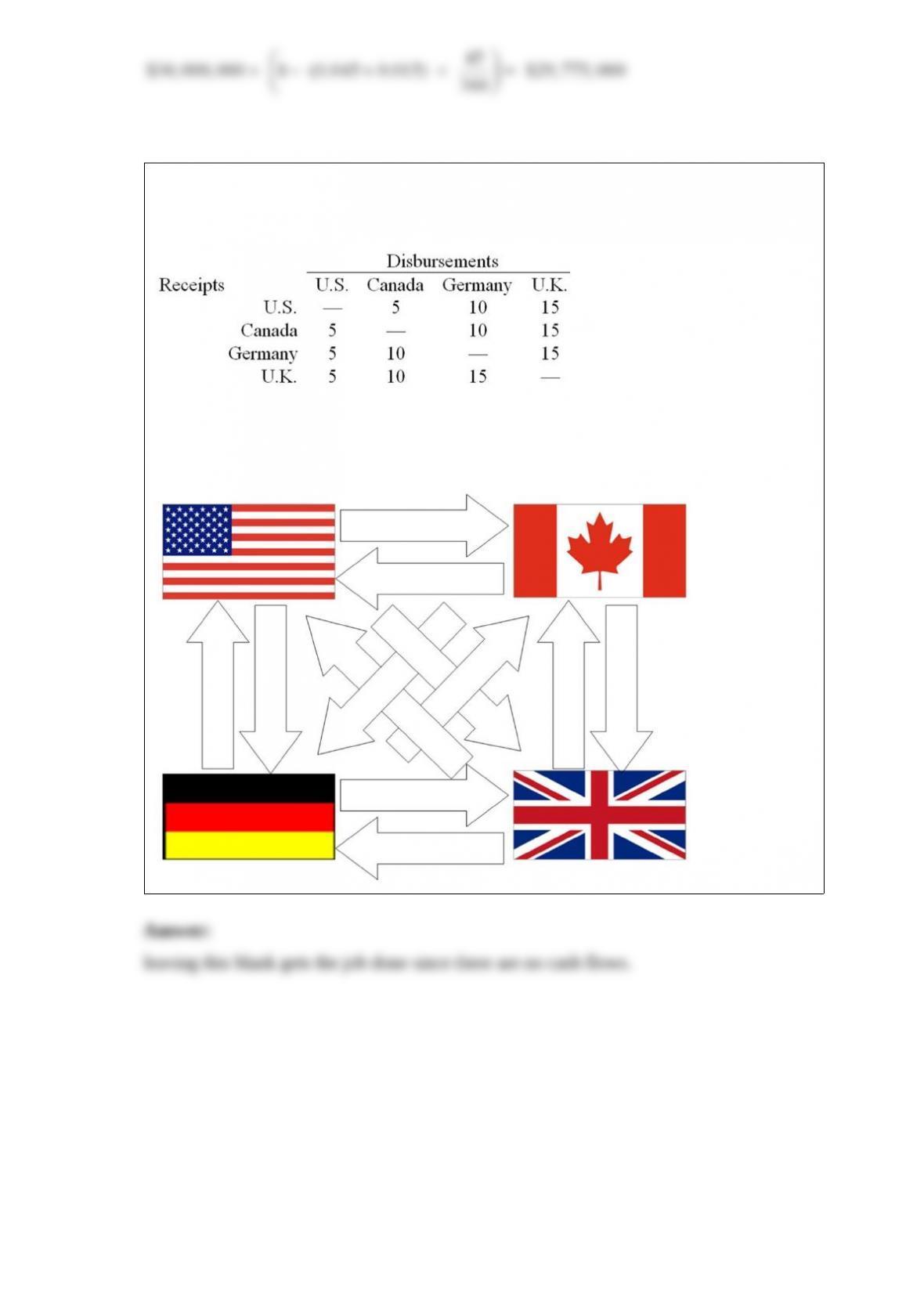
17) your firm’s interaffiliate cash receipts and disbursements matrix is shown below
($000):
using your results to the last question, use bilateral netting to simplify.
18) the time from acceptance to maturity on a $30,000,000 banker’s acceptance is 45
days.
the importing bank’s acceptance commission is 1.5 percent and that the market rate for
45-day b/as is 4 percent.
determine the amount the exporter will receive if he holds the b/a until maturity.
19) your firm is based in southern ireland (and thereby operates in euro, not pounds)
and is considering an investment in the united states.
the project involves selling widgets: you project a sales volume of 50,000 widgets per
year, sales price of $20 per widget with a contribution margin of $15 per widget.
the project will last for 5 years, require an investment of $1,000,000 at time zero (which
will be depreciated straight-line to $10,000 over the 5 years). salvage value for the
equipment is projected to be $10,000. the project will operate in rented quarters:
$300,000 rent is due at the start of each year.
the corporate tax rate is 12% in ireland and 40% in the u.s.
for simplicity, assume that taxes are paid like sales taxes: immediately.
the spot exchange rate is $1.50 = 1.00. the cost of capital to the irish firm for a domestic
project of this risk is 8%. the u.s. risk-free rate is 3%; the irish risk-free rate is 2%.
what is the dollar-denominated irr?