
Which of the following is NOT true of exchanges?
(a) Securities are bought and sold in one physical location.
(b) Securities are sold in an auction market.
(c) The NYSE is an exchange.
(d) The NASDAQ is an exchange.
Answer:
What did the Congressional Budget Office estimate the cost of the S&L debacle to be in
1992 dollars?
(a) $100 million
(b) $200 billion
(c) $1 trillion
(d) $3 trillion
Answer:
The financial system is primarily a means by which
(a) borrowers can use savers’ funds until the savers themselves need the funds.

(b) money is put into circulation.
(c) the government puts into operation its plans for the economy.
(d) business firms distribute their goods.
Answer:
The creation of a lender of last resort in the United States
(a) occurred in response to banking panics.
(b) was mandated in the U.S. Constitution.
(c) occurred in response to the S&L crisis of the 1980s.
(d) has been recommended by the Treasury in its report of late 1992.
Answer:
Which asset is sometimes referred to as a bank’s secondary reserves?
(a) Vault cash
(b) U.S. government securities
(c) Repurchase agreements

(d) Federal funds
Answer:
Which of the following is not a way in which power was divided up in the Federal
Reserve System?
(a) Between bankers and business interests
(b) Among states and regions
(c) Between importers and exporters
(d) Between government and the private sector
Answer:
Which of the following is NOT a bank liability?
(a) Checkable deposits
(b) CDs
(c) Mortgage loans
(d) Borrowings from the Federal Reserve

Answer:
How does the reserve policy of the European Central Bank (ECB) differ from the
reserve policy of the Fed?
(a) The ECB has a required reserve ratio of 100%.
(b) The ECB pays interest on reserve balances.
(c) The ECB does not apply reserve requirements to checkable deposits.
(d) The ECB applies the same required reserve ratio to all banks and all deposits.
Answer:
An asset in a portfolio always represents
(a) a medium of exchange.
(b) a unit of account.
(c) a store of value.
(d) the same thing as a liability.
Answer:

Diversification can eliminate
(a) all risk in a portfolio.
(b) the idiosyncratic risk in a portfolio.
(c) the market risk in a portfolio.
(d) risk only if the saver is risk neutral.
Answer:
Everything else being constant, a lower real interest rate
(a) increases desired saving and net exports.
(b) decreases desired saving but increases net exports.
(c) increases desired saving and investment.
(d) increases desired investment but decreases net exports.
Answer:
Which of the following is the dominant means by which the Fed attempts to change the
monetary base?
(a) Discount loans
(b) Open market operations
(c) Changes in the required reserve ratio
(d) Moral suasion
Answer:
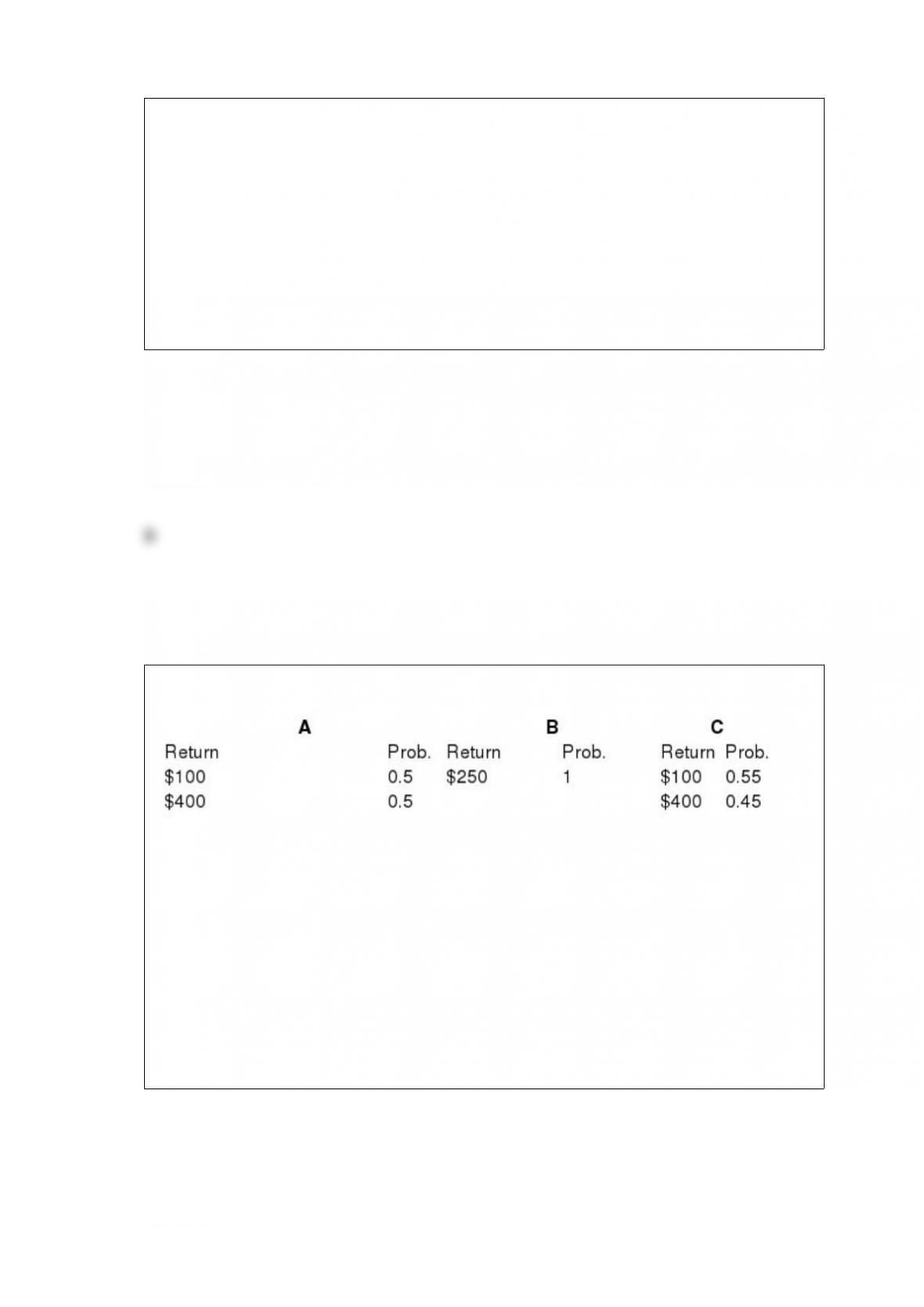
How would a risk-averse saver rank the following three investment opportunities?
(Let A > B > C stand for “Choice A is preferred to Choice B is preferred to Choice C”;
that is, the investor likes A the most and C the least.)
(a) A > B > C
(b) B > C > A
(c) B > A > C
(d) C > B > A
Answer:

From 1929 to 1933 expenditures on fixed investment, consumer durable goods, and
housing all declined in constant dollars by at least
(a) 5%.
(b) 10%.
(c) 25%.
(d) 50%.
Answer:
One reason that investment spending tends to decline during recessions is that
(a) interest rates tend to rise, reducing the expected future profitability of investment
projects undertaken with borrowed funds.
(b) many firms experience a decline in internal funds.
(c) government spending tends to rise, which crowds out investment spending.
(d) many firms experience an increase in taxes, reducing the expected future
profitability of investment projects.
Answer:

Promises given by borrowers to lenders are
(a) recognized as legally enforceable only in some states.
(b) not subject to federal taxation.
(c) assets to the borrowers.
(d) liabilities to the borrowers.
Answer:
Central banks have met to discuss their roles as lender of last resort several times at the
(a) United Nations.
(b) Bank for International Settlements.
(c) League of Nations.
(d) Bank of England
Answer:
What does stagflation mean?

(a) Rising output and falling prices
(b) Falling output and rising prices
(c) Rising output and prices
(d) Falling output and prices
Answer:
The oldest U.S. government intervention in financial intermediation is government
lending to
(a) individual home buyers.
(b) large corporations.
(c) small corporations.
(d) farmers.
Answer:
When a central bank buys foreign assets,
(a) its assets and liabilities rise by the same amount.
(b) its assets and liabilities fall by the same amount.

(c) the composition of its assets changes, but its liabilities are unaffected.
(d) the composition of its liabilities changes, but its assets are unaffected.
Answer:
The facts show that the political business cycle theory
(a) does a good job of explaining monetary policy during presidential election years.
(b) is unable to explain monetary policy during presidential election years.
(c) does a good job of explaining monetary policy during some presidential election
years, but not during others.
(d) explains monetary policy best during years in which the President is running for
reelection.
Answer:
In a repurchase agreement, a corporation
(a) agrees to buy back previously issued stock.
(b) agrees to pay back a bank loan whenever the bank asks it to.
(c) purchases Treasury bills from a bank and the bank commits to repurchase them the

next day.
(d) guarantees the quality of its goods by offering to buy them back if the customer is
dissatisfied.
Answer:
Automatic teller machines and debit cards are examples of
(a) electronic funds transfer systems.
(b) commodity monies.
(c) legal tender in the United States.
(d) modern barter systems.
Answer:
The Fed
(a) is obliged to make whatever discount loans are requested by banks that are members
of the Federal Reserve System.
(b) has been obliged since 1980 to make whatever discount loans are requested by any
depository institution.
(c) will make a discount loan only if it appears certain that the institution requesting the

loan would fail without it.
(d) extends discount loans at its discretion.
Answer:
Which of the following statements concerning the volume of outstanding bankers’
acceptances in the United States since the 1920s is accurate?
(a) The volume has continually increased between the 1920s and the 1990s.
(b) The volume has continually decreased between the 1920s and the 1990s.
(c) The volume has risen and fallen over the decades between the 1920s and the 1990s.
(d) Statistics on the volume of bankers’ acceptances outstanding are not available, so
movements in the volume can only be guessed at.
Answer:
If the prices of financial assets follow a random walk, then
(a) they should be easy to forecast, provided market participants have rational
expectations.
(b) they should be easy to forecast, provided market participants have adaptive
expectations.

(c) the change in price from one trading period to the next is not predictable.
(d) major traders in the market must not be making use of all available information
about the assets.
Answer:
Suppose that savers become much more willing to purchase a certain type of municipal
bond. The result will be that the bond’s price will
(a) fall relative to the price of U.S. Treasury securities but rise relative to the price of
corporate bonds.
(b) rise relative to the price of U.S. Treasury securities but fall relative to the price of
corporate bonds.
(c) rise relative to the prices of U.S. Treasury securities and corporate bonds.
(d) fall relative to the prices of U.S. Treasury securities and corporate bonds.
Answer:
In general, an older saver should choose a financial portfolio based on
(a) selecting safe assets to earn an expected real return of about zero.
(b) maximizing expected return with only limited concern for variability

(c) equal concern for expected return and variability.
(d) avoiding tax-free securities.
Answer:
If a bank grants you a mortgage, the mortgage is
(a) an asset to you as well as an asset to the bank.
(b) an asset to you, but a liability to the bank.
(c) a liability to you, but an asset to the bank.
(d) a liability to you as well as a liability to the bank.
Answer:
If households increase their saving at the same time that the government increases its
deficit
(a) the demand and supply curves for bonds will be unaffected.
(b) the demand curve for bonds will shift to the left.
(c) the supply curve for bonds will shift to the right.
(d) the equilibrium interest rate will definitely rise.

Answer:
A “primary market” is a market
(a) for government securities.
(b) in which newly issued claims are sold to buyers by borrowers.
(c) in which newly issued claims are sold by savers to borrowers.
(d) for debt by large or “primary” corporations.
Answer: