
1) The residual dividend theory implies that internally generated funds (i.e., retained
earnings) should be used to fund all new investment projects before the company uses
any additional debt.
2) To ensure that a borrower is not using short-term bank credit to finance a part of its
permanent needs for funds, banks often require borrowers to clean up their short-term
loans for a 30 – 45 day period during the year.
3) Two approaches that allow for the retirement of preferred stock are call provisions
and sinking fund provisions.
4) Registration of securities by the SEC indicates to investors that the risk of those
securities is reasonable.
5) The current yield is greater than the coupon rate for a bond selling above par value.
6) A return of 12% compounded annually is the same as a return of 1% per month.
7) Economic value added is calculated by taking (net income less the cost of all capital)
times total assets.

8) Trade credit is a source of spontaneous financing.
9) The balance sheet reflects the accounting equation: Assets = Liabilities + Owners’
Equity.
10) Investment A and Investment B both have the same expected return, but Investment
A is more risky than Investment B. In the technical jargon of modern portfolio theory,
Investment A is said to “dominate” Investment B.
11) Fixed costs are called indirect costs while variable costs are called direct costs.
12) The relevant risk to an investor is that portion of the variability of returns that
cannot be diversified away.
13) If a firm does not have enough money to pay any common stock dividends, it is
technically in default to the common shareholders.
14) Two projects that have the same cost and the same expected cash flows will have
the same net present value.

15) According to the expectations theory, the actual dividend must equal the expected
dividend, or else the stock price will decrease after the dividend amount is announced.
16) The cost of debt increases relative to the investor’s required return due to flotation
costs, but decreases relative to the investor’s required return due to the tax deductibility
of interest.
17) A direct quote of $1.6255 dollars to buy one U.K. pound corresponds to an indirect
quote of .6152 pounds per one dollar.
18) A liquidity-risk premium is the additional return required by investors in
longer-term securities to compensate them for the greater risk of price fluctuation on
those securities caused by interest rate changes.
19) In an efficient market, a stock with a standard deviation of returns of 12% could
have a higher expected return than a stock with a standard deviation of 10% because the
beta for the higher standard deviation stock could be lower than the beta for the lower
standard deviation stock.
20) The less risky the bond (or the higher the bond rating) the lower will be the yield to
maturity on the bond.
21) Which of the following features, or benefits, belong to a firm’s common

stockholders?
A) limited liability
B) ownership of the firm
C) voting rights
D) all of the above
22) Today is your 20th birthday and your bank account balance is $25,000. Your
account is earning 6.5% interest compounded semiannually. How much will be in the
account on your 50th birthday?
A) $159,795
B) $162,183
C) $163,823
D) $170,351
23) Table 4-1
Stewart Company
Balance Sheet
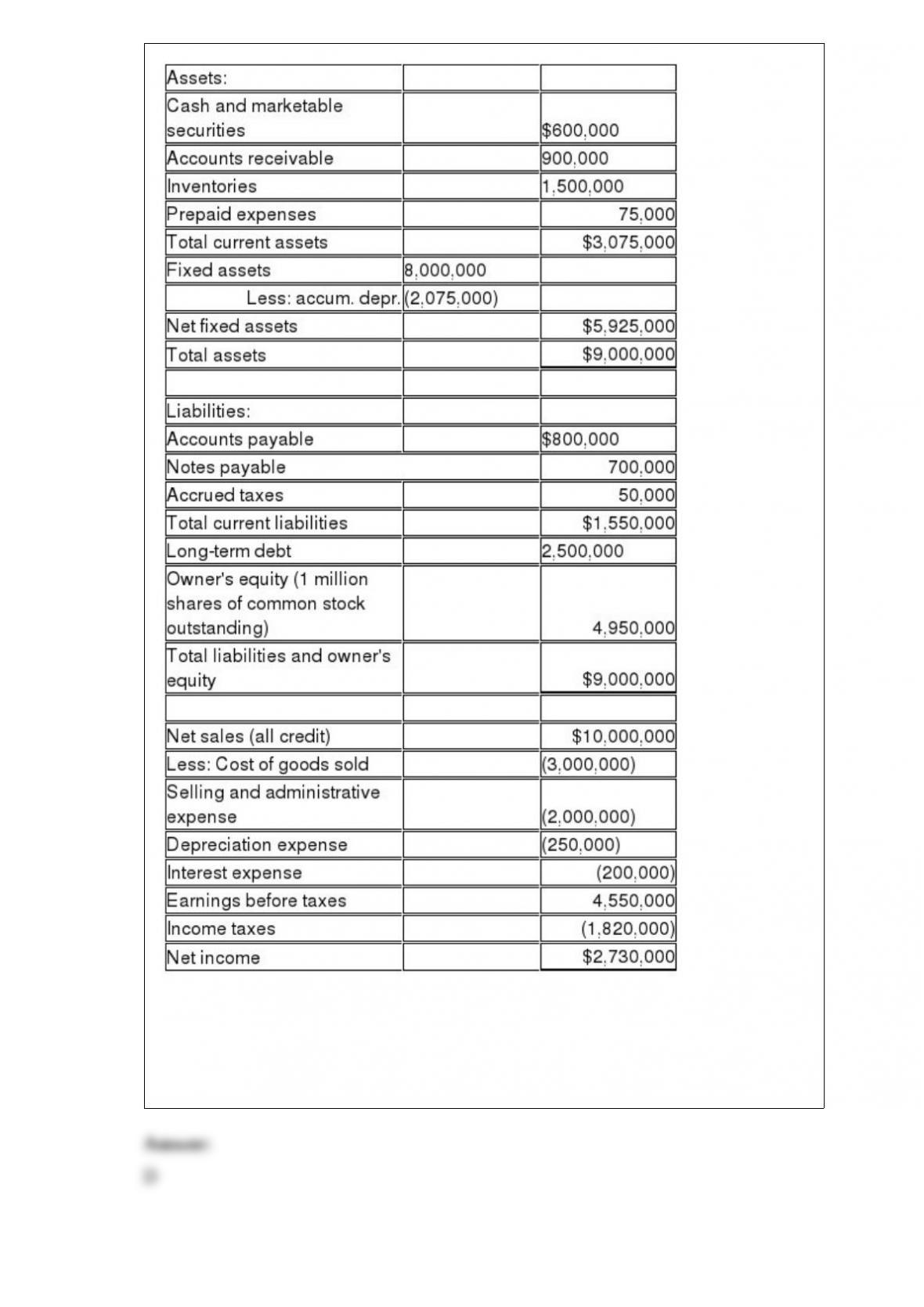
Assuming the company’s stock price is $30 per share, the P/E ratio is
A) 3.09
B) 4.83
C) 9.85
D) 10.99

24) MovieTone, Inc. is a producer and distributor of specialty DVDs. It sells directly to
large retail firms on terms of net 60 and has average monthly sales of $350,000. It has
recently decided to pledge all of its accounts receivable to its bank. The bank advances
up to 80 percent of the face value of these receivables at a rate of 4 percent over the
prime rate, while charging 2.5 percent on all receivables pledged for processing to
cover billing and collection services. Prior to this arrangement MovieTone was
spending $50,000 a year on its credit department. The prime rate is 6 percent.
a.What is the average level of accounts receivable?
b.What is the effective cost of using this short-term credit for one year?
25) The internal rate of return is
A) the discount rate that makes the NPV positive
B) the discount rate that equates the present value of the cash inflows with the present
value of the cash outflows
C) the discount rate that makes NPV negative and the PI greater than one
D) the rate of return that makes the NPV positive
26) Incremental cash flows refer to
A) the difference between after-tax cash flows and before-tax accounting profits
B) the new cash flows that will be generated if a project is undertaken
C) the cash flows of a project, minus financing costs
D) the cash flows that are foregone if a firm does not undertake a project
27) XYZ, Inc. has developed a project which results in additional accounts receivable
of $400,000, additional inventory of $180,000, and additional accounts payable of
$70,000. What is the additional investment in net working capital?
A) $580,000
B) $510,000
C) $270,000
D) $150,000

28) Corporation A decides to borrow $1,000,000 and use the money to buy back
$1,000,000 of its common stock. The corporation pays 6% interest on its borrowed
funds which exactly equals the amount of the dividend it used to pay on the common
stock it repurchased. Therefore
A) Corporation A’s operating income will decrease due to higher interest expense
B) Corporation A’s net income will increase due to the tax deductibility of interest
expense
C) Corporation A will have no change in its operating income since the interest expense
exactly offsets the prior dividend payment
D) Corporation A’s gross profit will decrease
29) The spot exchange rate in New York is 1.600 dollars per British pound. The
360-day forward exchange rate is 1.680 dollars per pound. The one-year interest rate in
Great Britain is 2% while the one-year interest rate in the United States is 4%.
a.If the interest rate in Great Britain remains at 2%, what should the interest rate be in
the United States according to the interest rate parity theory?
b.An American investor with $40,000 decides to take advantage of the differences in
rates. Ignoring transaction costs, how can the American investor exploit the
disequilibrium? Compare the amount of money the investor will have at the end of the
year if he or she invests in one-year U.S. securities versus one-year British securities.
30) What is the primary tool for short-term financial forecasting?
A) pro forma income statement
B) pro forma balance sheet
C) pro forma cash budget
D) capital budgeting
31) A significant advantage of the internal rate of return is that it
A) provides a means to choose between mutually exclusive projects
B) provides the most realistic reinvestment assumption
C) avoids the size disparity problem
D) considers all of a project’s cash flows and their timing
32) If you are an importer of goods and you need to make payment for the purchase of
inventory before the close of business today, which of the below is the correct term for
the exchange rate that you will use?
A) indirect rate
B) spot rate
C) direct rate
D) forward rate
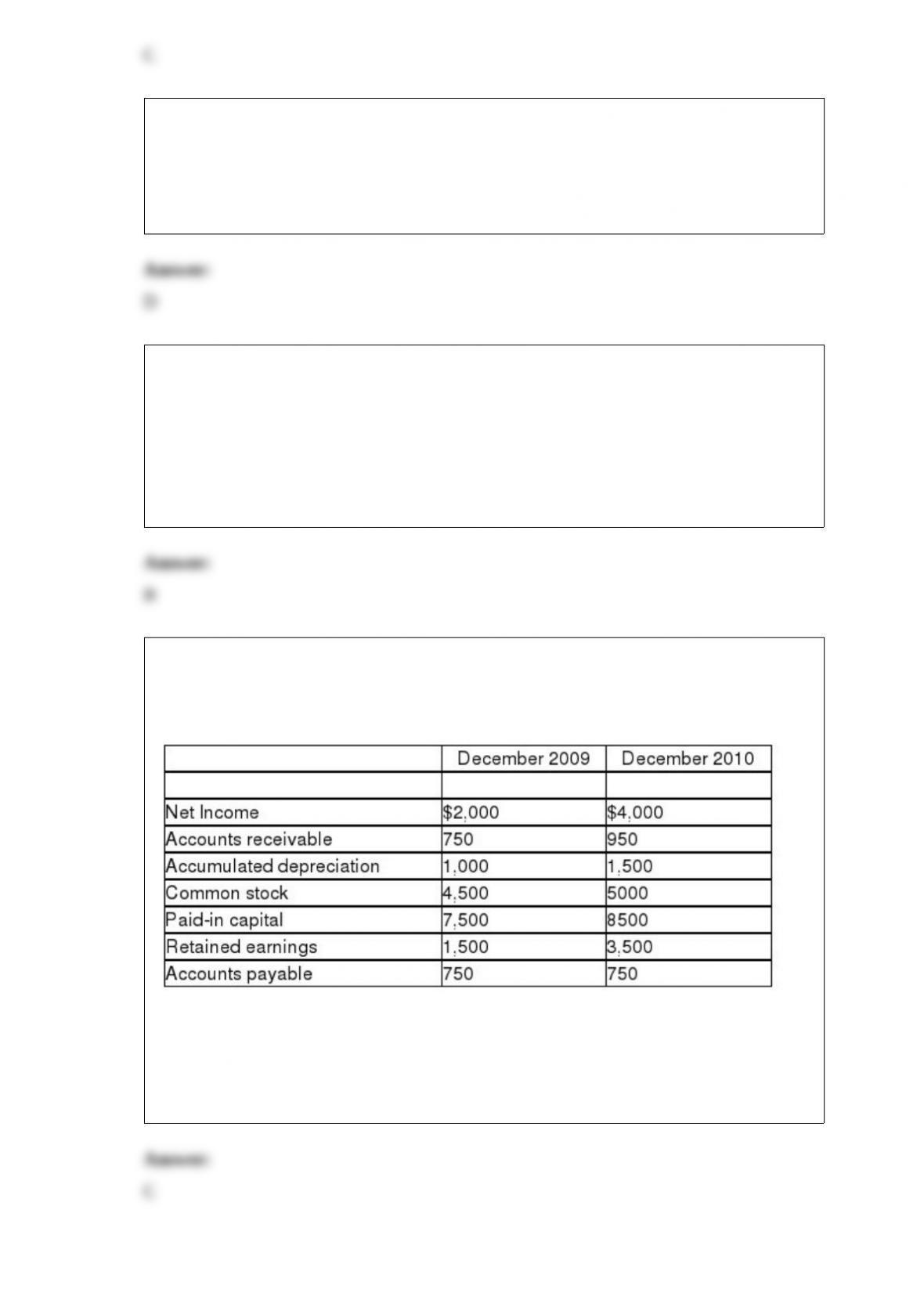
33) Table 3-1
Jones Company
Financial Information
The change in cash for 2010 is
A) $4,000
B) $4,950
C) $5,800
D) $5,500

34) Two considerations that cause a corporation’s cost of capital to be different than its
investors’ required returns are
A) corporate taxes and flotation costs
B) individual taxes and corporate taxes
C) individual taxes and dividends
D) corporate taxes and the earned income tax credit
35) Which of the following is NOT TRUE regarding mortgaged-backed
securities(MSB)?
A) MSB are sold to investors who can hold them as an investment or resell them to
other investors
B) The MSB process allows the mortgage bank or other financial institution that made
the original mortgage loan to get its money back out of the loan and lend it to someone
else
C) Securitization provides liquidity to the mortgage market and makes it possible for
banks to loan more money to home buyers
D) All of the above statements are TRUE
36) Miller’s preferred stock is selling at $54 on the market and pays an annual dividend
of $4.20 per share.
a.What is the expected rate of return on the stock?
b.If an investor’s required rate of return is 9%, what is the value of the stock to that
investor?
c.Considering the investor’s required rate of return, does this stock seem to be a
desirable investment?

37) At a minimum, the sales forecast for the coming year would reflect
A) any future trend in sales that is expected to begin in the new year
B) the influence of any anticipated events that might materially affect the sales trend
C) both of the above are correct
D) neither of the above are correct
38) All of the following business organizations provide limited liability to their owners
EXCEPT
A) general partnership
B) S-type corporation
C) corporation
D) limited liability company
39) Selection of a source of short-term financing should include all of the following
EXCEPT
A) the effective cost of credit
B) the availability of financing in the amount and for the time needed
C) the floatation costs for debentures
D) the effect of the use of credit from a particular source on the cost and availability of
other sources of credit
40) You are considering investing in a project with the following year-end after-tax cash
flows:
Year 1: $57,000
Year 2: $72,000
Year 3: $78,000
If the initial outlay for the project is $185,000, compute the project’s internal rate of
return.
A) 3.98%
B) 5.54%
C) 11.89%
D) 14.74%
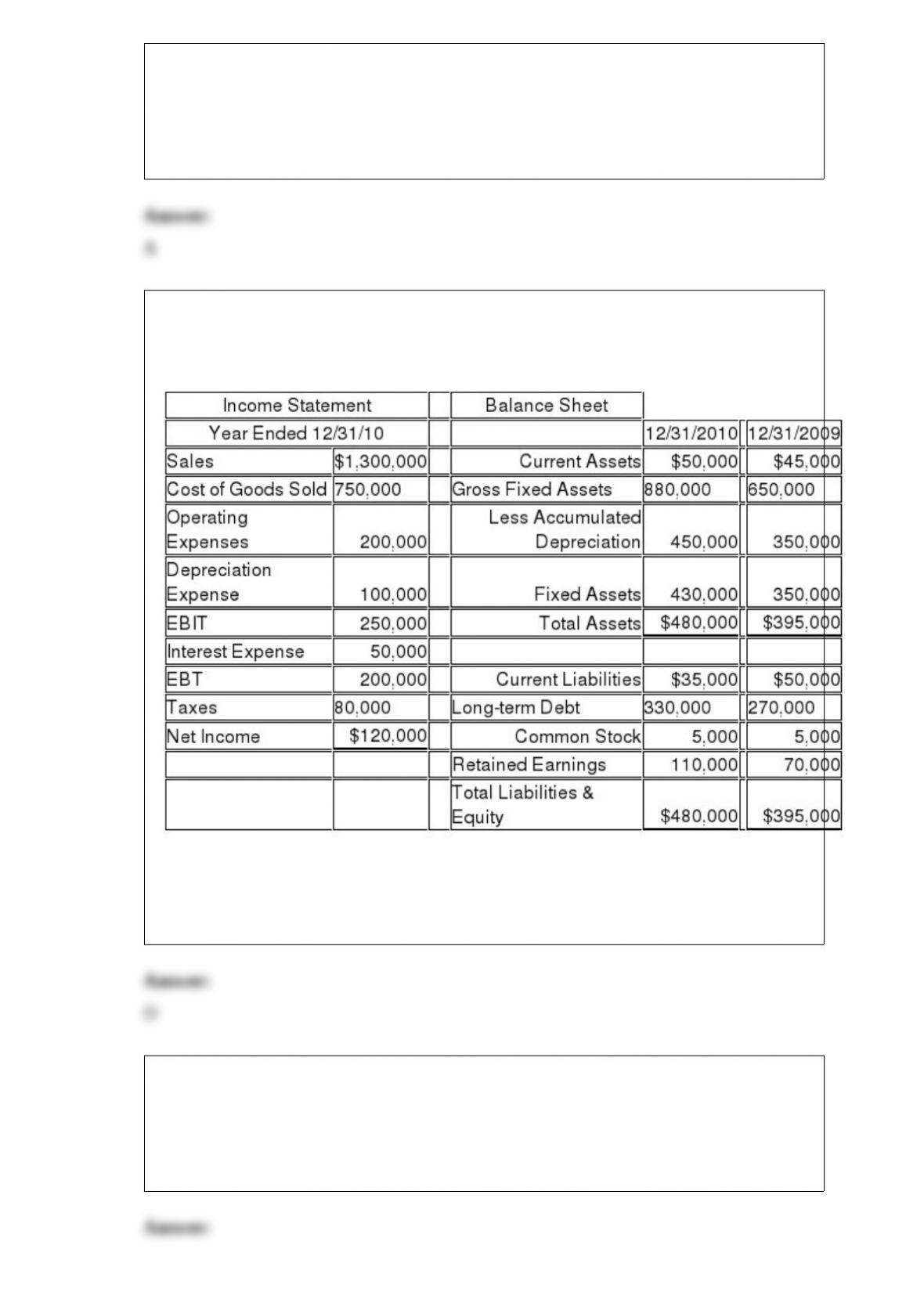
41) The acid-test ratio of a firm would be unaffected by which of the following?
A) Accounts payable are reduced by obtaining a short-term loan
B) Common stock is sold and the money is invested in marketable securities
C) Inventories are sold for cash
D) Inventories are sold on a short-term credit basis
42) Given the following financial statements for ACME Corporation, what amount did
the company pay in dividends for 2010?
A) $45,000
B) $25,000
C) $100,000
D) $80,000
43) Low dividends may increase stock value according to the
A) bird-in-the-hand theory
B) information effect
C) impact of agency costs
D) tax bias in favor of capital gains

44) Which of the following causes a firm’s cost of capital (WACC) to differ from an
investor’s required rate of return on the company’s common stock?
A) the fact that the risk free rate of interest has increased
B) the incurrence of flotation costs when new securities are issued
C) The market risk premium exceeds 12%
D) None of the above the WACC and required return are the same
45) Kelly Corporation is considering an investment proposal that requires an initial
investment of $150,000 in equipment. Fully depreciated existing equipment may be
disposed of for $40,000 pre-tax. The proposed project will have a five-year life, and is
expected to produce additional revenue of $65,000 per year. Expenses other than
depreciation will be $15,000 per year. The new equipment will be depreciated to zero
over the five-year useful life, but it is expected to actually be sold for $20,000. Kelly
has a 35% tax rate.
a.What is the net initial outlay for the proposed project?
b.What is the operating cash flow for years 1-4?
c.What is the total cash flow at the end of year five (operating cash flow for year 5 plus
terminal cash flow)?
46) AFB, Inc. is considering replacing an old machine with a new one. Two months ago
their chief engineer completed a training seminar on the new machine’s operation and
efficiency. The $3,000 cost for this training session has already been paid. If the new
machine is purchased, it would require $7,000 in installation and modification costs to
make it suitable for operation in the factory. The old machine originally cost $80,000
five years ago and is being depreciated by $10,000 per year. The new machine will cost
$100,000 before installation and modification. It will be depreciated by $12,000 per
year. The old machine can be sold today for $12,000. The marginal tax rate for the firm
is 40%. Compute the relevant initial outlay in this capital budgeting decision.
A) $79,500
B) $97,800

C) $90,800
D) $87,800
47) The correct order of dividend process dates is
A) date of record, declaration date, ex-dividend date, payment date.
B) declaration date, date of record, ex-dividend date, payment date.
C) ex-dividend date, date of record, declaration date, payment date.
D) declaration date, ex-dividend date, date of record, payment date.
48) The capital asset pricing model
A) provides a risk-return trade off in which risk is measured in terms of the market
volatility
B) provides a risk-return trade off in which risk is measured in terms of beta
C) measures risk as the coefficient of variation between security and market rates of
return
D) depicts the total risk of a security
49) Portfolio risk is typically measured by ________ while the risk of a single
investment is measured by ________.
A) standard deviation; beta
B) security market line; standard deviation
C) beta; standard deviation
D) beta; slope of the characteristic line
50) Using the percent of sales method and assuming that no excess capacity exists, a
20% increase in sales will result in
A) a 20% increase in total assets
B) a 20% increase in total liabilities
C) a 20% increase in retained earnings
D) a 20% increase in the company’s profit margin

51) The percent of sales method can be used to forecast
A) expenses
B) assets
C) liabilities
D) all of the above
52) MDX Sales Corp. is expecting a 10% increase in sales next year. MDX has an
inventory balance of $1,000,000 and uses the percent of sales forecasting method.
Which of the following could explain why the inventory forecast of $1,100,000 might
be too high?
A) The current inventory balance of $1,000,000 is lower than usual because of a
one-time end of year fire sale
B) The company is going to change its depreciation method in the coming year
C) The growth in sales could be as high as 15%
D) A fixed amount of inventory is required to do business, so inventory doesn’t increase
proportionally with sales