1) Like business bankruptcy and business failure, divestiture is most often undertaken
to relieve pressure by creditors such as bondholders and banks due to the firm’s
relatively high debt levels.
2) Under conservative funding strategy, short-term financing is used only to finance an
emergency, an unexpected outflow of funds, and the variable portion of a firm’s current
assets.
3) In large companies, CEOs are legally responsible for coordinating the assets and
liabilities of the employees’ pension fund.
4) Restrictive covenants place operating and financial constraints on the borrower.
5) The market value of a warrant is generally below the theoretical value of the warrant.
6) Higher the debt ratio, more the financial leverage a firm has and thus, the greater will
be its risk and return.
7) The cash conversion cycle of a firm is the difference between the number of days
resources are tied up in the operating cycle and the average number of days the firm can
delay making payment on the production inputs purchased on credit.
8) An option is a security that is neither debt nor equity but derives its value from an
underlying asset that is often another security.
9) The possibility that the issuer of a bond will not pay the contractual interest or
principal payments as scheduled is called default risk.
10) A firm’s credit standards are the minimum requirements for extending credit to a
customer.
11) The percentage advanced by a lender constitutes the principal of a secured loan and
varies according to the type and liquidity of the collateral.
12) A firm has an average age of inventory of 90 days, an average collection period of
40 days, and an average payment period of 30 days. The firm’s operating cycle is
________ days.
A) 110
B) 130
C) 120
D) 70
13) The firm has a total financing requirement of ________ for the period from
February through May. (See Table 4.3)
A) $ 0
B) $1,750
C) $1,250
D) $ 750
14) A ________ is a measure of relative dispersion used in comparing the risk of assets
with differing expected returns.
A) coefficient of variation
B) chi square
C) mean
D) standard deviation
15) Based on the Table 6.1, what is the last yield for this bond?
A) 11.0%
B) 14.2%
C) 16.8%
D) 18.9%
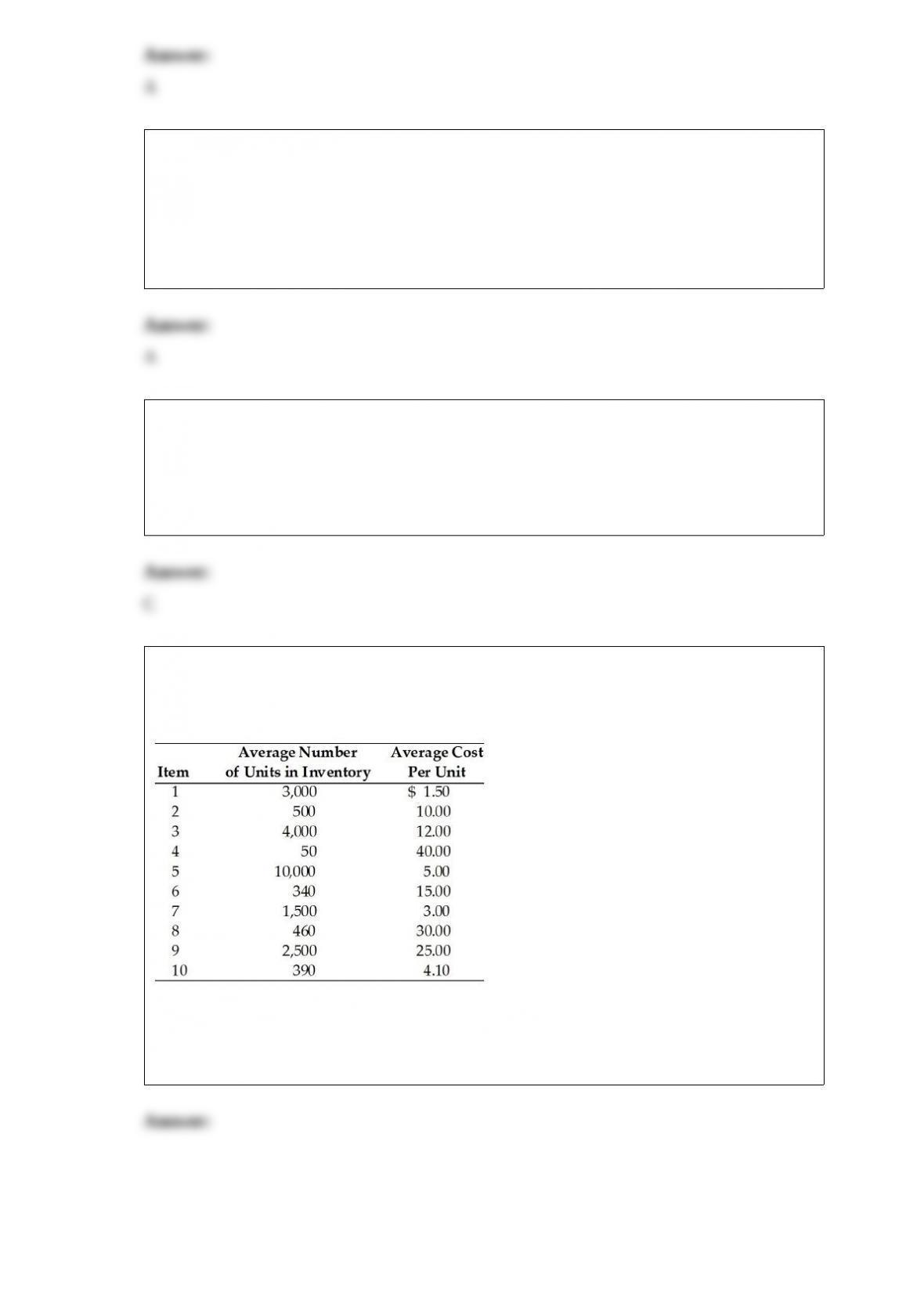
16) Harry’s Sheds has ten different items in its finished goods inventory. The average
number of units held in inventory and the average unit cost are listed for each item. The
firm uses an ABC system of inventory control.
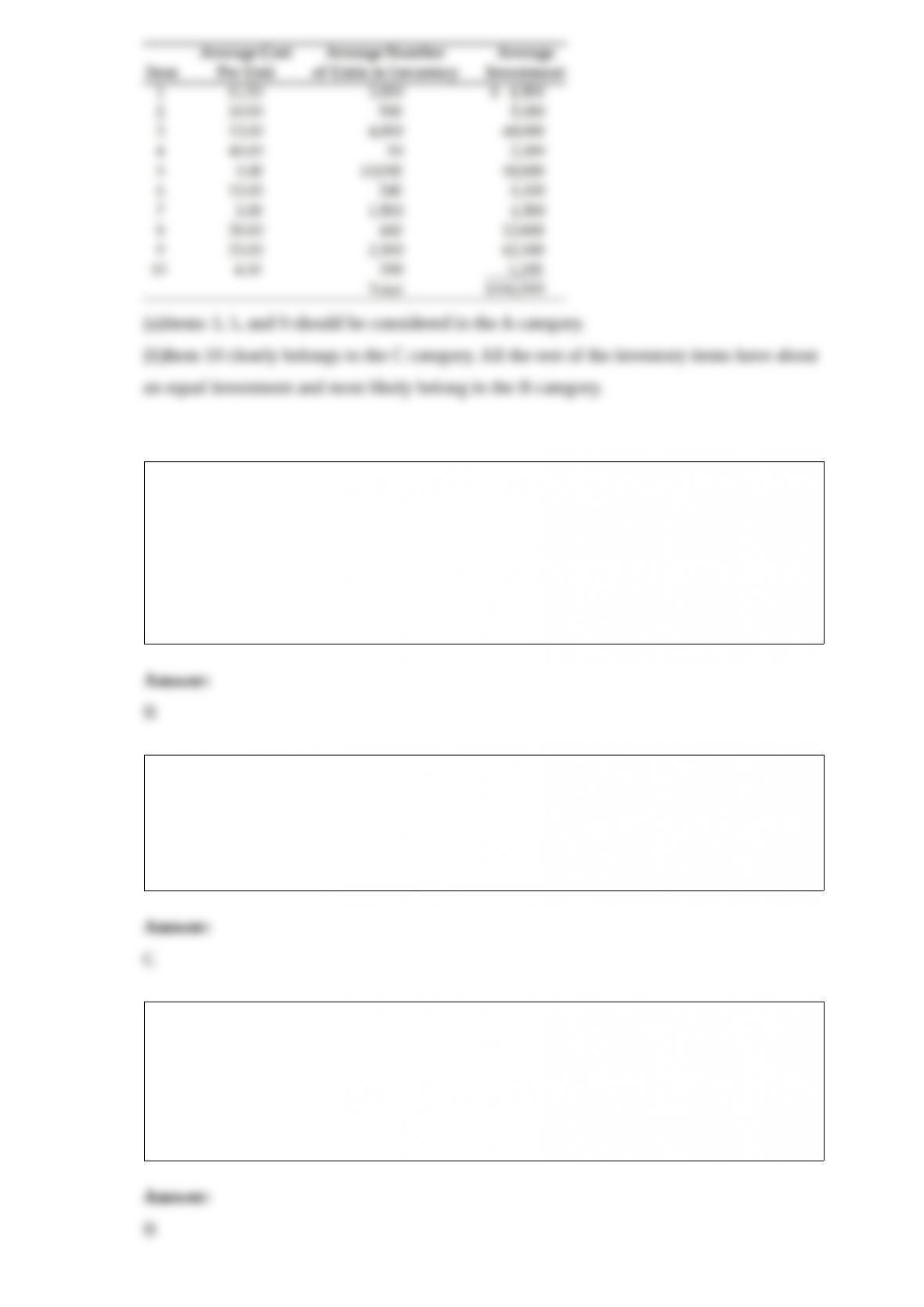
(a)Which items should be considered to be in the A category of an ABC system of
inventory?
(b)Which items should be considered to be in the B category of an ABC system of
inventory?
17) Asset Y has a beta of 1.2. The risk-free rate of return is 6 percent, while the return
on the market portfolio of assets is 12 percent. The asset’s market risk premium is
________.
A) 7.2 percent
B) 6.0 percent
C) 13.2 percent
D) 10 percent
18) An accountant’s primary function is ________.
A) the evaluation of the financial statements
B) making decisions based on financial data
C) the collection and presentation of financial data
D) the planning of cash flows
19) An attractive candidate for acquisition through a leveraged buyout should
________.
A) possess a relatively high leverage
B) have a solid profit history
C) have a high level of provision for doubtful accounts
D) have a low level of investment in fixed assets
20) Tangshan Mining has common stock at par of $200,000, paid-in capital in excess of
par of $400,000, and retained earnings of $280,000. In states where the firm’s legal
capital is defined as the par value of common stock, the firm could pay out ________ in
cash dividends without impairing its capital.
A) $200,000
B) $680,000
C) $600,000
D) $880,000
21) The yield curve in an economic period where lower future inflation is expected
would be ________.
A) upward-sloping
B) flat
C) downward-sloping
D) exponential
22) Zheng Sen’s Pen Company has an outstanding issue of convertible bonds with a
$1,000 par value. These bonds are convertible into 50 shares of common stock. They
have a 10 percent coupon and a 10-year maturity. The interest rate on a straight bond of
similar risk is 8 percent.
(a)Calculate the straight bond value of the bond.
(b)Calculate the conversion value of the bond when the market price of the stock is
$30/share.
(c)What is the least you would expect the bond to sell for at a market price of common
stock of $18/share?
23) A capital or capitalized lease is also known as ________.
A) an operating lease
B) a financial lease
C) a direct lease
D) a leveraged lease
24) Ashley owns stock in a company which has consistently paid a growing dividend
over the last five years. The first year Ashley owned the stock, she received $1.71 per
share and in the fifth year, she received $2.89 per share. What is the growth rate of the
dividends over the last five years?
A) 7 percent
B) 11 percent
C) 12 percent
D) 5 percent
25) If a firm’s sale price per unit decreases, the firm’s ________.
A) operating breakeven point will decrease
B) operating breakeven point will increase
C) variable costs per unit will decrease
D) variable costs per unit will increase