1) A security is considered liquid if it can be sold, regardless of the time it takes to make
the sale.
2) The risk-return tradeoff that investors face on a day-to-day basis is based on realized
rates of return because expected returns involve too much uncertainty.
3) A major disadvantage of the discounted payback period is the arbitrariness of the
process used to select the maximum desired payback period.
4) The fundamental goal of a business is to maximize the retained earnings available to
the corporation’s shareholders.
5) Spot exchange markets provide the potential for arbitrage opportunities.
6) Notes payable is a spontaneous source of financing.
7) The decision to forgo the discount available to those customers who pay early has an
advantage as well as a disadvantage.

8) The upper limit on common stock dividends, which is set by the SEC, is generally
equal to the sum of dividends paid on the company’s preferred stock.
9) The objective of capital structure management is to maximize the market value of the
firm’s common stock.
10) If a bond’s rating declines, the interest rate demanded by investors, called the
required return, also decreases.
11) A project’s net present value profile shows how sensitive the project is to the choice
of a discount rate.
12) If John owns 5% of XYZ corporation before its 2 for 1 stock split, John will own
5% of XYZ corporation after the stock split as well.
13) Flotation costs cause a corporation’s cost of capital to be lower than its investors’
required returns.
14) The optimal capital structure occurs when operating leverage equals financial
leverage.
15) A corporation that is short on cash will take a trade discount of 2/10 net 30 only if
the corporation’s cost of funds is less than 2%.
16) The competitive bid purchase is largely confined to railroad, public utility, and
municipal bond issues.
17) Mutually exclusive projects have more than one IRR.
18) The hedging principle is also called the principle of self-liquidating inventory.
19) Which of the following investments is clearly preferred to the others for a
risk-averse investor?
Investment
A14%12%
B22%20%
C18%16%
A) Investment A
B) Investment B
C) Investment C
D) cannot be determined without additional information
20) What method is used for calculation of the accounting beta?
A) simulation
B) regression analysis
C) sensitivity analysis
D) both A and C
21) With regard to the hedging principle, which of the following assets should be
financed with current liabilities?
A) minimum level of cash required for year round operations
B) expansion of accounts receivable to meet seasonal demand
C) machinery
D) buildings
22) Quincy Fathows & Co. plans to issue commercial paper for the first time in its
85-year history. The firm plans to issue $400,000 in 120-day maturity notes. The paper
will carry a 13% quarterly compounded rate with discounted interest and will cost
Quincy Fathows $8,000 in advance to issue.
a.What is the effective cost of credit to Quincy Fathows?
b.What other factors should the firm consider in analyzing whether or not to issue the
commercial paper?
23) Denver Systems has total assets of $1,000,000; common equity of $400,000; a
gross profit of $800,000; total operating expenses of $620,000; interest expense of
$20,000; income taxes of $74,000; and preferred dividends of $30,000. What is Denver
Systems’ return on equity?
A) 7.5%
B) 20.0%
C) 21.5%
D) 14.0%

24) All of the following are examples of political risk for a U.S. company investing in a
foreign country EXCEPT
A) expropriation of plant and equipment
B) the problem of blocked funds
C) substantial changes in foreign country tax laws
D) government requirements that ownership must be limited to U.S. citizens
25) The purpose of carrying inventory is to
A) make different production processes more dependent on sales
B) make sales more independent of the production process
C) have collateral for loans
D) improve the current ratio
26) If a firm with credit terms of 1/10 net 30 were to change its terms to 3/10 net 30, the
result would probably be
A) increased bank loans
B) increased accounts receivable turnover
C) an increase in the average level of accounts receivable
D) a decrease in accounts payable
27) Mountain Recreation, Inc. is considering a new product line. The company
currently manufactures several lines of snow skiing apparel. The new products,
insulated ski bikinis, are expected to generate sales of $1.2 million per year for the next
five years. They expect that during this five-year period, they will lose about $150,000
each year in sales on their existing lines of longer ski pants. The new line will require
no additional equipment or space in the plant and can be produced in the same manner
as the apparel products. The new project will, however, require that the company spend
an additional $50,000 per year on insurance in case customers sue for frostbite. Also, a
new marketing director would be hired to oversee the line at $75,000 per year in salary
and benefits. Because of the different construction of the bikinis, an increase in
inventory of $9,000 would be required initially. If the marginal tax rate is 35%,
compute the incremental after tax cash flows for years 1-5.
A) $634,500 per year
B) $625,000 per year

C) $601,250 per year
D) $537,500 per year
28) Variable costs include all of the following EXCEPT
A) property taxes
B) direct labor
C) sales commissions
D) annual rent
29) a Heights Inc. bonds have a coupon rate of 7%, a yield to maturity of 10%, a face
value of $1,000, and mature in 10 years. Which of the following statements is MOST
correct?
A) An investor who purchases the bond today will earn a return of 10% if he sells the
bond after one year
B) An investor who purchases the bond today will earn a return of 7% if he sells the
bond after one year
C) An investor who purchases the bond today will earn a return of 17% per year if he
holds the bond until it matures
D) An investor who purchases the bond today will earn a return of 10% per year if he
holds the bond until it matures
30) A local lamp store expects to sell 2000 lamps in the coming year. It costs the store
$1.00 in carrying costs for each lamp and $10.00 for each order placed.
a.What is the economic order quantity for the lamps?
b.How many orders will be placed each year?
c.If the store wants a one-week safety stock and it takes one week to receive an order
after it has been placed, what should the inventory level be when a new order is placed?
Assume a 50-week year.

31) You are considering investing in a project with the following possible outcomes:
Probability ofInvestment
StatesOccurrenceReturns
State 1: Economic boom18%20%
State 2: Economic growth42%16%
State 3: Economic decline30%3%
State 4: Depression10%-25%
Calculate the expected rate of return and standard deviation of returns for this
investment, respectively.
A) 8.72%, 12.99%
B) 7.35%, 12.99%
C) 3.50%, 1.69%
D) 2.18%, 1.69%
32) Lithium, Inc. is considering two mutually exclusive projects, A and B. Project A
costs $95,000 and is expected to generate $65,000 in year one and $75,000 in year two.
Project B costs $120,000 and is expected to generate $64,000 in year one, $67,000 in
year two, $56,000 in year three, and $45,000 in year four. Lithium, Inc.’s required rate
of return for these projects is 10%. The internal rate of return for Project B is
A) 29.74%
B) 30.79%
C) 35.27%
D) 36.77%
33) Break-even analysis is used to study the effect on EBIT of changes in all of the
following EXCEPT
A) corporate taxes
B) prices
C) cost structure
D) volume
34) In the context of managing working capital, the hedging principle refers to which of

the following?
A) speculation regarding the direction of short-term interest rates
B) the usage of interest rate swaps
C) matching the maturity of the source of financing to the cash flow generating
characteristics of the asset being financed
D) protecting the firm against the risk of rising interest rates
35) Since 1973 the exchange rates between the major currencies of the world are
A) on a floating exchange rate system
B) on an arbitrage exchange rate system
C) on a fixed exchange rate system
D) on a spot exchange rate system
36) Using the dividend valuation method, an analyst determines the value of Company
A’s stock to be $10 and the value of Company B’s stock to be $14. Based on this
information, which of the following statements is most accurate?
A) Company B must be riskier than Company A, and risk requires a reward
B) Other things being equal, if Company A and Company B have the same firm value,
Company B must have more debt, thus leveraging its returns for the benefit of
shareholders
C) Other things being equal, if Company A and Company B have the same firm value,
Company A may have more shares of stock outstanding than Company B
D) Company B’s required rate of return is higher than Company A’s required return
37) Funds that are available in a company’s bank account until its payment check has
cleared refers to
A) mail float
B) processing float
C) transit float
D) disbursing float
38) Lithium, Inc. is considering two mutually exclusive projects, A and B. Project A
costs $95,000 and is expected to generate $65,000 in year one and $75,000 in year two.

Project B costs $120,000 and is expected to generate $64,000 in year one, $67,000 in
year two, $56,000 in year three, and $45,000 in year four. Lithium, Inc.’s required rate
of return for these projects is 10%. Which project would you recommend using the
replacement chain method to evaluate the projects with different lives?
A) Project B because its NPV is higher than Project A’s replacement chain NPV of
$47,623
B) Project A because its replacement chain NPV is $76,652, which exceeds the NPV for
Project B
C) Project A because its replacement chain NPV is $45,642, which is less than the NPV
for Project B
D) Both projects will be valued the same since they are now both four year projects
39) Of the following EOQ model assumptions, the most limiting is
A) uniform demand
B) constant unit price
C) constant ordering costs
D) independent orders
40) What is the value of a bond that matures in 5 years, has an annual coupon payment
of $110, and a par value of $2,000? Assume a required rate of return of 8.69%.
A) $938.50
B) $1,876.99
C) $1,891.36
D) $1,749.83
41) Your firm is considering investing in one of two mutually exclusive projects.
Project A requires an initial outlay of $3,500 with expected future cash flows of $2,000
per year for the next three years. Project B requires an initial outlay of $2,500 with
expected future cash flows of $1,500 per year for the next two years. The appropriate
discount rate for your firm is 12% and it is not subject to capital rationing. Assuming
both projects can be replaced with a similar investment at the end of their respective
lives, compute the NPV of the two chain cycle for Project A and three chain cycle for
Project B.
A) $2,232 and $85
B) $5,000 and $1,500
C) $2,865 and $94
D) $3,528 and $136

42) Which of the following has the highest interest rate risk?
A) a 20-year U.S. Treasury Bond
B) Bendix Corporation six-month commercial paper
C) a six-month money market certificate at a federally issued bank
D) a Southwest Airlines bond maturing in four years
43) Under what condition would you NOT accept a project that has a positive net
present value?
A) If the project has a profitability index less than zero
B) If two or more projects are mutually inclusive
C) If the firm is limited in the capital it has available (capital rationing)
D) If a project has more than one sign reversal
44) Your firm is considering an investment that will cost $920000 today. The
investment will produce cash flows of $450,000 in year 1, $270,000 in years 2 through
4, and $200,000 in year 5 . The discount rate that your firm uses for projects of this type
is 11.25%. What is the investment’s net present value?
A) $540,000
B) $378,458
C) $192,369
D) $112,583
45) Interest costs for short-term debt are generally lower than interest costs for
long-term debt because
A) the term structure of interest rates generally reflects an upward sloping yield curve
B) short-term debt is more flexible, allowing a match of short-term needs with
short-term financing
C) both A and B
D) investors demand higher returns on short-term debt due to liquidity concerns

46) Brown Inc. needs to borrow $250,000 for the next 6 months. The company has a
line of credit with a bank that allows the company to borrow funds with an 8% interest
rate subject to a 20% of loan compensating balance. Currently, Brown Inc. has no funds
on deposit with the bank and will need the loan to cover the compensating balance as
well as their other financing needs. How much will Brown Inc. need to borrow?
A) $270,000
B) $300,000
C) $312,500
D) $347,222
47) Siskiyou, Inc. has total current assets of $1,200,000; total current liabilities of
$500,000; and long-term assets of $800,000. How much is the firm’s Total Liabilities &
Equity?
A) $2,500,000
B) $1,300,000
C) $2,000,000
D) $1,800,000
48) Which of the following refers to all institutions and procedures that provide for
transactions in short-term debt instruments generally issued by borrowers with very
high credit ratings?
A) capital market
B) commercial banks
C) money market
D) stock market
49) Balon Plastics, Inc. is financed entirely with 3 million shares of common stock
selling for $20 a share. Capital of $4 million is needed for this year’s capital budget.
Additional funds can be raised with new stock (ignore dilution) or with 13 percent
10-year bonds. The firm’s tax rate is 40 percent.
a.Calculate the financing plan’s EBIT indifference point.
b.The expected level of EBIT is $10,320,000 with a standard deviation of $2,000,000.
What is the probability that EBIT will be above the indifference point?
c.Does the “indifference point” calculated in question (a) above truly represent a point
where stockholders are indifferent between stock and debt financing? Explain your
answer.
50) Discuss the similarities and differences between a line of credit and a revolving
credit agreement.
51) You just invested $50,000 into an account that earns 7 percent compounded
annually. At the end of each year you can withdraw $4,971. How many years can you
continue to make the withdrawals?
52) Discuss five limitations to ratio analysis.
53) Frank Zanca is considering three different investments that his broker has offered to
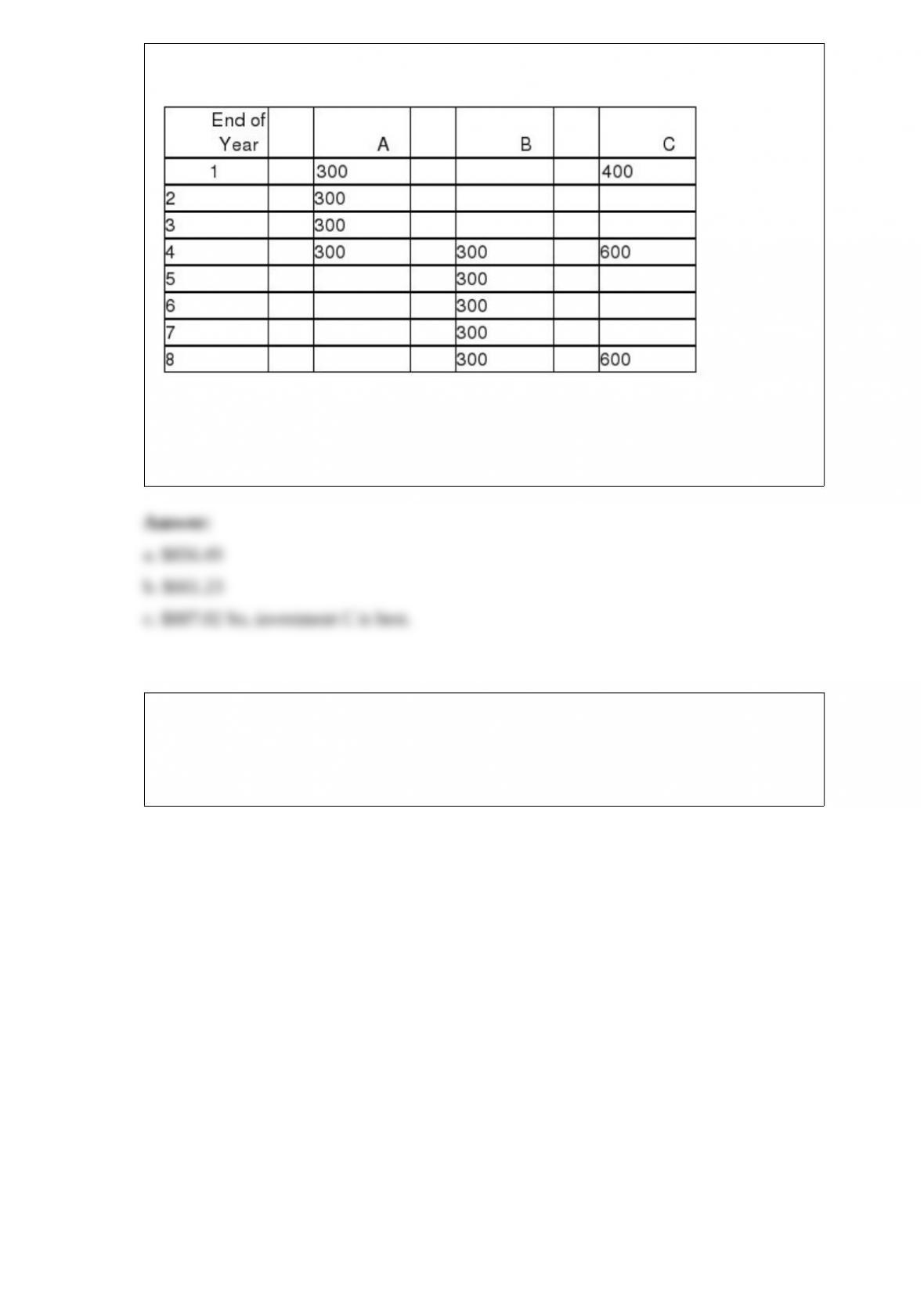
him. The different cash flows are as follows:
Because Frank only has enough savings for one investment, his broker has proposed the
third alternative to be, according to his expertise, “the best in town.” However, Frank
questions his broker and wants to calculate the present value of each investment.
Assuming a 15% discount rate, what is Frank’s best alternative?
54) The treasurer for Chic Man Clothing must decide how much money the company
needs to borrow in July. The balance sheet for June 30, 2010 is presented below:
Chic Man Clothing Balance Sheet
June 30, 2010
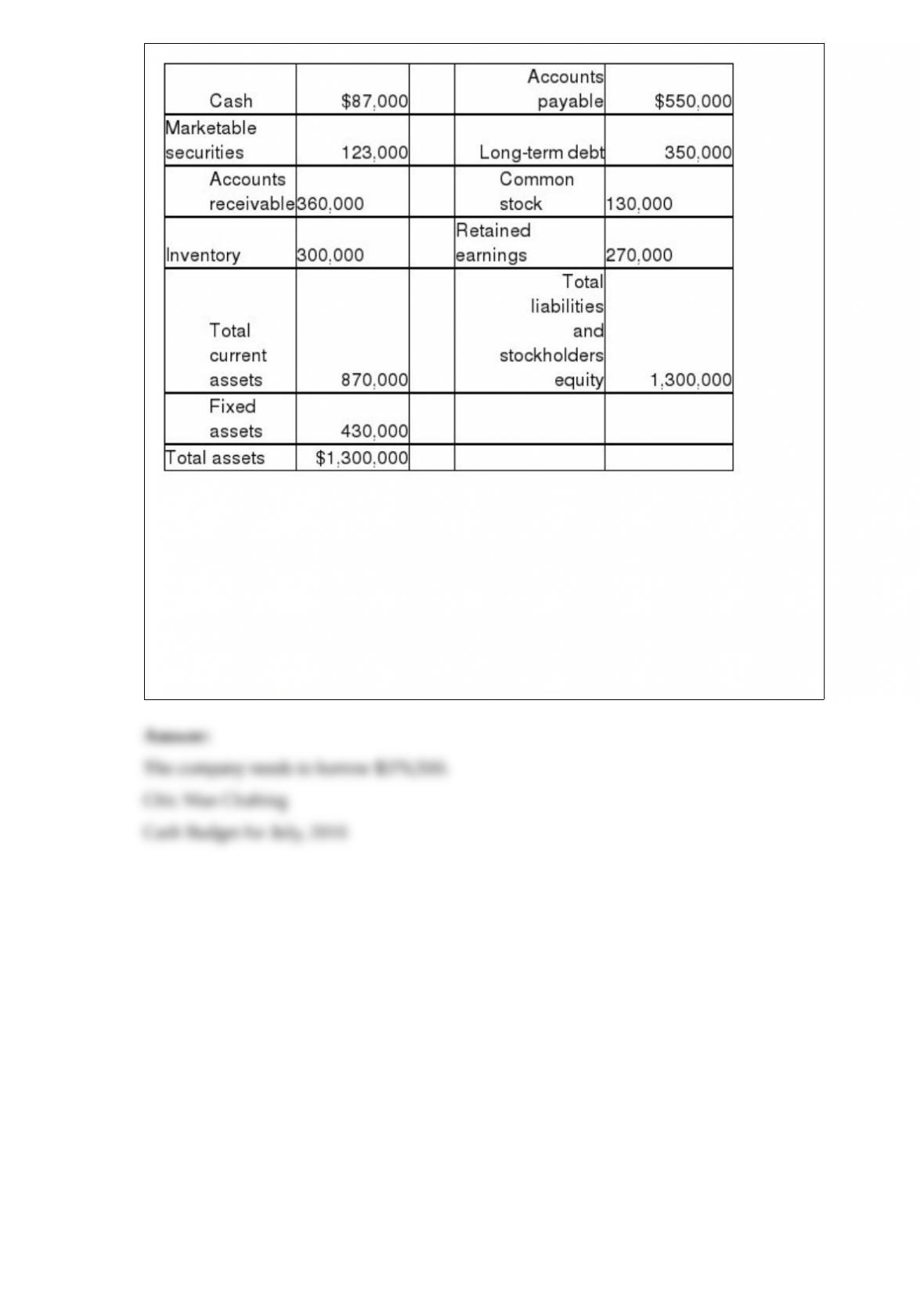
The company expects sales of $400,000 for July. The company has observed that 25%
of its sales is for cash and that the remaining 75% is collected in the following month.
The company plans to purchase $345,000 of new clothing. Usually 70% of purchases is
for cash and the remaining 30% of purchases is paid in the following month. Salaries
are $135,000 per month, lease payments are $35,000 per month, and depreciation
charges are $20,000 per month. The company plans to purchase a new van for $60,000
in July and sell its marketable securities for $123,000. If the company must maintain a
minimum cash balance of $25,000, how much money must the company borrow in
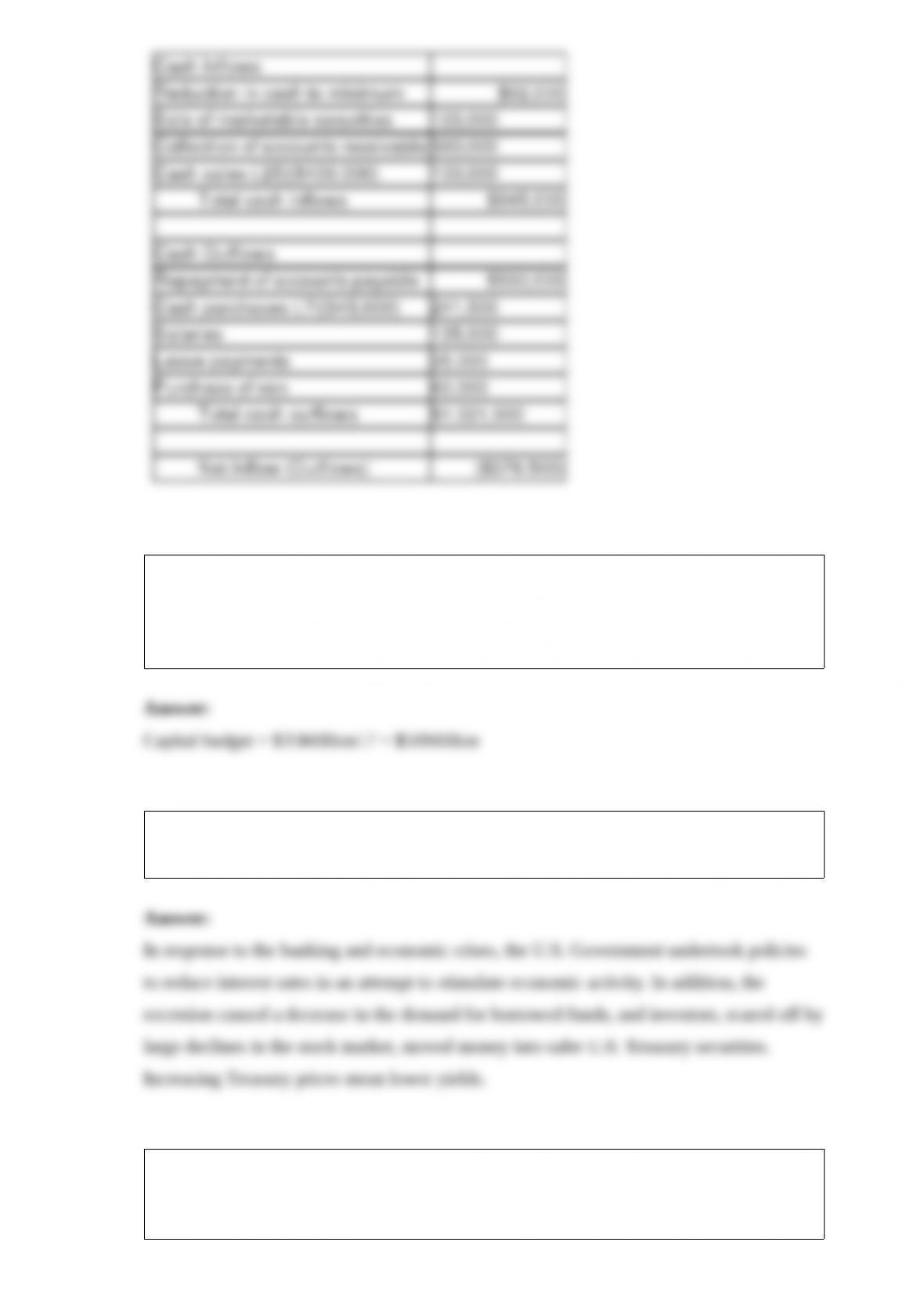
July?
55) Office Clean Corporation has a capital structure consisting of 30 percent debt and
70 percent common equity. Assuming the capital structure is optimal, what amount of
total investment can be financed by a $35 million addition to retained earnings without
selling new common stock?
56) The yield curve in 2009 was very low, with short-term rates close to zero and
long-term rates below 5 percent. What factors contributed to such low interest rates?
57) The ZYX Corporation is planning to request a line of credit from its bank and wants
to estimate its cash needs for the month of September. The following sales forecasts
have been made for 2010:
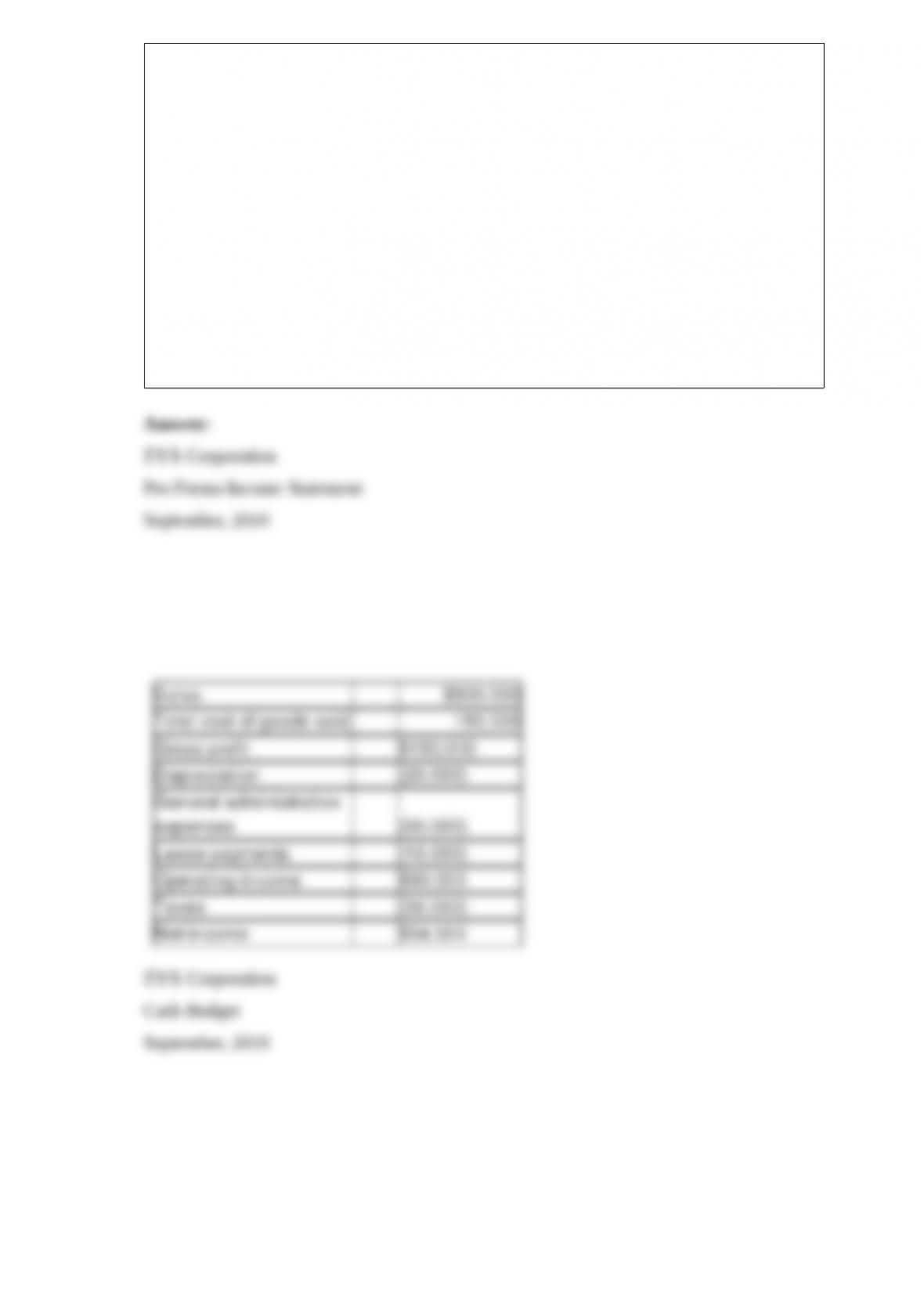
July$500,000
August 400,000
September 300,000
October 200,000
November 100,000
Collection estimates were obtained from the credit collection department as follows:
20% collected within the month of sale; 70% collected the first month following this
sale; and 10% collected the second month following the sale. Payments for labor and
raw materials are typically made in the month in which these costs are incurred. Total
labor and raw material costs each month are 50% of sales. General administrative
expenses are $30,000 per month, lease payments are $10,000 per month, and
depreciation charges are $20,000 per month. The corporation tax rate is 40%; however,
no corporate taxes are paid in September. Prepare a pro forma income statement and
cash budget for September.
58) Outpost has 2 million shares of common stock outstanding; net income is $300,000;
the P/E ratio is 9; and management is considering an 18% stock dividend. What will be
the expected effect on the price of the common stock? If an investor owns 300 shares in
the company, how does this change his total value? Explain.