
1) A cafeteria plan, also known as a flexible benefit plan, is an employer-sponsored plan
that gives the employee a choice of selecting either cash or one or more qualifying
nontaxable benefits.
2) Being able to prove your deductions with actual records is crucial to keeping more of
your money.
3) Mortgage insurance is generally required for almost all mortgage loans where the
initial loan-to-value ratio is more than 80 percent.
4) Long-term care policies can be written to cover in-home care.
5) Health savings accounts (HSAs) are intended for people who elect a high-deductible
health care plan.
6) The lower the payout ratio, the greater the odds that the company’s earnings will
sustain future dividend payments.
7) Time deposits are savings that are expected to remain on deposit in a financial
institution for an extended period.

8) A salary-reduction plan has tax benefits to the employee because the contributed
income is not included in the employee’s salary.
9) Dollar-cost averaging requires that you continue to invest if the longer-term
prospects suggest an eventual increase in price.
10) Real estate transfer taxes can affect the price a seller is willing to accept for a home.
11) A durable power of attorney gives the designated person virtually absolute power to
manage your financial affairs.
12) An internship may allow you to develop new skills as well as a chance to network.
13) Mortgage lenders generally require that monthly debt and housing payments do not
exceed 33 to 41 percent of gross monthly income.
14) Dan just received a $2,000 end-of-year bonus from his employer. If he pays a 25
percent marginal tax rate for federal income taxes, his state income tax is 5 percent, and
the Social Security tax rate is 7.65 percent, approximately how much of the $2,000
bonus will Dan have left to spend on holiday gifts?

a. $2,000
b. $1,400
c. $1,247
d. $753
15) Which of the following economic indicators tends to move in the opposite direction
of where the economy is headed?
a. procyclical indicators
b. employment rate
c. gross domestic product
d. counter cyclical indicators
16) A requirement of the federal Truth in Lending Act (TIL) requires that all installment
loan lenders disclose to credit applicants
a. the interest rate expressed as an annual percentage rate (APR)
b. the finance charge expressed in dollars
c. the interest rate (as an APR) and the finance charge (in dollars)
d. neither the interest rate (as an APR) nor the finance charge (in dollars)
17) ____ is the auto insurance coverage that would yield the most significant savings if
eliminated.
a. Collision
b. Towing
c. Comprehensive
d. Uninsured motorist
18) Open-end mutual fund shares have good liquidity because
a. they act very much like a bank account
b. the fund company will buy back the shares whenever requested
c. there are no redemption fees
d. you can always find another investor willing to purchase your shares
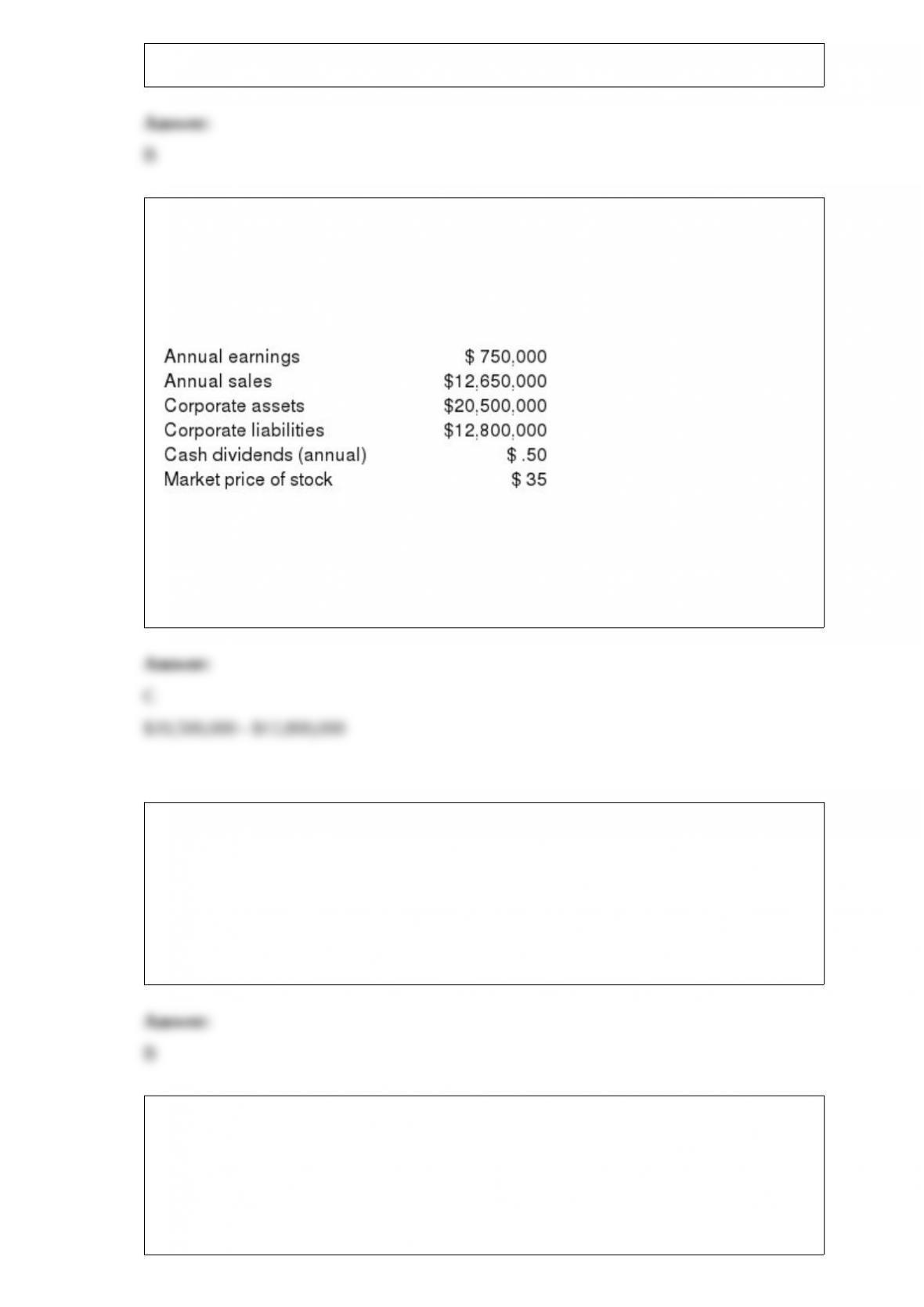
19) Figure 14-1
Rosa’s is a small chain of Mexican food restaurants that features five delicious varieties
of salsa. The business has grown over the past ten years from a hobby to a small
corporation with 200,000 shares of common stock outstanding. The corporation has not
issued any preferred stock. The following is Rosa’s latest financial data:
Refer to Figure 14-1. The book value of Rosa’s is currently
a. $20,500,000
b. $15,800,000
c. $7,700,000
d. $4,700,000
20) The type of employer retirement plan in which the benefit is determined by a
formula that generally includes the worker’s average pay and the number of years
worked for the company is called a ____ plan.
a. defined-contribution
b. defined-benefit
c. contributory
d. noncontributory
21) A single individual pays $9,444 on a taxable income of 49,110 and $9,469 on a
taxable income of $53,110. What is the marginal tax rate?
a. 15 percent
b. 25 percent
c. 28 percent
d. 33 percent

22) SEC regulations require all of the following except
a. that a prospectus be provided to mutual fund shareholders
b. that 12b-1 fees be capped at 0.75 percent
c. that a minimum guaranteed rate of return must be specified in the prospectus
d. that a mutual fund’s prospectus include a standardized expense table
23) Using a front-end ratio of 24 percent, one would need an annual gross income of at
least ____ to buy a home with total monthly payments of $1,245.
a. $63,115
b. $43,027
c. $62,250
d. $58,750
24) The speed and ease by which an asset can be converted into cash is referred to as its
a. risk
b. liquidity
c. diversity
d. safety
25) Mike and Anita make a $560 house payment every other week. Their loan is an
example of a ____ mortgage.
a. growing-equity
b. biweekly
c. graduated-payment
d. reverse

26) If you want to avoid paying capital gains taxes for the whole year on mutual fund
shares purchased partway into the year, you would want to buy the shares after the
a. closing date
b. transaction date
c. record date
d. reinvestment period
27) How is the premium paid on a vanishing premium life insurance policy?
a. The insurance company waives the premiums
b. The cash value in the policy is used to pay the premium
c. Tax savings are used to pay the premium
d. The beneficiary pays the premium from the death benefit
28) Assuming a market rate risk of 8 percent and a return on Treasury bills of 5 percent,
what would the total estimated return be for a stock with a beta of 0.7?
a. 5.6 percent
b. 10.6 percent
c. 11.5 percent
d. 13.7 percent
29) How much is Jeremiah and Sara’s real income after the $3,000 increase in income?
a. $63,000
b. $61,765
c. $60,000
d. $58,824
30) Which of the following is designed for employees of large, private profit-seeking
corporations?
a. 401(k) plan
b. 403(b) plan

c. 457 plan
d. SIMPLE IRA
31) Which of the following does not apply to monetary assets?
a. Very safe
b. High liquidity
c. High return
d. All of these
32) Long-term custodial care is not covered by health insurance because the care is
a. very expensive
b. not medically necessary
c. provided by nonlicensed practitioners
d. all of these
33) When one dies without a will, this is called dying
a. escheat
b. intestate
c. testate
d. probate
34) Jack and Jill have trouble keeping their checking account balanced. Because they
never know how much is really in their account, they have an automatic funds transfer
agreement with their bank. When Jack or Jill writes a bad check, what will happen?
a. The needed funds will automatically be borrowed from their Visa account
b. The needed funds will automatically be transferred from their savings account
c. The bank will honor the check and then call Jack and Jill and ask that they deposit the
needed funds into checking as soon as possible
d. The bank will stamp the check “insufficient funds” and return it to the payee

35) Justin Bailey had a beginning balance of $100 on his credit card as of May 1 last
month. On May 11 he charged a meal for $44. On May 21 he made a payment of $48.
What was his average daily balance for the month?
a. $46
b. $94
c. $100
d. $113
36) The ____ the APR, the ____ the true cost of the credit.
a. lower; higher
b. lower; lower
c. higher; lower
d. none of these
37) Lonnie and Paula Pickney have a homeowner’s policy with $75,000 coverage and a
$250 deductible. Their home recently suffered extensive fire damage in the amount of
$50,000. Assuming the replacement value of the home was $85,000, how much will the
insurance company pay on this loss?
a. $74,750
b. $50,000
c. $49,750
d. $44,750
38) A mutual fund that does not assess a sales charge at the time of the investment
purchase is called a ____ fund.
a. low-load
b. no-load
c. back-end load
d. front-end load

39) Attempting to invest based on predictions of short-term fluctuations in an
investment market is called
a. buy-and-hold investing
b. market timing
c. market seeking
d. passive investing
40) Twenty years ago, Granny Jones purchased a life insurance policy on the life of her
new-born grandson, Mike. The policy will pay a death benefit of $100,000 if Mike dies,
or it will pay Mike the $100,000 when he reaches age 21, whichever comes first. Which
type of life insurance is this?
a. Universal life
b. Whole life
c. Limited-pay life
d. Endowment life
41) Interest rates that go up and down according to interest rates in the economy as a
whole are referred to as
a. teaser rates
b. variable rates
c. default rates
d. prime rates
42) Stephanie Witman bought 250 shares of Discover stock in 1988 . Recently the
company declared a four-for-one stock split. Which of the following statements is true?
a. Stephanie now owns 750 shares of Discover
b. The total value of Stephanie’s stock increased four times
c. The market value per share of the new stock is worth approximately one-fourth the
value of the old stock
d. Stephanie now owns a larger percentage of Discover than before the stock split

43) Which of the following is a possible income after retirement?
a. Social Security
b. Pension
c. Both Social Security and pension
d. None of these
44) ____ coverages can be included in an automobile insurance policy.
a. Liability
b. Medical payments
c. Physical damage
d. All of these
45) Which of the following is not defined as part of gross income?
a. Gifts and inheritances
b. Capital gains
c. Scholarship income spent on room and board
d. Illegal income
46) Risk retention is not appropriate when
a. the worst possible loss is small
b. the losses are highly predicable in both frequency and severity
c. the retention is due to inaction
d. all of these
47) New companies sell stocks to obtain
a. market share
b. start-up capital
c. access to credit
d. a board of directors

48) It is not necessary that your values be consistent with your financial and lifestyle
goals.
49) Social Security contributions are deposited into the payer’s personal account to fund
future benefits for that person.
50) It is wise to finance real estate investments with adjustable interest terms.
51) The large-loss principle recommends that you insure the losses you can afford and
assume the losses that you cannot afford.
52) One point is equal to 1 percent of the price of the house.
53) The claims procedures for nearly all health care plans include patient payment for
the health service with the insurance reimbursing the patient after the appropriate forms
are filed.