
Most changes in EBIT are due to cost conditions and the effectiveness of management.
The consumption and production sectors, have in fact been unable to establish a flow of
savings dollars into the hands of producers, so there is a continual shortage of funds for
business projects.
If a firm’s current ratio and quick ratio have been steadily decreasing, the underlying
cause might be traced to the credit manager’s relaxed attitude about enforcing prompt
payment from customers.
The certainty equivalent approach uses computer simulation methods which make for a
more accurate prediction of cash flows.

One of the most significant exemptions for most people is interest on a home mortgage.
At an interest rate of 0%, $1.00 received in 10 years is equivalent to $1.00 received in 5
years.
For the most part, the dividend preference theory opposes the viewpoint that “a bird in
hand is worth two in the bush”.
Convertible bonds can generally be issued at somewhat lower interest rates than regular
bonds.

The degree of operating leverage is the ratio of the relative change in EBIT brought
about by a relative change in fixed costs.
The component cost of preferred stock is equal to the current dividend yield on a firm’s
existing shares of preferred stock.
There is virtually no distinction between economic and commercial business failures.
Which of the following is not a source of short-term financing?
A.Spontaneous financing from payables and accruals
B.Unsecured bank loans
C.Five year bonds with a call feature exercisable within one year
D.Commercial paper

The cost of financing the project is reflected in the ____ in capital budgeting analysis.
A.initial outlay
B.incremental cash flows
C.cost of capital
D.All of the above
Four units of Country A€s currency (call it €a€) can be exchanged for three units of
Country B€s currency (call it €b€). What would be the indirect quote in Country B?
A.4 a : 3 b
B.0.75 a : 1 b
C.1.33 a : 1 b
D.1 a : 0.75 b

Which of the following is a current asset?
A.Accounts payable
B.Accounts receivable
C.Revenue
D.Accumulated depreciation
If Company F and Company G merge and become Company F, what happens to the
stockholders of Company G?
A.They become stockholders of Company F.
B.They are paid for their shares of Company G.
C.They lose their investment.
D.Either a. or b.
E.Any of the above could occur.
The maturity risk premium reflects a preference by many lenders for:
A.shorter maturities.
B.reducing yields.
C.high yield securities.

D.longer maturities.
Which of the following is not a characteristic of a call option?
A.Fixed price
B.Right to buy
C.Right to sell
D.Specified period
The coefficient of variation is a:
A.relative measure of variation.
B.ratio of standard deviation to variance.
C.continuous random variable.
D.measure of return.

Common size income statements divide each account by:
A.revenues.
B.total assets.
C.net income.
D.None of the above
Which of the following would increase a firm’s financial leverage?
A.An increase in depreciation
B.An increase in interest expense
C.An increase in the number of shares of common stock outstanding
D.a and b
Which of the following is an administrative (non-economic) reason for holding cash?
A.To pay bills for the goods and services used
B.To meet short-term obligations
C.To compensate banks for services

D.To have cash available to take advantage of unexpected opportunities
An acquiring firm can bypass a target’s management by making a tender offer directly
to:
A.creditors.
B.shareholders.
C.preferred stockholders.
D.founders.
Market risk:
A.is the degree to which a stock’s return moves with the market’s return.
B.is caused by things that affect specific companies or industries.
C.can be diversified away.
D.is the chance of losing money in the stock market.

The maximum purchase price acceptable to the acquiring firm in a merger:
A.cannot exceed the pre-merger value of the target firm.
B.is always equal to the pre-merger value of the target firm.
C.is always less than the pre-merger value of the target firm.
D.a and c
E.None of the above
Riordan Manufacturing Company is considering replacing a machine. The machine was
purchased 6 years ago for $80,000 and has been depreciated straight line over an 8-year
life. The old machine will be sold for a market value of $14,500. The new machine
costs $55,000. Assuming a tax rate of 28%, calculate the initial outlay.
A.$38,960
B.$42,040
C.$45,460
D.$51,760
When using a future value of an annuity table:
A.payments are assumed to be made at the end of each period.
B.FVFA factors increase with an increase in the interest rate.
C.FVFA factors increase with an increase in the number of periods.
D.All of the above
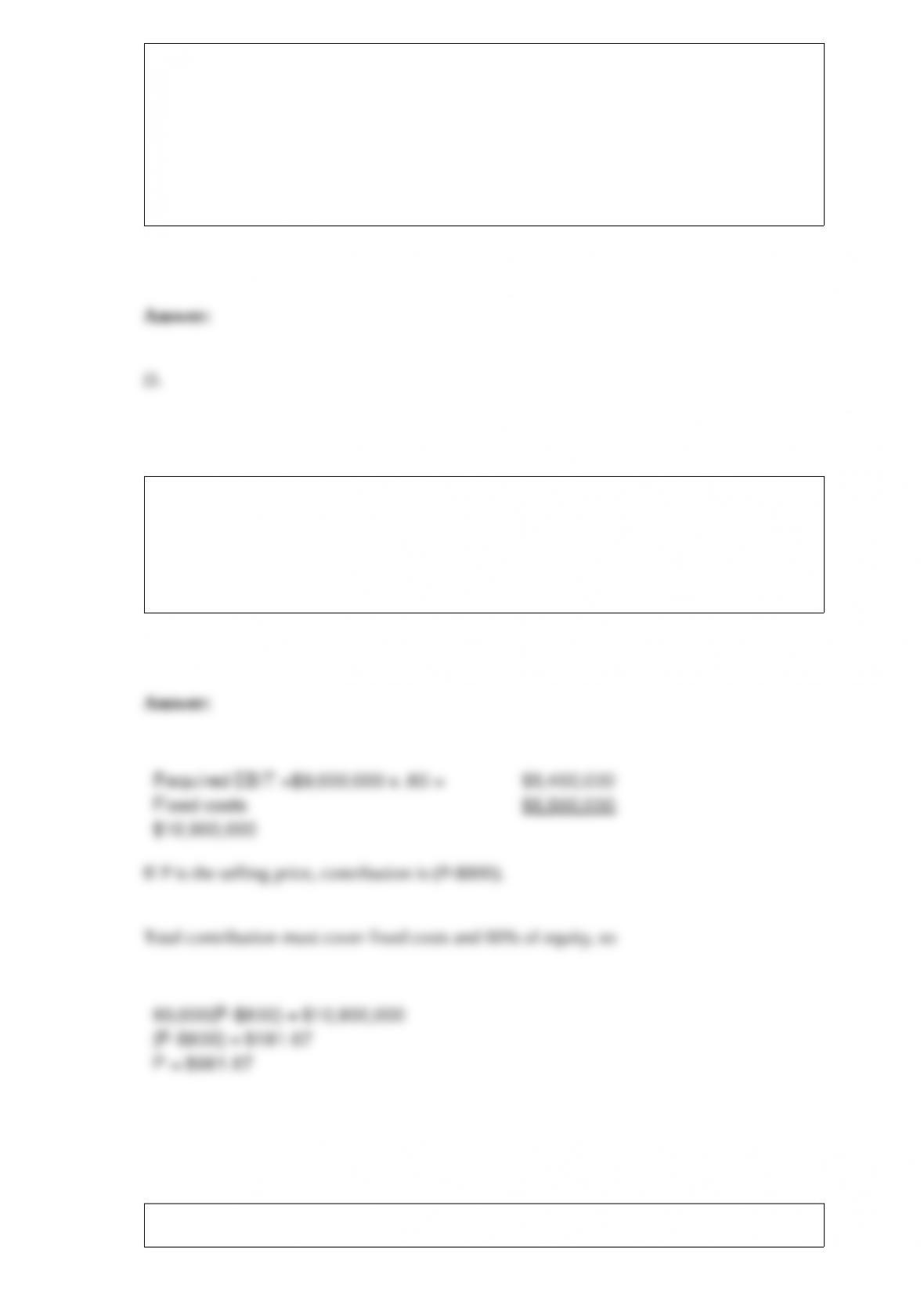
A small computer manufacturer wants to price its product to earn a return of 60% on
equity before interest and taxes. The computer has technological advantages that make
management certain they can sell the firm’s maximum production of 60,000 units per
year at any reasonable price. The variable cost to build and sell a computer is $800,
fixed costs are $5,500,000 per year and the firm has $9,000,000 in its equity account.
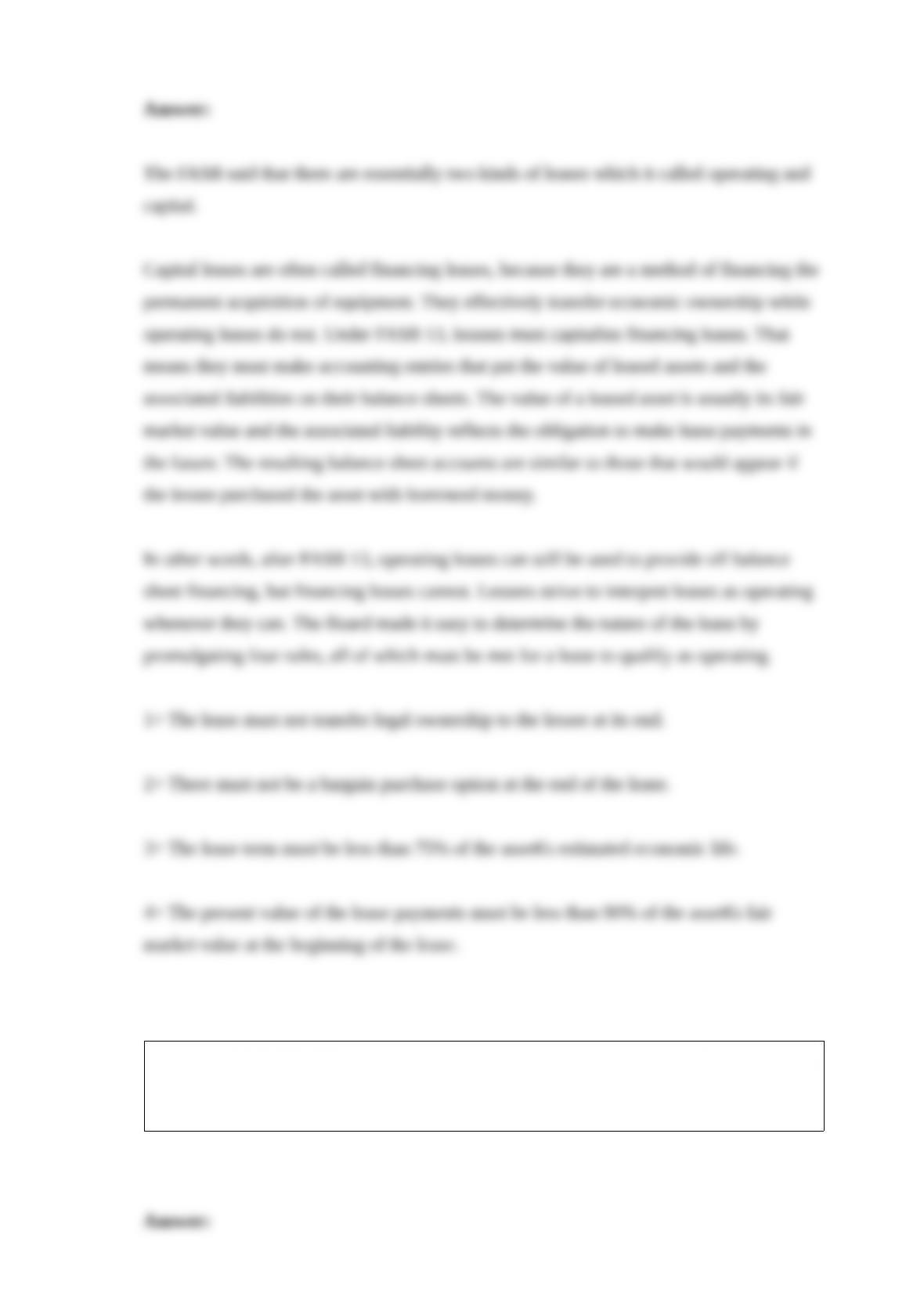
What are the different kinds of leases as per the FASB?
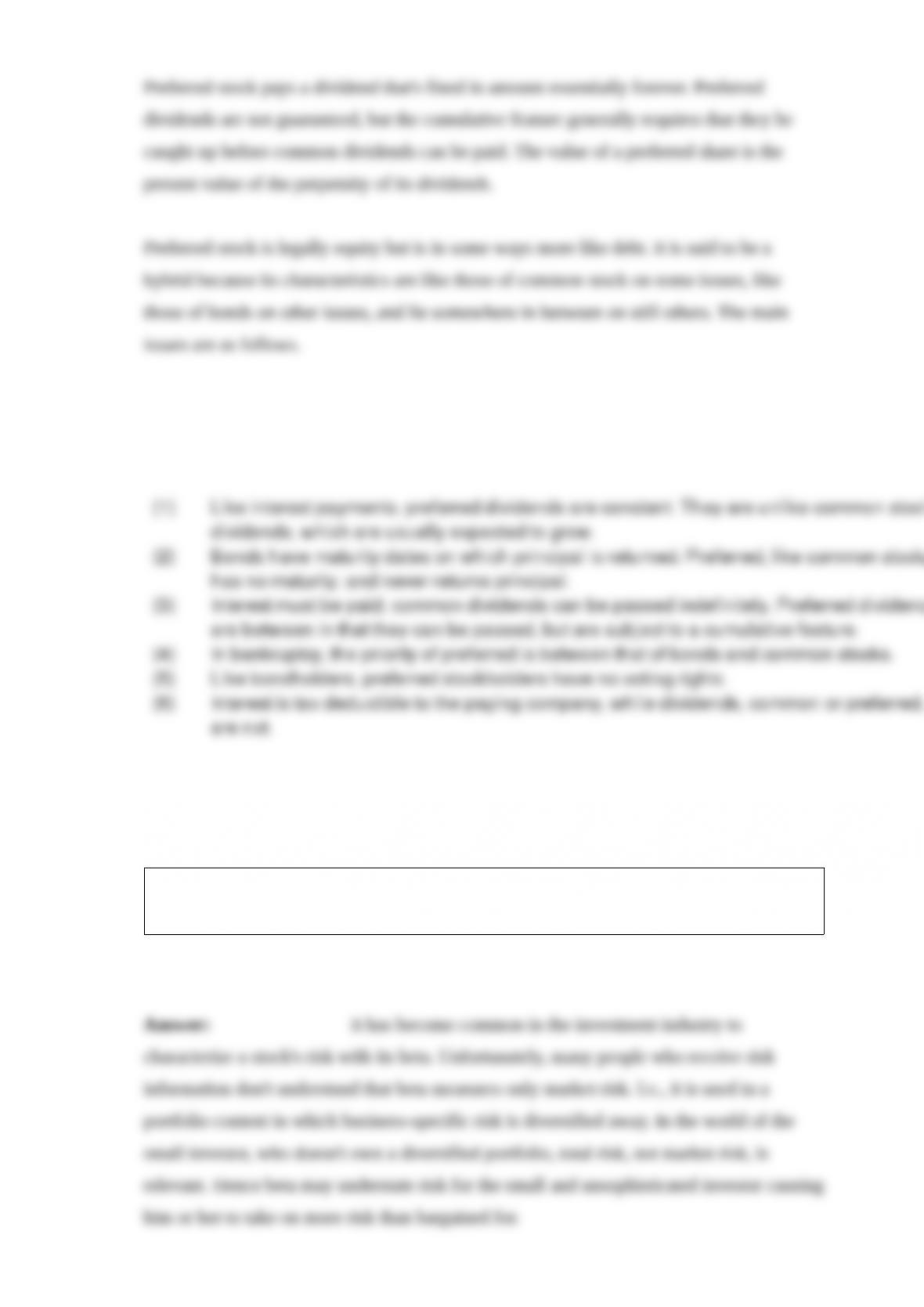
Preferred stock is said to be a hybrid security having similarities to both common stock
and bonds. Explain the similarities and differences between preferred stock, bonds, and
common stock.
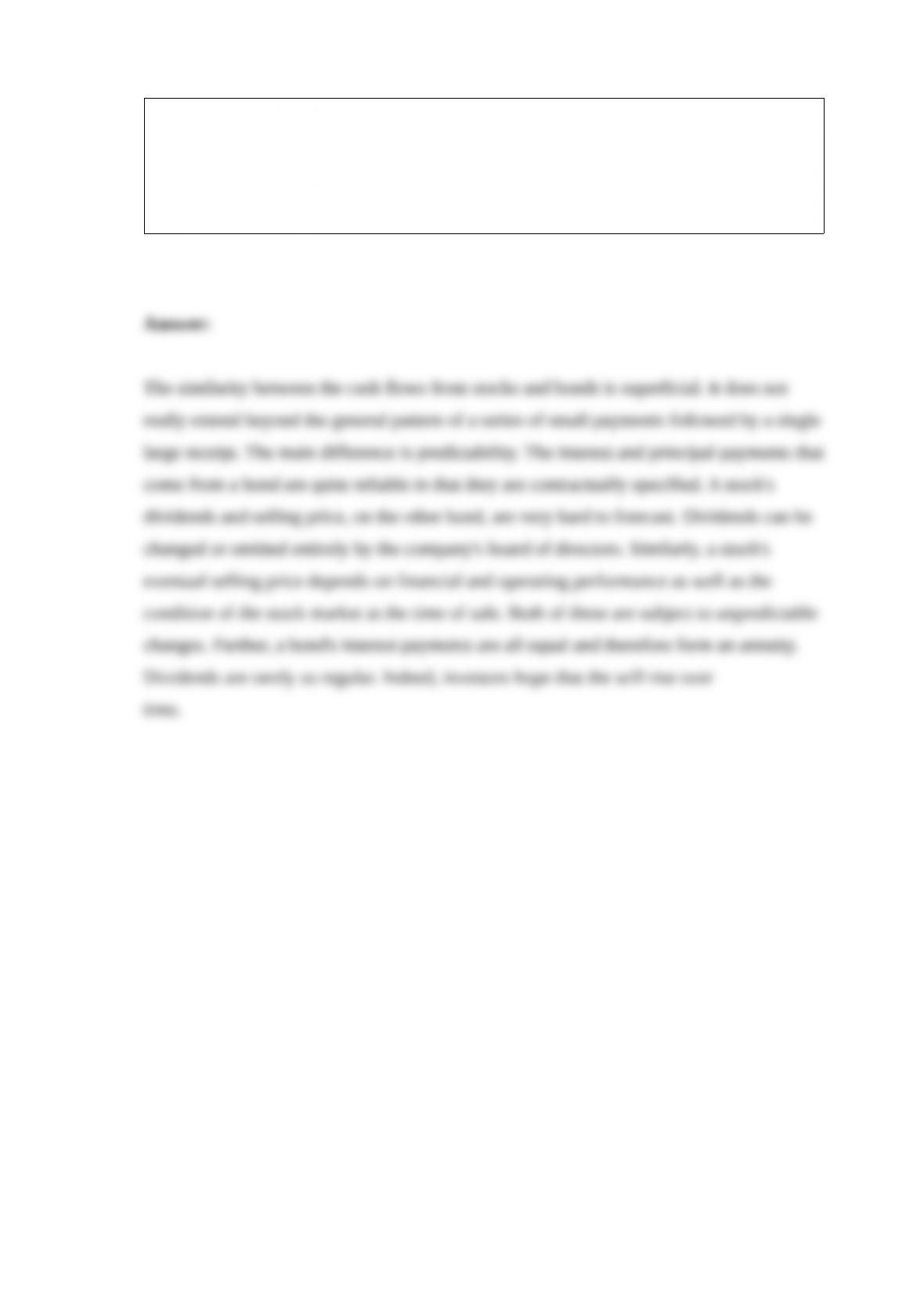
Why is the thinking behind the Capital Asset Pricing Model dangerous for small
investors?
The cash flows that come from investing in stocks and bonds appear similar in that they
both consist of a stream of relatively small payments followed by a single larger
payment. The smaller payments are dividends for stocks and interest for bonds, while
the larger ones are the eventual selling price of stock and the return of principal for a
bond. Critically evaluate this apparent similarity