Consider a coupon bond that pays $150 every year and repays its principal amount of
$1,500 at the end of five years.If the annual rate of discount is 7 percent, the present
value of the bond is approximately
a. $214.29.
b. $808.39.
c. $1,684.50.
d. $1,742.52.
Answer:
Suppose the M1 multiplier is currently 1.95 and the M2 multiplier is currently 8.03. If
the ratio of retail money-market mutual funds to transaction accounts increases, the M1
multiplier will and the M2 multiplier will .
a. not change; increase
b. increase; also increase
c. decrease; also decrease
d. increase; not change
Answer:

In which of the following periods was output growth the slowest in the U.S. economy?
a. Long boom period
b. Economic liftoff period
c. Post 2009
d. Reorganization period
Answer:
The sum of seasonal credit discount loans, secondary credit discount loans, and primary
credit discount loans that banks take out because of temporary problems are known as
a. unsubstantiated discount loans.
b. discount loans for profit.
c. discount loans that arise for business needs.
d. inelastic discount loans.
Answer:
Which of the following is the purpose of the Bank Holding Company Act of 1956?
a. To prevent bank holding companies from branching across state lines

b. To allow bank holding companies to open branches across state lines
c. To allow interstate bank mergers
d. To prevent banks from owning commercial firms
Answer:
Which of the following acts abolishes the FSLIC and gives responsibility of thrift
deposit insurance to the FDIC?
a. The GarnSt. Germain Act
b. The Community Reinvestment Act
c. The Federal Deposit Insurance Corporation Improvement Act
d. The Financial Institutions Reform, Recovery, and Enforcement Act
Answer:
Interest payments are
a. the periodic payments on equity securities.
b. made by the borrower to the investor along with the principal.

c. tax-free payments from insurance companies.
d. taxable Social Security payments.
Answer:
An investor buys stock for $10,000 at the beginning of the year. She earns dividends of
$300 during the course of the year. At the end of the year, the stock is worth $10,800.
The tax rate on dividends and capital gains is 15 percent. The inflation rate is 3 percent.
What is the real return accrued on the stock at the end of the year, provided the investor
does not sell the stock?
a. 6.35 percent.
b. 6.95 percent.
c. 7.55 percent.
d. 8 percent.
Answer:
Consider the following hypothetical situation. The interest rate on a two-year bond
today is 7.5 percent and the interest rates on two one-year bonds are 3 percent and 4
percent respectively. The term premium earned by the investors is
a. 5 percent.

b. 4 percent.
c. 4.25 percent.
d. 6 percent.
Answer:
Which of the following is true of bank spread?
a. The more vigorous the competition among banks, the smaller will be spread between
the interest rates on loans and deposits.
b. The larger the banks that are competing with each other, the larger will be spread
between the interest rates on loans and deposits.
c. The spread between the interest rates on loans and deposits will be much narrower in
banks in rural areas than the banks in big cities.
d. The lower the number of banks in a city, the smaller will be the spread between the
banks’ interest rates on loans and deposits.
Answer:
Which of the following securities is likely to be most liquid?
a. Debt security issued by the government of a small town

b. Stock in a small corporation
c. Government savings bonds
d. 3 month treasury bills
Answer:
In inflation targeting, the range that represents the goal for the inflation rate is known as
the
a. target band.
b. optimal range.
c. central tendency.
d. ultimate goal.
Answer:
According to the Consumer Financial Protection Bureau, banks must not offer mortgage
loans to households for whom the monthly mortgage payments costs more than of their
income.
a. 20 percent
b. 35 percent

c. 43 percent
d. 50 percent
Answer:
The U.S. Treasury security that was issued most recently, in the primary market, is
known as the
a. off-the-run security.
b. on-the-run security.
c. in-the-money security.
d. out-of-the-money security.
Answer:
Consider a fixedpayment security that pays $100 at the end of every year for five years.
If the annual rate of
discount is 7 percent, the present value of the security is
a. $142.64.
b. $410.02.

c. $789.34.
d. $999.63.
Answer:
Before October 2008, banks earned interest on reserve balances that they held at the
Federal Reserve at a rate of
a. 0.00%.
b. 0.05%.
c. 0.60%.
d. 1.00%.
Answer:
The ATM model of the demand for cash is a
a. general-equilibrium model.
b. steady state model.
c. partial-equilibrium model.

d. no-equilibrium model.
Answer:
Suppose you are an investor facing a choice between three investments that are
identical in every way except in terms of their rates of return and taxability. Which
investment provides the highest after-tax return?
Investment A: interest rate 10 percent, tax rate 40 percent of interest income.
Investment B: interest rate 8 percent, tax rate 25 percent of interest income.
Investment C: interest rate 5 percent, tax rate 0 percent.
Investment D: interest rate 5 percent, tax rate 1 percent.
a. Investment A
b. Investment B
c. Investment C
d. Investment D
Answer:
The supply curve of reserves in an economy is_____ when the federal funds rate is less
than the primary credit discount rate.

a. downward-sloping
b. upward-sloping
c. horizontal
d. vertical
Answer:
In 2004, the number of unemployed people in a country decreased from 8.8 million to
8.1 million, while the labor force increased from 146.5 million to 147.4 million. By
how much did the unemployment rate decrease?
a. 0.5 percentage point
b. 0.7 percentage point
c. 0.9 percentage point
d. 1.1 percentage point
Answer:
The percentage by which real gross domestic product is above or below its potential
level is called the

a. inflation rate
b. output gap
c. real interest rate
d. rate of compounding
Answer:
An investor earns $400 in dividends and $800 in capital gains over a year. If the tax rate
on these earnings is 15%, what is the total tax that the investor is liable to pay on these
earnings?
a. $0.
b. $60.
c. $120.
d. $180.
Answer:
Which of the following is a government regulation that enables the government to
achieve its goals for the banking
system?

a. A government regulation that allows for mergers in order to help increase the size of
a bank.
b. A government regulation that provides complete discretion to banks to manage the
supply of money.
c. Banks are required to hold reserves in order to control the money supply.
d. Banks are penalized in case of inefficient functioning.
Answer:
Which of the following is true of the analysis of the term structure of interest rates?
a. It assumes that investors in longterm securities face high transaction costs.
b. It assumes that investors can predict shortterm interest rates accurately.
c. It assumes that the yield curve is always flat.
d. It assumes that investors in bonds have a preferred habitat.
Answer:
A period when output, income, and employment are falling is known as
a. a recession.

b. an expansion.
c. a peak.
d. a trough.
Answer:
In the CAPM, unsystematic risk
a. is also known as market risk.
b. can be diversified away.
c. is the risk to a stock’s return that is attributable to the fluctuations in the overall stock
market.
d. is assumed to be zero.
Answer:
The amount of output produced when the unemployment rate equals the natural rate of
employment in an economy is called output.
a. natural
b. aggregate

c. full-employment
d. long-run
Answer:
With the price level measured on the vertical axis and output measured on the
horizontal axis, the aggregate-demand curve
a. is vertical.
b. is downward-sloping.
c. is horizontal.
d. is upward-sloping.
Answer:
Suppose you take out a home equity loan of $100,000 for 5 years at an annual interest
rate of 5 percent, with payments to be made monthly. What will the approximate
monthly payments be? The relevant formula is:

a. $1,320.71
b. $1,887.12
c. $1,924.79
d. $5,282.82
Answer:
The idea that stock prices fully reflect all available information is called
a. asymmetric information.
b. random walk theory.
c. volatile markets hypothesis.
d. the efficient markets hypothesis.
Answer:
Suppose, that participants in the underground economy in Europe suddenly decide to
switch from using dollars to using euros. Thus, they supply a huge volume of dollars to
the market in exchange for euros. As a result,
a. the dollar appreciates and the euro depreciates.
b. the dollar and the euro both appreciate.
c. the dollar depreciates and the euro appreciates.
d. the dollar and the euro both depreciate.
Answer:
What are the two major drawbacks of the International Monetary Fund that prevents it
from bailing out countries in
crises?
Answer:
If the Fed does not change its monetary policy in an economy that is producing an
output lower than the full-employment level of output, the short-run aggregate supply

curve will eventually shift,___and the price level will____.
a. left; increase
b. left; decline
c. right; decline
d. right; increase
Answer:
Why did M1 grow so rapidly in the early 1990s, whereas M2 did not?
Answer:
Compare a two-year bond with two successive one-year bonds, in which an investor
buys a one-year bond today, then another one-year bond when the first matures.
Suppose the two-year bond has an annual interest rate of 4 percent.
Consider the pattern of interest rates on the one-year bonds listed below and explain
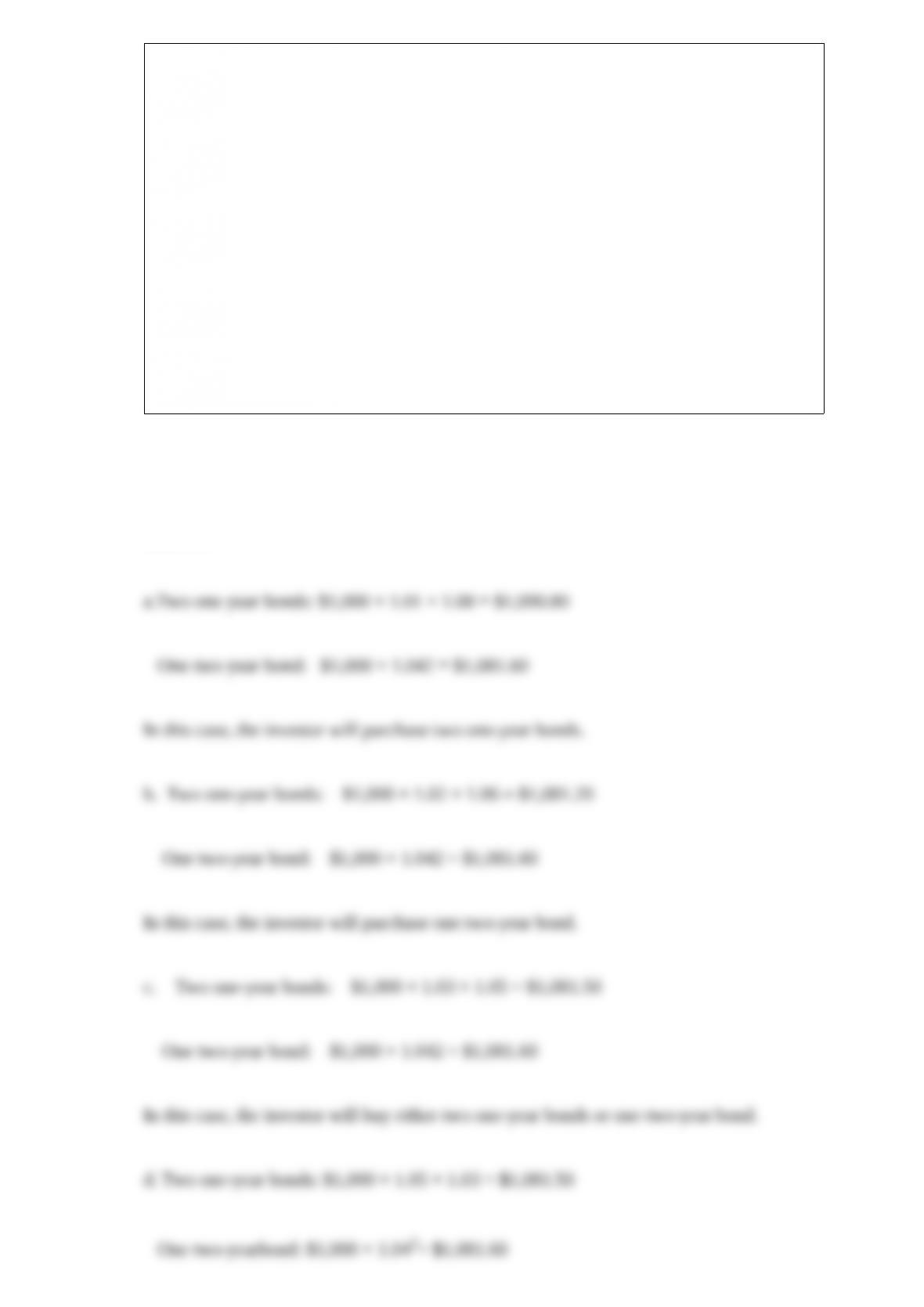
whether an investor should buy the two-year bond or the one-year bond today,
assuming that the only thing that matters to the investor is the amount of money she has
at the end of the two years; that is, she is risk neutral. In each case, how much would an
investor have at the end of two years if she invested $1,000 today? Show your work.
Round to the nearest penny ($0.01). In each case be sure to say which bond the investor
would buy today.
a. The interest rate on a one-year bond today is 1 percent, and the interest rate on a
one-year bond purchased in one year from now is 8 percent.
b. The interest rate on a one-year bond today is 2 percent; and the interest rate on a
one-year bond purchased one-year from now is 6 percent.
c. The interest rate on a one-year bond today is 3 percent; and the interest rate on a
one-year bond purchased one-year from now is 5 percent.
d. The interest rate on a one-year bond today is 5 percent; nd the interest rate on a
one-year bond purchased one-year from now is 3 percent.
Answer:

Describe three different changes in the ATM model that would increase the time
between ATM visits and increase the quantity of money demanded.
Answer:
Describe how inflation interacts with the tax system to distort savings and thus affect
investment. Is this problem more severe now or less severe than it has been in the prior
20 years? Why?
Answer:

Suppose another breakthrough in computer technology greatly increases total factor
productivity. Explain how this would affect aggregate supply, output, and the price level
in the short run and the long run.
Answer:
Also assume that the current nominal exchange rates are 115 yen per dollar and 4 pesos
per dollar. Calculate the real exchange rates between each pair of countries.
Answer:
If the expected inflation rate is 4 percent, the nominal interest rate is 6 percent, and the

actual inflation rate turns out to be 2 percent, then the realized real interest rate
is____than the expected real interest rate and borrowers_____relative to lenders.
a. less; gain
b. less; lose
c. greater; gain
d. greater; lose
Answer:
Are there any benefits to having both banking supervisors and economic researchers
working together at a Reserve bank?
Answer:

A model in which actions that occur at one time affect what happens at other times is
known as
a. a dynamic model.
b. a static model.
c. a general-equilibrium model.
d. a partial-equilibrium model.
Answer:
Suppose the U.S. has domestic savings of $50 billion, domestic investment of $120
billion, and a government budget deficit of $150 billion. Japan has domestic savings of
25 trillion yen, domestic investment of 10 trillion yen, and a government budget deficit
of 8 trillion yen. Calculate the amounts of net foreign investment by the U.S. and by
Japan.
Answer:
A bill is introduced into Congress proposing that the U.S. go back to the gold standard,
in which only gold coins could circulate as money. What are the major drawbacks of
such a proposal?
Answer:
How should a country respond when foreign investors withdraw investments from that
country?
Answer:
Describe the standard equation used to describe the demand for money. In that equation,
what would happen to the demand for money if prices were to double?
Answer:
Explain the rationale behind having twelve Federal Reserve Banks scattered around the
country.
Answer:
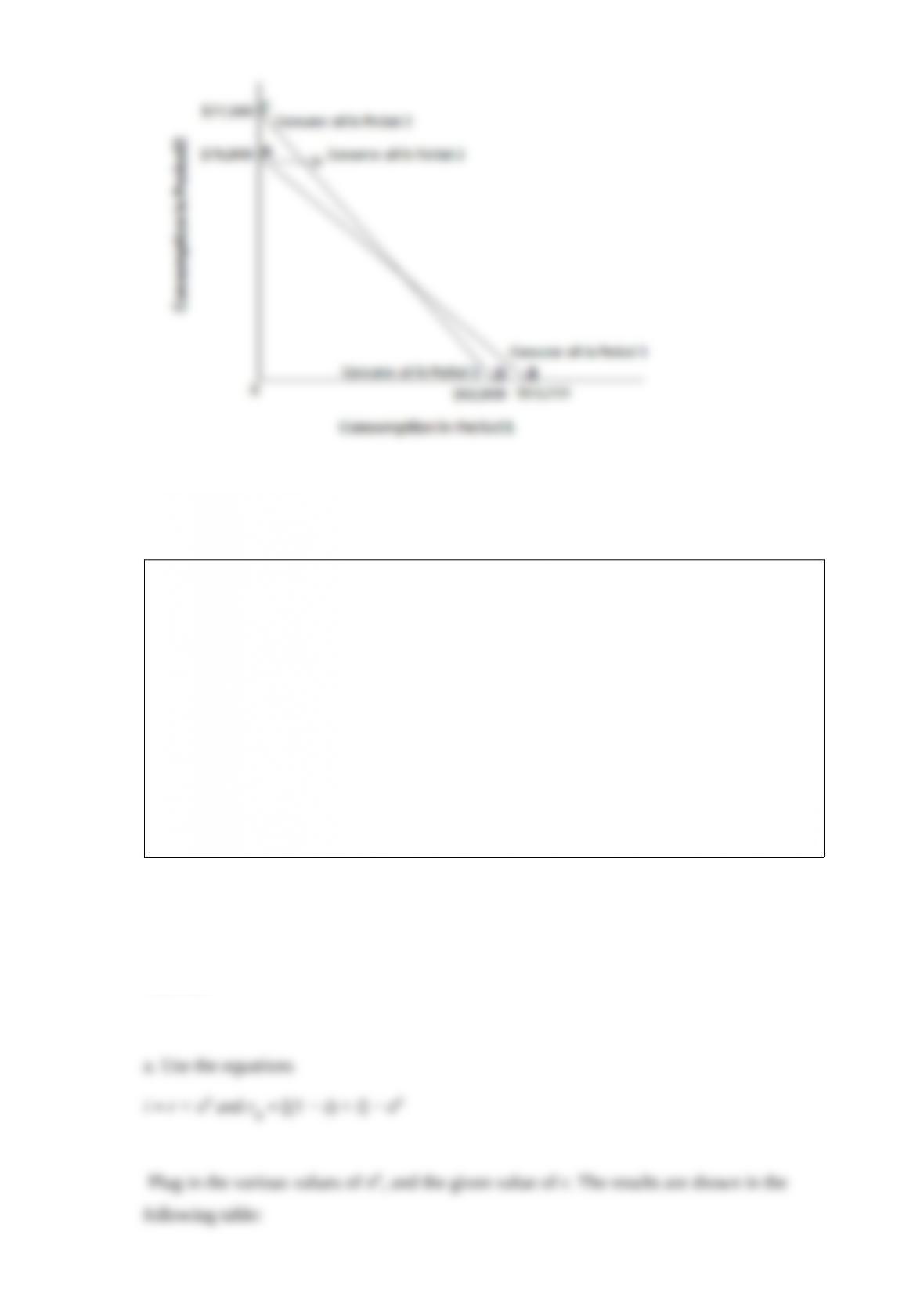
In the two-period model, suppose a household’s income in the first period is $30,000,
income in the second period is
$40,000, and the real interest rate is 20 percent. Draw a diagram showing the budget
constraint. Now, suppose the real interest rate rises to 25 percent. Draw the new budget
constraint. For the budget constraints you have drawn, be sure to show the values of the
intercepts on each axis. Show your work.
Answer:
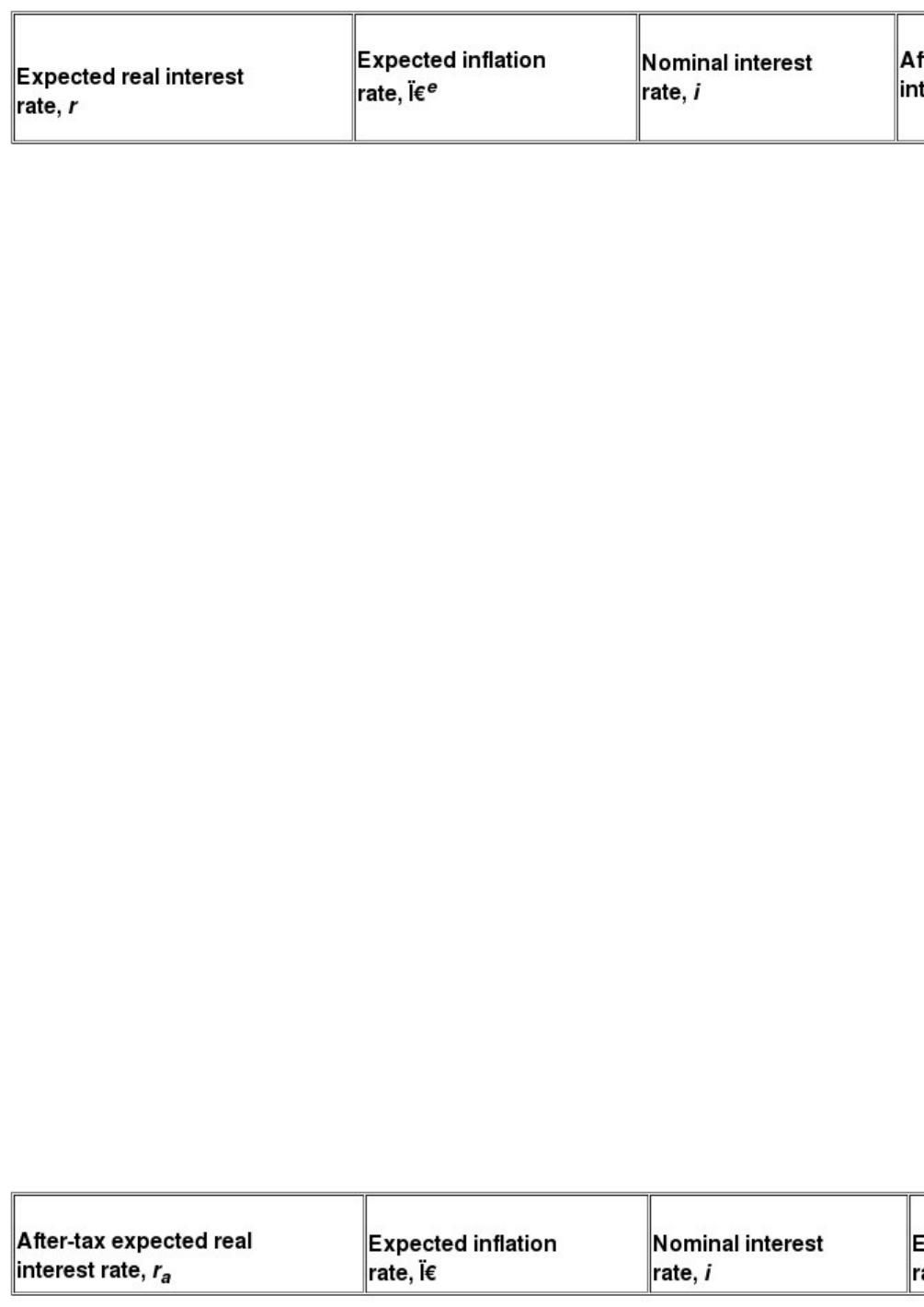
a.Suppose the Fisher hypothesis holds for an economy that has an expected real interest
rate of 3 percent. For each of the expected inflation rates of 0, 3, 6, 9, and 12 percent,
calculate the after-tax expected real interest rate (expressed in percentage pounts with
two decimals), if the tax rate is 15 percent.
b. Suppose the Fisher hypothesis does not hold, but instead that the after-tax expected
real interest rate will be unchanged at 2.5 percent if the expected inflation rate changes.
For each of the expected inflation rates of 0, 3, 6, 9, and 12 percent, calculate the
(before-tax)
expected real interest rate (expressed in percentage points with two decimals), if the tax
rate is 15 percent.
Answer: