
In derivative markets trade takes place in
(a) assets such as bonds or common stock that derive their value from the value of the
companies that issue them.
(b) assets whose rates of returns must be derived from information published in
financial tables.
(c) assets that derive their value from underlying assets.
(d) assets that are not allowed to be traded on organized exchanges.
Answer:
In the federal funds market diagram, a decrease in the required reserve ratio
(a) shifts the demand curve for reserves to the left.
(b) increases the federal funds rate.
(c) results in a multiple expansion of deposits, which increases the equilibrium level of
reserves held by banks.
(d) shifts the supply curve of reserves to the right.
Answer:
Which of the following is considered a significant drawback to using interest rate

targets?
(a) Monetary aggregates are clearly preferable on the basis of the criterion of
controllability.
(b) Monetary aggregates are clearly preferable on the basis of the criterion of
measurability.
(c) A Fed policy to stabilize interest rates may be inconsistent with the Fed’s goal of
maintaining steady economic growth.
(d) The Fed’s influence over nominal interest rates is weaker than its influence over real
interest rates.
Answer:
Which of the following is a contractual saving institution?
(a) The New York Stock Exchange
(b) Greater Illinois Savings and Loan
(c) Prudential Insurance Company
(d) Fidelity Magellan Mutual Fund
Answer:

Which of the following is NOT true of the foreign-exchange market?
(a) It is an over-the-counter market.
(b) Most foreign-exchange trading takes place in London.
(c) Trading volume exceeds $100 billion per day in the United States.
(d) Trading volume worldwide exceeds $1 trillion per day.
Answer:
During the term of Arthur Burns as chairman of the Fed, the FOMC gave top priority to
(a) fighting unemployment.
(b) stabilizing M1.
(c) stabilizing M2.
(d) stabilizing the federal funds rate.
Answer:
Which of the following would NOT cause a shift in the IS curve?
(a) An increase in the domestic real interest rate

(b) An increase in consumer confidence
(c) A decrease in the expected future profitability of capital
(d) A decrease in government purchases
Answer:
If the economy is in general equilibrium and the Fed reduces the money supply,
(a) the previous equilibrium combination of output and the real interest rate represents a
point of excess demand for money.
(b) the previous equilibrium combination of output and the real interest rate represents a
point where saving is greater than investment.
(c) the LM curve shifts down and to the right.
(d) the level of investment spending will increase.
Answer:
A tariff is a
(a) limit on the volume of foreign goods that can be brought into the country.
(b) tax on goods purchased from other countries.

(c) tax on goods exported to other countries.
(d) subsidy by governments to firms that produce goods for export to other countries.
Answer:
In terms of the AD–AS model, the new classical approach indicates that an expected
decrease in the money supply will not affect output because
(a) neither the AD nor SRAS curve will be affected.
(b) the AD curve will shift left, but the SRAS curve will not shift.
(c) the SRAS curve will shift down, but the AD curve will not be affected.
(d) the AD curve will shift left, and the SRAS will shift down by the same amount.
Answer:
Closed-end mutual funds
(a) will always redeem shares issued.
(b) are not obligated to redeem shares issued.
(c) issue shares that always sell at the market value of the underlying assets.
(d) may not hold U.S. government securities in their portfolios.

Answer:
In what sense can a reserve requirement be said to be a tax on bank intermediation?
(a) Banks must pay tax on any funds deposited in a reserve account at a rate equal to the
applicable corporate income tax rate.
(b) Banks must pay tax on any funds removed from a reserve account at a rate equal to
the applicable corporate income tax rate.
(c) Banks must pay taxes on the amount by which they fail to meet their reserve
requirements.
(d) Banks are unable to lend out all their deposits.
Answer:
Suppose that information costs fall with respect to medium-quality corporate bonds.
The result will be that the prices of medium-quality corporate bonds will
(a) fall relative to the price of U.S. Treasury securities but rise relative to the price of
high-quality corporate bonds.
(b) rise relative to the price of U.S. Treasury securities but fall relative to the price of
high-quality corporate bonds.
(c) rise relative to the prices of U.S. Treasury securities and high-quality corporate
bonds.
(d) fall relative to the prices of U.S. Treasury securities and high-quality corporate
bonds
Answer:
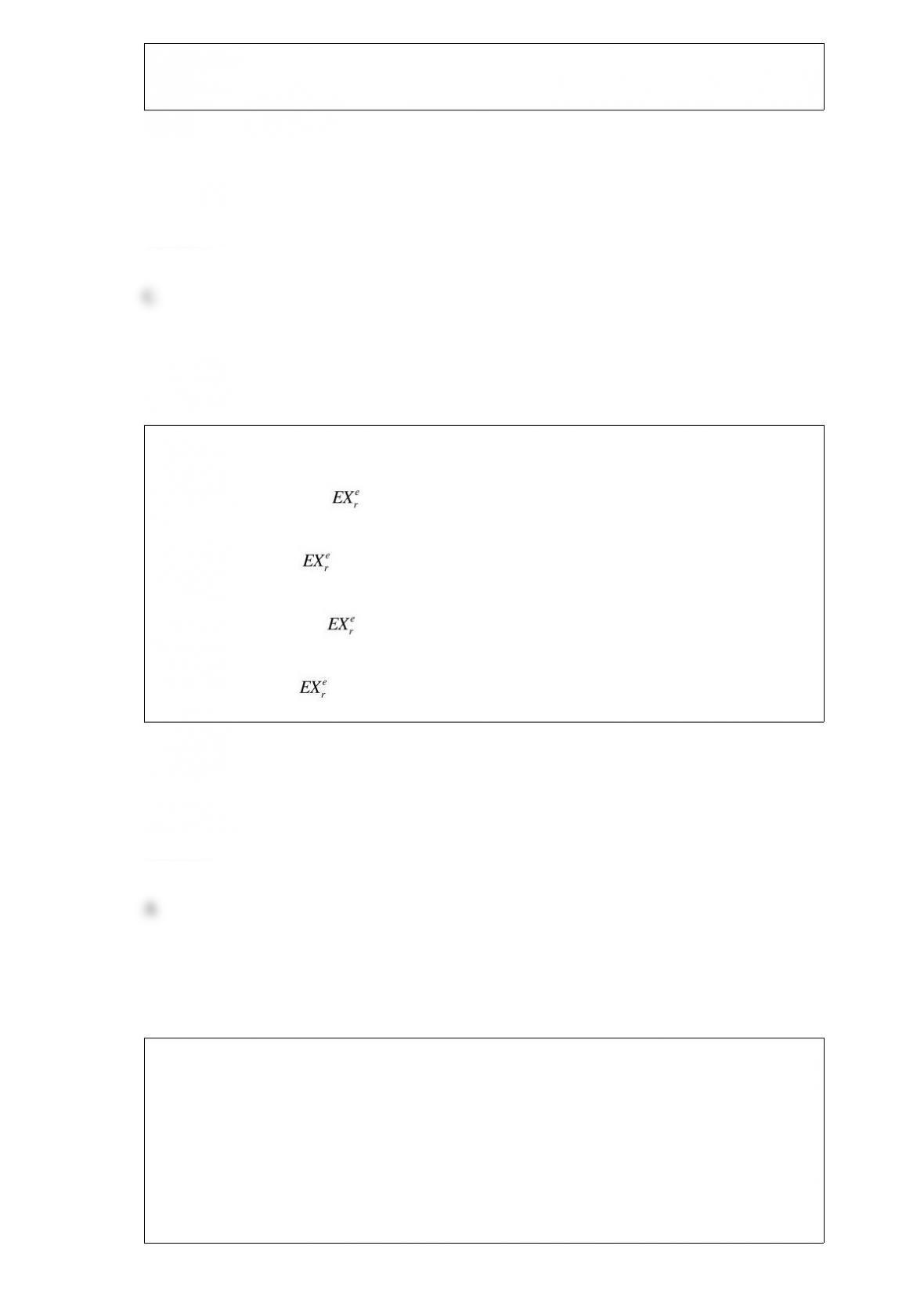
Which of the following expressions gives the real interest rate parity condition?
(a) 1 + r = (1 + rf)(EXr/ )
(b) 1 r = (1 rf)(EXr/ )
(c) 1 + rf= (1 + r)(EXr/ )
(d) 1 + r = (1 + rf)( /EXf)
Answer:
Which of the following is NOT true of a fixed payment loan?
(a) The borrower is required to make regular periodic payments to the lender.
(b) The payments made by the borrower include both interest and principal.
(c) The borrower is left with a substantial unpaid principal at the maturity of the loan.

(d) A Home mortgage is an example of fixed payment loan.
Answer:
How was it possible for stamped and unstamped commodity money to circulate at the
same time?
(a) It was not possible; the unstamped money drove the stamped money out of
circulation.
(b) It was not possible; the stamped money drove the unstamped money out of
circulation.
(c) The unstamped money was accepted at a discount to the stamped money.
(d) The stamped money was accepted at a discount to the unstamped money.
Answer:
A U.S. bank has £75 million in deposits and makes a loan of £90 million when the
exchange rate is $1 = £1. 5. If the exchange rate changes to $1 = £1, then the bank’s net
worth will change by
(a) +$5 million.
(b) +$30 million.
(c) $5 million.

(d) $30 million.
Answer:
Anticompetitive restrictions on banks generally result in
(a) an increase in innovation and competition.
(b) a stifling of innovation.
(c) the persistence of traditional ways of doing things.
(d) a passive attitude on the part of bank managers as they realize attempts to compete
vigorously have been closed off.
Answer:
Why was the Securities and Exchange Commission established?
(a) To ensure that “noise trading” on the New York Stock Exchange did not become
excessive
(b) To regulate the commission charged by stockbrokers
(c) In response to disreputable underwriting practices
(d) In response to the financial panic of 1907

Answer:
If the Fed buys $2 billion of short-term securities issued by the Bank of Japan and pays
for them by writing a check for $2 billion
(a) its assets will rise by $2 billion and the monetary base will rise by $2 billion.
(b) its assets will fall by $2 billion and the monetary base will fall by $2 billion.
(c) its assets will rise by $2 billion and the monetary base will fall by $2 billion.
(d) its assets will fall by $2 billion and the monetary base will rise by $2 billion.
Answer:
The slope of the LM curve is determined by
(a) the sensitivity of investment spending to the real interest rate.
(b) the gap between the return on money and the market interest rate.
(c) the effectiveness of monetary policy.
(d) the sensitivity of the demand for real money balances to the nominal interest rate.
Answer:

Dynamic open market operations
(a) are aimed at achieving changes in monetary policy.
(b) are used much more frequently than defensive open market transactions.
(c) are used to offset disturbances to the monetary base.
(d) make it easy to deduce the Fed’s intentions for monetary policy.
Answer:
Between 1934 and 1981 about how many banks failed per year in the United States?
(a) 0
(b) 10
(c) 1000
(d) 2000
Answer:

The average pay for jobs is highest in which of the following sectors?
(a) The financial sector
(b) The wholesale and retail trade sector
(c) The manufacturing sector
(d) The construction sector
Answer:
Which of the following is not a leading underwriting firm?
(a) Merrill Lynch
(b) First Boston
(c) Fidelity Magellan Fund
(d) Goldman Sachs
Answer:
Which of the following holds a deposit account at the Fed?

(a) The State of New York
(b) The FDIC
(c) The City of Los Angeles
(d) The City of New York
Answer:
If the nominal interest rate is 10%, the tax rate is 25%, and the expected inflation rate is
5%, what is the real after-tax return?
(a) 2.5%
(b) 1.25%
(c) 2.5%
(d) 3.75%
Answer:
The periodic payments received by owners of equity are referred to as
(a) interest.
(b) dividends.

(c) maturity.
(d) coupons.
Answer:
In which of the following markets is a producer likely to be a price taker?
(a) The apple market
(b) The automobile market
(c) The steel market
(d) The college textbook market
Answer:
In the federal funds market diagram, a decrease in the discount rate
(a) decreases the slope of the reserve supply curve.
(b) increases the slope of the reserve supply curve.
(c) decreases the federal funds rate.
(d) has no effect on the reserve supply curve.

Answer:
The volume of transactions is
(a) greater than GDP, because GDP does not include purchases of assets.
(b) greater than GDP, because GDP does not include spending by the government.
(c) smaller than GDP, because GDP includes purchases of assets which are not included
in the volume of transactions.
(d) smaller than GDP, because data on the volume of transactions are published
monthly, whereas data on GDP are published annually.
Answer:
Most economists believe that the short-run aggregate supply curve
(a) slopes down.
(b) slopes up.
(c) is a vertical line.
(d) is a horizontal line.

Answer:
How were open market operations conducted prior to 1935?
(a) They were carried out by the Federal Open Market Committee.
(b) They were carried out under the direction of the Secretary of the Treasury.
(c) They were carried out by the district Federal Reserve banks.
(d) They were carried out by the Banking Committee of the House of Representatives.
Answer: