
Use the information for the question(s) below.
Suppose that in the coming year, you expect Exxon-Mobil stick to have a volatility of
42% and a beta of 0.9, and Merck’s stock to have a volatility of 24% and a beta of 1.1.
The risk free interest rate is 4% and the markets expected return is 12%.
The cost of capital for a project with the same beta as Merck’s stock is closest to:
A) 11.2%
B) 12.8%
C) 12.4%
D) 11.6%
Answer:
If the appropriate interest rate is 8%, then present value of $500 paid at the beginning of
each of the next 40 years is closest to:
A) $23
B) $5,962
C) $6,439
D) $20,0000
Answer:

Use the following information to answer the question(s) below.
John Galt is a mutual fund manager at Atlas Asset Management. He can generate an
alpha of 2% a year up to $500 million of invested capital. After that amount his skills
are spread too thin, so he cannot add value and his alpha is zero for all investments over
$500 million. Atlas Asset Management charges a fee of 0.80% on the total amount of
money under management. Assume that there are always investors looking for positive
alpha investments and no investor would invest in a fund with a negative alpha. Assume
that the fund is in equilibrium, meaning that no investor either takes out money or
wishes to invest new money into the fund.
The alpha that investors in Galt’s fund expect to receive is closest to:
A) -0.80%
B) 0.00%
C) 0.80%
D) 1.80%
Answer:
This period is known for known for “strategic” or “global” deals that were more likely
to be friendly and to involve companies in related businesses; these mergers often were
designed to create strong firms on a scale that would allow them to compete globally:

A) 1960s
B) 1970s
C) 1980s
D) 1990s
Answer:
Use the information for the question(s) below.
Suppose that a young couple has just had their first baby and they wish to ensure that
enough money will be available to pay for their child’s college education. Currently,
college tuition, books, fees, and other costs, average $12,500 per year. On average,
tuition and other costs have historically increased at a rate of 4% per year.
Assuming that costs continue to increase an average of 4% per year, tuition and other
costs for one year for this student in 18 years when she enters college will be closest to:
A) $12,500
B) $21,500
C) $320,568
D) $25,323
Answer:

Which of the following statements is false?
A) In a pledging of accounts receivableagreement, the lender reviews the invoices that
represent the credit sales of the borrowing firm and decides which credit accounts it
will accept as collateral for the loan, based on its own credit standards.
B) With a trust receipts loan or floor planning, all inventory items are held in a trust as
security for the loan.
C) If the factoring agreement is without recourse, the borrowing firm must receive
credit approval for a customer from the factor prior to shipping the goods. If the factor
gives its approval, the firm ships the goods and the customer is directed to make
payment directly to the lender.
D) In a warehouse arrangement, the inventory that serves as collateral for the loan is
stored in a warehouse.
Answer:
Wyatt Oil has an issue of commercial paper with a face value of $10,000,000 and a
maturity of three months. Wyatt received $9,800,000 when it sold the paper. The effect
annual rate for this financing is closest to:
A) 5.6%
B) 6.6%
C) 7.2%
D) 8.4%

Answer:
Which of the following is not a reason why cash flow may not equal net income?
A) Amortization is added in when calculating net income.
B) Changes in inventory will change cash flows but not income.
C) Capital expenditures are not recorded on the income statement.
D) Depreciation is deducted when calculating net income.
Answer:
Which of the following statements is false?
A) When using the incremental IRR rule, you must keep track of which project is the
incremental project and ensure that the incremental cash flows are initially positive and
then become negative.
B) Picking one project over another simply because it has a larger IRR can lead to
mistakes.
C) Problems arise using the IRR method when the mutually exclusive investments have
differences in scale.
D) When the risks of two projects are different, only the NPV rule will give a reliable
answer.

Answer:
In January 2010, the U.S. Treasury issued a $1000 par. five-year, inflation-indexed note
with a coupon of 5%. On the date of issue, the consumer price index (CPI) was 250. By
January 2020, the CPI had decreased to 200. The principal payment that was made in
January 2015 is closest to:
A) $800
B) $1000
C) $1250
D) $1500
Answer:
Which of the following statements is false?
A) A value-weighted portfolio is an equal-ownership portfolio: We hold an equal
fraction of the total number of shares outstanding of each security in the portfolio.
B) When buying a value-weighted portfolio, we end up purchasing the same percentage
of shares of each firm.

C) To maintain a value-weighted portfolio, we do not need to trade securities and
rebalance the portfolio unless the number of shares outstanding of some security
changes.
D) In a value weighted portfolio the fraction of money invested in any security
corresponds to its share of the total number of shares outstanding of all securities in the
portfolio.
Answer:
Use the information for the question(s) below.
Monsters Incorporated (MI) in ready to launch a new product. Depending upon the
success of this product, MI will have a value of either $100 million, $150 million, or
$191 million, with each outcome being equally likely. The cash flows are unrelated to
the state of the economy (i.e. risk from the project is diversifiable) so that the project
has a beta of 0 and a cost of capital equal to the risk-free rate, which is currently 5%.
Assume that the capital markets are perfect.
Assuming that in the event of default, 20% of the value of MI’s assets will be lost in
bankruptcy costs, the initial value of MI’s equity without leverage is closest to:
A) $150 million
B) $147 million
C) $140 million
D) $133 million
Answer:

Consider the following equation:
Pretain = Pcum
The term τc in this equation represents
A) the corporation’s tax rate on interest income.
B) the investor’s tax rate on interest income.
C) the investor’s tax rate on cumulative dividends.
D) the investor’s tax rate on capital gains.
Answer:
Which of the following money market investments is a draft written by the borrower
and guaranteed by the bank on which the draft is drawn. Typically used in international
trade transactions. The borrower is an importer who writes the draft in payment for
goods?
A) Treasury Bill
B) Repurchase Agreement
C) Certificates of Deposit (CD)
D) Banker’s Acceptance
E) Commercial Paper

Answer:
Which of the following statements is false?
A) The matching principle indicates that the firm should finance permanent working
capital with short-term sources of funds.
B) Following the matching principle should, in the long run, help minimize a firm’s
transaction costs.
C) In a perfect capital market, the choice of financing is irrelevant; thus how the firm
chooses to finance its short-term cash needs cannot affect value.
D) A portion of a firm’s investment in its accounts receivable and inventory is
temporary and results from seasonal fluctuations in the firm’s business or unanticipated
shocks.
Answer:
Use the table for the question(s) below.
Consider the following four bonds that pay annual coupons:
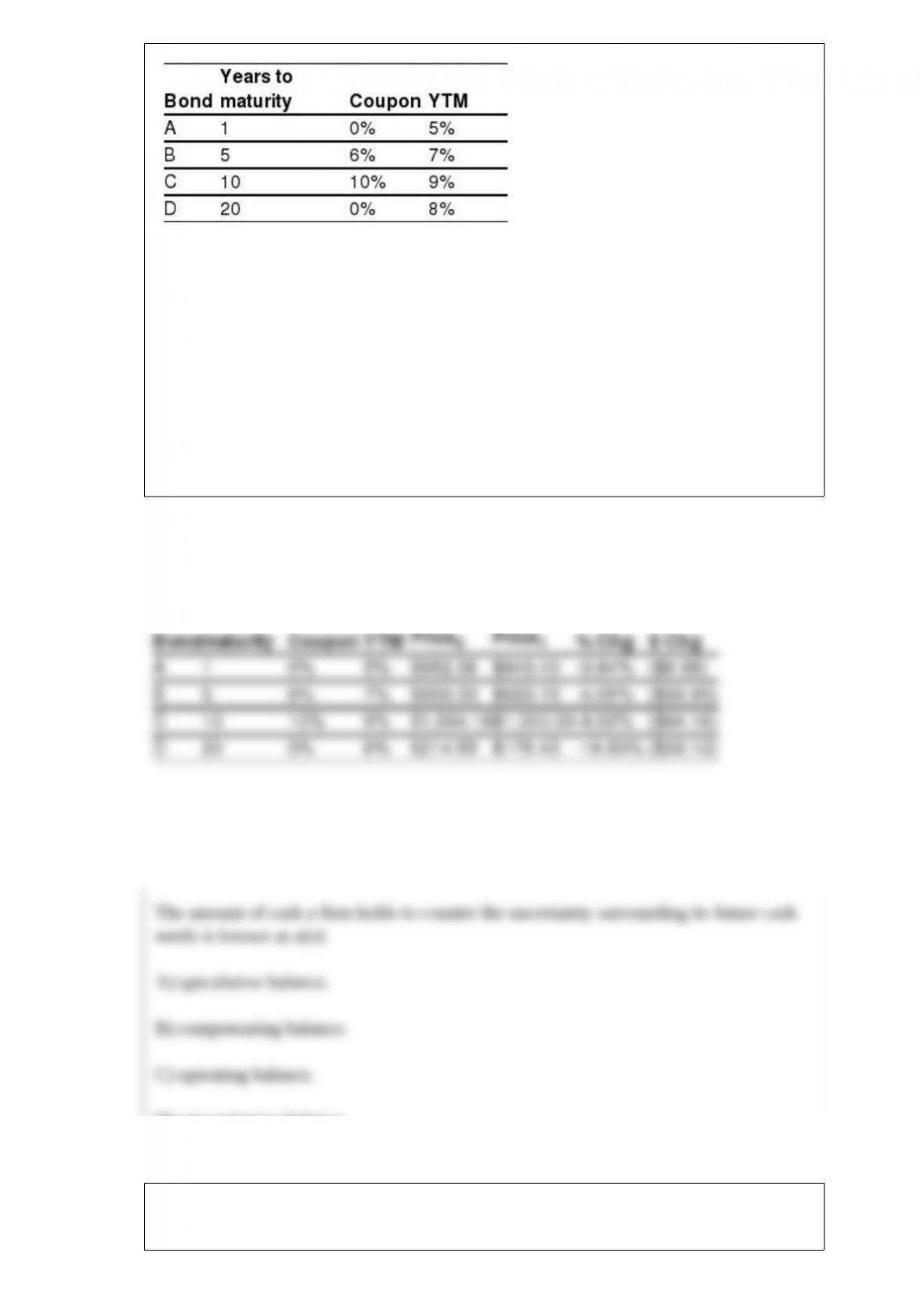
The percentage change in the price of the bond “A” if its yield to maturity increases
from 5% to 6% is closest to:
A) -4%
B) -6%
C) -1%
D) 4%
Answer:
The amount of cash a firm holds to counter the uncertainty surrounding its future cash
needs is known as a(n)

A) speculative balance.
B) compensating balance.
C) operating balance.
D) precautionary balance.
Answer:
Which of the following statements is false?
A) When a firm pays a dividend, shareholders are taxed according to the dividend tax
rate. If the firm repurchases shares instead, and shareholders sell shares to create a
homemade dividend, the homemade dividend will be taxed according to the capital
gains tax rate.
B) When the tax rate on dividends exceeds the tax rate on capital gains, shareholders
will pay lower taxes if a firm uses share repurchases for all payouts rather than
dividends.
C) Firms that use dividends will have to pay a lower after-tax return to offer their
investors the same pre-tax return as firms that use share repurchases.
D) The optimal dividend policy when the dividend tax rate exceeds the capital gain tax
rate is to pay no dividends at all.
Answer:
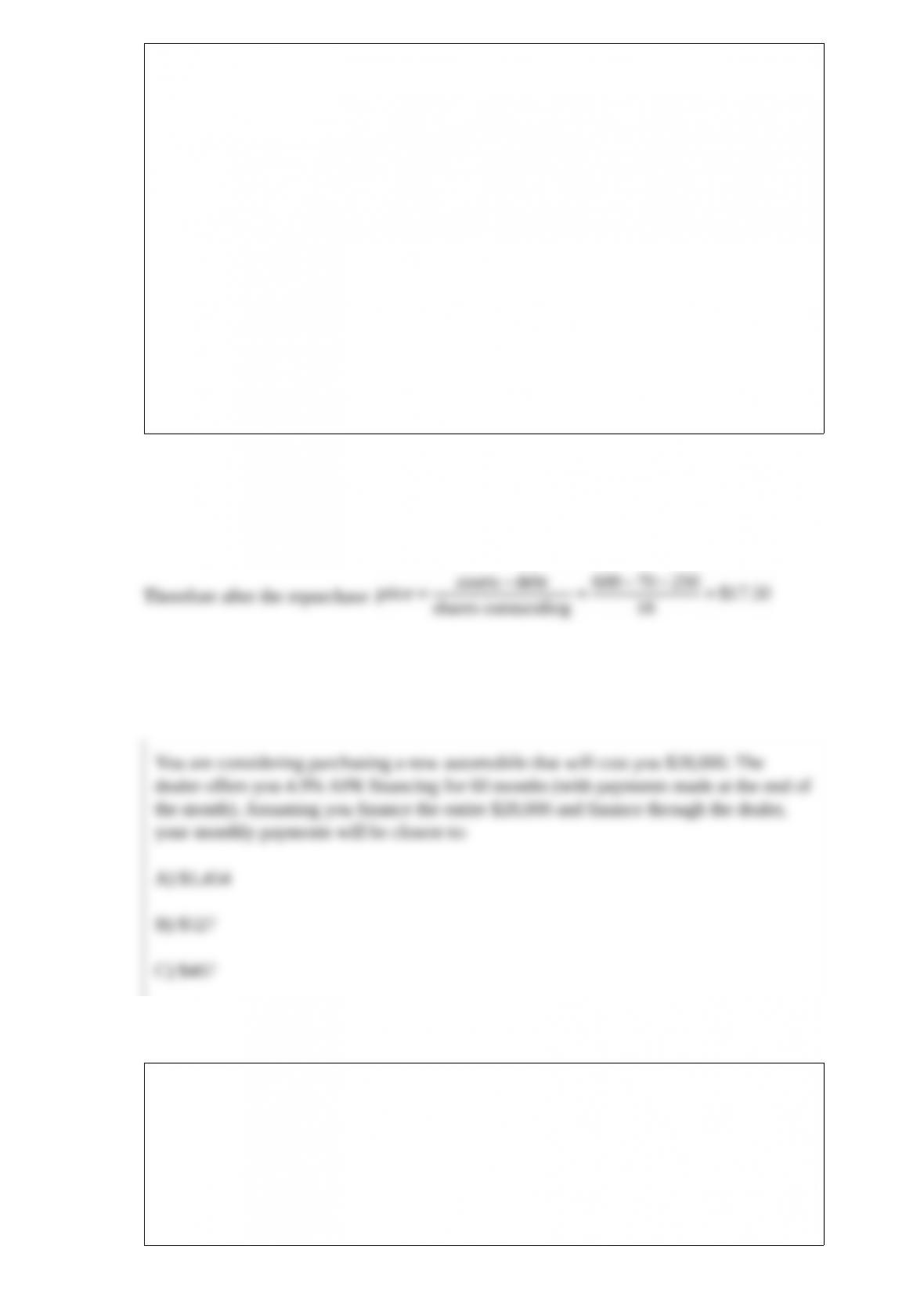
Use the following information to answer the question(s) below.
Wyatt Oil has assets with a market value of $600 million, $70 million of which are
cash. It has debt of $250 million, and 20 million shares outstanding. Assume perfect
capital markets.
If Wyatt Oil distributes the $70 million as a share repurchase, then its stock price after
the share repurchase will be closest to:
A) $11.00
B) $12.50
C) $14.00
D) $17.50
Answer:
You are considering purchasing a new automobile that will cost you $28,000. The
dealer offers you 4.9% APR financing for 60 months (with payments made at the end of
the month). Assuming you finance the entire $28,000 and finance through the dealer,
your monthly payments will be closest to:
A) $1,454

B) $527
C) $467
D) $457
Answer:
Use the table for the question(s) below.
Pro Forma Income Statement for Ideko, 2005-2010
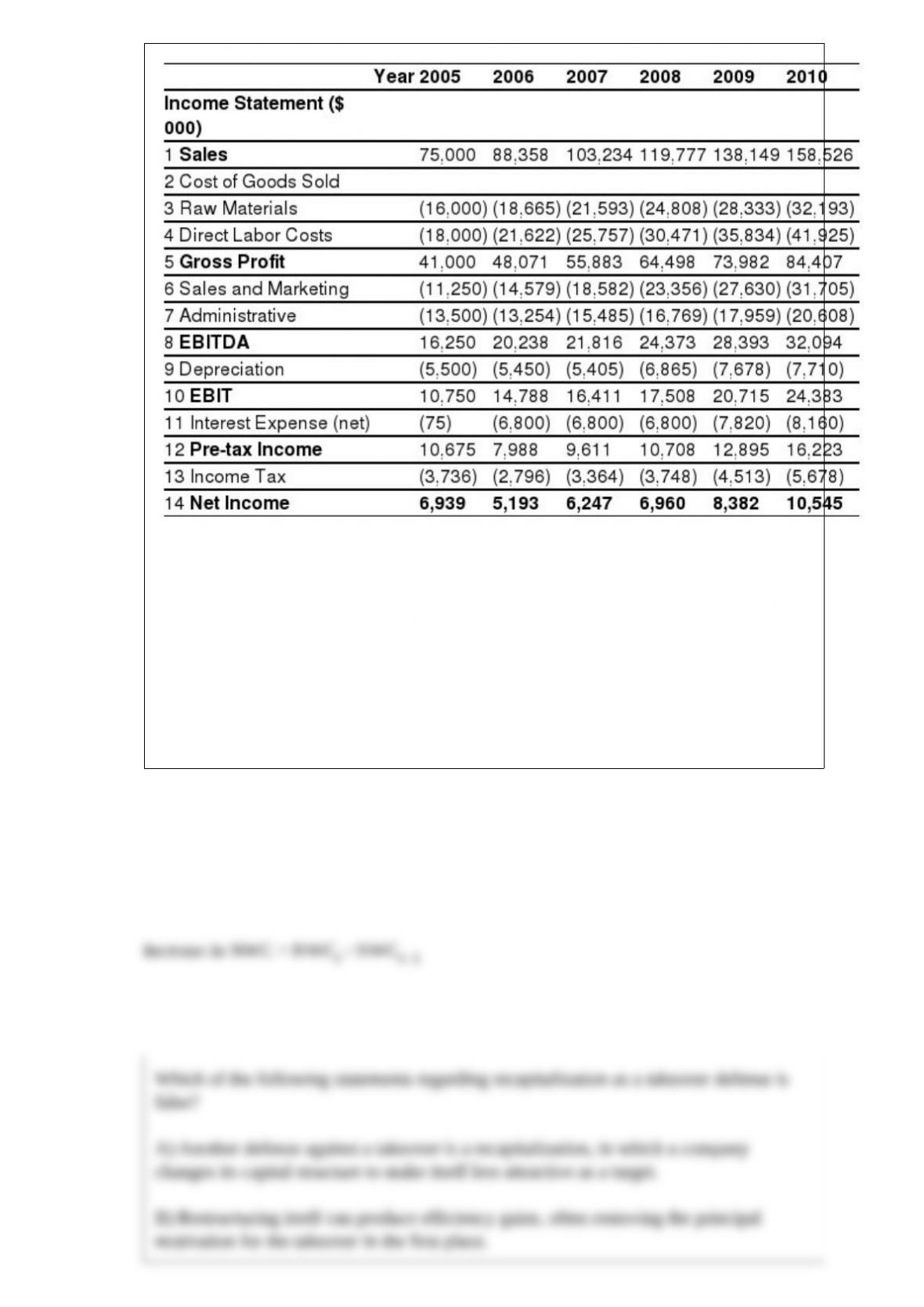
The amount of the increase in net working capital for Ideko in 2007 is closest to:
A) $4,090
B) $4,685
C) $3,665
D) $5,230
Answer:

Which of the following statements regarding recapitalization as a takeover defense is
false?
A) Another defense against a takeover is a recapitalization, in which a company
changes its capital structure to make itself less attractive as a target.
B) Restructuring itself can produce efficiency gains, often removing the principal
motivation for the takeover in the first place.
C) By increasing leverage on its own, the target firm can reap the benefit of the interest
tax shields.
D) In many cases, a substantial portion of the synergy gains that an acquirer anticipates
from a takeover are savings from a decrease in leverage as well as other cost reductions.
Answer:
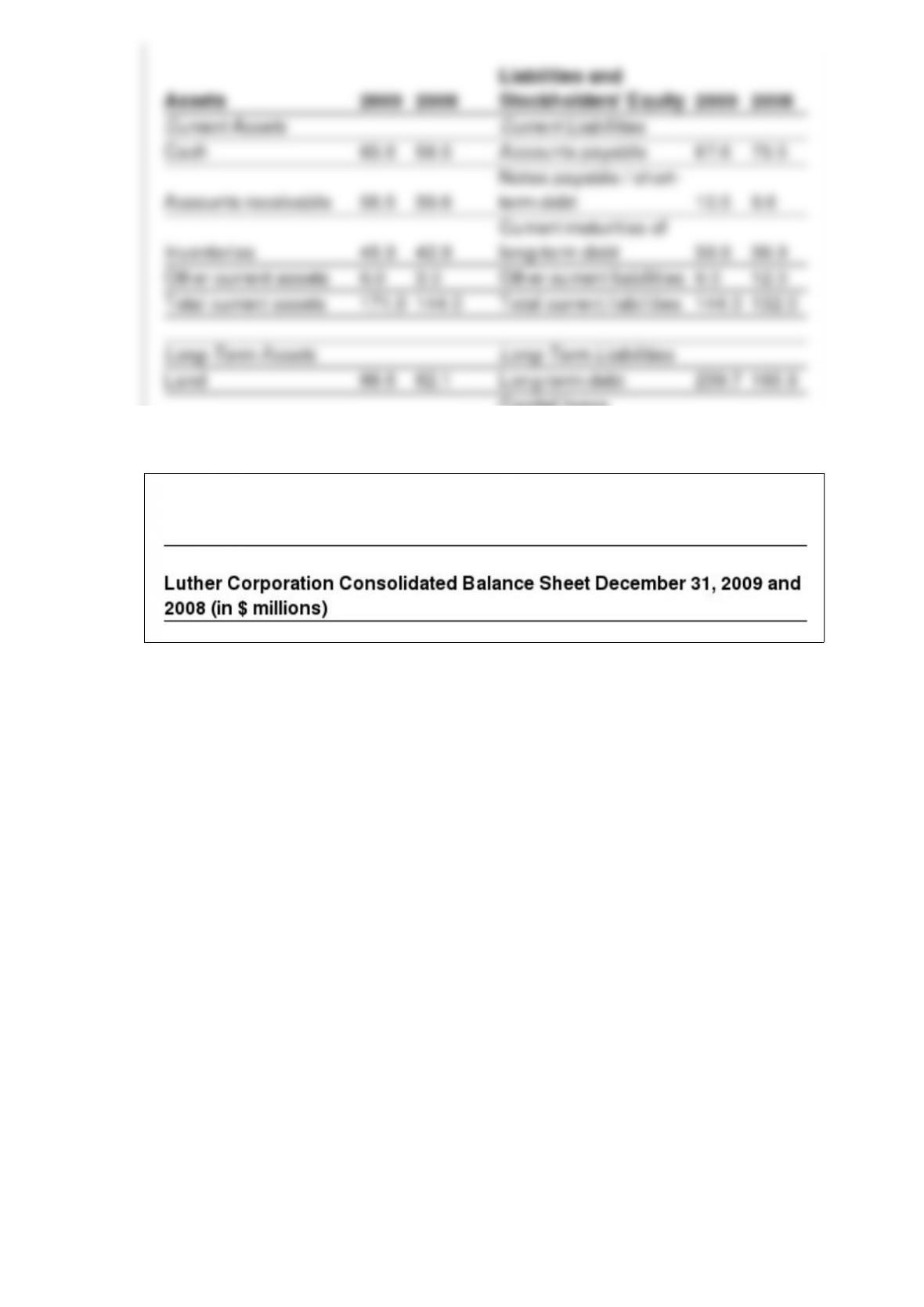
Consider the following balance sheet:
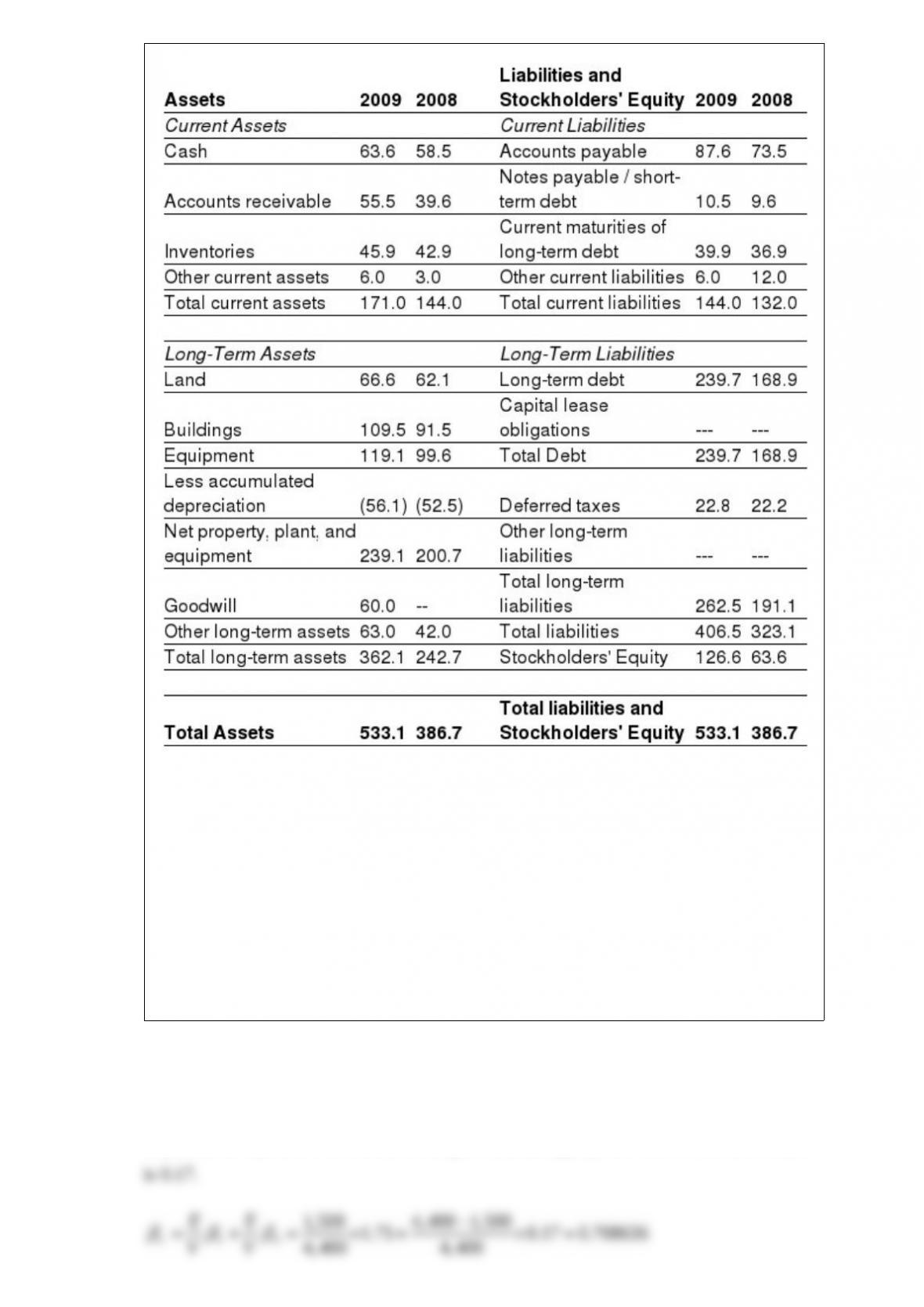
If in 2009 Luther has 10.2 million shares outstanding and these shares are trading at $16
per share, then Luther’s Market-to-book ratio would be closest to:
A) 0.39
B) 0.76
C) 1.29
D) 2.57
Answer:
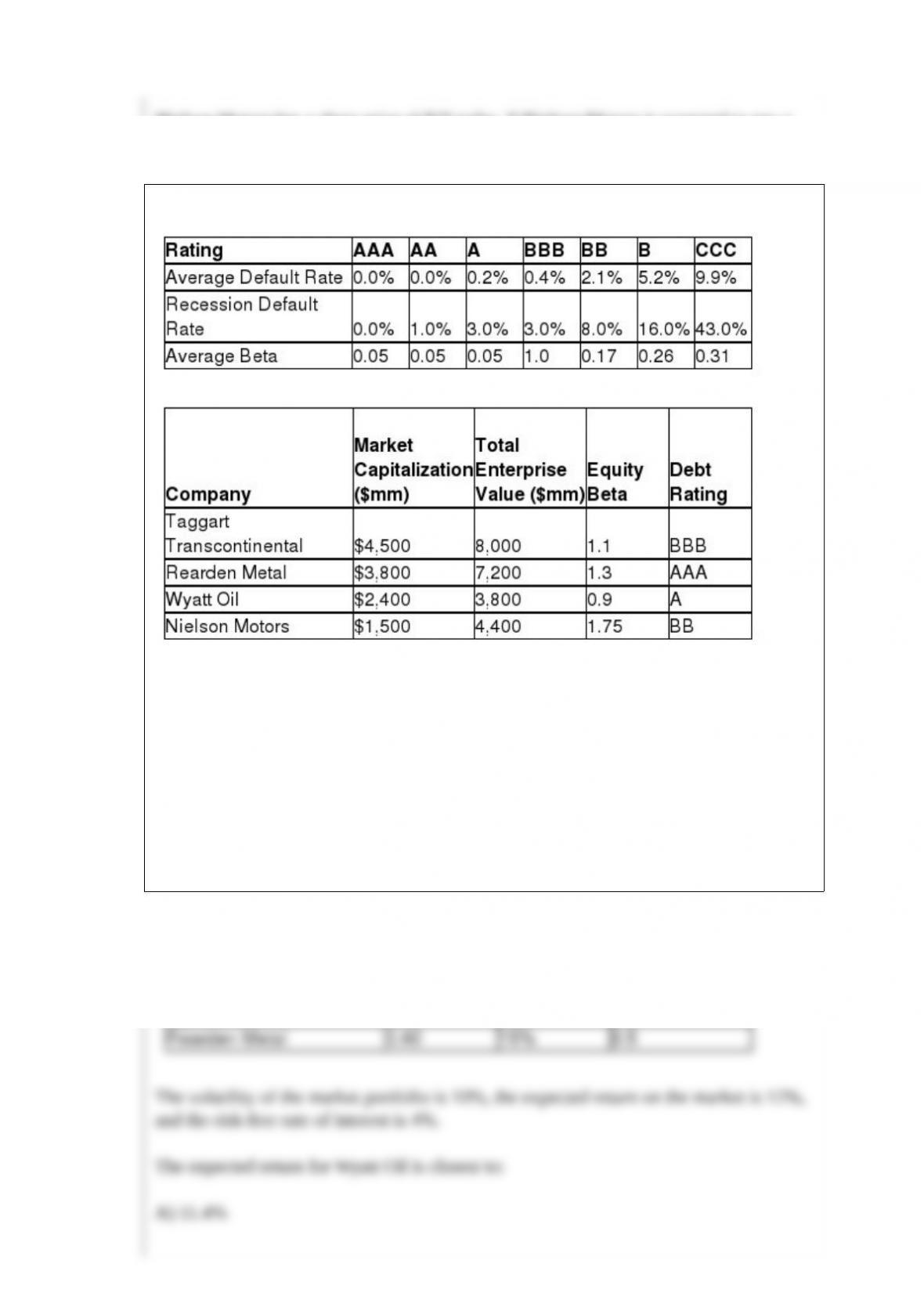
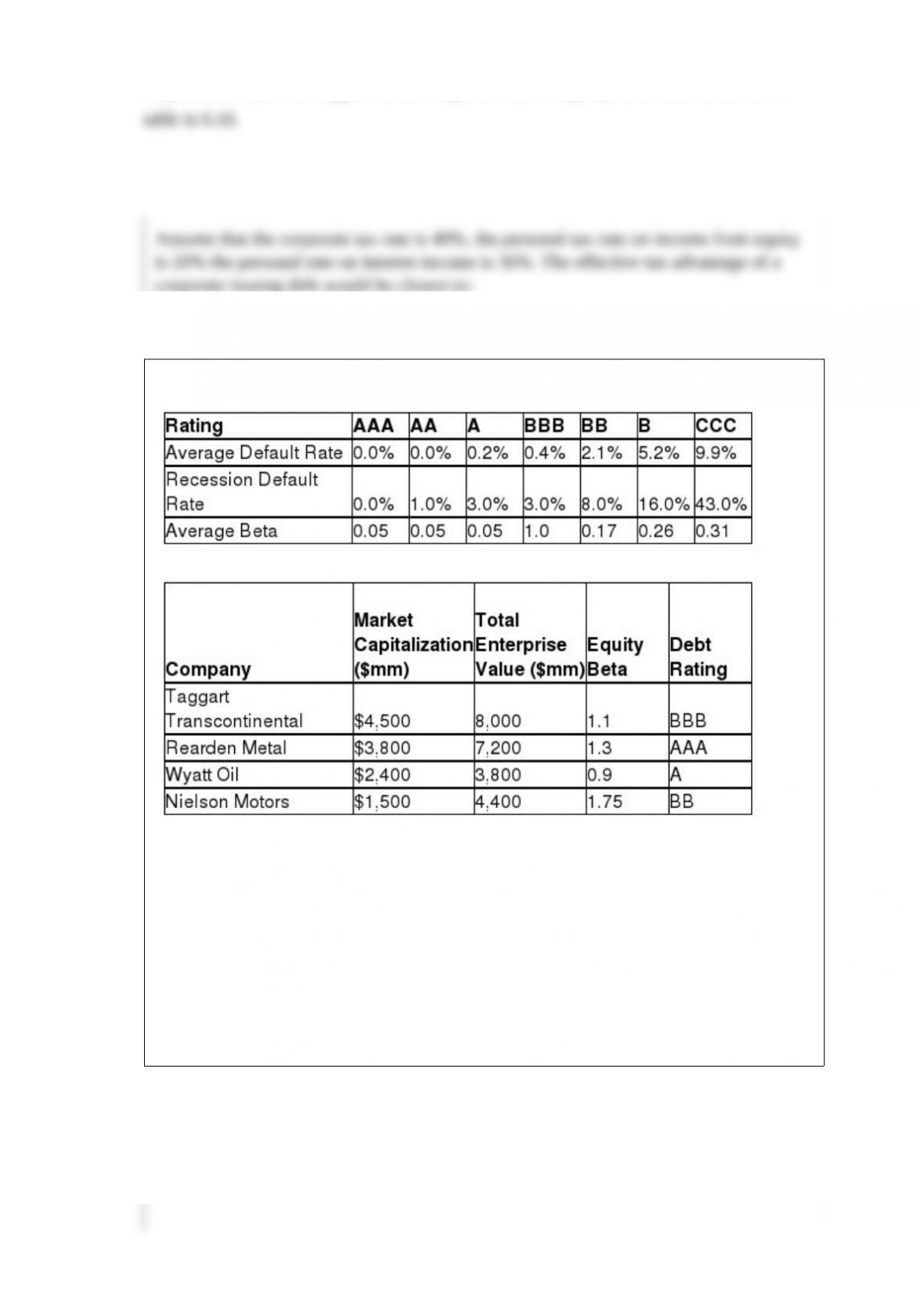
Consider the following information regarding corporate bonds:
Your estimate of the asset beta for Nielson Motors is closest to:
A) 0.59
B) 0.66
C) 0.71
D) 1.75
Answer:
Nielson Motors has a share price of $25 today. If Nielson Motors is expected to pay a
dividend of $0.75 this year, and its stock price is expected to grow to $26.75 at the end
of the year, then Nielson’s dividend yield and equity cost of capital are:
A) 3.0% and 7.0% respectively
B) 3.0% and 10.0% respectively
C) 4.0% and 6.0% respectively
D) 4.0% and 10.0% respectively
Answer:
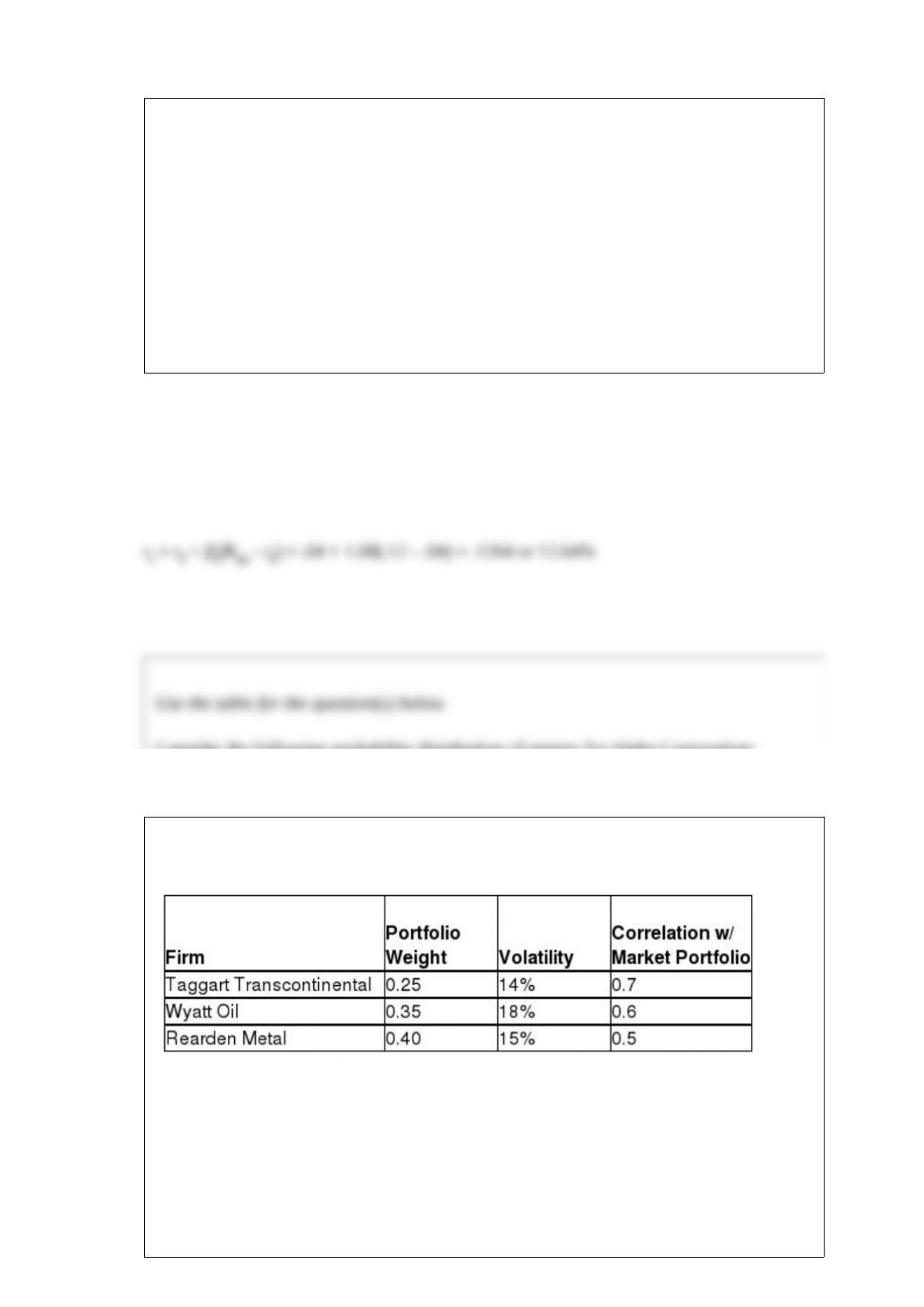
Use the following information to answer the question(s) below.
The volatility of the market portfolio is 10%, the expected return on the market is 12%,
and the risk-free rate of interest is 4%.
The expected return for Wyatt Oil is closest to:
A) 11.4%
B) 11.8%
C) 12.0%
D) 12.6%
Answer:
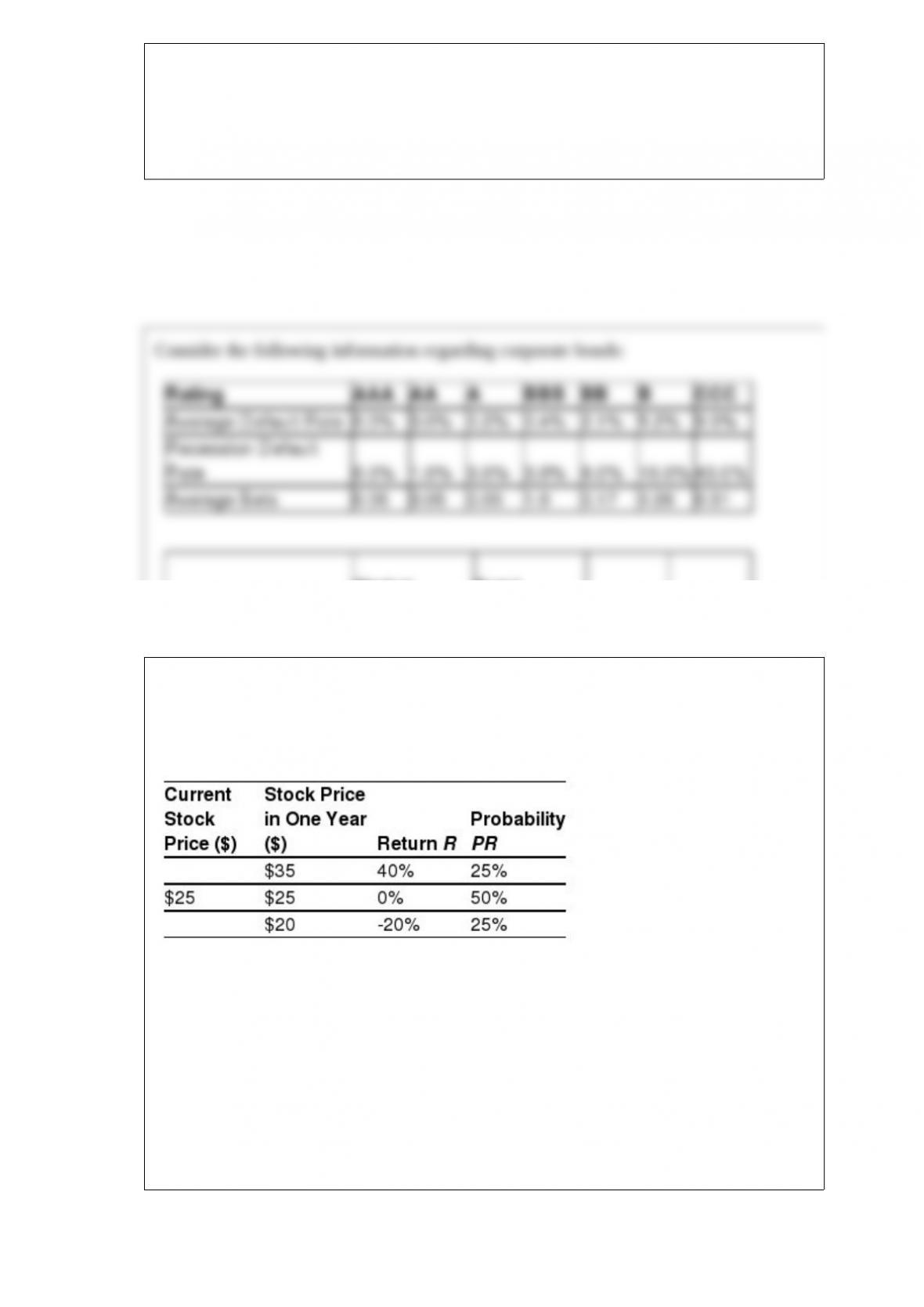
Use the table for the question(s) below.
Consider the following probability distribution of returns for Alpha Corporation:
The variance of the return on Alpha Corporation is closest to:
A) 5.00%
B) 4.75%
C) 3.625%
D) 3.75%
Answer:
Consider the following information regarding corporate bonds:
Your estimate of the debt beta for Taggart Transcontinental would be:
A) 0.05
B) 0.10
C) 0.17
D) 1.00
Answer:
Assume that the corporate tax rate is 40%, the personal tax rate on income from equity
is 20% the personal rate on interest income is 36%. The effective tax advantage of a
corporate issuing debt would be closest to:
A) 10%
B) 15%
C) 25%
D) 28%
Answer:
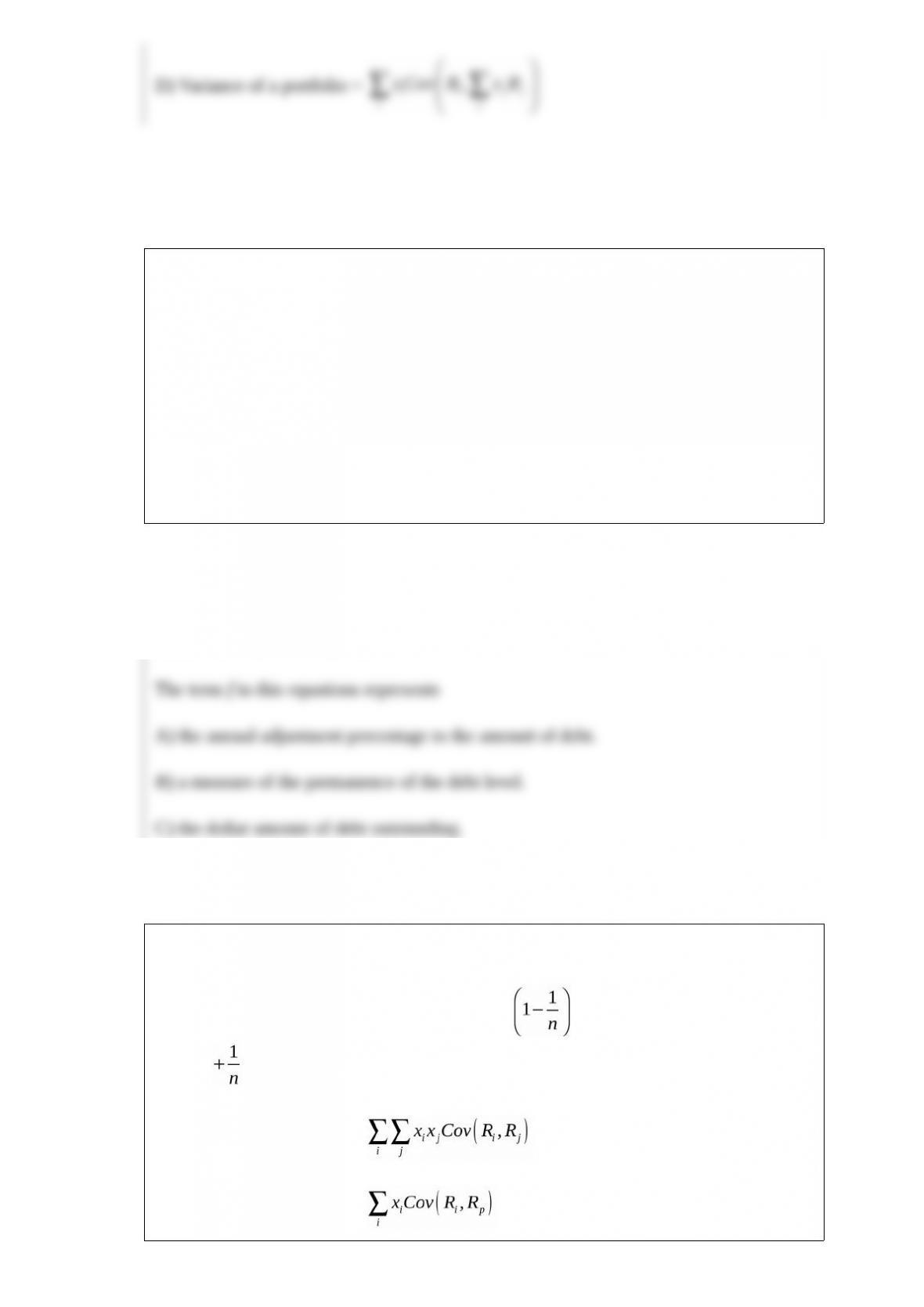
Which of the following formulas is incorrect?
A) Variance of an equally Weighted Portfolio = (Average Variance of Individual
Stocks) (Average covariance between the stocks)
B) Variance of a portfolio =
C) Variance of a portfolio =

D) Variance of a portfolio =
Answer:
Consider the following equation for the Project WACC with a fixed debt schedule:
rwacc= rU– dτc[rD + f(rU – rD)]
The term f in this equations represents
A) the annual adjustment percentage to the amount of debt.
B) a measure of the permanence of the debt level.
C) the dollar amount of debt outstanding.
D) the debt-to-value ratio.
Answer:
Which of the following statements is false?

A) As long as investors can borrow or lend at the same interest rate as the firm,
homemade leverage is a perfect substitute for the use of leverage by the firm.
B) When investors use leverage in their own portfolios to adjust the leverage choice
made by the firm, we say that they are using homemade leverage.
C) The value of the firm is determined by the present value of the cash flows from its
current and future investments.
D) The investor can re-create the payoffs of unlevered equity by borrowing and using
the proceeds to purchasethe equity of the firm.
Answer: