
Use the information for the question(s) below.
Monsters Incorporated (MI) in ready to launch a new product. Depending upon the
success of this product, MI will have a value of either $100 million, $150 million, or
$191 million, with each outcome being equally likely. The cash flows are unrelated to
the state of the economy (i.e. risk from the project is diversifiable) so that the project
has a beta of 0 and a cost of capital equal to the risk-free rate, which is currently 5%.
Assume that the capital markets are perfect.
Suppose that MI has zero-coupon debt with a $125 million face value due next year.
The expected return of MI’s debt is closest to:
A) 25.0%
B) 12.5%
C) 5.0%
D) 7.8%
Use the information for the question(s) below.
The current price of KD Industries stock is $20. In the next year the stock price will
either go up by 20% or go down by 20%. KD pays no dividends. The one year risk-free
rate is 5% and will remain constant.
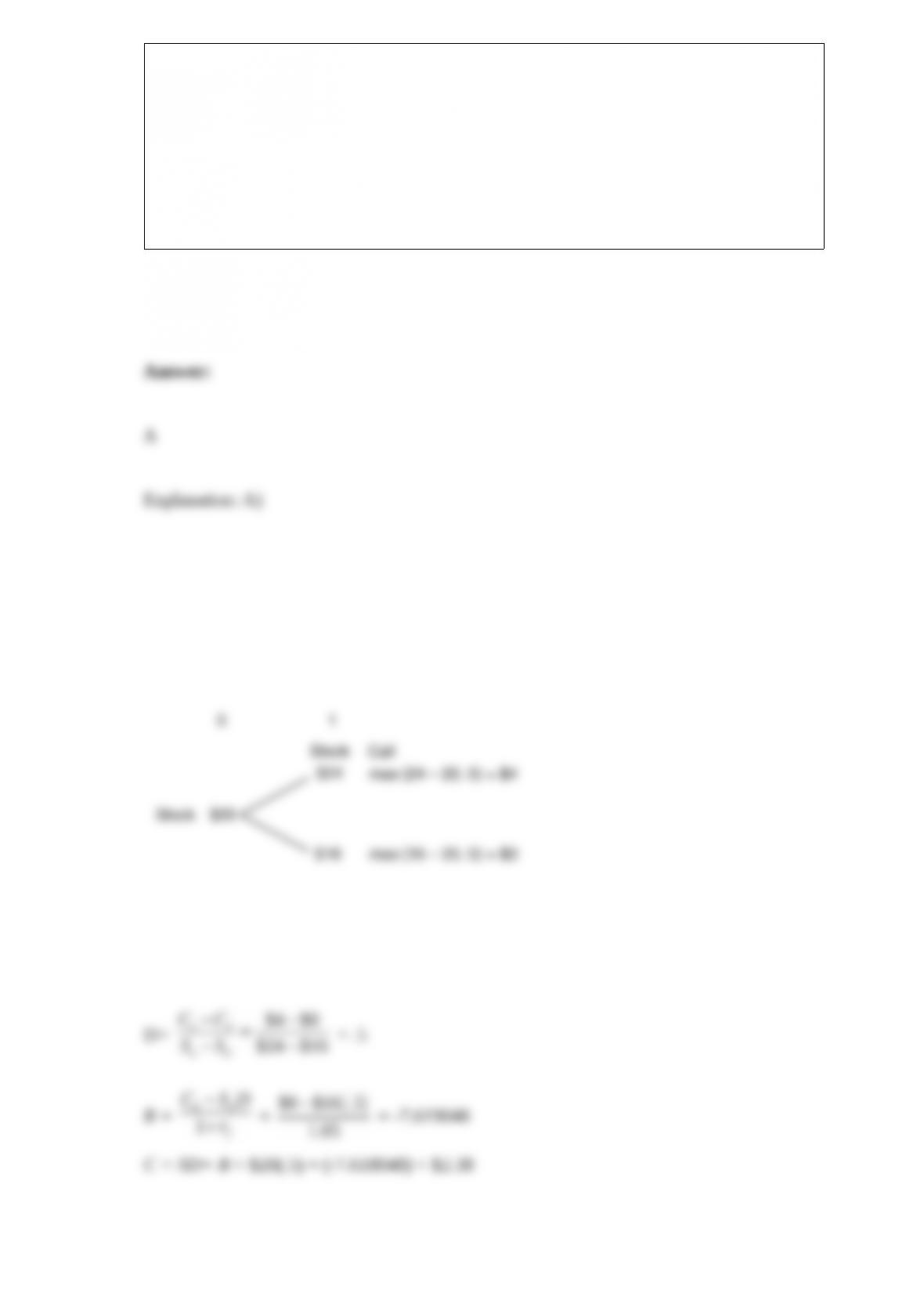
Using the binomial pricing model, the calculated price of a one-year call option on KD
stock with a strike price of $20 is closest to:
A) $2.40
B) $2.00
C) $2.15
D) $1.45
Backdating refers to
A) choosing the strike price of a stock option retroactively.
B) choosing the exercise date of the stock option retroactively.
C) choosing the share conversion ratio retroactively.
D) choosing the grant date of a stock option retroactively
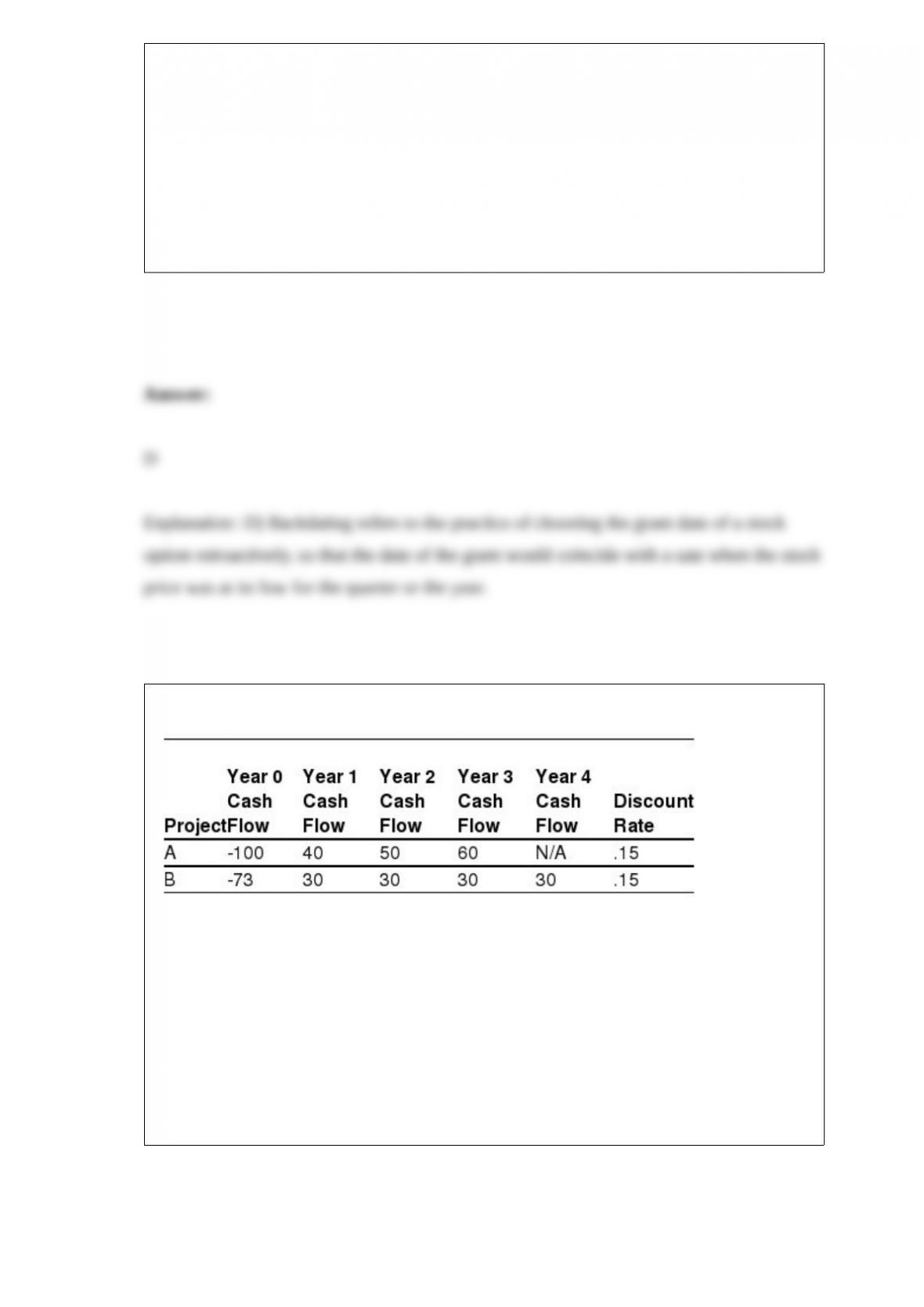
Consider the following two projects:
The maximum number of IRRs that could exist for project B is:
A) 3
B) 1
C) 2
D) 0

Which of the following statements is false?
A) Recently, shareholders have started organizing “no” votes. That is, when they are
dissatisfied with a board, they simply refuse to vote to approve the slate of nominees for
the board.
B) One early study of proxy contests found that the announcement of a contest
increased firm stock price by 8% on average, even if the challenge was eventually
unsuccessful and the incumbents won reelection.
C) Shareholders’ only real role in governance is in electing the directors of the
company.
D) Perhaps the most extreme form of direct action that disgruntled shareholders can
take is to hold a proxy contest and introduce a rival slate of directors for election to the
board.
Use the information for the question(s) below.
JR Industries has a $20 million loan due at the end of the year and under its current
business strategy its assets will have a market value of only $15 million when the loan
comes due. JR is considering a new much riskier business strategy. While this new
riskier strategy can be implemented using JR’s existing assets without any additional
investment, the new strategy has only a 40% probability of succeeding. If the new
strategy is a success, the market value of JR’s assets will be $30, but if the strategy fails
the assets will be worth only $5 million.
What is the expected payoff to debt holders with the speculative oil lease deal?
A) $10 million
B) $275 million
C) $85 million
D) $160 million
Use the following information to answer the question(s) below.
The volatility of the market portfolio is 10%, the expected return on the market is 12%,
and the risk-free rate of interest is 4%.
The Sharpe Ratio for the market portfolio is closest to:
A) 0.40
B) 0.48
C) 0.56
D) 0.80

Use the following information to answer the question(s) below.
Suppose that the market portfolio is equally likely to increase by 24% or decrease by
8%. Security “X” goes up on average by 29% when the market goes up and goes down
by 11% when the market goes down. Security “Y” goes down on average by 16% when
the market goes up and goes up by 16% when the market goes down. Security “Z” goes
up on average by 4% when the market goes up and goes up by 4% when the market
goes down.
The expected return on security with a beta of 1.2 is closest to:
A) 4.8%
B) 8.0%
C) 8.8%
D) 9.6%

Consider the following time line:
If the current market rate of interest is 8%, then the present value of this timeline is
closest to:
A) $1000
B) $857
C) $860
D) $926
Which of the following statements is false?
A) In the flow-to-equity valuation method, the cash flows to equity holders are then
discounted using the weighted average cost of capital.
B) In the WACC and APV methods, we value a project based on its free cash flow,
which is computed ignoring interest and debt payments.
C) In the flow-to-equity (FTE) valuation method, we explicitly calculate the free cash
flow available to equity holders taking into account all payments to and from debt
holders.
D) The first step in the FTE method is to determine the project’s free cash flow to equity
(FCFE).
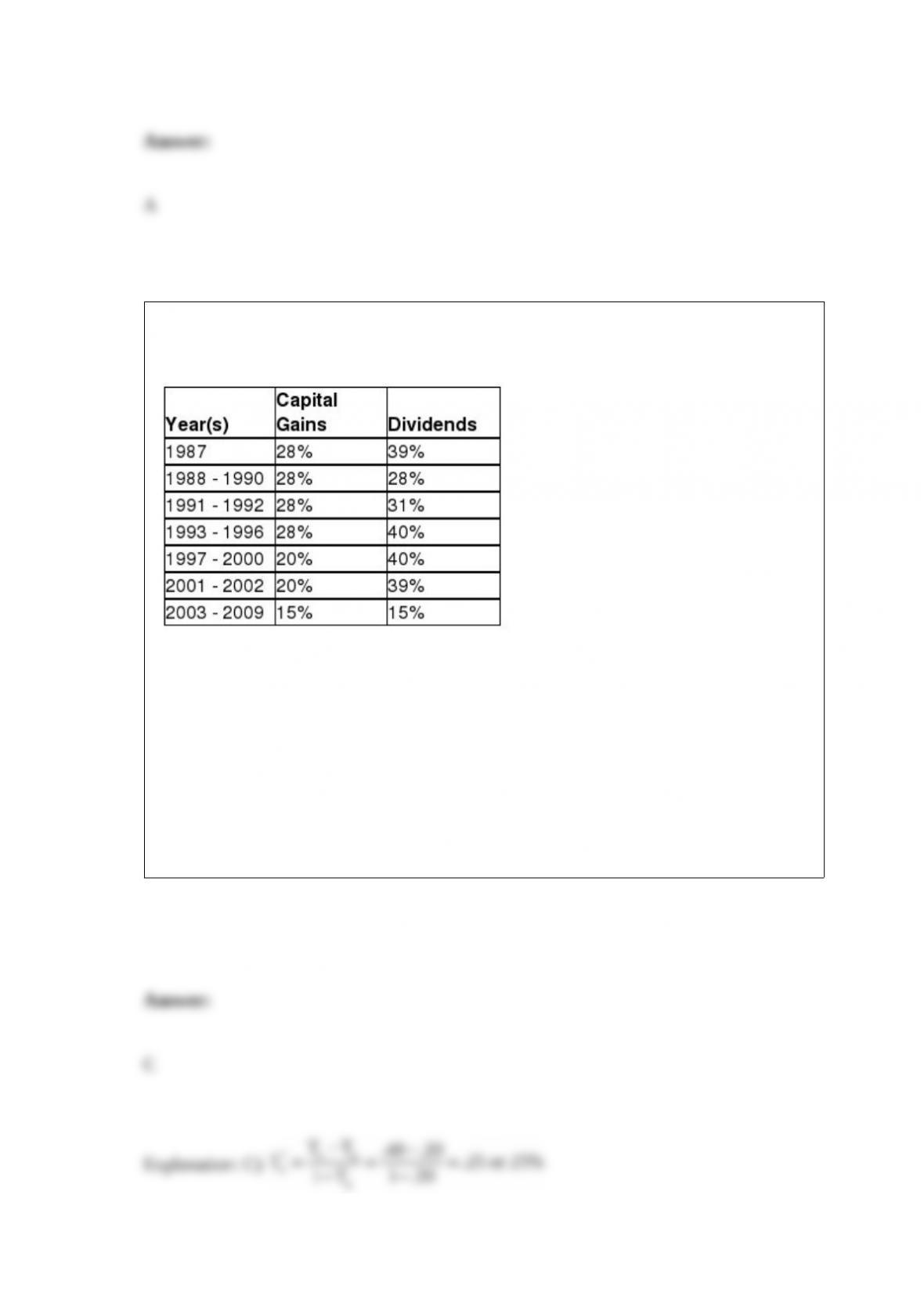
Use the following information to answer the question(s) below.
The effective dividend tax rate in 1999 is closest to:
A) 0%
B) 20%
C) 25%
D) 30%

Which of the following statements is false?
A) The tax deductibility of interest lowers the effective cost of debt financing for the
firm.
B) When a firm uses debt financing, the cost of the interest it must pay is offset to some
extent by the tax savings from the interest tax shield.
C) With tax-deductible interest, the effective after-tax borrowing rate is r(τC).
D) The WACC represents the cost of capital for the free cash flow generated by the
firm’s assets.
Which of the following statements regarding currency options is false?
A) Firms often prefer forward contracts to currency options if the transaction they are
hedging might not take place.
B) Currency optionsare another method that firms commonly use to manage exchange
rate risk. Currency options, like the stock options, give the holder the right”but not the
obligation”to exchange currency at a given exchange rate.
C) Currency forward contracts allow firms to lock in a future exchange rate; currency
options allow firms to insure themselves against the exchange rate moving beyond a
certain level.
D) Many managers want the firm to benefit if the exchange rate moves in their favor,
rather than being stuck paying an above-market rate.

Use the following information to answer the question(s) below:
Rearden Metal (RM) had $120 million in sales in 2009. Its cost of goods sold was $85,
and its average inventory balance was $15 million.
The industry average days of inventory is 75 days. The amount that Rearden would
have to increase/decrease its inventory in order to match the industry average is closest
to:
A) decrease inventory by 2.2 million
B) increase inventory by 2.2 million
C) increase inventory by 2.5 million
D) increase inventory by 4.2 million
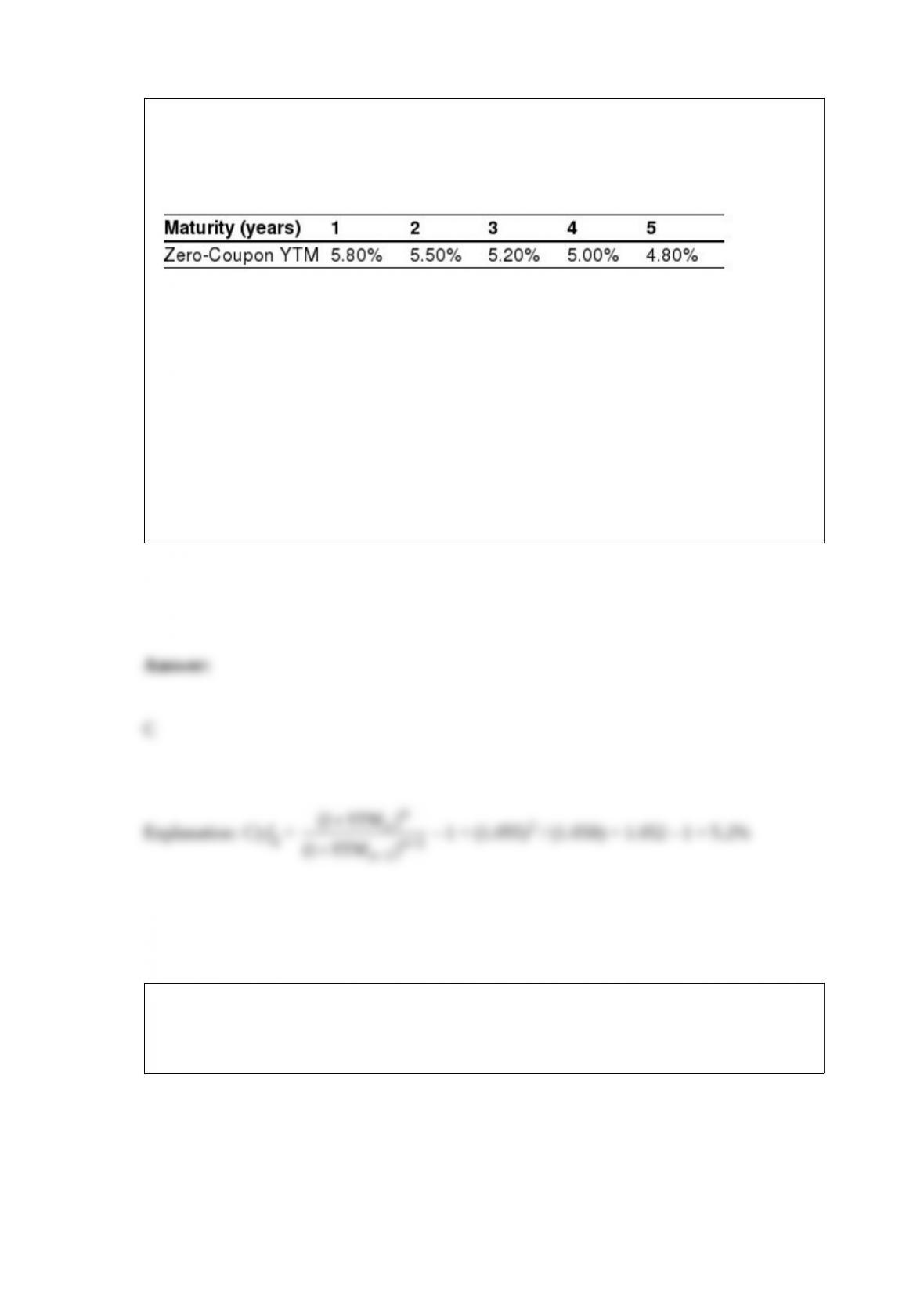
Use the table for the question(s) below.
Consider the following zero-coupon yields on default free securities:
The forward rate for year 2 (the forward rate quoted today for an investment that begins
in one year and matures in two years) is closest to:
A) 5.80%
B) 5.50%
C) 5.20%
D) 5.65%
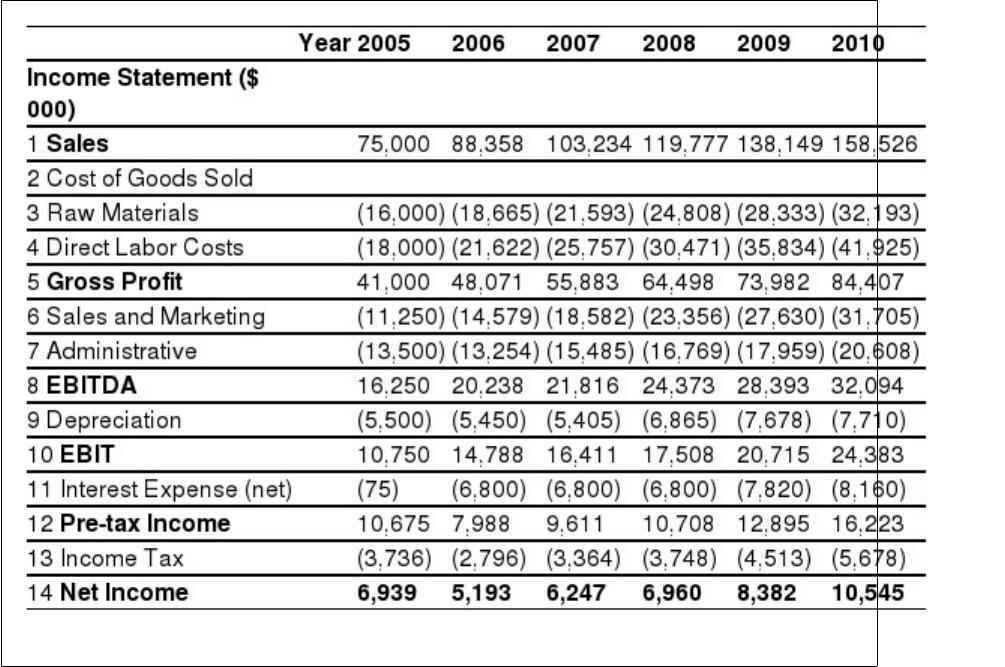
Use the tables for the question(s) below.
Pro Forma Income Statement for Ideko, 2005-2010
Pro Forma Balance Sheet for Ideko, 2005-2010
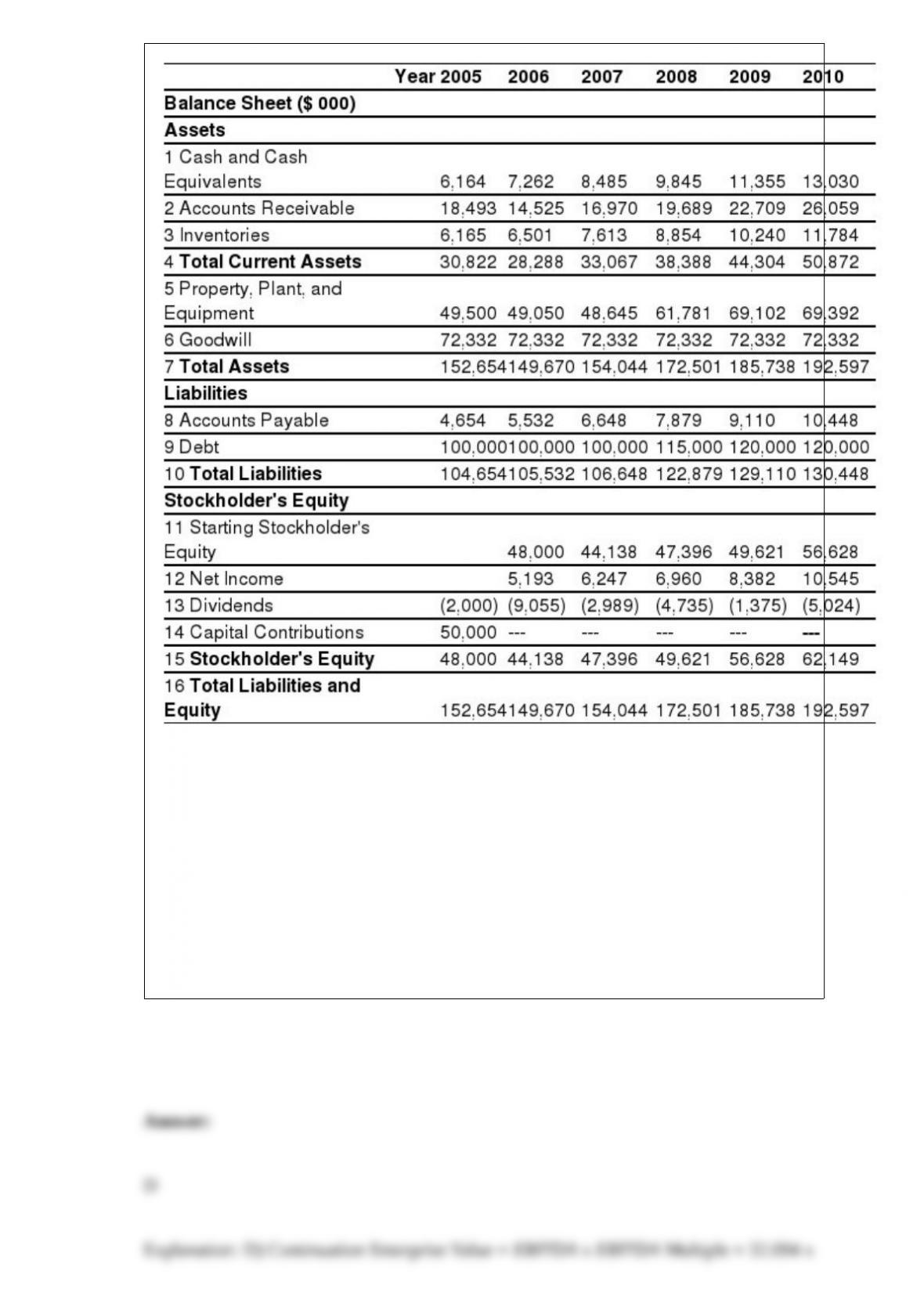
Assuming that Ideko has a EBITDA multiple of 8.5, then the continuation levered P/E
ratio of Ideko in 2010 is closest to:
A) 19.0
B) 17.2
C) 16.4
D) 14.5
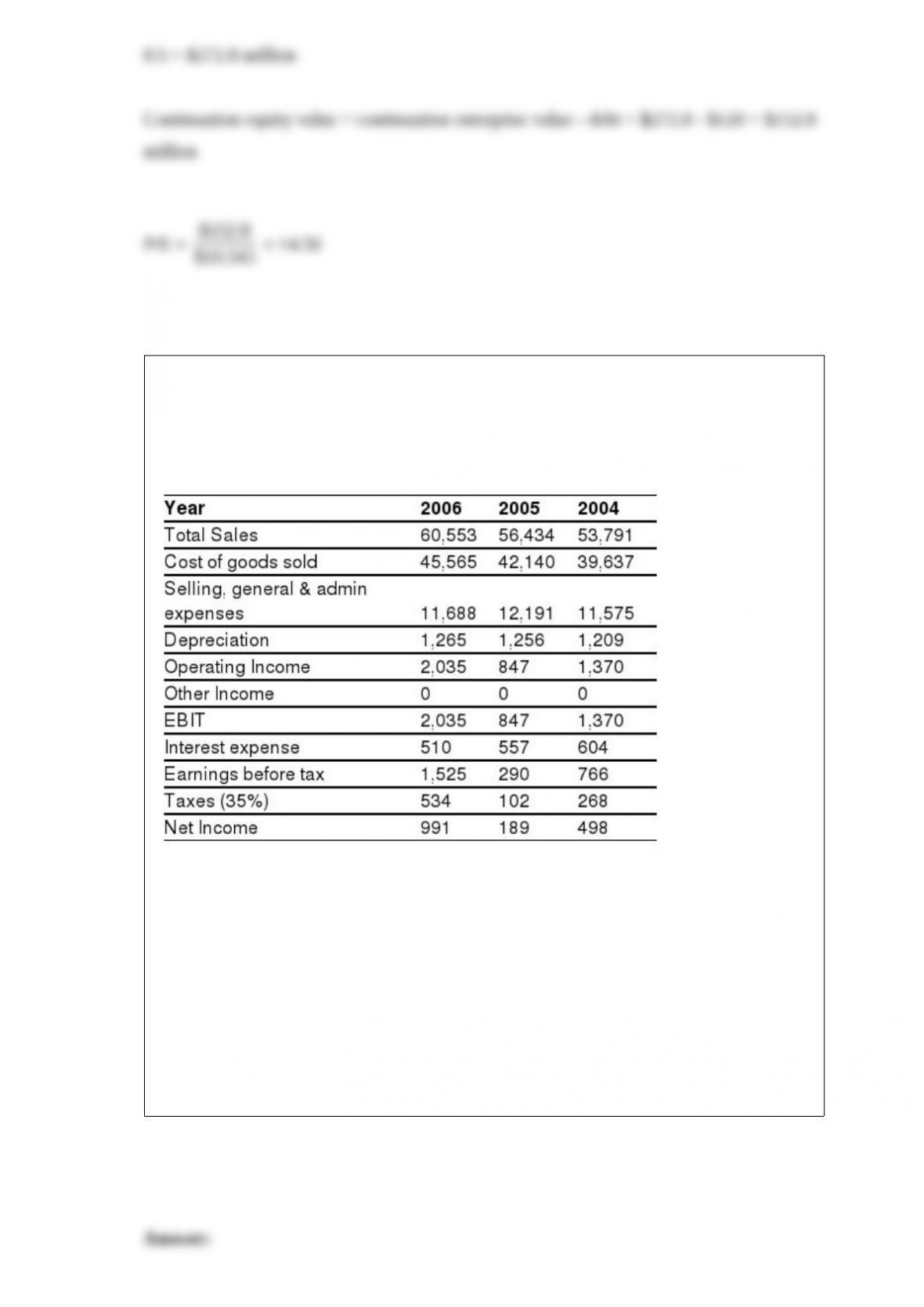
Use the table for the question(s) below.
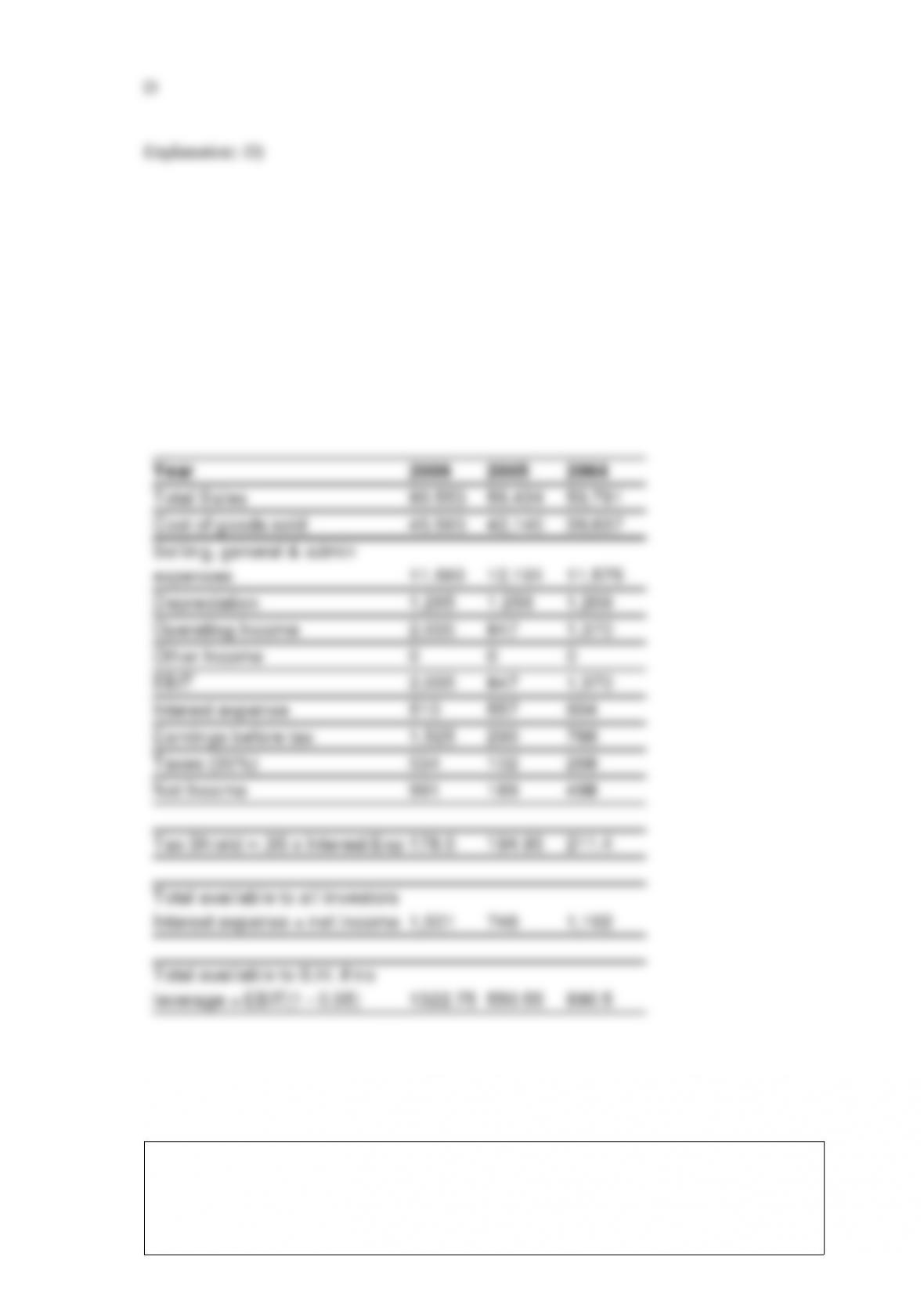
Consider the following income statement for Kroger Inc. (all figures in $ Millions):
The income that would be available to equity holders in 2006 if Kroger was not levered
is closest to:
A) $1,525 million
B) $2,035 million
C) $1,500 million
D) $1,325 million
Which of the following statements is false?
A) Horizontal integrationentails the merger of a firm and its supplier or a firm and its
customer.

B) Like insurance, hedging involves contracts or transactions that provide the firm with
cash flows that offset its losses from price changes.
C) For many firms, changes in the market prices of the raw materials they use and the
goods they produce may be the most important source of risk to their profitability.
D) Because an increase in the price of the commodity raises the firm’s costs and the
supplier’s revenues, these firms can offset their risks by merging.
Which of the following statements is false?
A) We must discount the cash flows from stock based on the equity cost of capital for
the stock.
B) The divided yield is the percentage return the investor expects to earn from the
dividend paid by the stock.
C) The firm might pay out cash to its shareholders in the form of a dividend.
D) The dividend yield is the expected annual dividend of a stock, divided by its
expected future sale price.

Use the information for the question(s) below.
Defenestration industries plans to pay a $4.00 dividend this year and you expect that the
firm’s earnings are on track to grow at 5% per year for the foreseeable future.
Defenestration’s equity cost of capital is 13%.
Suppose that Defenestration decides to pay a dividend of only $2 per share this year and
use the remaining $2 per share to repurchase stock. If Defenestration’s payout rate
remains constant, then Defenestration’s stock price is closest to:
A) $50.00
B) $22.25
C) $32.30
D) $30.75
The holder of a put option has
A) the obligation to sell a security for a given price.
B) the right to buy a security for a given price.
C) the right to sell a security for a given price.
D) the obligation to buy a security for a given price.

Which of the following statements is false?
A) If the foreign project is owned by a domestic corporation, managers and
shareholders need to determine the home currency value of the foreign currency cash
flows.
B) The most obvious difference between a domestic project and a foreign project is that
the foreign project will most likely generate cash flows in a foreign currency.
C) The risk of the foreign project is unlikely to be exactly the same as the risk of
domestic projects (or the firm as a whole), because the foreign project contains residual
exchange rate risk that the domestic projects often do not contain.
D) In an internationally integrated capital market, two equivalent methods are available
for calculating the NPV of a foreign project: Either we can calculate the NPV in the
foreign country and convert it to the local currency at the forward rate, or we can
convert the cash flows of the foreign project into the local currency and then calculate
the NPV of these cash flows.
If the appropriate interest rate is 8%, then present value of $500 paid at the end of each
of the next 40 years is closest to:
A) $23

B) $5,962
C) $6,439
D) $20,0000
Use the information for the question(s) below.
KD Industries has 30 million shares outstanding with a market price of $20 per share
and no debt. KD has had consistently stable earnings, and pays a 35% tax rate.
Management plans to borrow $200 million on a permanent basis through a leveraged
recapitalization in which they would use the borrowed funds to repurchase outstanding
shares.
The preset value of KD’s interest tax shield is closest to:
A) $130 million
B) $200 million
C) $400 million
D) $70 million
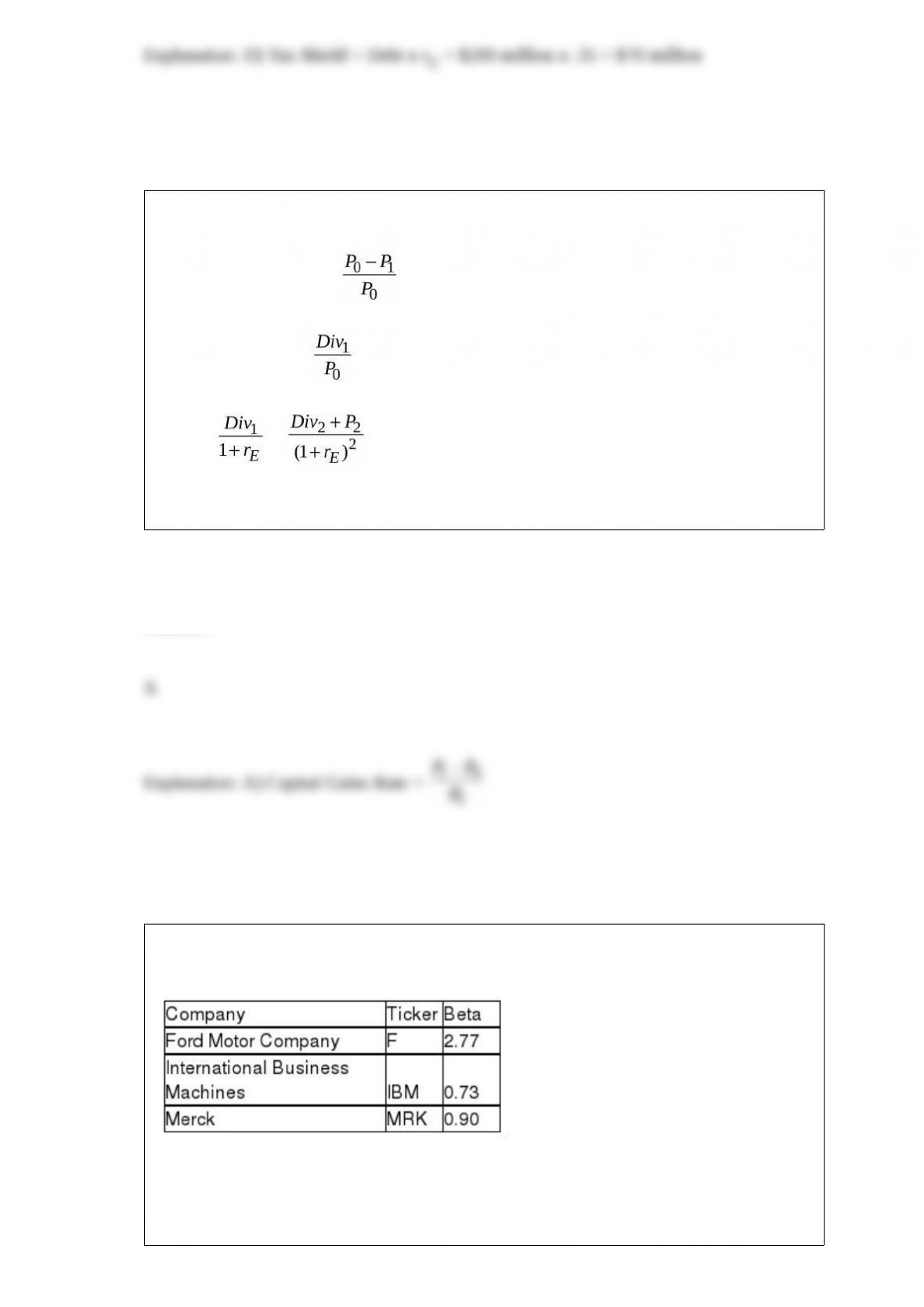
Which of the following formulas is incorrect?
A) Capital Gains Rate =
B) Dividend Yield =
C) P0 = +
D) rE = Capital Gains Rate + Dividend Yield
Use the following information to answer the question(s) below.
If the risk-free rate is 5% and the expected return of investing in Merck is 11.3%, then
the expected return on the market must be:

A) 8.0%
B) 10.0%
C) 10.4%
D) 12.0%
Which of the following was not a finding of the Cadbury Commission?
A) Audit and compensation committees should be made up entirely of independent
directors or, at least, have a majority of them.
B) Auditors should be rotated, and there should be fuller disclosure of non-audit work.
C) The CEO should not be chairman of the board, and at the very least there should be a
lead independent director with similar agenda-setting powers.
D) The CEO and the CFO should personally attest to the accuracy of the financial
statements presented to shareholders.
Consider the following equation:
C = S – K + dis(K) + P

In this equation, S – K tells us
A) the market value of the option.
B) the time value of the option.
C) the option spread.
D) the intrinsic value of the option.
If the current inflation rate is 4% and you have an investment opportunity that pays
10%, then the real rate of interest on your investment is closest to:
A) 10.0%
B) 14.0%
C) 6.0%
D) 5.8%
A board of directors is said to be captured when
A) a majority of the directors are independent directors.
B) a majority of the directors are outside directors.
C) its monitoring duties have been compromised by connections or perceived loyalties
to management.
D) when the CEO also serves as chairman of the board of directors.
Describe “just-in-time” inventory management.
Luther Industries bills its accounts on terms of 2/10, net 30. The firm’s accounts
receivable include $250,000 that has been outstanding for 10 or fewer days, $375,000
outstanding for 11 to 30 days, $70,000 outstanding for 31 to 40 days, $35,000
outstanding for 41 to 50 days, $20,000 outstanding for 51 to 60 days, and $8,000
outstanding for more than 60 days. Prepare an aging schedule for Luther Industries.
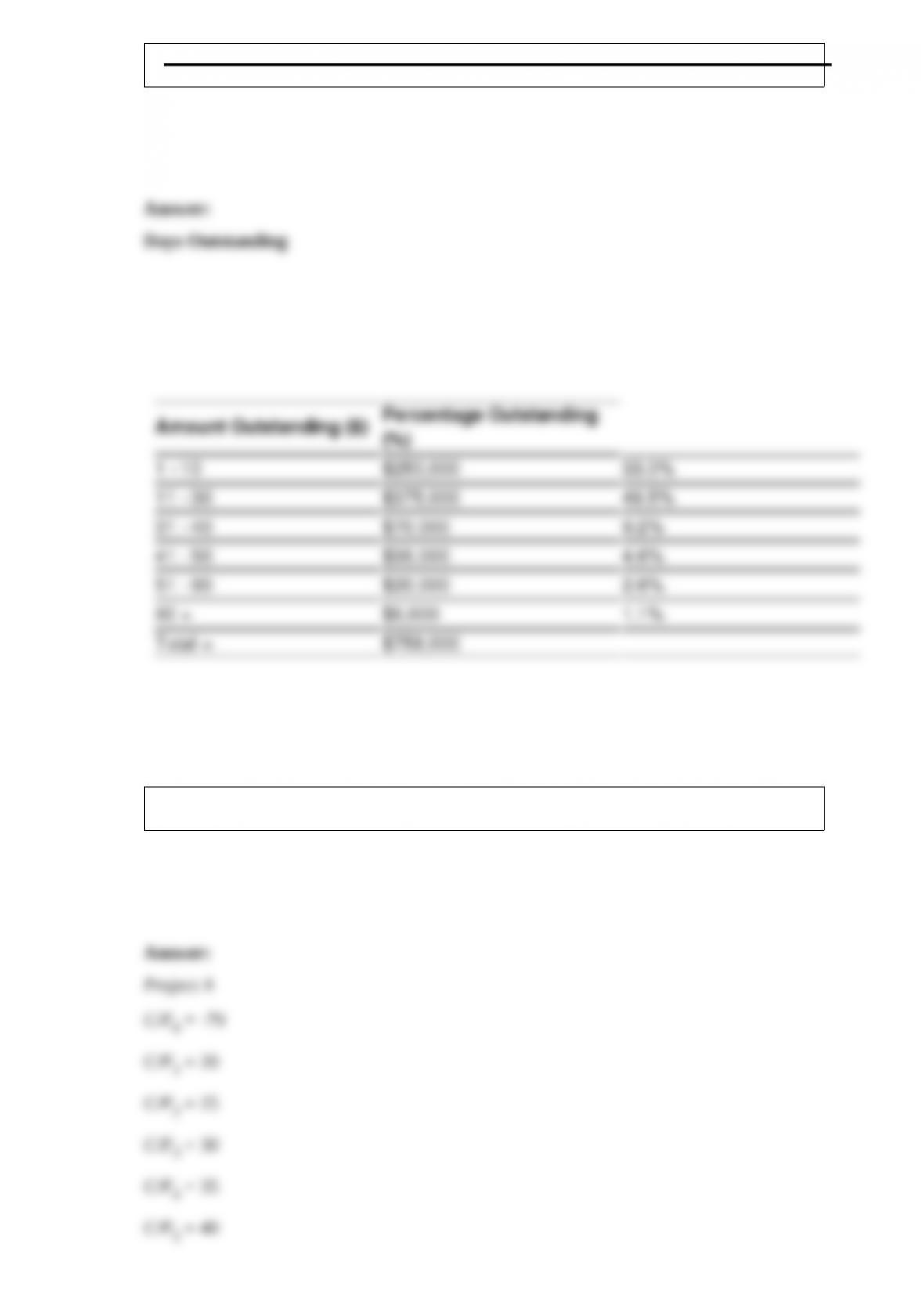
Using the equivalent annual benefit method, which project would you select and why?
How much money did the venture capitalists receive?
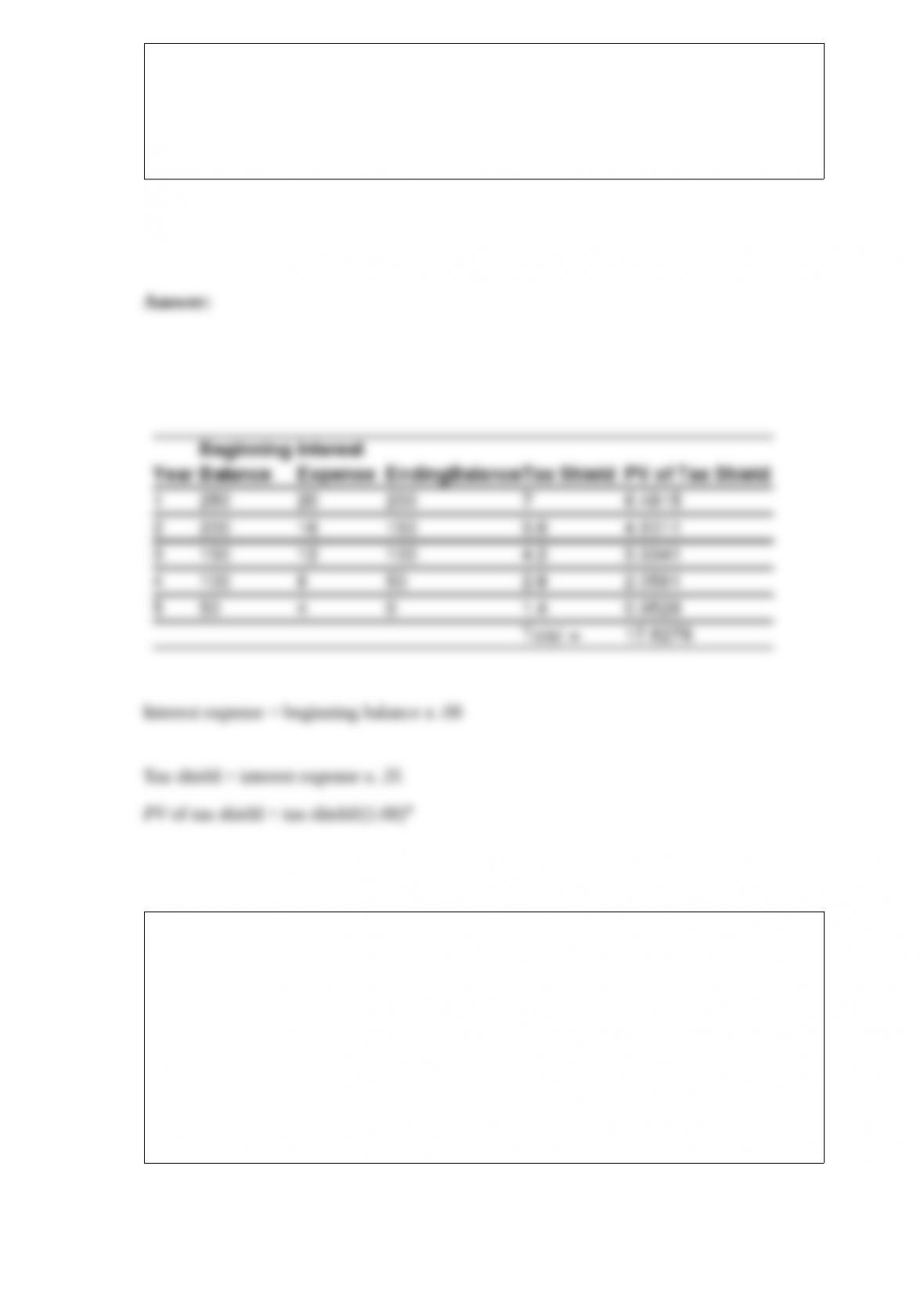
Your firm currently has $250 million in debt outstanding with an 8% interest rate. The
terms of the loan require the firm to repay $50 million of the balance each year.
Suppose that the marginal corporate tax rate is 35% and that the interest tax shields
have the same risk as the loan. What is the present value of the interest tax shields from
this debt?
Use the information for the question(s) below.
Consider a project with free cash flows in one year of $90,000 in a weak economy or
$117,000 in a strong economy, with each outcome being equally likely. The initial
investment required for the project is $80,000, and the project’s cost of capital is 15%.
The risk-free interest rate is 5%.
Suppose that you borrow only $45,000 in financing the project. According to MM
proposition II, calculate the firm’s equity cost of capital.
Assuming that your firm will purchase insurance, what is the minimum-size deductible
that would leave your firm with an incentive to implement the new safety policies?
Use the information for the question(s) below.
Luther Industries sold 10 million shares of stock in an SEO. The market price of Luther
at the time was $25 per share. Of the 10 million shares sold, 6 million shares were
primary shares being sold by the company, and the remaining 4 million shares were
being sold by venture capitalists. Luther’s underwriters charges 5% of the gross
proceeds as an underwriting fee.
How much money did Luther raise?
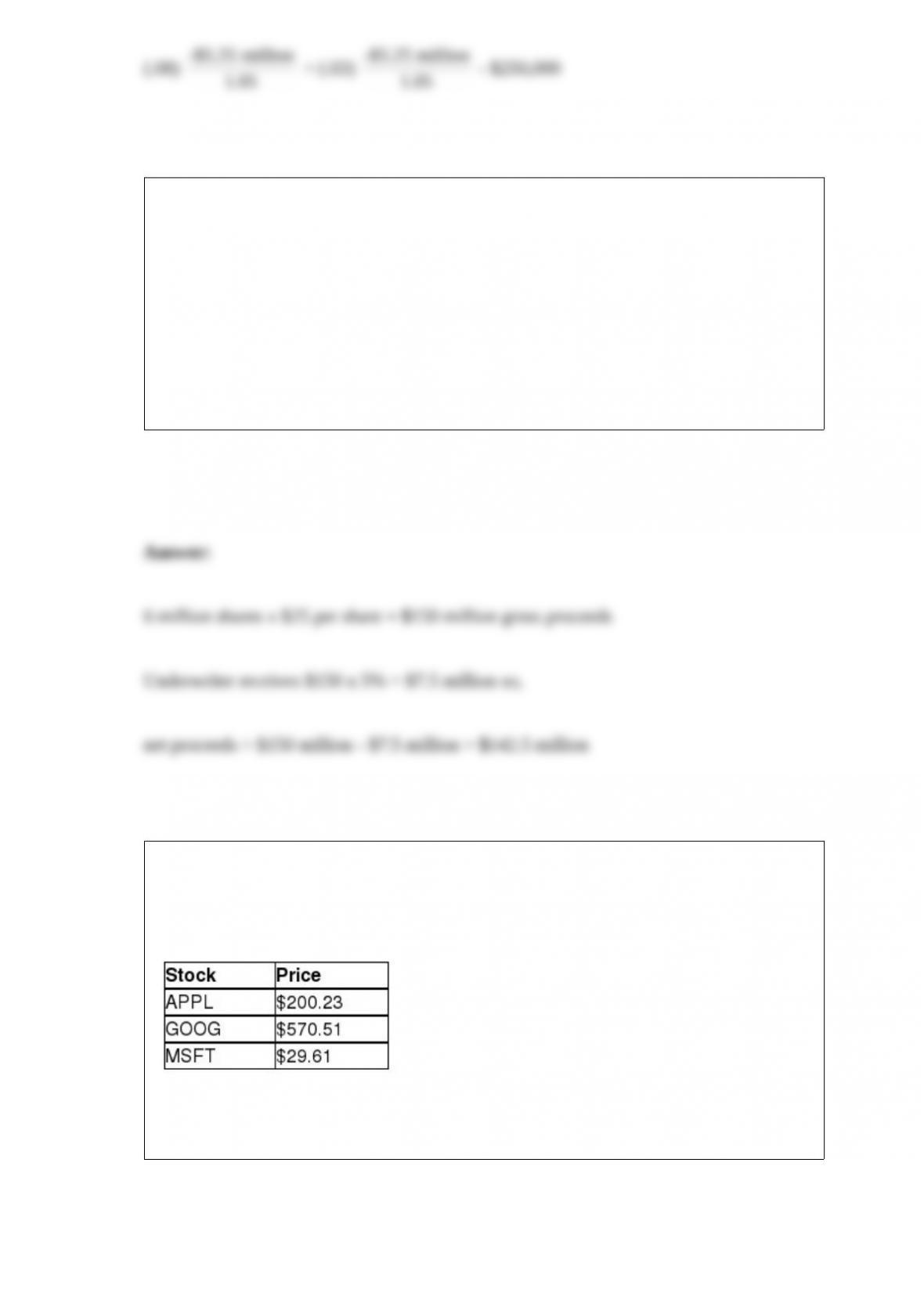
An exchange traded fund (ETF) is a security that represents a portfolio of individual
stocks. Consider an ETF for which each share represents a portfolio of two shares of
Apple Inc. (APPL), one share of Google (GOOG), and ten shares of Microsoft (MSFT).
Suppose the current stock prices of each individual stock are as shown below:
If the ETF is currently trading for $1,200, what arbitrage opportunity is available? What
trades would you make?

Assume that you are 30 years old today, and that you are planning on retiring at age 65.
Your current salary is $45,000 and you expect your salary to increase at a rate of 5% per
year as long as you work. To save for your retirement, you plan on making annual
contributions to a retirement account. Your first contribution will be made on your 31st
birthday and will be 8% of this year’s salary. Likewise, you expect to deposit 8% of
your salary each year until you reach age 65. At retirement (age 65) you will begin
withdrawing equal annual payments to pay for your living expenses during retirement
(on your 65th birthday). If you expect to die one day before your 101st birthday (Your
last withdraw will be on your 100th birthday) and if the annual rate of return is 7%,
then how much money will you have to spend in each of your golden years of
retirement?