
*The current tax rates are set to expire in 2008 unless Congress extends them. The tax
rates shown are for financial assets held for one year. For assets held less than one year,
capital gains are taxed at the ordinary income tax rate (currently 35% for the highest
bracket); the same is true for dividends if the assets are held for less than 61 days.
The effective dividend tax rate for a buy and hold individual investor in 1999 is closest
to:
A) 25%
B) 0%
C) 20%
D) 40%
Which of the following statements is FALSE?
A) The incremental IRR need not exist.
B) If a change in the timing of the cash flows does not affect the NPV, then the change
in timing will not impact the IRR.
C) Although the incremental IRR rule can provide a reliable method for choosing
among projects, it can be difficult to apply correctly.
D) When projects are mutually exclusive, it is not enough to determine which projects
have positive NPVs.

Which of the following statements is FALSE?
A) In the flow-to-equity valuation method, the cash flows to equity holders are then
discounted using the weighted average cost of capital.
B) In the WACC and APV methods, we value a project based on its free cash flow,
which is computed ignoring interest and debt payments.
C) In the flow-to-equity (FTE) valuation method, we explicitly calculate the free cash
flow available to equity holders taking into account all payments to and from debt
holders.
D) The first step in the FTE method is to determine the project’s free cash flow to equity
(FCFE).
Omicron Industries’ Market Value Balance Sheet ($ Millions)
and Cost of Capital
Omicron Industries New Project Free Cash Flows

Assume that this new project is of average risk for Omicron and that the firm wants to
hold constant its debt to equity ratio.
The Debt Capacity for Omicron’s new project in year 1 is closest to:
A) $38.75
B) $48.25
C) $50.25
D) $58.00
Which of the following statements is FALSE?
A) Because the enterprise value represents the entire value of the firm before the firm
pays its debt, to form an appropriate multiple, we divide it by a measure of earnings or
cash flows after interest payments are made.
B) We can compute a firm’s P/E ratio by using either trailing earnings or forward
earnings with the resulting ratio called the trailing P/E or forward P/E.
C) It is common practice to use valuation multiples based on the firm’s enterprise value.
D) Using a valuation multiple based on comparables is best viewed as a ‘shortcut” to the
discounted cash flow method of valuation.

Shepard Industries is evaluating a proposal to expand its current distribution facilities.
Management has projected the project will produce the following cash flows for the
first two years (in millions).
The incremental EBIT for Shepard Industries in year one is closest to:
A) $360
B) $750
C) $595
D) $510

Assets $200 million
Shareholder Equity $100 million
Sales $300 million
Net Income $15 million
Interest Expense $2 million
If ECE’s net profit margin is 8%, then ECE’s return on equity (ROE) is:
A) 10%
B) 12%
C) 24%
D) 30%
Dustin’s Donuts experienced a decrease in the value of the trademark of a company it
acquired two years ago. This reduction in value results in:
A) an impairment charge.
B) depreciation expense.
C) an operating expense.
D) goodwill.
Suppose that the risk-free rate is 5% and the market portfolio has an expected return of
13% with a volatility of 18%. Monsters Inc. has a 24% volatility and a correlation with
the market of .60, while California Gold Mining has a 32% volatility and a correlation
with the market of -.7. Assume the CAPM assumptions hold.California Gold Mining’s

required return is closest to:
A) -5%
B) 13%
C) 15%
D) 5%
Which of the following statements is FALSE?
A) The CAPM states that we should use the risk-free interest rate corresponding to the
investment horizon of the firm’s investors.
B) To determine the risk premium for a stock using the security market line, we need an
estimate of the market risk premium.
C) When surveyed, the vast majority of large firms and financial analysts reported using
the yields of Treasury Bills to determine the risk-free rate.
D) The risk-free interest rate is generally determined using the yields of U.S. Treasury
securities, which are free from default risk.
Omicron Technologies has $50 million in excess cash and no debt. The firm expects to
generate additional free cash flows of $40 million per year in subsequent years and will
pay out these future free cash flows as regular dividends. omicrons unlevered cost of
capital is 10% and there are 10 million shares outstanding. Omicron’s board is meeting
to decide whether to pay out its $50 million in excess cash as a special dividend or to
use it to repurchase shares of the firm’s stock.
Assume that Omicron uses the entire $50 million to repurchase shares. The number of
shares that Omicron will have outstanding following the repurchase is closest to:
A) 8.8 million

B) 1.2 million
C) 9.0 million
D) 8.9 million
Consider the following two projects:
Assume that projects A and B are mutually exclusive. The maximum number of
incremental IRRs that could exist for project B over project A is:
A) 1
B) 2
C) 0
D) 3
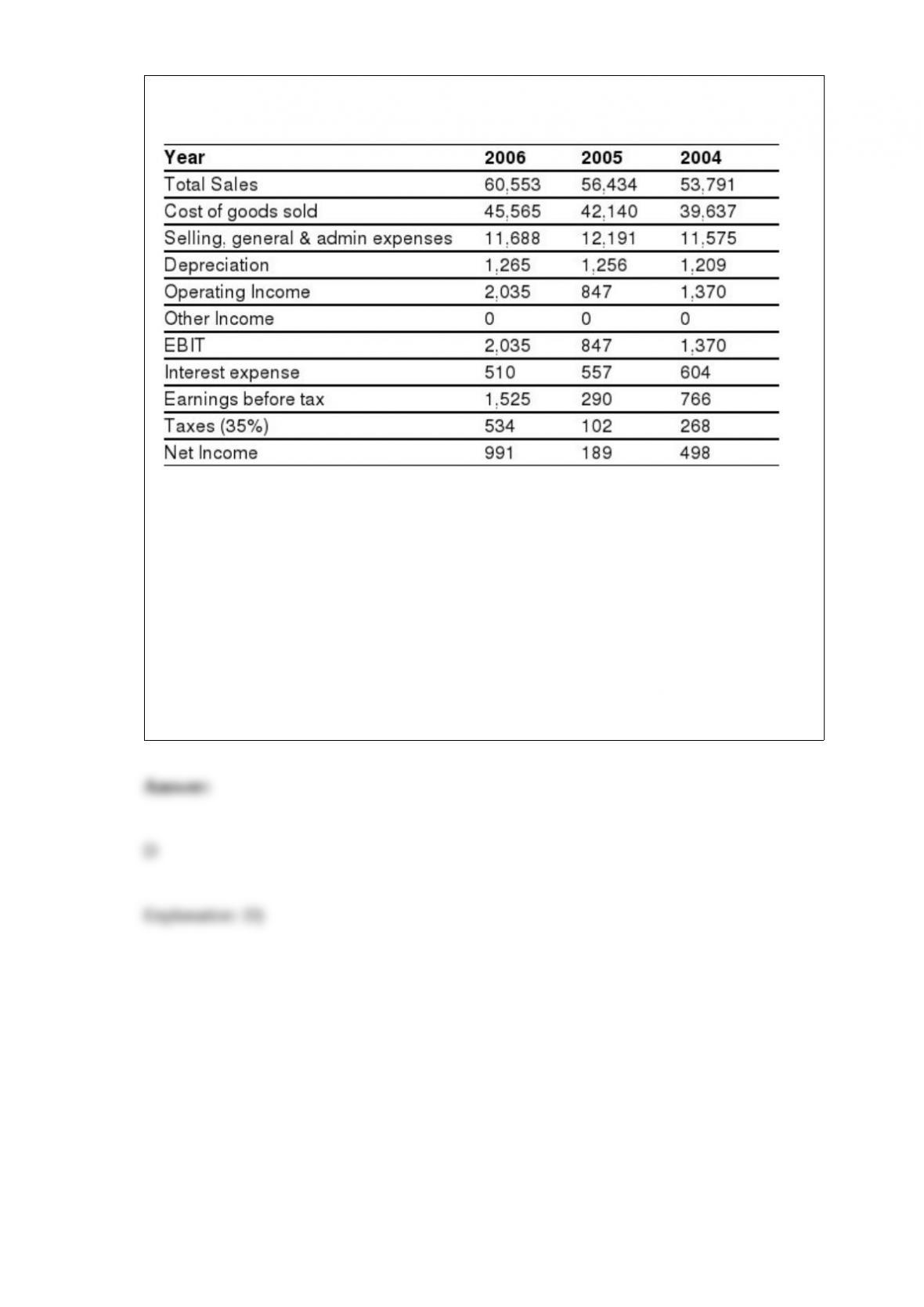
Consider the following income statement for Kroger Inc. (all figures in $ Millions):
The income that would be available to equity holders in 2006 if Kroger was not levered
is closest to:
A) $1,525 million
B) $2,035 million
C) $1,500 million
D) $1,325 million

Which of the following statements is FALSE?
A) We should be suspicious of beta estimates that are extreme relative to industry
norms.
B) When using historical data, there is always the possibility of estimation error.
C) Evidence suggests that betas tend to revert toward zero over time.
D) For stocks, common practice is to use at least two years of weekly return data or five
years of monthly return data when estimating beta.
Consider the following linear regression model:
(Ri– rf) = ai+ bi(RMkt– rf) + ei
The eiin the regression
A) measures the market risk in returns.
B) measures the deviation from the best fitting line and is zero on average.
C) measures the sensitivity of the security to market risk.
D) measures the historical performance of the security relative to the expected return

predicted by the SML.
Suppose you have $10,000 in cash and you decide to borrow another $10,000 at a 6%
interest rate to invest in the stock market. You invest the entire $20,000 in an exchange
traded fund (ETF) with a 12% expected return and a 20% volatility.The Sharpe ratio for
the efficient portfolio is closest to:
A) 0.7
B) 1.0
C) 1.4
D) 1.2
A tax free municipal bond pays an effective annual rate of 7.2%. If your tax rate is 30%,
then the effective annual rate that a comparable corporate bond would have to offer you
an equivalent after tax return would be closest to:
A) 5.0%
B) 7.2%
C) 9.4%
D) 10.3%
Luther Industries has no debt and expects to generate free cash flows of $48 million
each year. Luther believes that if it permanently increases its level of debt to $100
million, the risk of financial distress may cause it to lose some customers and receive

less favorable terms from its suppliers. As a result, Luther’s expected free cash flows
with debt will be only $44 million per year. Suppose Luther’s tax rate is 40%, the
risk-free rate is 6%, the expected return of the market is 14%, and the beta of Luther’s
free cash flows is 1.25 (with or without leverage).
The value of Luther without leverage is closest to:
A) $315 million
B) $300 million
C) $205 million
D) $340 million
Which of the following statements is FALSE?
A) Prices of bonds with lower durations are more sensitive to interest rate changes.
B) When a bond is trading at a discount, the price increase between coupons will
exceed the drop when a coupon is paid, so the bond’s price will rise and its discount will
decline as time passes.
C) Coupon bonds may trade at a discount, at a premium, or at par.
D) The sensitivity of a bond’s price changes in interest rates is the bond’s duration.
Which of the following statements is FALSE?
A) All investors should demand the same efficient portfolio of securities in the same
proportions.
B) The Capital Asset Pricing Model (CAPM) allows corporate executives to identify the
efficient portfolio (of risky assets) by using knowledge of the expected return of each
security.

C) If investors hold the efficient portfolio, then the cost of capital for any investment
project is equal to its required return calculated using its beta with the efficient
portfolio.
D) The CAPM identifies the market portfolio as the efficient portfolio.
Suppose a risky security pays an average cash flow of $100 in one year. The risk-free
rate is 5%, and the expected return on the market index is 13%. If the returns on this
security are high when the economy is strong and low when the economy is weak, but
the returns vary by only half as much as the market index, what risk premium is
appropriate for this security?
A) 4%
B) 6.5%
C) 9%
D) 11%