
Rising medical expenditures are caused mainly by
A. managerial inefficiency.
B. excessive regulation.
C. new technology, procedures, and medications together with insurance.
D. insurance.
Answer:
The cost to a person of undertaking higher education equals ___.
A. tuition
B. foregone earnings
C. tuition plus foregone earnings
D. tuition minus foregone earnings
Answer:

If a $20 tax per ton of carbon is imposed, then the ___ of cutback will be $20.
A. marginal benefit
B. marginal cost
C. total benefit
D. total cost
Answer:
An EITC reform that would reduce the poverty rate of large families would be to
A. increase the EITC phase-in rate.
B. reduce the EITC phase-out rate.
C. give a higher EITC for a third child.
D. raise the EITC of a married couple relative to single parents.
Answer:

Low-income city residents _____ support state ____ taxes to fund grants to cities
because they would pay ____ than they would receive in benefits.
A. should; income; less in income taxes
B. should; sales; less in sales taxes
C. should not; income; more in income taxes
D. should not; sales; more in sales taxes
Answer:
Suppose two identical homes that differ in commuting times sell for different prices.
One measure of the benefit of a new highway is the ____.
A. price of the closer home
B. price of the farther home
C. difference in the prices
D. sum of the prices
Answer:

Ant and Grasshopper both work in the summer but only Ant saves for the winter. Which
tax is hardest on Ant?
A. An income tax
B. A wage income tax
C. A consumption tax
D. A value-added tax
Answer:
Without government insurance for retirees, the typical individual retiree would be
charged a premium equal to ___.
A. the average medical cost of all retirees in society
B. the average medical cost of all retirees covered by his own private insurer
C. his own expected medical cost
D. his own expected medical cost adjusted for his income
Answer:

The public choice school of economists contends that legislators will spend ____ than
what is best for the citizenry unless ____ by _____.
A. more; restrained; a constitution
B. more; restrained; a law
C. less; stimulated; a constitution
D.less; stimulated; a law
Answer:
In 2007, U.S. Treasury debt held by the public and U.S. government agencies was
____.
A. $1 trillion
B. $5 trillion
C. $9 trillion
D. $13 trillion
Answer:
From 1960 to 2007, spending on medical care in the U.S. rose from 5% to ___ of GDP.

A. 10%
B. 13%
C. 16%
D. 19%
Answer:
In contrast to a wage subsidy, the EITC benefits only _____.
A. low-income households in which someone works
B. low-wage workers
C. low-wage workers in low-income households
D. low-income households regardless of whether someone works
Answer:
If there were no government role in education, there would be ____.

A. no schools
B. private schools and equal quality of schooling for all children
C. private schools and unequal quality of schooling due to unequal incomes
D. private schools and high quality schooling for all children
Answer:
A tax on a good causes an efficiency loss equal to the area of a ____ to the ____ of the
D/S intersection.
A. triangle; right.
B. triangle; left
C. rectangle; right
D. rectangle; left
Answer:
Under a defined-___ plan, a worker’s retirement benefit is the sum that has actually
accumulated for the worker.

A. benefit
B. contribution
C. retirement
D. formula
Answer:
With no policy, each firm emits 120 tons of carbon. As H reduces its emissions from
120 to 0, its marginal abatement cost (MAC) rises from $0 to $480; as L reduces its
emissions from 120 to 0, its MAC rises from $0 to $120. The MD of a ton of carbon is
$96. The tax per ton is T.
Refer to Figure 2.2. Government should set T = ____; then total emissions would be
____.
A. $480; 0
B. $120; 90
C. $96; 120
D. $0; 240
Answer:

Many citizens would contribute voluntarily to finance a ____ good because they believe
it is _____ to do so.
A. private; morally right
B. public; morally right
C. private; profitable
D.public; profitable
Answer:
Some economists disagree with the public choice school by pointing out that _____
stimulates spending.
A. advertising; government
B. advertising; private
C. propaganda; government
D.propaganda; private
Answer:

Economists believe reducing global warming should ___ be subject to cost-benefit
analysis.
A. definitely
B. possibly
C. definitely not
D. possibly not
Answer:
According to the Actuary of the Social Security Administration, in about 2030 payroll
taxes plus interest on bonds will ____ scheduled benefits.
A. exceed
B. no longer exceed (will for the first time be less than)
C. for the first time exceed
D. continue to exceed
Answer:

The standard approach to the free-rider problem is
A. an appeal for contributions. B. an appeal to conscience.
C. an appeal to patriotism.
D. taxation.
Answer:
The initial cost estimate by the Bush White House and Defense Department of an
intervention in Iraq was ___ billion or ___ per person.
A. $10; $30
B. $45; $150
C. $150; $500
D. $300; $1,000
Answer:
With no policy, each firm emits 120 tons of carbon. As H reduces its emissions from
120 to 0, its marginal abatement cost (MAC) rises from $0 to $480; as L reduces its
emissions from 120 to 0, its MAC rises from $0 to $1 The MD of a ton of carbon is
$96. The tax per ton is T.
Refer to Figure 2.2. Suppose country H proposes a treaty where governments H and L
would agree to levy a tax of $96 on its own polluters. If L is unaffected by global
warming, L should still agree to levy this tax on its own polluters if H pays L at least
______.
A. $2,304
B. $4,608
C. $6,912
D. $9,216
Answer:
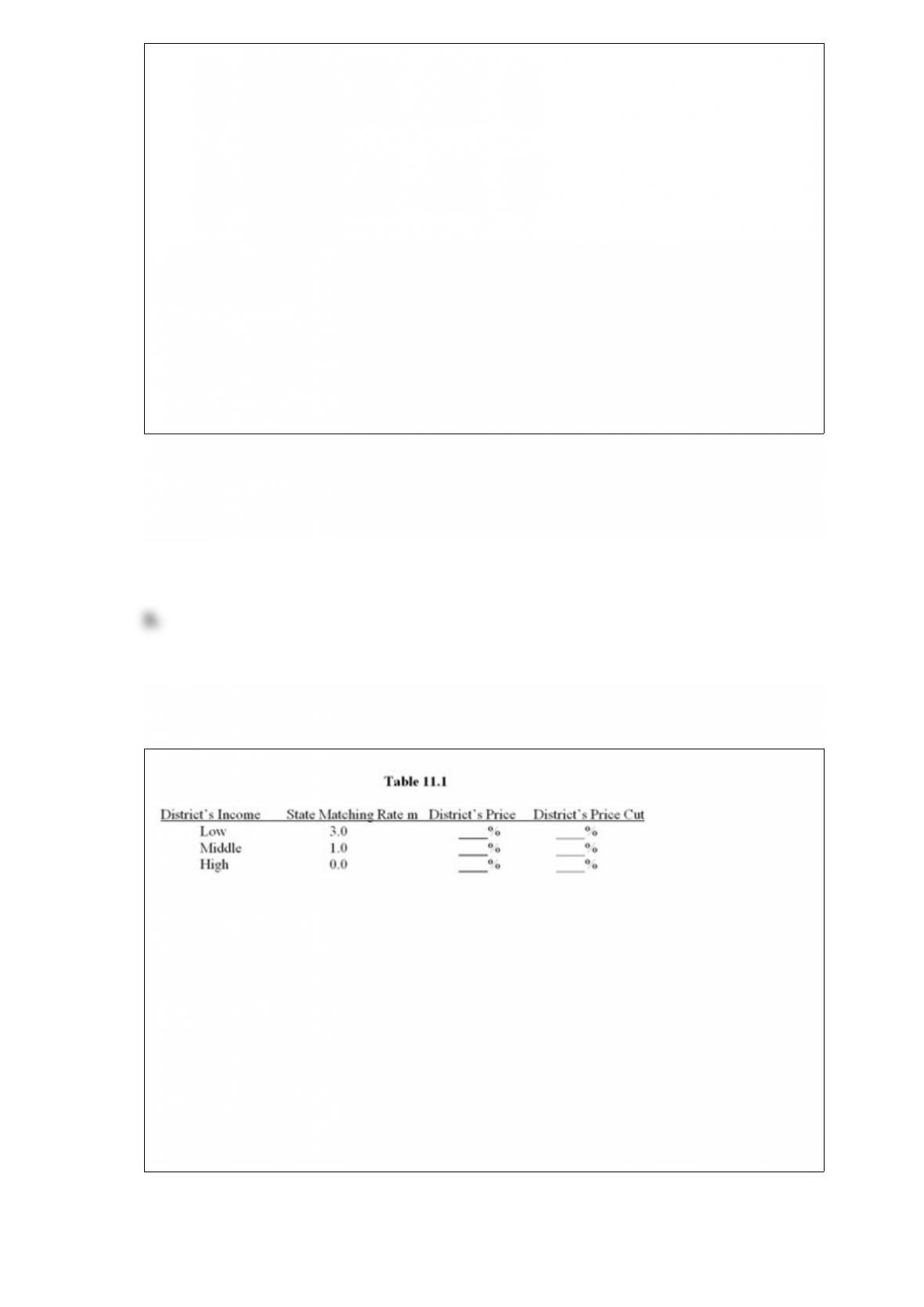
Refer to Table 11.1. The district’s price for the high-income district is ___.
A. 100%
B. 80%
C. 75%
D. 50%

Answer:
If H (in a 35% tax bracket) and L (in a 10% tax bracket) each give $1,000 to charity,
then under the charitable deduction, H’s tax saving is ___ and L’s is ___.
A. $350; $100
B. $650; $900
C. $350; $900
D. $650; $100
Answer:
From 1960 to 2007, spending on medical care in the U.S. rose from 5% to __ of GDP.
Answer:

See your figure from question 6. With 100% insurance, draw the demand curve D”. If
the government sets a price control of $100, then supply will be ___, demand will be
___, and the wait list will be ___.
Answer:
The EITC provides about ___ billion in assistance to about ___ million low-income
families.
Answer:
The chapter describes a plan in which high school juniors would be mailed a _____ that
shows the grant they will receive according to their family’s ______.
Answer:

Because households differ in income, residential location is influenced by a ____
process that is implemented by ____.
Answer:
If Congress replaced the charitable deduction with a charitable credit, then H and L’s
tax saving would depend on ____.
Answer:
To reduce the 2040 problem, Congress can immediately raise ___ growth and slow ___
growth.
Answer: