
The intrinsic value of a put is equal to the:
A. lesser of the strike price or the stock price.
B. lesser of the stock price minus the exercise price or zero.
C. lesser of the stock price or zero.
D. greater of the strike price minus the stock price or zero.
E. greater of the stock price minus the exercise price or zero.
Answer:
Warrants are most often issued in combination with new:
A. publicly placed common stock.
B. privately placed common stock.
C. publicly placed bonds.
D. privately placed bonds.
E. preferred stock.
Answer:

A stock had returns of 16 percent, 4 percent, -22 percent, 15 percent, and -2 percent for
the past five years. What is the variance of these returns?
A. .01997
B. .02037
C. .02402
D. .01869
E. .02340
Answer:
The Upper Tier has a current debt-equity ratio of .52 and a target debt-equity ratio of .
45. The cost of floating equity is 9.5 percent and the flotation cost of debt is 6.6 percent.
What should the firm use as their weighted average flotation cost?
A. 8.01%
B. 8.52%
C. 8.33%
D. 7.76%
E. 8.60%
Answer:

Which one of the following statements is true?
A. Both APT and CAPM argue that expected excess return must be proportional to the
beta(s).
B. APT and CAPM are the only quantitative approaches to measure expected returns in
risky assets.
C. Both CAPM and APT are empirical models.
D. CAPM provides the means for a more-detailed estimate of a security’s expected
return than does APT.
E. CAPM assigns a beta of 1 to the market while APT assigns the market a beta of zero.
Answer:
Concerning warrants and call options, which one of the following statements generally
is correct?
A. The issue procedures for both are quite similar.
B. When a call option is exercised, the firm must issue new stock.
C. When a warrant is exercised, existing stock changes hands.
D. Exercise of a call option does not affect share value, but warrant exercise does.
E. The issuance of a call option generally decreases share value.
Answer:

You are working on a bid for a contract. Thus far, you have determined that you will
need $156,000 for fixed assets and another $32,000 for net working capital at Time 0.
You have also determined that you can recover $68,400 aftertax for the combined fixed
assets and net working capital at the end of the 4-year project. What operating cash flow
will be required each year for the project to return 16 percent in nominal terms?
A. $46,666.67
B. $48,929.74
C. $55,200,16
D. $53,686.06
E. $50,725.50
Answer:
The discounted payback rule may cause:
A. projects with discounted payback periods in excess of the project’s life to be
accepted.
B. the most liquid projects to be rejected in favor of less liquid projects.
C. projects to be incorrectly accepted due to ignoring the time value of money.
D. some projects with negative net present values to be accepted.
E. some positive net present value projects to be rejected.
Answer:

In 2008, which country experienced a decline in its stock market value in excess of 90
percent?
A. India
B. Russia
C. China
D. United States
E. Iceland
Answer:
Alpha Co. is paying a $.72 per share dividend today. There are 138,000 shares
outstanding with a par value of $1 per share. As a result of this dividend, the:
A. retained earnings will decrease by $99,360.
B. retained earnings will decrease by $138,000.
C. common stock account will decrease by $138,000.
D. common stock account will decrease by $99,360.
E. capital in excess of par value account will decrease by $38,640.
Answer:

A convertible bond is selling for $800, matures in 10 years, has a face value of $1,000,
and acoupon rate of 10 percent. Similar nonconvertible bonds are priced to yield 14
percent. The conversion price is $42.50. The stock currently sells for $31.30 a share.
What is the conversion premium?
A. 37.25%
B. 43.33%
C. 40.25%
D. 33.33%
E. 35.78%
Answer:
Phillips Co. currently pays no dividend. The company is anticipating dividends of $.02,
$.05, $.10, $.20, and $.30 over the next 5 years, respectively. After that, the company
anticipates increasing the dividend by 3.5 percent annually. One step in computing the
value of this stock today is to compute the value of:
A. P1.
B. P3.
C. P4.
D. P5.
E. P6.

Answer:
Orio, Inc. has a beginning receivables balance on January 1st of $685. Sales for January
through April are $735, $690, $770, and $850, respectively. The accounts receivable
period is 30 days. How much did the firm collect in the month of April? Assume a
30-day month.
A. $735
B. $690
C. $730
D. $810
E. $770
Answer:
Alpha stock is currently trading at $34.50 a share and the 6-month call options are at the
money. The stock returns have a standard deviation of 21 percent and the risk-free rate
is 4.21 percent. What is the price of the call option per share given that N(d1) is .
585508 and N(d2) is .526913?
A. $1.07
B. $2.79
C. $1.38
D. $2.40

E. $1.64
Answer:
Lucie is reviewing a project with an initial cost of $38,700 and cash inflows of $9,800,
$16,400, and $21,700 for Years 1 to 3, respectively. Should the project be accepted if it
has been assigned a required return of 9.75 percent? Why or why not?
A. yes; because the IRR exceeds the required return by .34 percent
B. yes; because the IRR is less than the required return by .28 percent
C. yes; because the IRR is exceeds the required return by .46 percent
D. no; because the IRR exceeds the required return by .43 percent
E. no; because the IRR is only 9.69 percent
Answer:
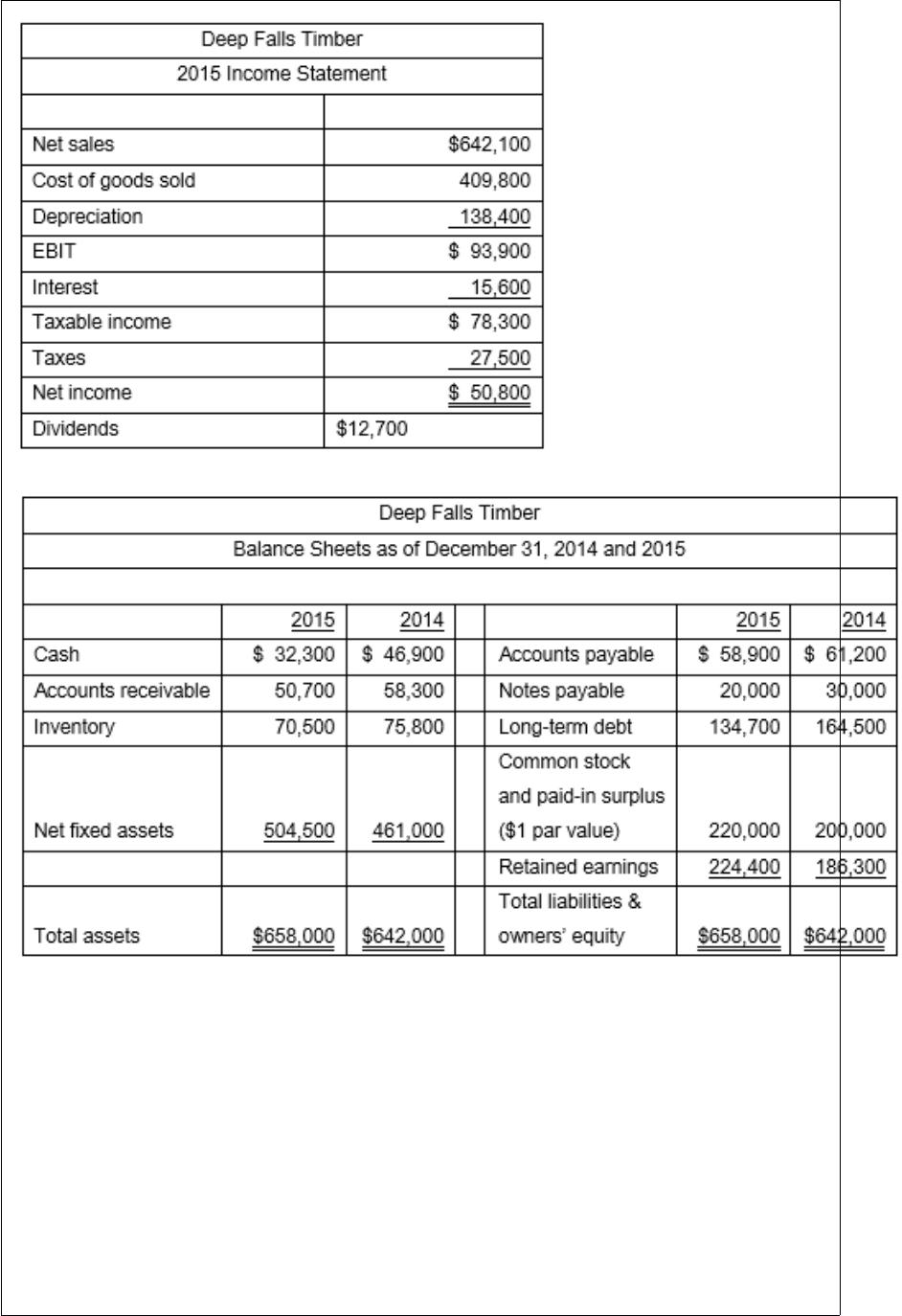
What are the values of the three components of the DuPont identity for 2015?
A. 7.91%; 1.0248; 1.4806
B. 8.57%; 1.0248; .6754
C. 7.91%; .9758; 1.4806
D. 11.43%; .9758; .6754
E. 11.43%; 1.0248; 1.4806
Answer:

A project costing $6,200 initially should produce cash inflows of $2,860 a year for three
years. After the three years, the project will be shut down and will be sold at the end of
Year 4 for an estimated net cash amount of $3,300. What is the net present value of this
project if the required rate of return is 11.3 percent?
A. $2,474.76
B. $2,903.19
C. $935.56
D. $3,011.40
E. $1,980.02
Answer:
Utilizing a decision tree, the NPV used to make the decision to commence the testing
for a project is dependent on:
A. only the cash flows related to the actual test.
B. on the path with the highest probability of occurrence.
C. all project cash flows and probabilities over the project’s entire life.
D. only the cash flows and probabilities of the most successful path.
E. all cash flows and probabilities for only the first year of the project’s life.
Answer:
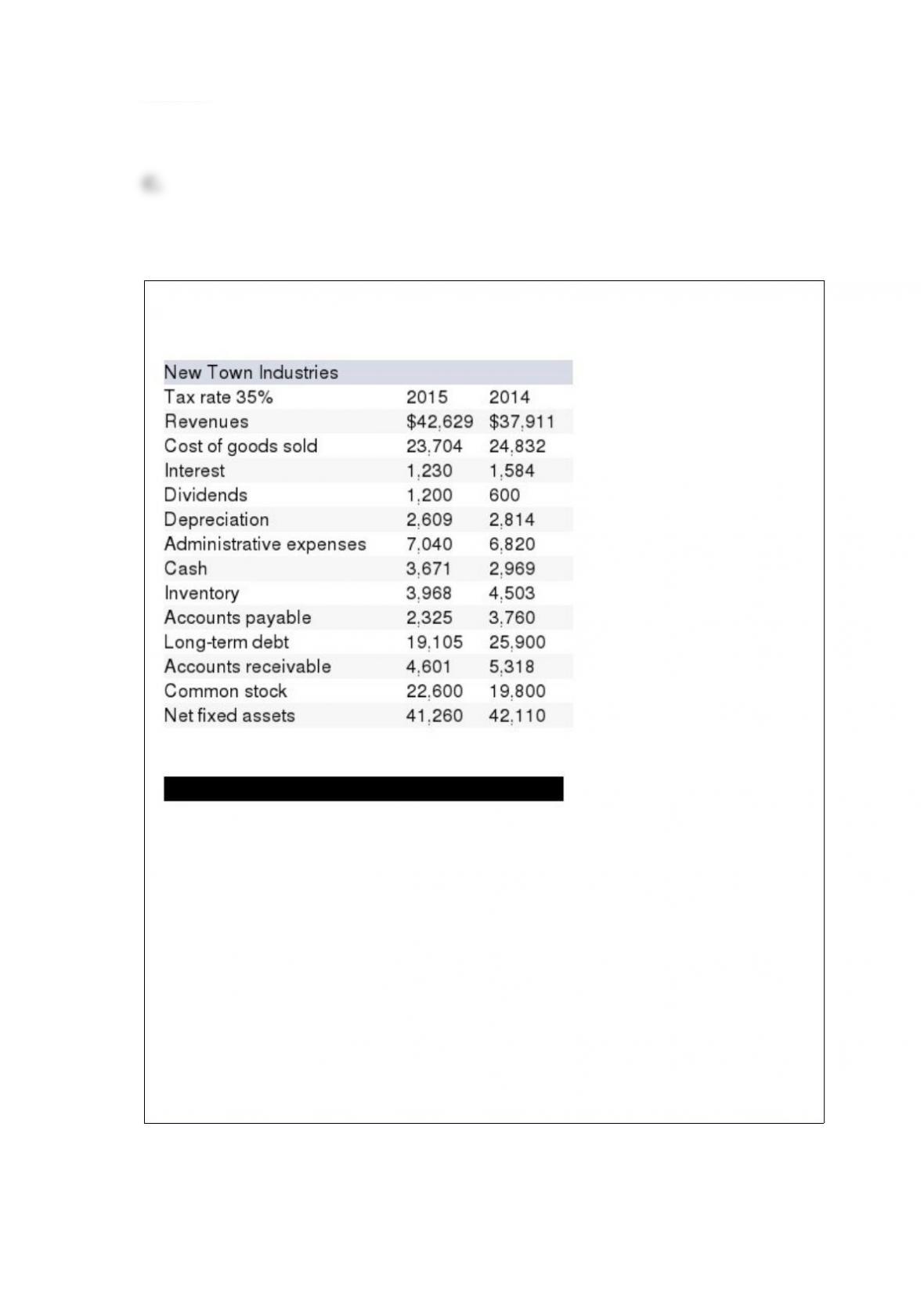
What is net new borrowing for 2015?
A.$6,795
B.-$5,565
C.$8,025
D.-$6,795
E.$5,565
Answer:
Ratios that measure a firm’s ability to pay its bills over the short run without undue
stress are known as:
A. asset management ratios.
B. long-term solvency measures.
C. liquidity measures.
D. profitability ratios.
E. market value ratios.
Answer:
Which one of the following statements correctly describes your situation as the owner
of an American call option?

A. You are obligated to buy at a set price at any time up to and including the expiration
date.
B. You have the right to sell at a set price at any time up to and including the expiration
date.
C. You have the right to buy at a set price only on the expiration date.
D. You are obligated to sell at a set price if the option is exercised.
E. You have the right to buy at a set price at any time up to and including the expiration
date.
Answer:
A proposed project has a contribution margin of $5, fixed costs of $12,000, variable
costs per unit of $12, depreciation of $30,000, an EAC of $41,185 and a tax rate of 35
percent. What is the present value break-even point in units per year?
A. 8,4581
B. 9,489
C. 11,842
D. 10,603
E. 9,617
Answer:

A security that is fairly priced will have a return _____ the security market line.
A. below
B. on or below
C. on
D. on or above
E. above
Answer:
Section 363 as it relates to a bankruptcy filing:
A. works like an auction to speed up the bankruptcy process.
B. establishes the bankruptcy judge as the assignor of all bankruptcy assets.
C. permits creditors to force a firm into an involuntary bankruptcy.
D. allows creditors to submit a reorganization plan.
E. requires all employee wages and benefits be paid prior to creditors.
Answer:

Binder and Sons borrowed $138,000 for three years from their local bank and now they
are paying monthly payments that include both principal and interest. Paying off debt
by making installments payments, such as Binder and Sons is doing, is referred to as:
A. foreclosing on the debt.
B. amortizing the debt.
C. funding the debt.
D. calling the debt.
E. refunding the debt.
Answer:
The projections for a new project show sales of 12,000 units, give or take 3 percent.
The expected variable cost per unit is $11.24 and the expected fixed cost is $38,290.
The fixed and variable cost estimates have a plus or minus range of 2 percent. The
depreciation expense is $21,400. The tax rate is 34 percent. The sale price is estimated
at $19.65 a unit, give or take 4 percent. What are the earnings before interest and taxes
under the best-case scenario?
A. $52,694.40
B. $64,854.40
C. $57,516.89
D. $54,048.91
E. $61,940.08
Answer:

For a multi-product firm, if a project’s level of risk differs from that of the overall firm,
then the:
A. CAPM can no longer be used to estimate the cost of equity as beta no longer applies.
B. project should be discounted using the overall firm’s beta.
C. project should be discounted using a beta commensurate with the project’s risks.
D. project should be discounted at the market rate.
E. project should be discounted at the T-bill rate.
Answer:
Reena Industries has $138,000 of debt outstanding that is selling at par and has a
coupon rate of 7 percent. If the tax rate is 34 percent, what is the present value of the
tax shield?
A. $28,412
B. $51,010
C. $46,920
D. $3,284
E. $9,660
Answer:

A portfolio is comprised of 100 shares of Stock A valued at $22 a share, 600 shares of
Stock B valued at $17 each, 400 shares of Stock C valued at $46 each, and 200 shares
of Stock D valued at $38 each. What is the portfolio weight of Stock C?
A. 46.87%
B. 48.09%
C. 42.33%
D. 45.27%
E. 47.92%
Answer:
____ can provide a potential tax gain from an acquisition.
A. A reduction in the level of debt
B. An increase in surplus funds
C. The use of net operating losses
D. A decreased use of leverage
E. Increased diseconomies of scale
Answer:

An international firm which imports raw materials can reduce its _____ exposure to
_____ rate risk by entering into a forward contract.
A. long-term; inflation
B. short-term; inflation
C. short-run; exchange
D. long-run; exchange
E. total; interest
Answer:
The equivalent annual cost method is useful in determining:
A. the annual operating cost of a machine if the annual maintenance is performed
versus when the maintenance is not performed as recommended.
B. the tax shield benefits of depreciation given the purchase of new assets for a project.
C. operating cash flows for cost-cutting projects of equal duration.
D. which one of two machines to acquire given equal machine lives but unequal
machine costs.
E. which one of two machines to purchase when the machines are mutually exclusive,
have different machine lives, and will be replaced once they are worn out.

Answer:
Firms may prefer to issue cumulative preferred stock rather than debt for which reason?
A. If there is no current taxable income, preferred stock dividends are automatically
voided.
B. Preferred stock has no voting rights but debt does.
C. Preferred dividends provide a tax shield but debt does not.
D. Corporate investors can receive a tax break on dividends but not on interest.
E. Dividend payments are tax deductible, interest on debt is not.
Answer:
Which one of these combinations of bond ratings represents a crossover situation?
A. BBB; Baa
B. BB; Ba
C. Ba; B
D. Baa; BB
E. B; CCC

Answer:
Firm X has a market value of $8,400 with 120 shares outstanding and a price per share
of $70. Firm Y has a market value of $2,000 with 100 shares outstanding and a price
per share of $20. Firm X is acquiring Firm Y by exchanging 30 of its shares for all 100
of Firm Y’s shares. Assume the merger creates $400 of synergy. What will be the value
of Firm A’s shareholders’ stake in the merged firm?
A. $8,080
B. $9,200
C. $8,820
D. $8,640
E. $9,050
Answer: