1) Exhibit 4.7
USE THE INFORMATION BELOW FOR THE FOLLOWING PROBLEM(S)
Shares of RossCorp stock are selling for $45 per share. Brokerage commissions are 2%
for purchases and 2% for sales. The interest rate on margin debt is 6.25% per year. The
maintenance margin is 30%.
Refer to Exhibit 4.7. At the end of one year shares of RossCorp stock are selling for $55
per share and the company paid dividends of $0.85 per share. Assuming that you
borrowed 25% of cost of the purchase, what is your rate of return?
a.-23.51%
b.29.35%
c.23.51%
d.5.21%
e.10.06%
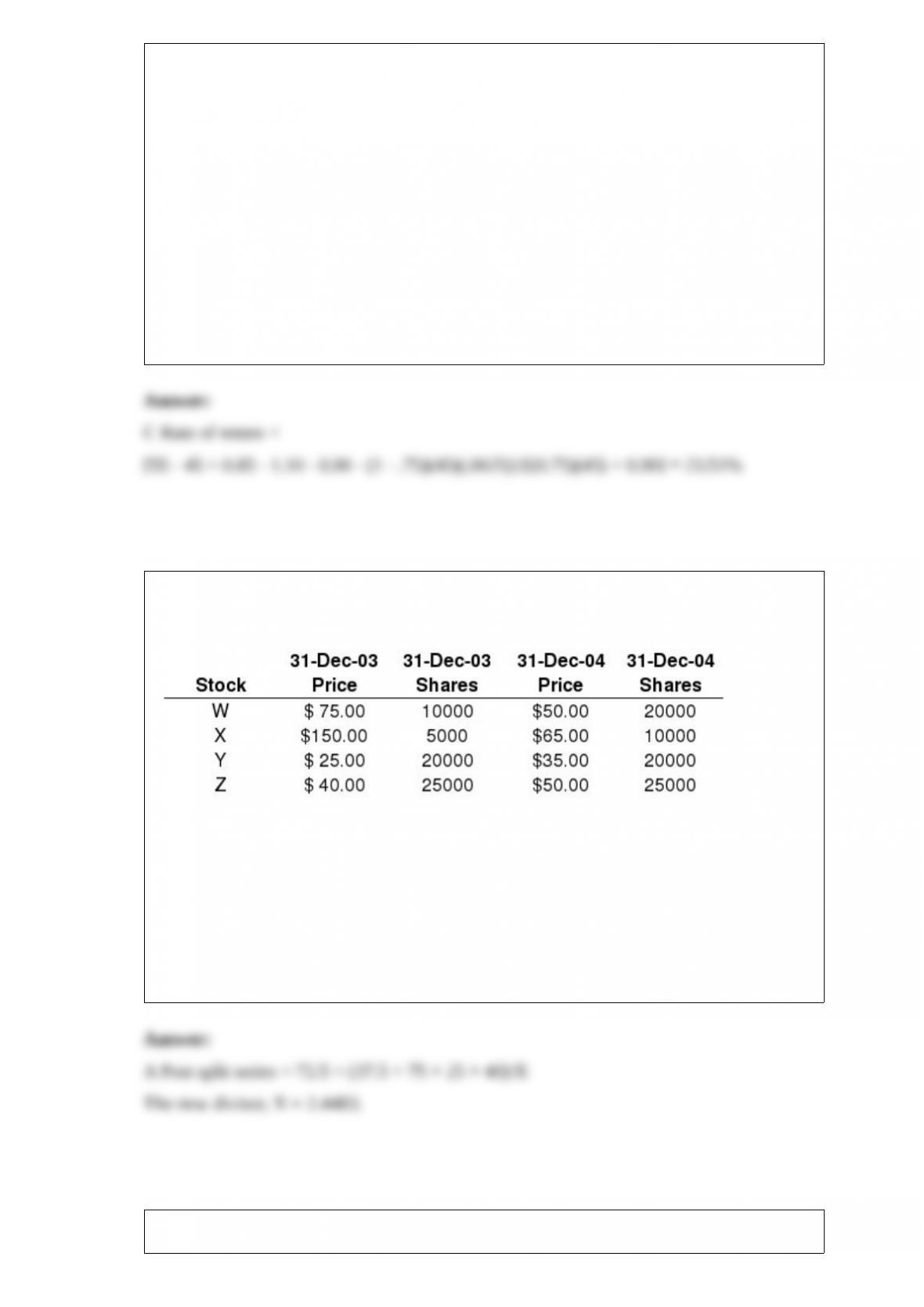
2) Exhibit 5.5
USE THE INFORMATION BELOW FOR THE FOLLOWING PROBLEM(S)
Stocks W and X had 2 for 1 splits after the close on Dec 31, 2003.
Refer to Exhibit 5.5. Calculate the price weighted series for Dec 31, 2003, after the
splits.
a.72.5
b.100.0
c.119.25
d.121.25
e.81.69
3) The Pekay Company has FCFE of $800. FCFE is expected to grow by 7% next year.

The cost of capital is 7% and the level of debt is $4000. The number of shares
outstanding is 700. Calculate the firm’s share price.
a. $44.25
b. $65.12
c. $38.19
d. $40.76
e. $50.56
4) Funds that attempt to provide current income, safety of principal and liquidity are
known as
a. Balanced funds.
b. Flexible funds.
c. Income funds.
d. Money market funds.
e. Index funds.
5) Exhibit 23.5
USE THE INFORMATION BELOW FOR THE FOLLOWING PROBLEM(S)
Exclusive Industries has debentures outstanding (par value $1,000.00) convertible into
exclusive’s common stock at $30. The coupon rate is 11% payable semiannually and
they mature in 10 years.
Calculate the straight-bond value assuming that bonds of equivalent risk and maturity
are yielding 13% per year compounded semiannually.
a. $942.65
b. $902.65
c. $889.82
d. $796.83
e. $757.37

6) Exhibit 18.1
USE THE INFORMATION BELOW FOR THE FOLLOWING PROBLEM(S)
A $1000 par value bond with 5 years to maturity and a 6% coupon has a yield to
maturity of 8%. Interest is paid semiannually.
Estimate the percentage price change for this 5-year $1,000 par value bond, with a 6%
coupon, if the yield rises from 8% to 8.5%. Interest is paid semiannually.
a. 2.1%
b. -2.1%
c. 4.4%
d. -4.4%
e. None of the above
7) Which of the following statements about a market is true?
a.It is not necessary for the market to have a physical location.
b.The market does not necessarily own the goods or services involved.
c.A market can deal in any variety of goods and services.
d.All of the above
e.None of the above
8) A technical analyst might consider the following as a bearish signal

a. Investment advisory opinion is bearish
b. Investment advisory opinion is bullish
c. CBOE put-call ratio above 0.60
d. CBOE put-call ratio below 0.40
e. b and d
9) In the APT model the idea of riskless arbitrage is to assemble a portfolio that
a. requires some initial wealth, will bear no risk, and still earn a profit.
b. requires no initial wealth, will bear no risk, and still earn a profit.
c. requires no initial wealth, will bear no systematic risk, and still earn a profit.
d. requires no initial wealth, will bear no unsystematic risk, and still earn a profit.
e. requires some initial wealth, will bear no systematic risk, and still earn a profit.
10) Exhibit 22.8
USE THE INFORMATION BELOW FOR THE FOLLOWING PROBLEM(S)
Consider the following information on put and call options for a common stock
Calculate the payoff of a long straddle at an expiration stock price of $20.
a. -$4.50
b. -$2.00
c. $2.00
d. $4.50
e. $20.50
11) Which of the following statements concerning SWOT analysis is false?
a. Strengths are the factors that give the firm a comparative advantage in the
marketplace.

b. Weaknesses result when the company has potentially exploitable advantages over
other firms.
c. Opportunities are environmental factors that favor the firm.
d. Threats are environmental factors that can hinder the firm in achieving its goals.
e. None of the above (that is, all statements are true)
12) Derivative instruments exist because
a. They help shift risk from risk-averse investors to risk-takers.
b. They help in forming prices.
c. They have lower investment costs.
d. Choices a and b
e. All of the above
13) A technical analyst might consider the following a bearish signal.
a. The percentage of speculators in stock index futures exceeds 70%.
b. The percentage of speculators in stock index futures exceeds 30%.
c. The percentage of speculators in stock index futures falls to 30%.
d. The percentage of speculators in stock index futures remains flat.
e. None of the above.
14) Exhibit 4.4
USE THE INFORMATION BELOW FOR THE FOLLOWING PROBLEM(S)
You decide to sell 100 shares of Davis Industries short when it is selling at its yearly
high of $35. Your broker tells you that your margin requirement is 55 percent and that
the commission on the sale is $15. While you are short, Davis pays a $0.75 per share
dividend. At the end of one year you buy your Davis shares (cover your short sale) at
$30 and are charged a commission of $15 and a 6 percent interest rate.
Refer to Exhibit 4.4. What is your rate of return on the investment?
a.10.48%
b.12.87%
c.13.98%
d.15.49%
e.18.87%
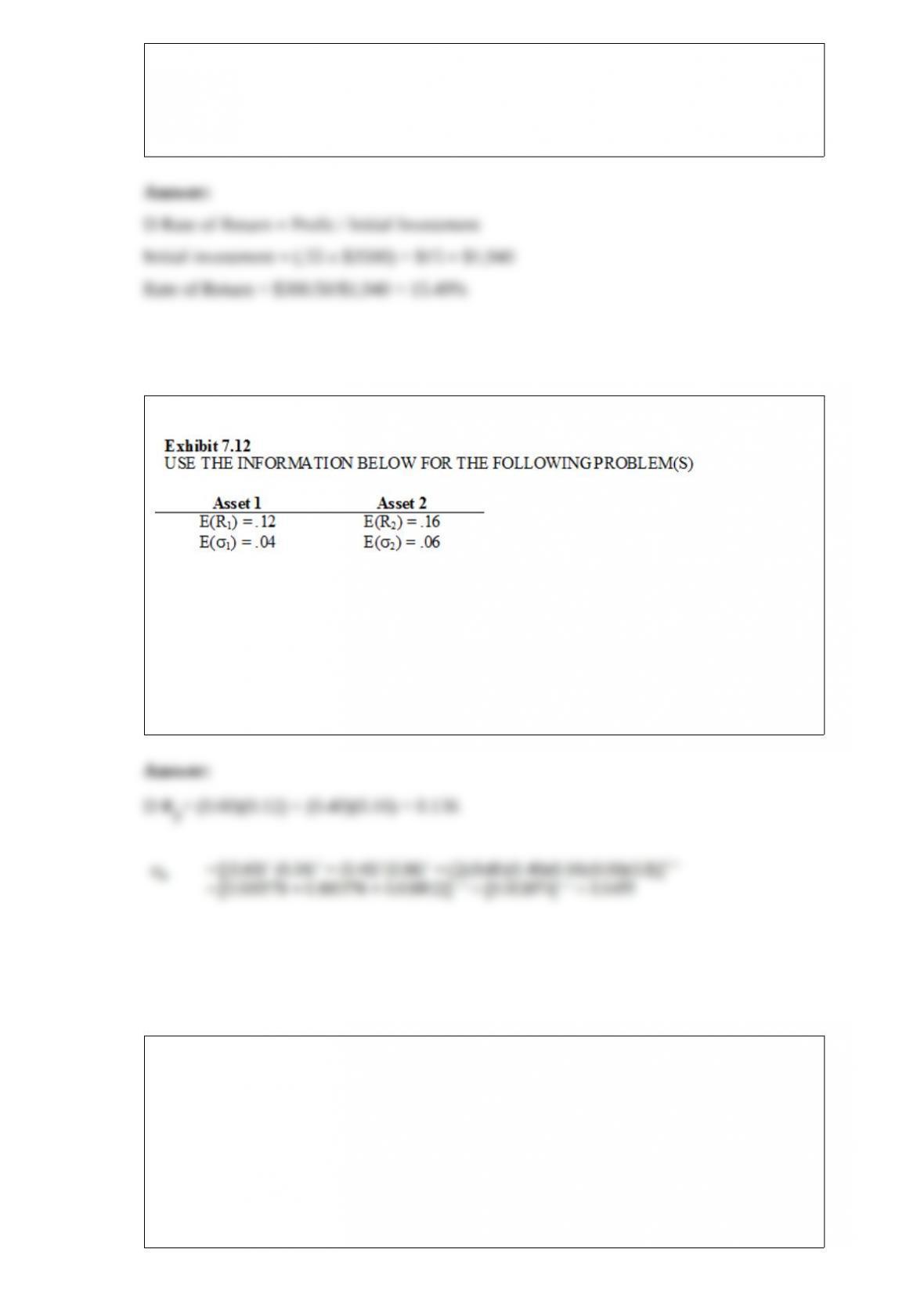
15)
Refer to Exhibit 7.12. Calculate the expected returns and expected standard deviations
of a two stock portfolio when r1,2= .80 and w1= .60.
a. .144 and .0002
b. .144 and .0018
c. .136 and .0045
d. .136 and .0455
e. .136 and .4554
16) Exhibit 22.6
USE THE INFORMATION BELOW FOR THE FOLLOWING PROBLEM(S)
The following information is provided in the context of a two period (two six month
periods) binomial option pricing model. A stock currently trades at $60 per share, a call
option on the stock has an exercise price of $65. The stock is equally likely to rise by
15% or fall by 15% during each six month period. The one-year risk free rate is 3%.
Calculate the price of the call option after the stock price has already moved down in
value once (Cd).

a. $7.77
b. $14.35
c. $0
d. $4.21
e. $6.44
17) Theoretically, the correlation coefficient between a completely diversified portfolio
and the market portfolio should be
a. -1.0.
b. +1.0.
c. 0.0.
d. -0.5.
e. +0.5.
18) Exhibit 7A.1
USE THE INFORMATION BELOW FOR THE FOLLOWING PROBLEM(S)
The general equation for the weight of the first security to achieve the minimum
variance (in a two stock portfolio) is given by:
Refer to Exhibit 7A.1. Show the minimum portfolio variance for a two stock portfolio
when r1.2= 1.
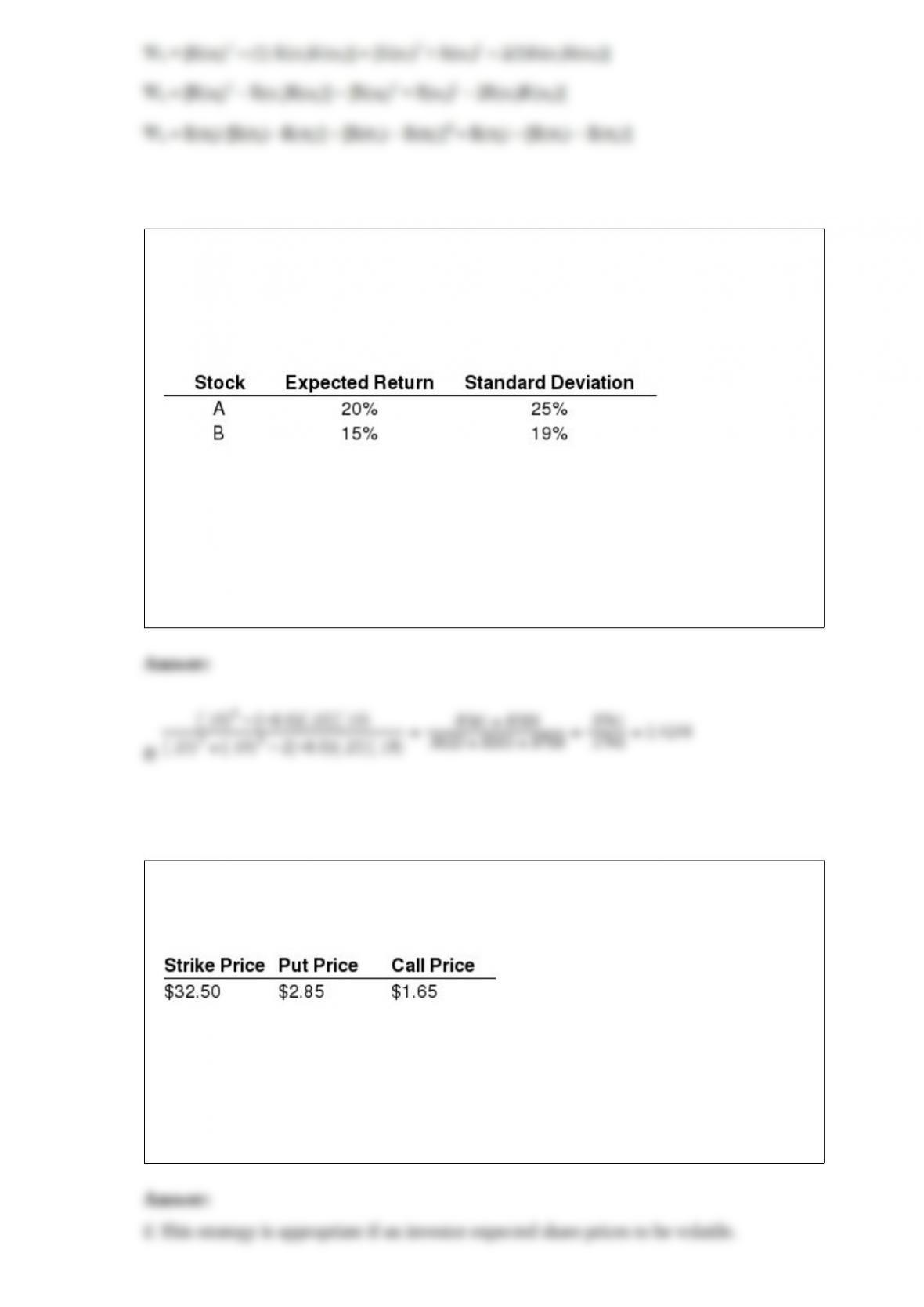
19) Exhibit 7.14
USE THE INFORMATION BELOW FOR THE FOLLOWING PROBLEM(S)
Stocks A and B have a correlation coefficient of –0.8. The stocks’ expected returns and
standard deviations are in the table below. A portfolio consisting of 40% of stock A and
60% of stock B is constructed.
Refer to Exhibit 7.14. What percentage of stock A should be invested to obtain the
minimum risk portfolio that contains stock A and B?
a. 35%
b. 42%
c. 58%
d. 65%
e. 72%
20) Exhibit 22.4
USE THE INFORMATION BELOW FOR THE FOLLOWING PROBLEM(S)
Consider the following information on put and call options for Citigroup
A long strap is an appropriate strategy if
a. An investor wishes to generate additional income.
b. An investor wished to insure against a decline in share values.
c. An investor expected share prices to be volatile.
d. An investor expected share prices to remain in a trading range.
e. An investor expected share prices to be volatile, but was inclined to be bullish.

21) In a buy-and-hold strategy, bonds are purchased in light of the investor’s objectives
and constraints and then held until maturity.
22) Because you expect market interest rates to decline during the next four months, if
you were offered two bonds with equal duration, you would select the one with the
higher measure of convexity.
23) An investor in a hedge position is no longer exposed to the absolute price
movement of the underlying asset, but the investor is still exposed to basis risk.
24) Negotiation, competitive bids, and best efforts are three forms of underwriting
arrangements.
25) Market index funds attempt to match the composition and performance of a
specified market indicator series.

26) A put option is in the money if the current market price is above the strike price.
27) Cross-sectional analysis is a useful technique for estimating future performance that
involves examining a firm’s relative performance over time.
28) A bond’s maturity is affected by: call features, non-refunding provisions, and
sinking fund provisions.
29) Financial ratios can be used to estimate systematic risk.