
Shepard Industries is evaluating a proposal to expand its current distribution facilities.
Management has projected the project will produce the following cash flows for the
first two years (in millions).
The depreciation tax shield for Shepard Industries project in year two is closest to:
A) $84
B) $196
C) $72
D) $96
Consider the following realized annual returns:
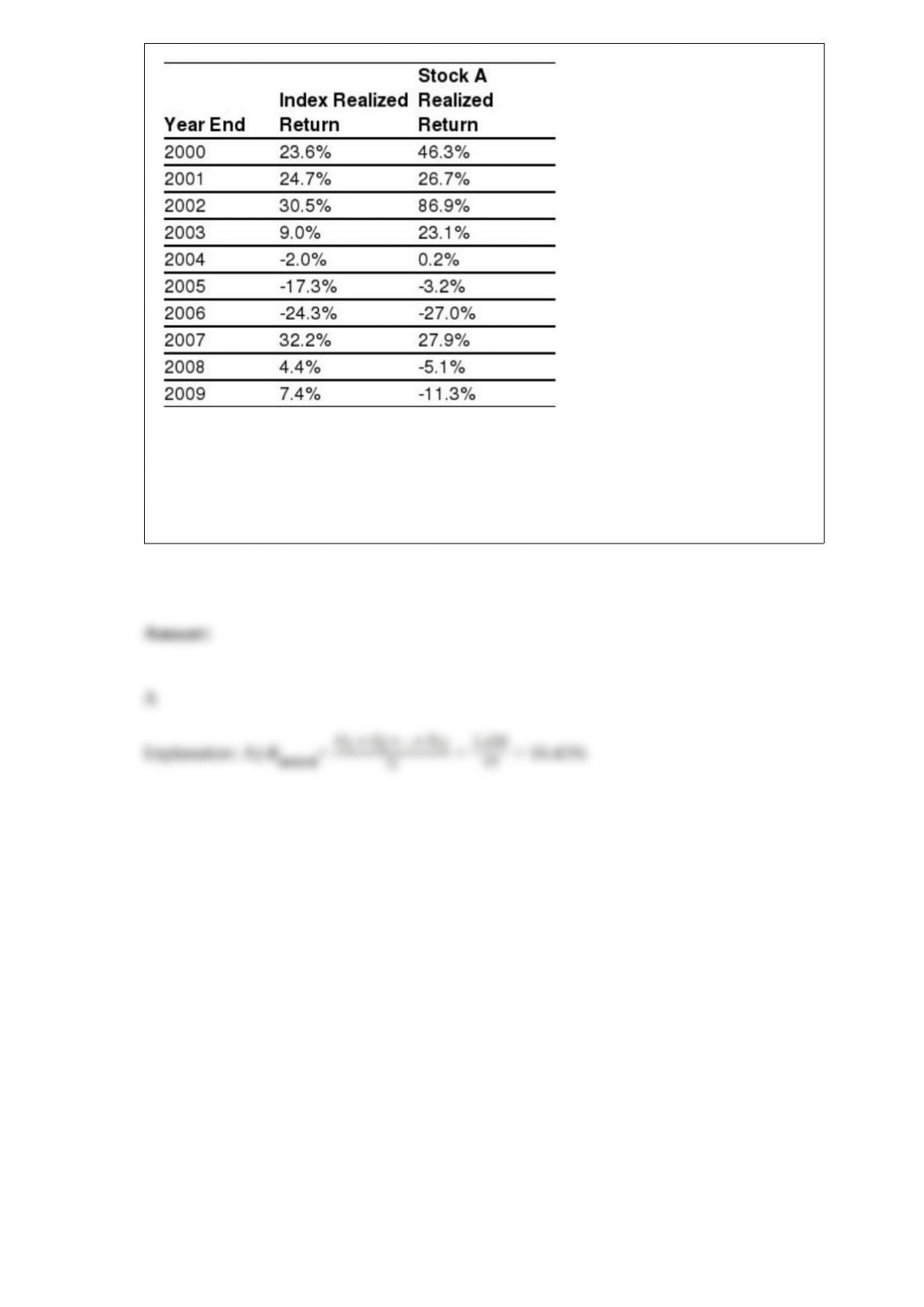
The standard deviation of the returns on Stock A from 2000 to 2009 is closest to:
A) 33.2%
B) 16.4%
C) 31.5%
D) 11.0%

Which of the following is NOT true regarding individual investor behavior?
A) Individual investors fail to diversify their portfolios adequately.
B) A vast majority of individual investors hold fewer than 10 stocks in their portfolio.
C) Employees tend to overinvest in their company’s own stock.
D) Individual investors’ portfolios consistently outperform the market averages.
Suppose you have $1,000 today and the risk-free rate of interest (rf) is 3.5%. The
equivalent value in one year is closest to:
A) $965.00 today.
B) $966.18 today.
C) $1000.00 today.
D) $1035.00 today.

Consider a project with free cash flows in one year of $90,000 in a weak economy or
$117,000 in a strong economy, with each outcome being equally likely. The initial
investment required for the project is $80,000, and the project’s cost of capital is 15%.
The risk-free interest rate is 5%.
Suppose that to raise the funds for the initial investment the firm borrows $40,000 at the
risk free rate and issues new equity to cover the remainder. In this situation, the cost of
capital for the firm’s levered equity is closest to:
A) 23%
B) 25%
C) 15%
D) 18%
Consider the following four corporate bonds that have semiannual compounding:

If the YTM of these bonds decreases to 7%, which bond’s price would be most sensitive
to this change in YTM?
A) #1
B) #2
C) #3
D) #4
E) #3 and #4
Which of the following statements is FALSE?
A) Firms with steady, reliable cash flows, such as utility companies, are able to use high
levels of debt and still have a very low probability of default.
B) If there were no costs of financial distress, the value of the firm would continue to
increase with increasing debt until the interest on the debt exceeds the firm’s earnings
before interest and taxes and the tax shield is exhausted.
C) The costs of financial distress reduce the value of the levered firm, VL. The amount
of the reduction decreases with the probability of default, which in turn increases with
the level of the debt D.
D) The tradeoff theory states that firms should increase their leverage until it reaches
the level D* for which VL is maximized.

Which of the following statements is FALSE?
A) If the market portfolio were not efficient, investors could find strategies that would
“beat the market” with higher average returns and lower risk.
B) The CAPM states that the cost of capital depends only on systematic risk.
C) Efficient capital markets is a much stronger hypothesis than the CAPM.
D) The market portfolio is an efficient portfolio.
Suppose that all stocks can be grouped into two mutually exclusive portfolios (with
each stock appearing in only one portfolio): growth stocks and value stocks. Assume
that these two portfolios are equal in size (market value), the correlation of their returns
is equal to 0.6, and the portfolios have the following characteristics:
The risk free rate is 3.5%.
The Sharpe ratio for the market (which is a 50-50 combination of the value and growth
portfolios) portfolio is closest to:
A) .53
B) .58
C) .61
D) .79

Taggart Transcontinental is considering adding a trucking division to expand the
coverage of its existing rail lines. The trucking division will cost $1,000,000 and is
expected to generate free cash flows of $100,000 for each of the next five years.
Taggart Transcontinental forecasts that future free cash flows after year 5 will grow at
2% per year, forever. Taggart Transcontinental’s cost of capital is 10%.
The continuation value for the trucking division in year five is closest to:
A) 1,000,000
B) 1,250,000
C) 1,275,000
D) 1,375,000
Consider the following list of projects:

Assuming that your capital is constrained, which investment tool should you use to
determine the correct investment decisions?
A) Profitability Index
B) Incremental IRR
C) NPV
D) IRR
Consider the following factor model:
E[Rs] – rf= (E[RMkt] – rf) + E[RSMB] + E[RHML] + E[RPR1
YR]
The term measures the sensitivity of the securities returns to:
A) momentum.
B) the overall market.
C) book to market.
D) size.
Which of the following statements is FALSE?
A) When a firm faces financial distress, shareholders have an incentive not to invest
and to withdraw money from the firm if possible.
B) Because top managers often hold shares in the firm and are hired and retained with
the approval of the board of directors, which itself is elected by shareholders, managers
will generally make decisions that increase the value of the firm’s equity.

C) An over-investment problem occurs when shareholders have an incentive to invest in
risky positive-NPV projects.
D) A negative-NPV project destroys value for the firm overall.
When investors imitate each other’s actions, this is known as ________ behavior.
A) pack
B) flock
C) herd
D) shepherd
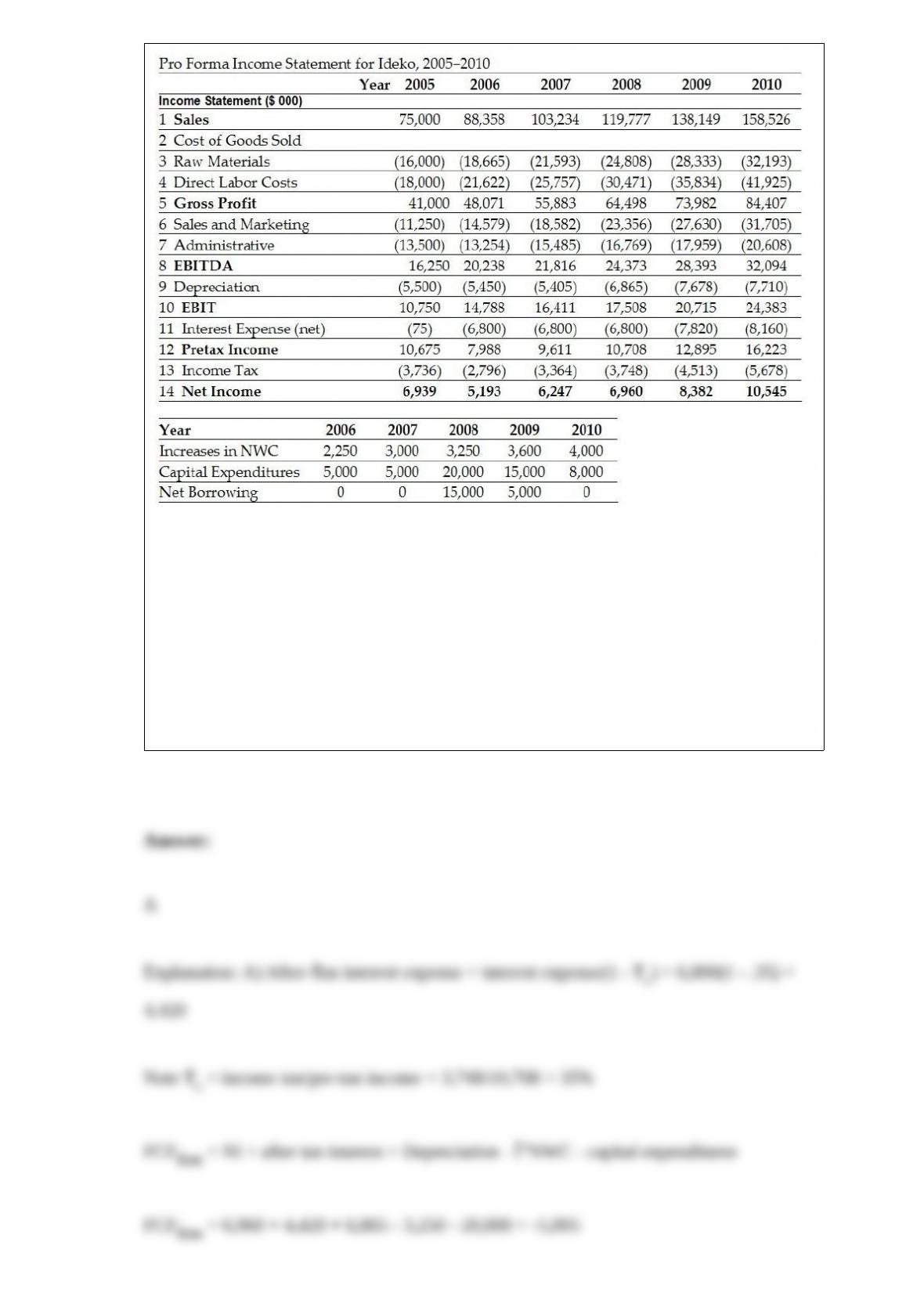
The free cash flow to the firm in 2008 is closest to:
A) -5,005
B) -1,755
C) 5,575
D) 14,995

Which of the following statements is FALSE?
A) The money taken in by the firm as a result of the share issue exactly offsets the
dilution of the shares.
B) Most analysts prefer to use performance measures and valuation multiples that are
based on the firm’s earnings before interest has been deducted.
C) Because the firm’s earnings per share and price-earnings ratio are affected by
leverage implies that we can always reliably compare these measures across firms with
different capital structures.
D) In general, as long as the firm sells the new shares of equity at a fair price, there will
be no gain or loss to shareholders associated with the equity issue itself.
Which of the following statements is FALSE?
A) Future dividend payments and stock prices are not known with certainty; rather
these values are based on the investor’s expectations at the time the stock is purchased.
B) The capital gain is the difference between the expected sale price and the purchase
price of the stock.
C) The sum of the dividend yield and the capital gain rate is called the total return of the
stock.
D) We divide the capital gain by the expected future stock price to calculate the capital
gain rate.
Which of the following statements is FALSE?

A) As a general rule, the WACC method is the easiest to use when the firm will
maintain a fixed debt-to-value ratio over the life of the investment.
B) The FTE method is typically used only in complicated settings for which the values
of other securities in the firm’s capital structure or the interest tax shield are themselves
difficult to determine.
C) For alternative leverage policies, the FTE method is usually the most straightforward
approach.
D) When used consistently, the WACC, APV, and FTE methods produce the same
valuation for the investment.
Which of the following statements is FALSE?
A) The APV approach explicitly values the market imperfections and therefore allows
managers to measure their contribution to value.
B) We need to know the debt level to compute the APV, but with a constant debt-equity
ratio we need to know the project’s value to compute the debt level.
C) The WACC method is more complicated than the APV method because we must
compute two separate valuations: the unlevered project and the interest tax shield.
D) Implementing the APV approach with a constant debt-equity ratio requires solving
for the project’s debt and value simultaneously.