1) The Financial Accounting Standards Board (FASB) has expressed a strong
preference for the indirect method, but allows companies to use the direct method in
calculating the cash flow from operating activities.
2) The three forms or states in the development of inventory for a manufacturer are
direct materials, direct labor, and finished goods.
3) The International Accounting Standards Board (IASB) was created in order to
develop worldwide accounting standards that must be used for all financial statements
prepared regardless of country.
4) Essentially, the entire statement of financial position is inverted compared to what is
commonly seen in the United States.
5) Accountants need not worry about calculations based upon the concept of the time
value of money.
6) The only reason a company needs to create an internal control system is to deter
intentional fraudulent acts.
7) An external event involves interaction between an entity and its environment.
8) Costs incurred related to plant assets that are already in use are called revenue
expenditures if the cost increases the useful life or the asset’s productivity.
9) Comprehensive income is the increase in net assets resulting from all transactions
occurring during an accounting period except stockholders investments and dividends.
10) The FASB has allowed certain items to be reported directly to stockholders’ equity
in an effort to mitigate the possibility of income fluctuating widely from period to
period.
11) The inventory method that assigns the most recent costs to ending inventory is
LIFO.
12) Net purchases equals purchases less purchase returns, allowances, and discounts
plus transportation-in.
13) Apple Company had terms of net 60 days for customers. The number of days’ sales
in accounts receivable for Apple was 42 days. Apple is efficient in the collection of its
receivables.
14) The maker of a note recognizes a note receivable on the balance sheet and interest
revenue on its income statement.
15) Royal Company purchased a dump truck at the beginning of 2012 at a cost of
$50,000. The truck had an estimated life of 5 years and an estimated residual value of
$20,000. On January 1, 2014, the company made major repairs of $30,000 to the truck
that extended the life 3 years. Thus, starting with 2014, the truck has a remaining life of
5 years and a new salvage value of $8,000. Royal uses the straight-line depreciation
method
What is the book value of the truck to be reported on the balance sheet at December 31,
2014?
A.$44,000
B.$50,000
C.$56,000
D.$62,000
16) If the business has an _________ from a customer, then the customer has an
________ to the business.
A.account receivable; account receivable
B.account payable; account payable
C.account receivable; account payable
D.account payable; account receivable
17) If cost of goods sold under FIFO was $8,000 and was $10,000 under LIFO,
assuming a tax rate of 40%, how much tax savings resulted from using LIFO?
A.There would be no tax savings
B.$ 800
C.$ 1,200
D.$ 2,000
18) The second step in the ethical decision-making model is to
A.List alternatives and evaluate the impact of each on those affected
B.Select the best alternative
C.Recognize an ethical dilemma
D.Analyze the key elements in the situation
19) A company’s weekly payroll amounts to $50,000 and payday for the week is every
Friday. Employees work five days per week, Monday through Friday. The appropriate
journal entry was recorded at the end of the accounting period, Tuesday, March 31,
2013. What amount is wages expense for April for the payday, Friday, April, 3, 2013?
A.$ -0-
B.$20,000
C.$30,000
D.$50,000
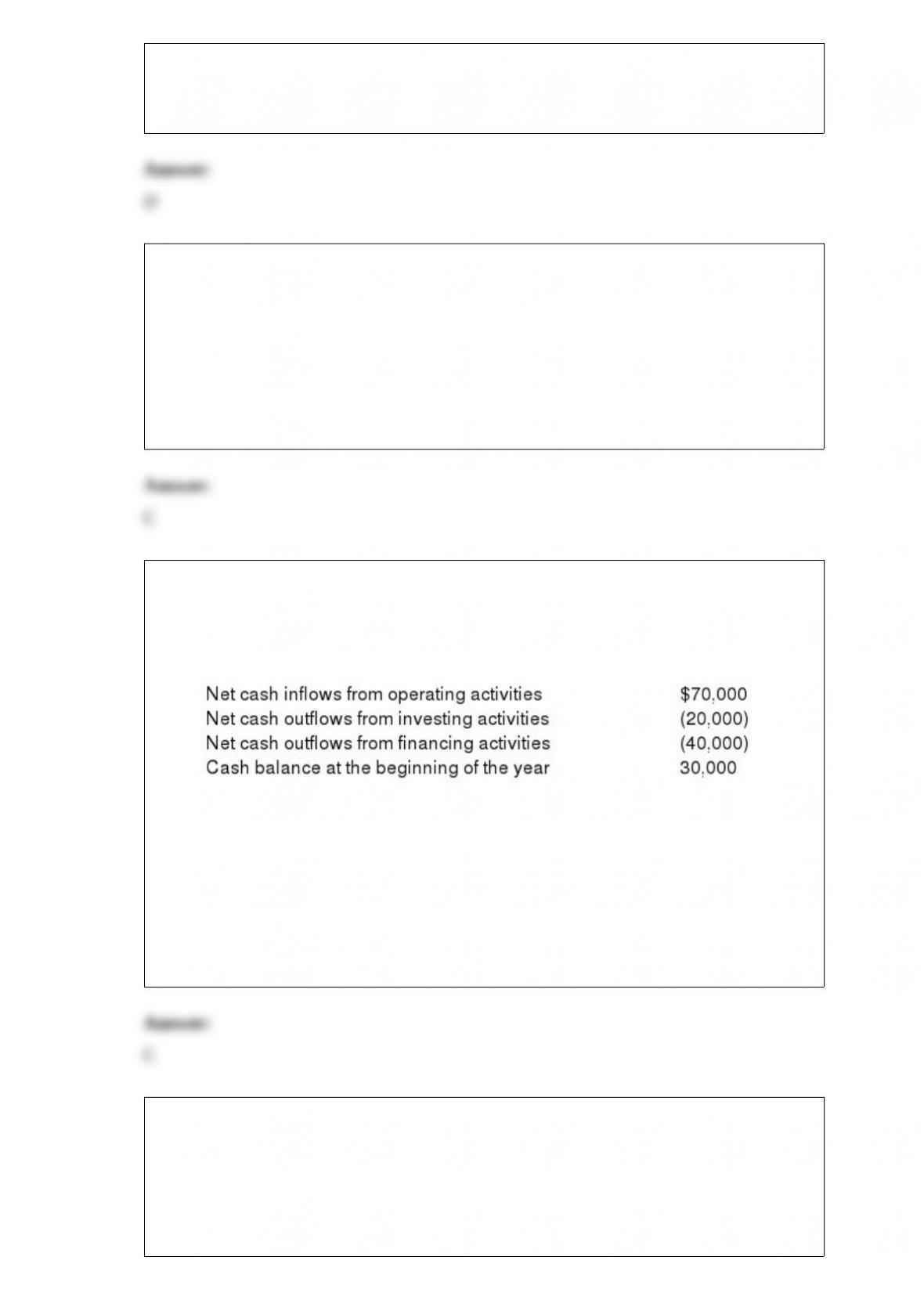
20) Marvel Shoes
Marvel Shoes reported the following items on its statement of cash flows for the current
year:
Read the information about Marvel Shoes. What was the cash balance for Marvel Shoes
at the end of the current year?
A.$ 10,000
B.$ 30,000
C.$ 40,000
D.$ 70,000
21) Which financial statement would you refer to in order to determine whether a
company owed funds to creditors?
A.Balance Sheet
B.Statement of Retained Earnings
C.Income Statement
D.Statement of Public Accounting
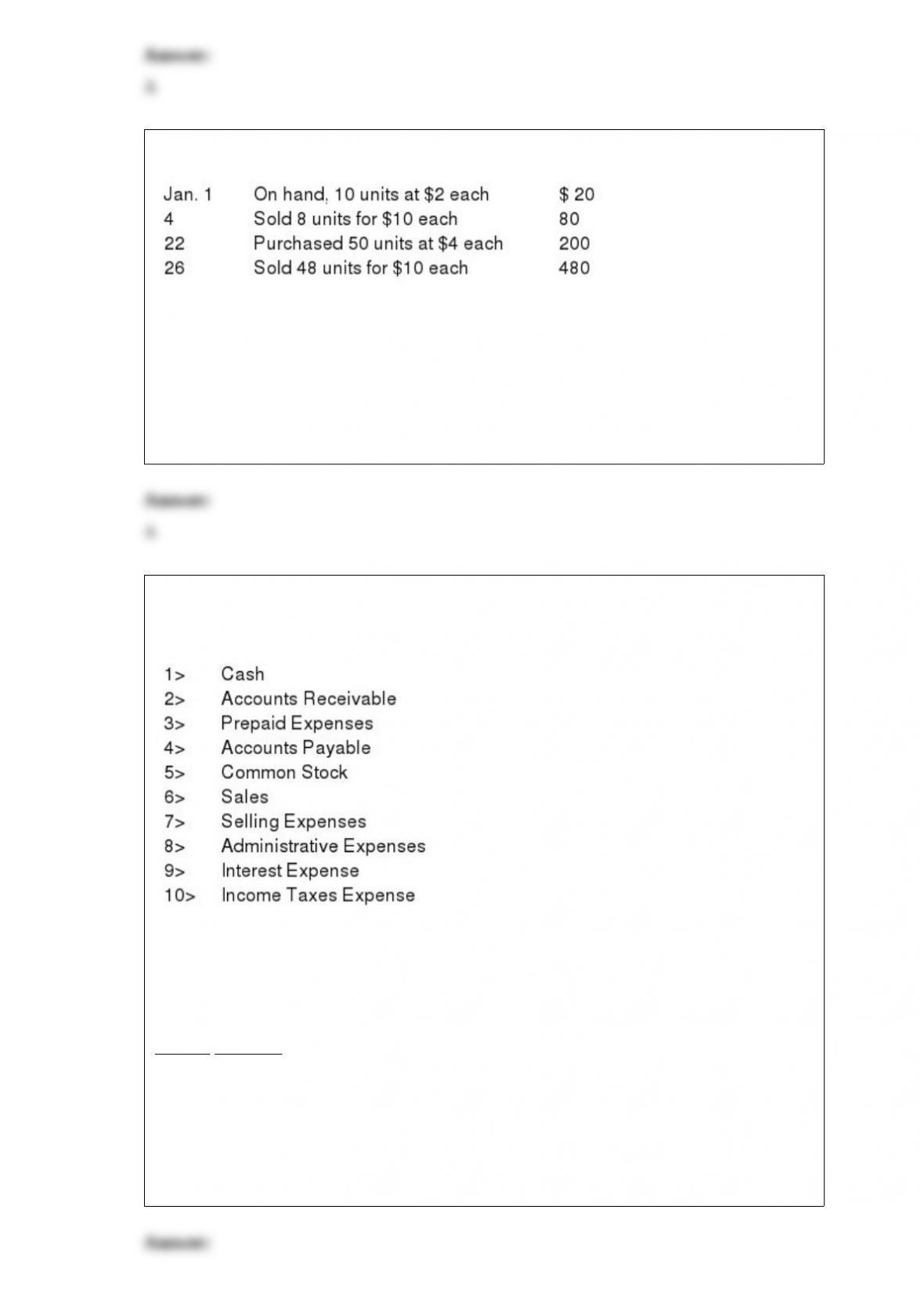
22) Adam Inc. uses a perpetual inventory system.
If Adam uses the FIFO method, how much is cost of goods sold for the month of
January?
A.$204
B.$208
C.$212
D.$560
23) Presented below are several accounts from the financial statements of James, Inc.
for the year ended December 31, 2013:
Each of these accounts has been assigned an identification number which you will use
as answers for the transactions described below. Enter the account number(s) in the
blank spaces under the headings DEBIT and CREDIT to indicate the accounts debited
and credited when each transaction is recorded in a general journal.
DEBIT CREDIT
A) The company issues common stock at par value. ________ ________
B) A bill is received for advertising placed by the company’s ad agency; payment is due
in 30 days. ________ ________
C) Interest due on long-term debt is paid. ________ ________
D) Received an invoice from their insurance company for next year’s coverage and
payment was made. ________ ________
24) Match each of the following terms pertaining to liabilities to their definitions.
1>Amounts owed for the purchase of inventory, goods, or services acquired in the
normal course of business. A. Current maturities of long-term liabilities
2>A contra-liability account that represents interest deducted from a loan or note in
advance. B. Current liability
3>The portion of a long-term liability that will be paid within one year of the balance
sheet date. C. Accrued liabilities
4>A liability that has been incurred but has not been paid as of the balance sheet date.
D. Accounts payable
5>Amounts owed that are represented by a formal contractual agreement. These
amounts usually require the payment of interest. E. Contingent liability
6>Accounts that will be satisfied within one year or the next operating cycle. F. Notes
payable
7>A liability that involves an existing condition for which the outcome is not known
with certainty and depends on some future event. G. Discount on notes payable
25) Which one of the following situations reflects a weak internal control system?
A.all employees are well supervised
B.a single employee is responsible for comparing a receiving report to an invoice
C.all employees must take their vacations
D.a single employee is responsible for collecting and recording of cash
26) [APPENDIX] When a company has a credit balance in its Deferred Tax account,
this amount would appear as a(n)
A.contra asset on the balance sheet
B.stockholders equity account on the balance sheet
C.expense account on the income statement
D.liability account on the balance sheet
27) One significant difference between a classified and a non-classified balance sheet is
the distinction between which of the following items?
A.Assets and liabilities
B.Current and noncurrent items
C.Liabilities and owners equity
D.Resources invested by the owners and amounts borrowed from creditors
28) Which one of the following is an investing activity on the statement of cash flows?
A.Collection of accounts receivable
B.Purchase of long-term investments
C.Receipt of interest
D.Receipt of dividends
29) On the issuance date, the Bonds Payable account had a balance of $50,000,000 and
Premium on Bonds Payable had a balance of $1,000,000. What was the issue price of
the bonds?
A.$50,000,000
B.$49,000,000
C.$51,000,000
D.Unable to determine from the information given.
30) Crouch Apartments purchased an apartment building to rent to university students
on December 15, 2012. The tenants moved in on January 1, 2013. On Super Bowl
Sunday, a student punched a hole in the wall when his favorite team fumbled the ball. It
cost the landlord $400 to repair the hole. How should this cost be recorded?
A.It should be recorded as part of the asset account
B.It should be recorded as repair and maintenance expense
C.It should not be recorded as the tenants will be charged for the damage
D.It should not be recorded since this is an immaterial amount to the landlord
31) Which of the following is not a requirement of a companys external auditors under
Sarbanes-Oxley?
A.They must give an opinion that managements assessment that the internal control
system over financial reporting is fairly stated
B.They must give an opinion that the company maintained an effective internal control
system over financial reporting
C.They must design and implement an effective information system design
D.They can not perform any brokerage services for the company
32) Why do accounting standards require a company to separately disclose income
taxes paid and interest paid if it uses the indirect method?
33) Distinguish between capital and revenue expenditures.
34) From an accounting perspective, what are source documents? Give examples of at
least three source documents.
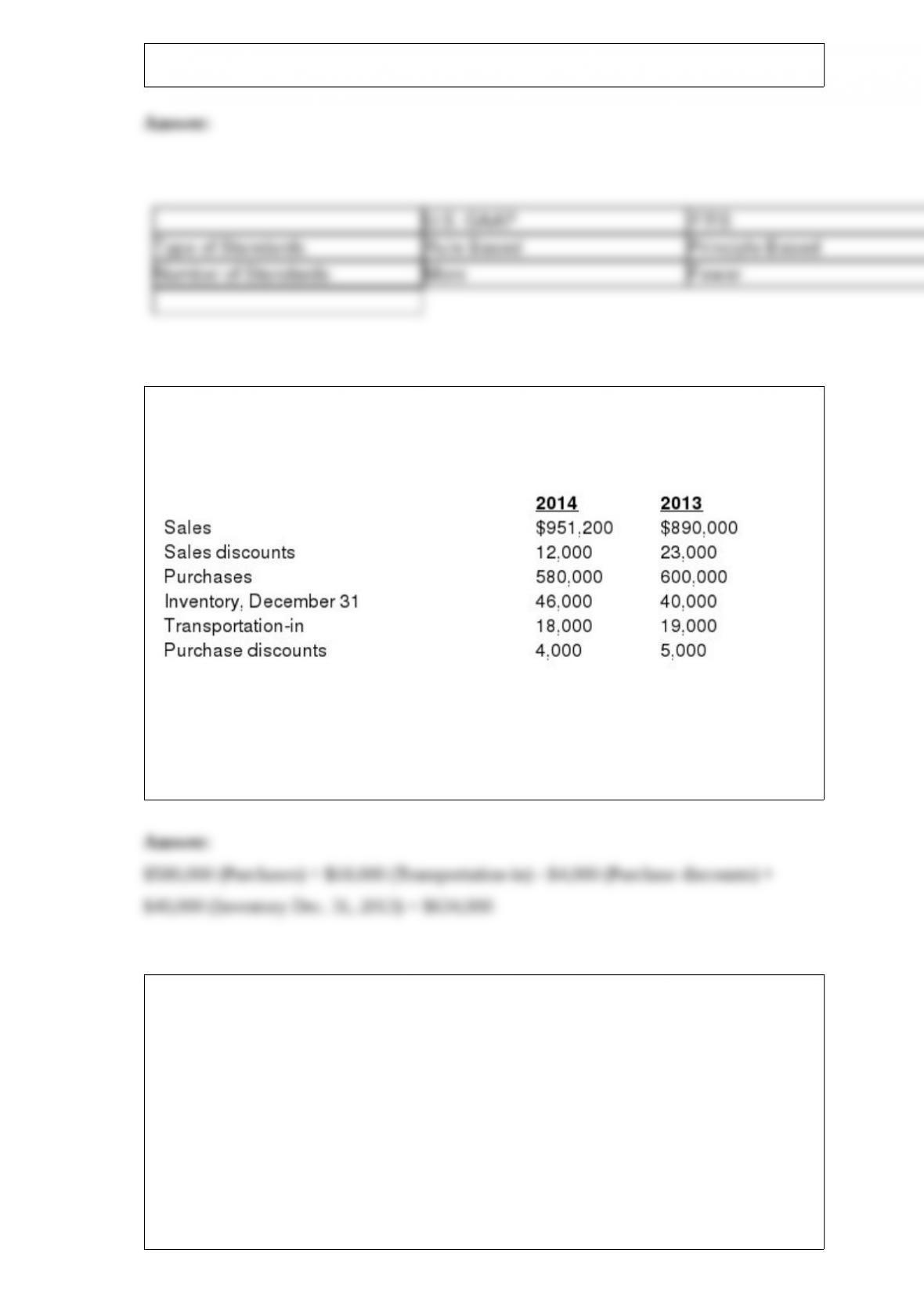
35) Summarize some of the common differences between U.S. GAAP and IFRS.
36) Baucus, Inc.
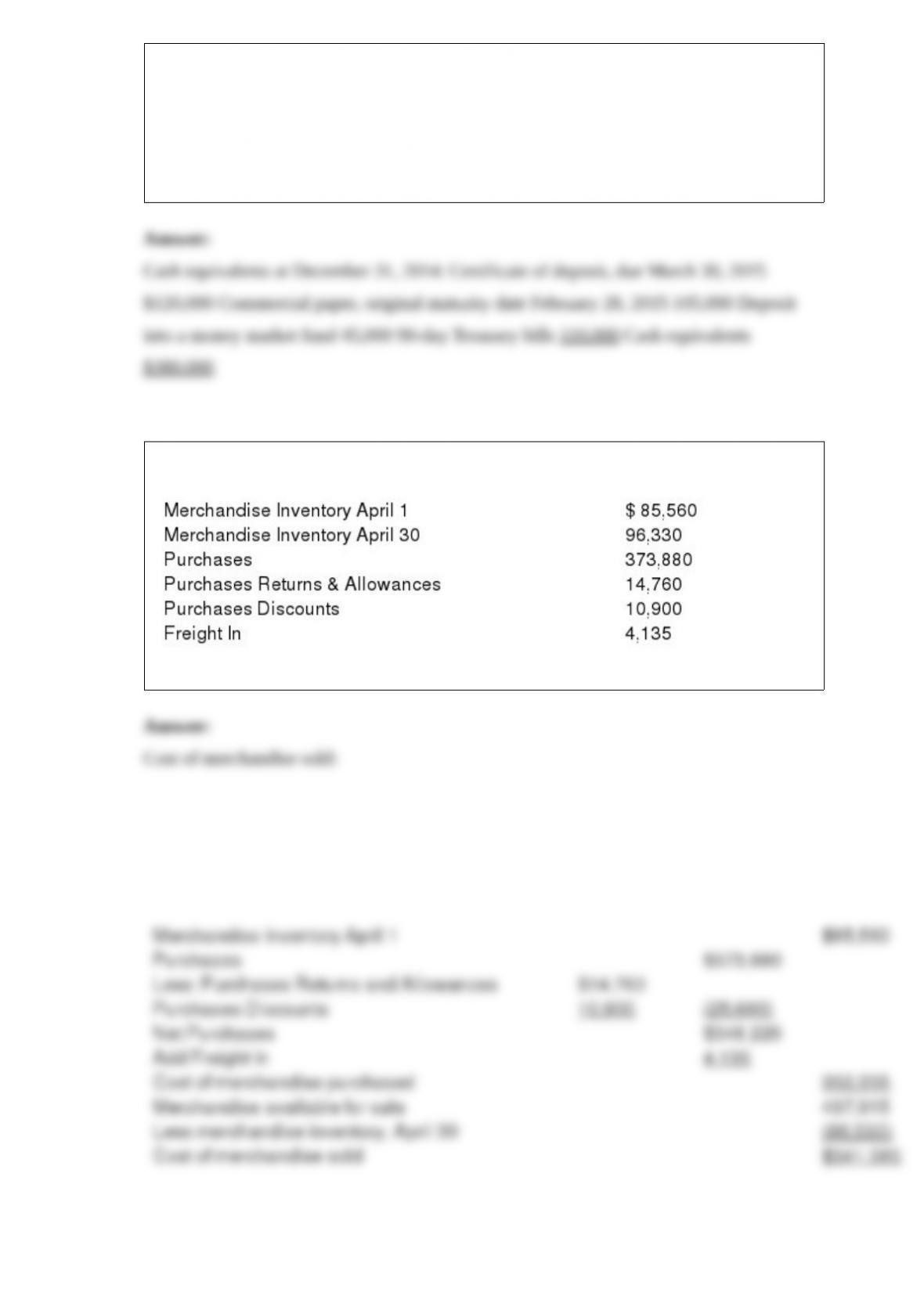
Baucus, Inc. reported the following information for 2014 and 2013:
Refer to the information for Baucus, Inc.
What amount is cost of goods available for sale for 2014?
37) Lower Enterprises invested its excess cash in the following instruments during
December 2014:
Certificate of deposit, due January 31, 2017 $ 85,000
Certificate of deposit, due March 30, 2015 120,000
Commercial paper, original maturity date February 28, 2015 105,000
Deposit into a money market fund 45,000
Investment in stock 55,000
90-day Treasury bills 110,000
Treasury note, due December 1, 2042 400,000
REQUIRED:
Determine the amount of cash equivalents that should be combined with cash on the
companys balance sheet at December 31, 2014, and for purposes of preparing a
statement
of cash flows for the year ended December 31, 2014.
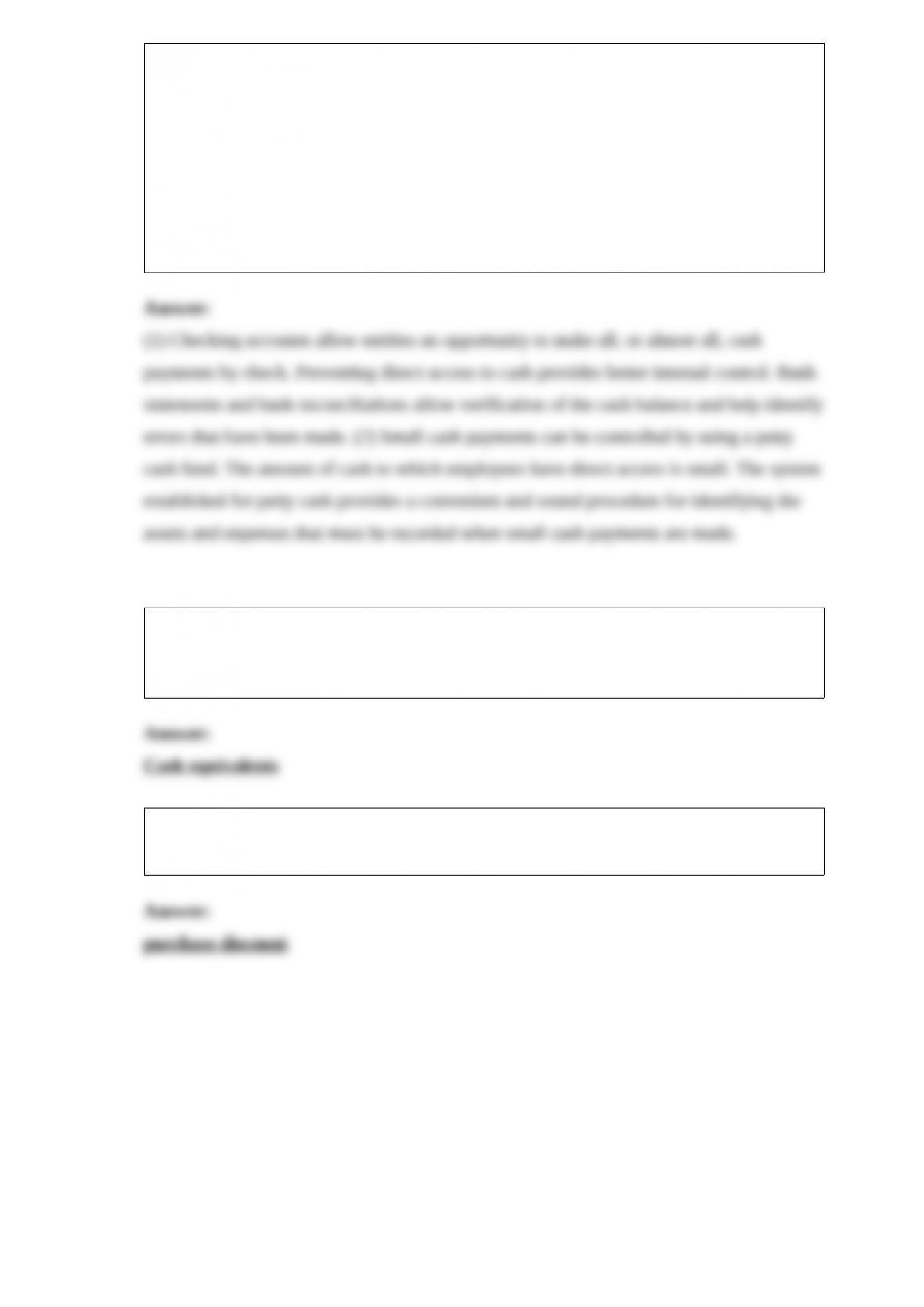
38) Based upon the following data, determine the cost of merchandise sold for April.
39) Sarcon Corp. prepares monthly bank reconciliations of its checking account
balance.
REQUIRED:
(1) Explain how checking accounts, bank statements, and bank reconciliations are used
by Sarcon to control its cash.
(2) Explain how Sarcon can control small payments that must be made in cash rather
than by check.
40) __________________________ are items which are readily convertible into a
known amount of cash and have an original maturity to the investor of three months or
less.
41) A _________________________ is an amount deducted by customers for payment
within the discount period.