
When the price level falls, the ________ curve for nominal money ________, and
interest rates ________, everything else held constant.
A) demand; decreases; fall
B) demand; increases; rise
C) supply; increases; rise
D) supply; decreases; fall
The S&L Crisis can be analyzed as a principal-agent problem. The agents in this case,
the ________, did not have the same incentive to minimize cost to the economy as the
principals, the ________.
A) politicians/regulators; taxpayers
B) taxpayers; politician/regulators
C) taxpayers; bank managers
D) bank managers; politicians/regulators
When the central bank ________ the money supply, the LM curve shifts to the right,
interest rates ________, and equilibrium aggregate output ________, everything else
held constant.
A) increases; fall; increases
B) increases; rise; decreases
C) decreases; rise; decreases
D) decreases; fall; increases

If uncertainty about banks’ health causes depositors to begin to withdraw their funds
from banks, the country experiences a(n)
A) banking crisis.
B) financial recovery.
C) reduction of the adverse selection and moral hazard problems.
D) increase in information available to investors.
The teal book is the Fed research document containing
A) the forecast of national economic variables for the next three years.
B) forecasts of the money aggregates conditional on different monetary policy stances.
C) information on the state of the economy in each Federal Reserve district.
D) both A and B.
E) A, B and C.
Under a fixed exchange rate regime, if a central bank must intervene to purchase the
domestic currency by selling foreign assets, then, like an open market sale, this action
________ the monetary base and the money supply, causing the interest rate on
domestic assets to ________.
A) increases; rise
B) increases; fall
C) reduces; rise
D) reduces; fall

Which policy measure makes it unlawful for a registered public accounting firm to
provide any nonaudit service to a client contemporaneously with an impermissible
audit?
A) Sarbanes-Oxley Act of 2002
B) Global Legal Settlement of 2002
C) Gramm-Leach-Bliley Act of 1999
D) Riegle-Neal Act of 1994
If a forecast made using all available information is NOT perfectly accurate, then it is
A) still a rational expectation.
B) not a rational expectation.
C) an adaptive expectation.
D) a second-best expectation.
A reason why rogue traders have bankrupt their banks is due to
A) the separation of trading activities from the bookkeepers.
B) stringent supervision of trading activities by bank management.
C) accounting errors.
D) a failure to maintain proper internal controls.
The Obama administration increased the tax on the top income tax bracket from 35% to
39%. Supply and demand analysis predicts the impact of this change was a ________
interest rate on municipal bonds and a ________ interest rate on Treasury bonds, all

else the same.
A) higher; lower
B) lower; lower
C) higher; higher
D) lower; higher
Since the early 1990s, the Fed has conducted monetary policy by setting a target for the
A) level of borrowed reserves.
B) monetary base.
C) federal funds rate.
D) inflation rate.
Macroeconomic equilibrium requires
A) equilibrium in the goods market.
B) equilibrium in the money market.
C) equilibrium in both the goods and money markets.
D) equilibrium in neither the goods nor the money market.
Franco Modigliani has found that an expansionary monetary policy can cause stock
market prices to ________ and consumption to ________.
A) increase; increase
B) increase; decrease
C) decrease; decrease

D) decrease; increase
The demand for silver decreases, other things equal, when
A) the gold market is expected to boom.
B) the market for silver becomes more liquid.
C) wealth grows rapidly.
D) interest rates are expected to rise.
Everything else held constant, a shift in tastes in the U.S. towards American goods will
________ net exports in the U.S. and cause the quantity of aggregate output demanded
to ________ in Mexico.
A) decrease; rise
B) decrease; fall
C) increase; rise
D) increase; fall
The price of one country’s currency in terms of another country’s currency is called the
A) exchange rate.
B) interest rate.
C) Dow Jones industrial average.
D) prime rate.

One purpose of regulation of financial markets is to
A) limit the profits of financial institutions.
B) increase competition among financial institutions.
C) promote the provision of information to shareholders, depositors and the public.
D) guarantee that the maximum rates of interest are paid on deposits.
Mutual funds are primarily held by
A) financial institutions.
B) households.
C) nonfinancial businesses.
D) the Social Security trust fund.
An example of the ________ problem would be if Brian borrowed money from Sean in
order to purchase a used car and instead took a trip to Atlantic City using those funds.
A) moral hazard
B) adverse selection
C) costly state verification
D) agency

As a result of recent empirical research, there has been a convergence of Keynesian and
monetarist opinion to the view that
A) money is all that matters.
B) money does matter.
C) money does not matter.
D) fiscal policy is all that matters.
Some automobile owners will drive faster knowing that they are covered by health and
automobile insurance. This behavior creates the problem of
A) fraudulent claims.
B) moral hazard.
C) adverse selection.
D) pecuniary purchases.
The measure of the aggregate price level that is most frequently reported in the media is
the
A) GDP deflator.
B) producer price index.
C) consumer price index.
D) household price index.
A bank has excess reserves of $1,000 and demand deposit liabilities of $80,000 when
the reserve requirement is 25 percent. If the reserve requirement is lowered to 20

percent, the bank’s excess reserves will be
A) $1,000.
B) $5,000.
C) $8,000.
D) $9,000.
The mismanagement of financial liberalization in emerging market countries can be
understood as a severe
A) principal/agent problem.
B) asymmetric information problem.
C) lemons problem.
D) free-rider problem.
Everything else held constant, a depreciation of the domestic currency will cause the IS
curve to shift to the ________ and aggregate demand will ________.
A) right; increase
B) right; decrease
C) left; increase
D) left; decrease
Suppose on any given day the prevailing equilibrium federal funds rate is above the
Federal Reserve’s federal funds target rate. If the Federal Reserve wishes for the federal
funds rate to be at their target level, then the appropriate action for the Federal Reserve

to take is a ________ open market ________, everything else held constant.
A) defensive; sale
B) defensive; purchase
C) dynamic; sale
D) dynamic; purchase
Rising interest-rate risk
A) increased the cost of financial innovation.
B) increased the demand for financial innovation.
C) reduced the cost of financial innovation.
D) reduced the demand for financial innovation.
Conflicts of interest is a type of ________ problem that occurs when a person or
institution has multiple objectives that are in conflict with each other.
A) moral hazard
B) adverse selection
C) risk sharing
D) spinning
Thrift institutions include
A) commercial banks.
B) brokerage firms
C) insurance companies.
D) mutual savings banks.
Estimates from large macroeconometric models of the U.S. economy suggests that it
takes over ________ for monetary policy to affect output and over ________ for
monetary policy to affect the inflation rate.
A) 1 year; 2 years
B) 2 years; 1 year
C) 1 year; 6 months
D) 6 months; 1 year
A(n) ________ is a subsidiary of a U.S. bank that is engaged primarily in international
banking.
A) Edge Act corporation
B) Eurodollar agency
C) universal bank
D) McFadden corporation
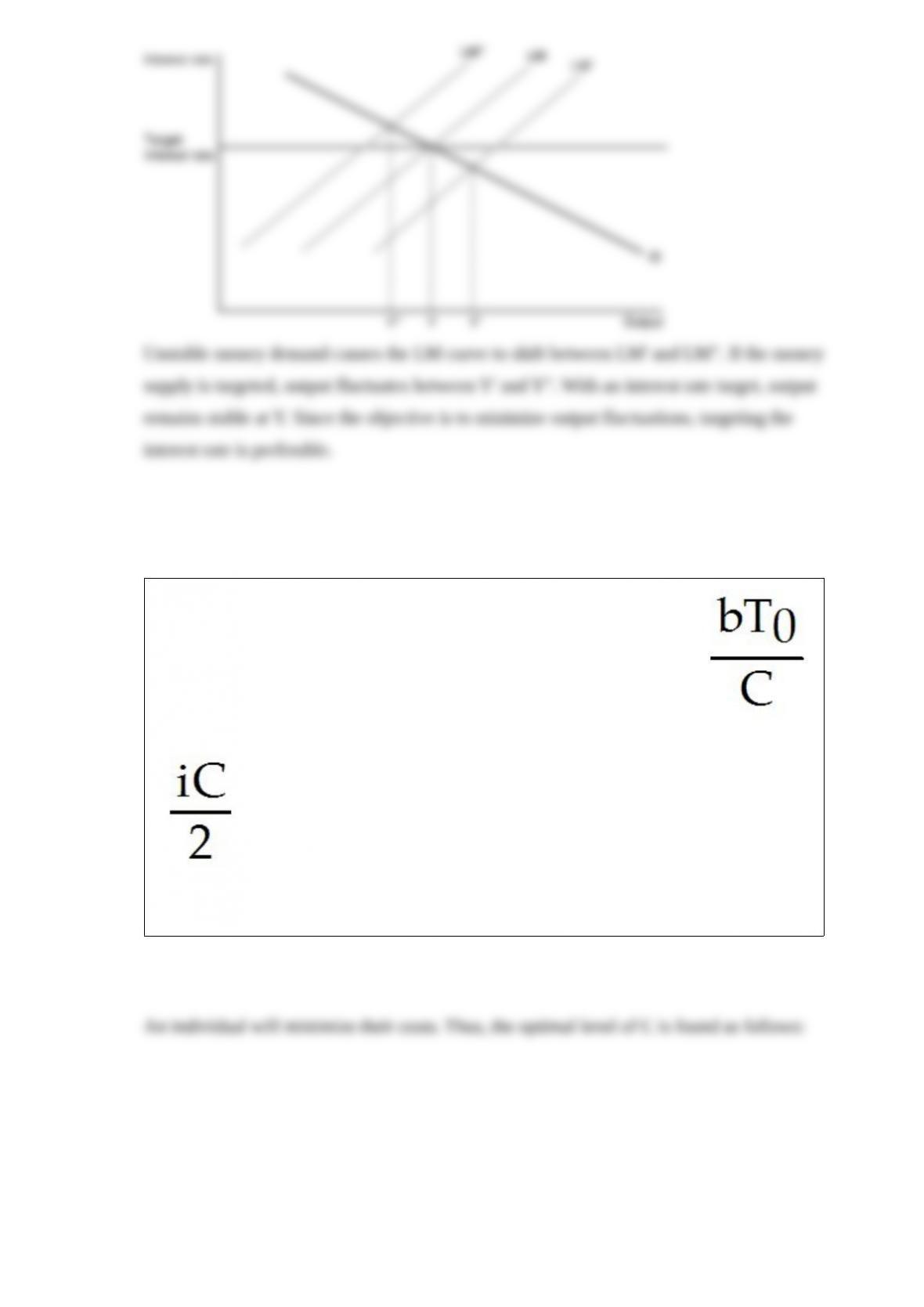
Show graphically and explain why targeting an interest rate is preferable when money
demand is unstable and the IS curve is stable.
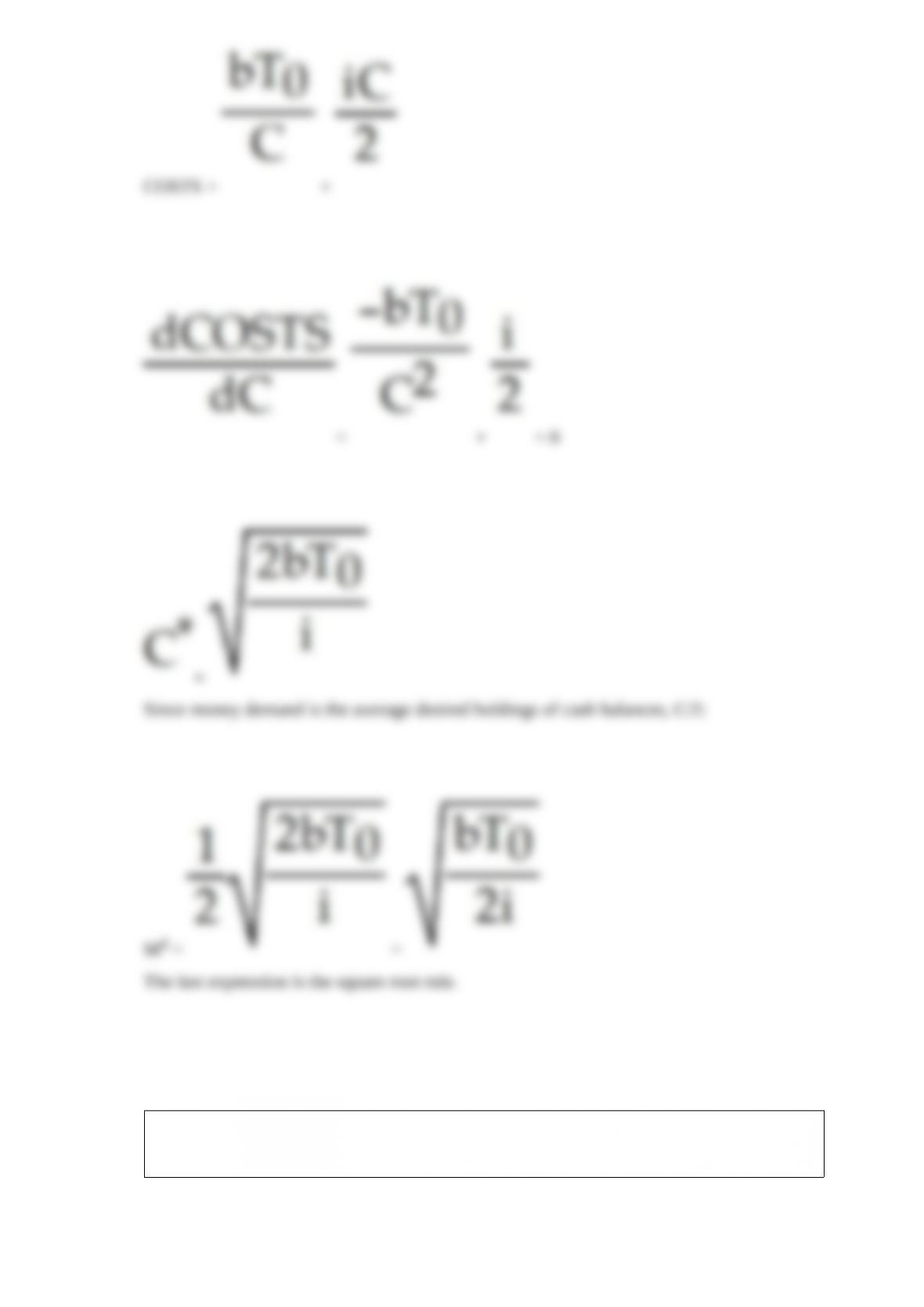
In the Baumol-Tobin model, given that total costs for an individual equals
+ , where T0 = monthly income, b = brokerage costs, and C = amount raised
from each bond transaction, derive the so-called square root rule.
The government safety net creates both an adverse selection problem and a moral
hazard problem. Explain.
Explain the principal-agent problem as it pertains to equity contracts.
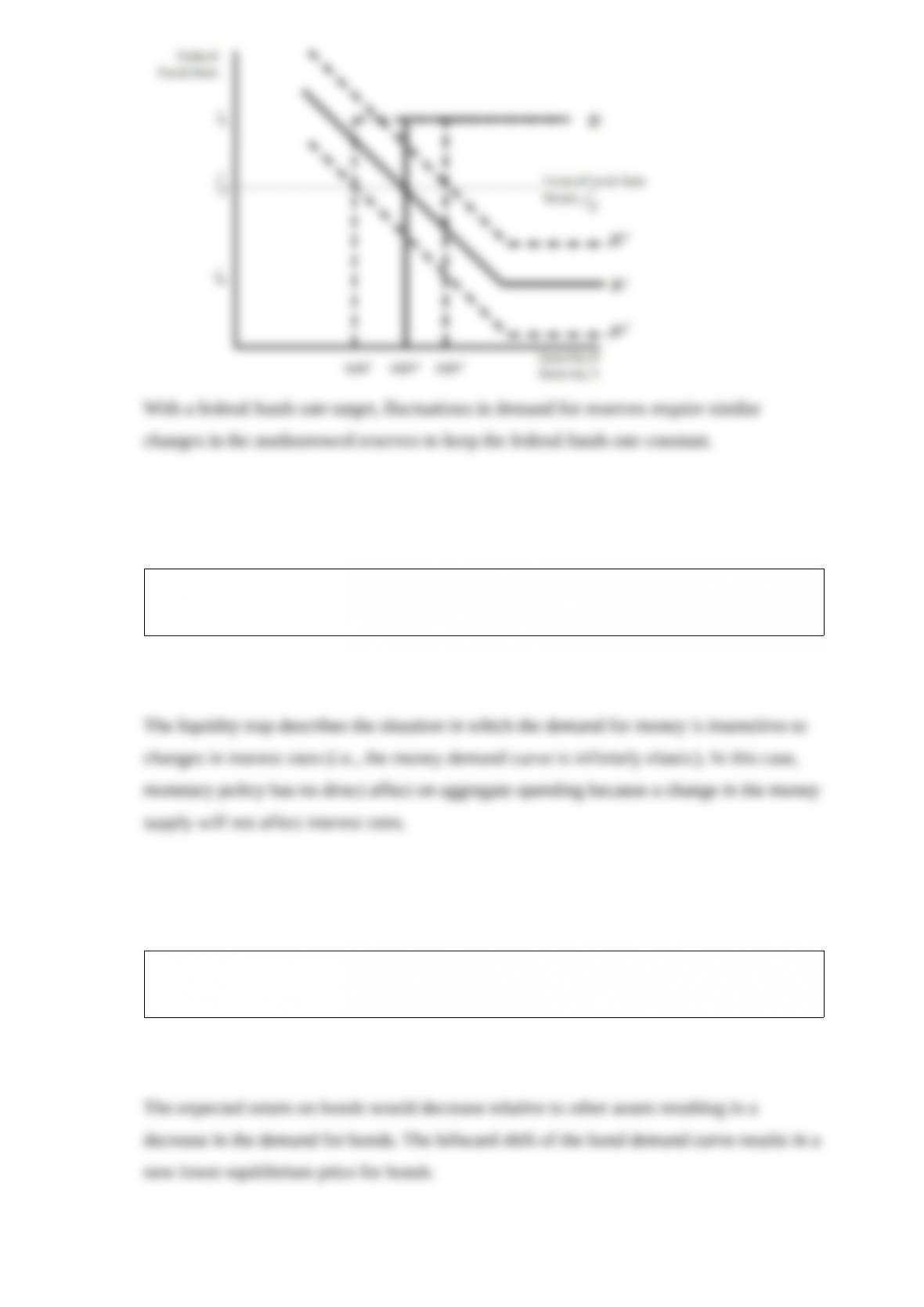
Explain and demonstrate graphically how targeting the federal funds rate can result in
fluctuations in nonborrowed reserves.
Describe what the liquidity trap is. Explain how it can be problematic for monetary
policymakers.
Use demand and supply analysis to explain why an expectation of Fed rate hikes would
cause Treasury prices to fall.
How does collateral help to reduce the adverse selection problem in credit market?
The monetary base increased by 20% during the contraction of 1929-1933, but the
money supply fell by 25%. Explain why this occurred. How can the money supply fall
when the base increases?
Make the case for and against an independent Federal Reserve.
Who are the voting members of the Federal Open Market Committee and why is this
committee important? Where does the power lie within this committee?
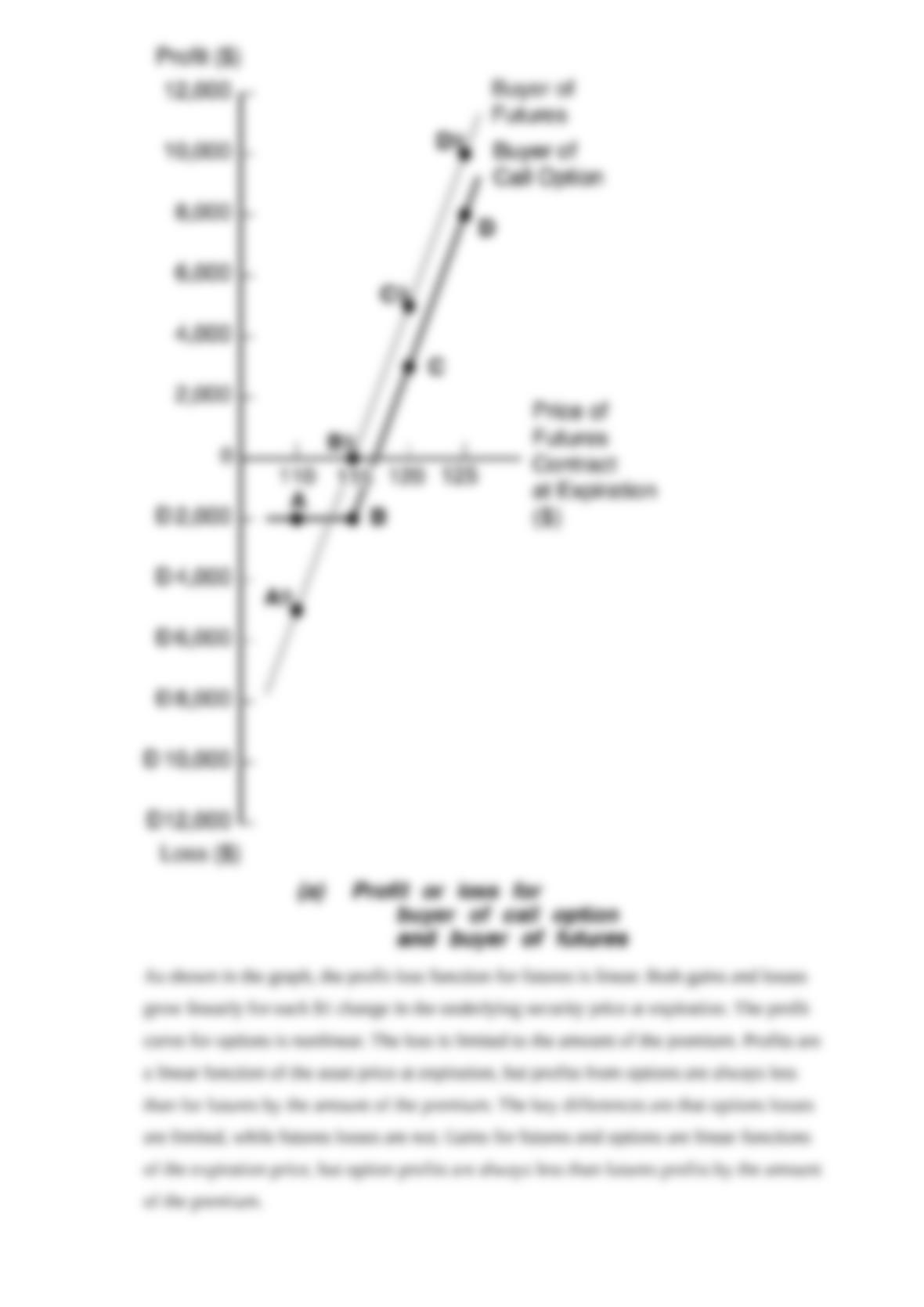
Show graphically and explain the profits and losses of buying futures relative to buying
call options.
Banking crises have occurred throughout the world. What similarities do we find when
we look at the different countries?
Explain two concepts of central bank independence. Is the Fed politically independent?
Why do economists think central bank independence is important?
Explain how cigarettes could be called “money” in prisoner-of-war camps of World War
II.
Explain the type of conflicts of interest that can arise from the development of universal
banking.