
1) The main disadvantage of futures contracts as compared to options on futures
contracts is that futures
A) remove the possibility of gains
B) increase the transactions cost
C) are not as effective a hedge
D) do not remove the possibility of losses
2) Which of the following statements about mutual savings banks are true?
A) There are currently under 200 mutual savings banks in the United States
B) Most mutual savings banks are federally chartered
C) Both A and B of the above are true
D) None of the above are true
3) A stronger dollar benefits ________ and hurts ________
A) American businesses; American consumers
B) American businesses; foreign businesses
C) American consumers; American businesses
D) foreign businesses; American consumers
4) Which of the following are true of mortgages?
A) A mortgage is a long-term loan secured by real estate
B) Borrowers pay off mortgages over time in some combination of principal and
interest payments that result in full payment of the debt by maturity
C) Less than 65 percent of mortgage loans finance residential home purchases
D) All of the above are true of mortgages
E) Only A and B of the above are true of mortgages
5) A steep upward-sloping yield curve indicates that short-term interest rates are
expected to
A) neither rise nor fall in the near future
B) remain relatively unchanged, but that long-term rates are expected to fall
C) neither rise nor fall, but that long-term rates are expected to rise moderately
D) rise moderately in the near future

6) A corporation acquires new funds only when its securities are sold in the
A) secondary market by an investment bank
B) primary market by an investment bank
C) secondary market by a stock exchange broker
D) secondary market by a commercial bank
7) The price of one country’s currency in terms of another’s is called
A) the foreign exchange rate
B) the interest rate
C) the Dow Jones industrial average
D) none of the above
8) One advantage of using swaps to eliminate interest-rate risk is that swaps
A) are less costly than futures
B) are less costly than rearranging balance sheets
C) are more liquid than futures
D) have better accounting treatment than options
9) Which of the following are accurate statements concerning the role that restrictive
covenants play in reducing moral hazard in financial markets?
A) Covenants reduce moral hazard by restricting borrowers’ undesirable behavior
B) Covenants require that borrowers keep collateral in good condition
C) Covenants require periodic accounting statements and income reports
D) All of the above
E) Only A and B of the above
10) First National Bank

Table 23.2
Referring to Table 23.2, if interest rates rise by 5 percentage points, then bank profits
(measured using gap analysis) will
A) decline by $0.5 million
B) decline by $1.5 million
C) decline by $2.5 million
D) increase by $2.0 million
11) First National Bank
Table 23.2
Referring to Table 23.2, First National Bank has a gap of ________.
A) -10
B) 10
C) 20
D) 0
12) Which of the following is not a financial innovation stimulated by information
technology?
A) credit card
B) debit card
C) adjustable-rate mortgage
D) electronic banking
13) Intermediaries are active in the swap markets because
A) they increase liquidity
B) they reduce default risk
C) they reduce search cost
D) all of the above are true

14) Most investment banks are attached to
A) large commercial banks
B) large brokerage houses
C) finance companies
D) large nonfinancial corporations
15) Under a fixed exchange rate regime, when the domestic currency is overvalued, the
central bank must ________ the domestic currency to keep the exchange rate fixed; as a
result, it ________ international reserves.
A) purchase; loses
B) sell; loses
C) purchase; gains
D) sell; gains
16) (I) Prices of longer-maturity bonds respond more dramatically to changes in interest
rates.
(II) Prices and returns for long-term bonds are less volatile than those for short-term
bonds.
A) (I) is true, (II) false
B) (I) is false, (II) true
C) Both are true
D) Both are false
17) Which of the following led to the U.S. financial crisis of 2007-2009?
A) financial innovation in mortgage markets
B) agency problems in mortgage markets
C) an increase in moral hazard at credit rating agencies
D) all of the above
E) only A and B of the above
18) “Stripping” a Treasury bond
A) means selling each of its future payments as a separate zero-coupon bond
B) decreases the total present discounted value of future payments
C) both A and B
D) none of the above
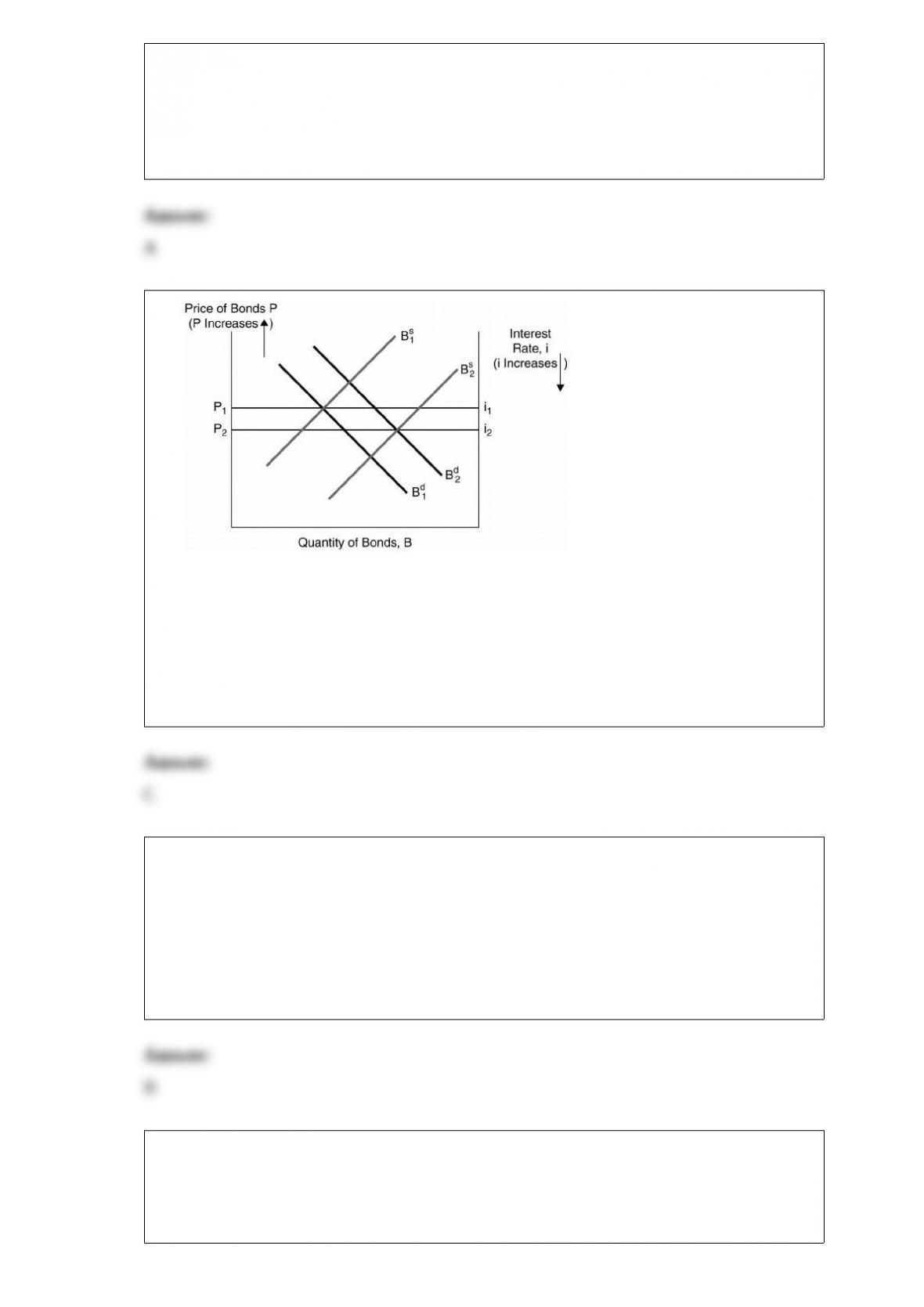
19)
Figure 4.2
In Figure 4.2, one possible explanation for the increase in the interest rate from i1 to i2
is a(n) ________ in ________.
A) increase; the expected inflation rate
B) decrease; the expected inflation rate
C) increase; economic growth
D) decrease; economic growth
20) Insurance companies’ attempts to minimize adverse selection and moral hazard
explain which of the following insurance practices?
A) requiring collateral for policies
B) risk-based premiums
C) compensating balances
D) all of the above
E) only A and B of the above
21) In November 2007, the Fed announced major enhancements to its communication
strategy. Which of the following was a part of the changes?
A) The forecast horizon for the FOMC’s projections was extended from two calendar
years to three

B) The committee publishes FOMC projections four times a year instead of twice a year
C) The release would include a narrative of the forces shaping the outlook and risks to
that outlook
D) All of the above were proposed changes
22) Which of the following are primary concerns of a bank manager?
A) maintaining sufficient reserves to minimize the cost to the bank of deposit outflows
B) extending loans to borrowers who will pay high interest rates, but who are also good
credit risks
C) acquiring funds at a relatively low cost, so that profitable lending opportunities can
be realized
D) all of the above
23) Which of the following statements about financial markets and securities are
TRUE?
A) Few common stocks are traded over-the-counter, although the over-the-counter
markets have grown in recent years
B) A corporation acquires new funds only when its securities are sold in the primary
market
C) Capital market securities are usually more widely traded than longer-term securities
and so tend to be more liquid
D) All of the above are true
E) Only A and B of the above are true
24) If the desired intermediate target is an interest rate, then the preferred operating
target will be a(n) ________ variable like the ________.
A) interest rate; three-month Treasury bill rate
B) interest rate; federal funds rate
C) reserve aggregate; monetary base
D) reserve aggregate; nonborrowed base
25) The purpose of reserve requirements
A) is to limit the expansion of the money supply

B) is to ensure adequate liquidity for the institutions
C) is both A and B of the above
D) is neither A nor B of the above
26) When a financial institution hedges the interest-rate risk for a specific asset, the
hedge is called a ________.
A) macro hedge
B) micro hedge
C) cross hedge
D) futures hedge
27) Options are contracts that give the purchasers the
A) opportunity to buy or sell an underlying asset
B) the obligation to buy or sell an underlying asset
C) the right to hold an underlying asset
D) the right to switch payment streams
28) Under a managed float exchange rate regime, policymakers frequently do not want
to see their currencies depreciate because it makes ________ goods more expensive for
________ consumers and contributes to inflation.
A) foreign; foreign
B) foreign; domestic
C) domestic; foreign
D) domestic; domestic