
Which one of the following is evidence of indebtedness?
A. Terms of sale
B. Credit cost curve
C. Credit instrument
D. Concentration policy
E. Credit policy
Answer:
Which one of the following statements is correct?
A. A prepack is a plan of liquidation used to distribute a firm’s assets.
B. Bankruptcy courts have “cram-down” powers.
C. The absolute priority rule must be strictly followed in all bankruptcy proceedings.
D. Creditors cannot force a firm into bankruptcy even though they might like to do so.
E. A reorganization plan can be approved only if the firm’s creditors all agree with the
plan.
Answer:

Wesson Metals has an outstanding loan that calls for equal annual payments of
$9,768.46 over the life of the loan. The original loan amount was $50,000 at an APR of
8.5 percent. How much of the second loan payment is interest?
A. $3,525.61
B. $3,780.93
C. $4,250.00
D. $5,409.16
E. $5,987.53
Answer:
The spot rate on the Norwegian kroner is 6.689. The exchange rate one year from now
is expected to be 6.745 assuming that relative interest rate parity exists. Interest rates in
Norway are 3.7 percent. What is the interest rate in the U.S.?
A. 2.86 percent
B. 3.02 percent
C. 3.59 percent
D. 4.54 percent
E. 4.68 percent

Answer:
Which one of the following applies to a general partnership?
A. The firm’s operations must be controlled by a single partner.
B. Any one of the partners can be held solely liable for all of the partnership’s debt.
C. The profits of the firm are taxed as a separate entity.
D. Each partner’s liability for the firm’s debts is limited to each partner’s investment in
the firm.
E. The profits of a general partnership are taxed the same as those of a corporation.
Answer:
Computing the present value of a growing perpetuity is most similar to computing the
current value of which one of the following?
A. Non-dividend-paying stock
B. Stock with a constant dividend
C. Stock with irregular dividends

D. Stock with a constant growth dividend
E. Stock with growing dividends for a limited period of time
Answer:
Which of the following terms can be used to describe unsystematic risk?
I. Asset-specific risk
II. Diversifiable risk
III. Market risk
IV. Unique risk
A. I and IV only
B. II and III only
C. I, II, and IV only
D. II, III, and IV only
E. I, II, III, and IV
Answer:
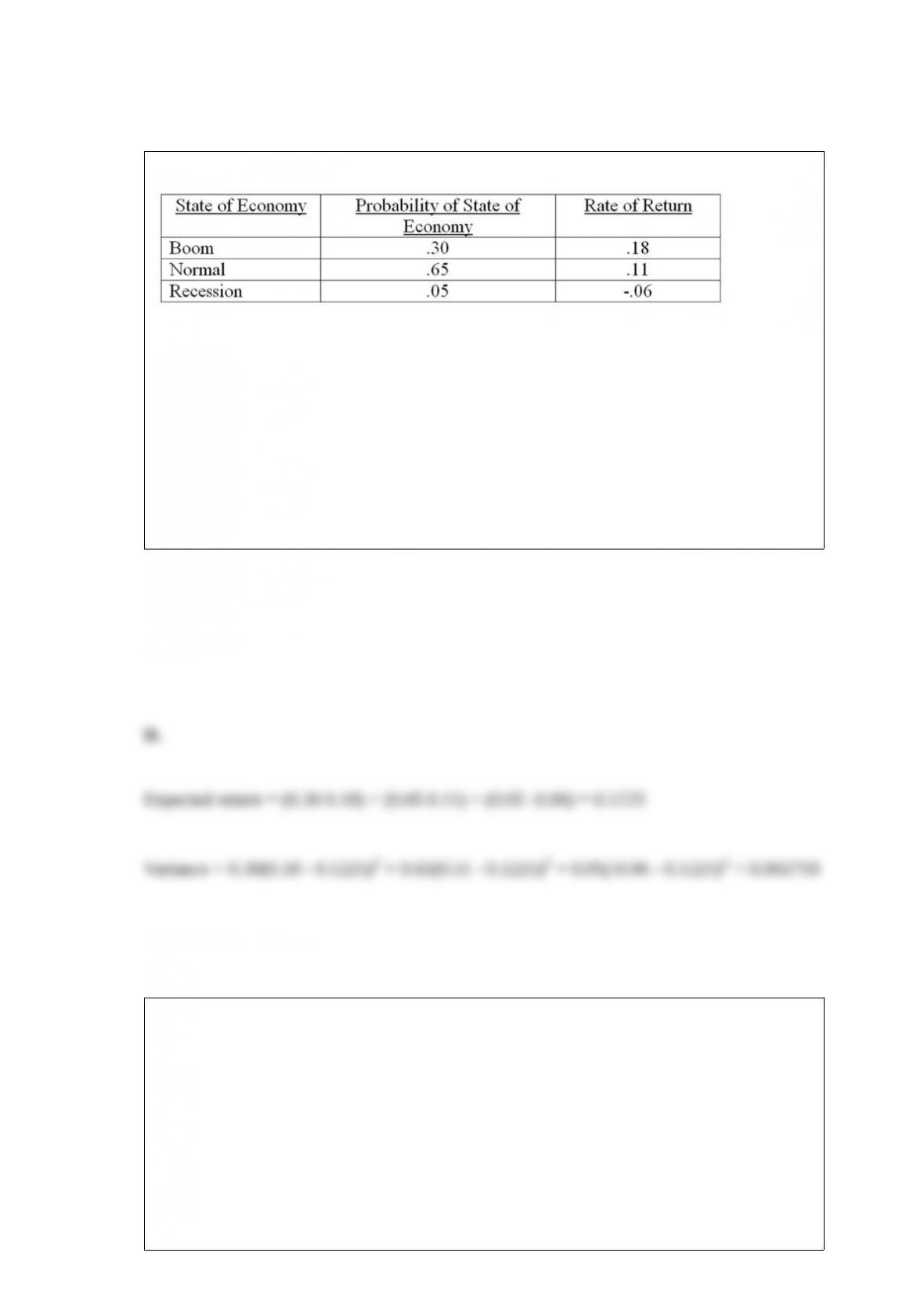
Given the following information, what is the variance of the returns on this stock?
A. 0.002453
B. 0.002663
C. 0.002691
D. 0.002759
E. 0.002914
Answer:
The Farmer’s Market recently announced that it will pay its first annual dividend two
years from today. The first dividend will be $0.50 a share with that amount doubling
each year for the following two years. After that, the dividend is expected to increase by
4 percent annually. What is the value of this stock today if the required return is 10
percent?
A. $23.57
B. $25.16

C. $26.21
D. $28.32
E. $30.18
Answer:
Casper’s is analyzing a proposed expansion project that is much riskier than the firm’s
current operations. Thus, the project will be assigned a discount rate equal to the firm’s
cost of capital plus 3 percent. The proposed project has an initial cost of $17.2 million
that will be depreciated on a straight-line basis over 20 years. The project also requires
additional inventory of $687,000 over the project’s life. Management estimates the
facility will generate cash inflows of $2.78 million a year over its 20-year life. After 20
years, the company plans to sell the facility for an estimated $1.3 million. The company
has 60,000 shares of common stock outstanding at a market price of $49 a share. This
stock just paid an annual dividend of $1.84 a share. The dividend is expected to
increase by 3.5 percent annually. The firm also has 10,000 shares of 12 percent
preferred stock with a market value of $98 a share. The preferred stock has a par value
of $100. The company has a 9 percent, semiannual coupon bond issue outstanding with
a total face value of $1.1 million. The bonds are currently priced at 102 percent of face
value and mature in 16 years. The tax rate is 33 percent. Should the firm pursue the
expansion project at this point in time? Why or why not?
A. Accept; the NPV is $2.648 million.
B. Accept; the NPV is $4.507 million.
C. Reject; the NPV is -$3.241 million.
D. Reject; the NPV is -$3.027 million.
E. Reject; the NPV is -$1.040 million.
Answer:
Kurt, who is a divisional manager, continually brags that his division’s required return
for its projects is 1 percent lower than the return required for any other division of the
firm. Which one of the following most likely contributes the most to the lower rate
requirement for Kurt’s division?
A. Kurt tends to overestimate the projected cash inflows on his projects.
B. Kurt tends to underestimate the variable costs of his projects.
C. Kurt has the most efficiently managed division.

D. Kurt’s division is less risky than the other divisions.
E. Kurt’s projects are generally financed with debt while the other divisions’ projects are
financed with equity.
Answer:
Which one of the following 5 Cs refers to the general economic climate in a customer’s
line of business?
A. Capital
B. Conditions
C. Capacity
D. Character
E. Collateral
Answer:
What is the net present value of a project that has an initial cost of $40,000 and

produces cash inflows of $8,000 a year for 11 years if the discount rate is 15 percent?
A. $798.48
B. $1,240.23
C. $1,869.69
D. $2,111.41
E. $2,470.01
Answer:
The use of borrowing by an individual to adjust his or her overall exposure to financial
leverage is referred to as:
A. M&M Proposition I.
B. capital restructuring.
C. homemade leverage.
D. M&M Proposition II.
E. financial risk management.
Answer:

The computation of which one of the following requires assigning every proposed
investment to a particular risk class?
A. Pure play cost of capital
B. Cost of equity
C. Aftertax cost of debt
D. WACC
E. Subjective cost of capital
Answer:
A broker is an agent who:
A. trades on the floor of an exchange for himself or herself.
B. buys and sells from inventory.
C. offers new securities for sale to dealers only.
D. is ready to buy or sell at any time.
E. brings buyers and sellers together.
Answer:

Essary Brothers has 39,000 shares of stock outstanding at a price per share of $59. How
many shares will be outstanding if the firm does a 3-for-2 stock split?
A. 24,000 shares
B. 39,000 shares
C. 55,667 shares
D. 58,500 shares
E. 61,000 shares
Answer:
Newborn Nursery has 8,000 bonds outstanding with a face value of $1,000 each. The
coupon rate is 6.5 percent and the tax rate is 40 percent. What is the present value of the
interest tax shield?
A. $2.82 million
B. $2.83 million
C. $3.09 million

D. $3.13 million
E. $3.20 million
Answer:
Which one of the following statements is correct?
A. NASDAQ has more listed stocks than does the NYSE.
B. The NYSE is a dealer market.
C. NASDAQ is an auction market.
D. NASDAQ has the most stringent listing requirements of any U.S. exchange.
Answer:
In a typical month, River City Tours received 60 checks totaling $144,000. These are
delayed 3 days on average. What is the average daily float? Assume 30 days in a month.

A. $12,500
B. $13,333
C. $14,400
D. $16,217
E. $16,667
Answer:
High Mountain Gear issued 240,000 shares of stock last week. The underwriters
charged a 7.85 percent spread in exchange for agreeing to a firm commitment. The legal
and accounting fees were $385,000. The company incurred $98,000 in indirect costs
related to management time and other internal expenses. The offer price was $21 a
share. Within the first hour of trading, the stock was selling for $23.20 a share. What
was the flotation cost as a percentage of the funds raised?
A. 21.53 percent
B. 25.29 percent
C. 27.46 percent
D. 33.80 percent
E. 41.22 percent
Answer:

Tim has been promoted and is now in charge of all fixed asset purchases. In other
words, Tim is in charge of:
A. capital structure management.
B. asset allocation.
C. risk management.
D. capital budgeting.
E. working capital management.
Answer: