
1) Investors will be indifferent between two investments if both investments have the
same expected return.
2) Issuers of commercial paper usually maintain lines of credit with banks to back up
their short-term financing needs.
3) Dividends per share divided by earnings per share equal the dividend payout ratio.
4) Leveraged b (los) are used by existing corporate bondholders to increase the rate of
return earned on their bonds.
5) The initial outlay includes the immediate cash outflow necessary to purchase the
asset and put it in operating order.
6) IRR should not be used to choose between mutually exclusive projects.
7) The investor’s required rate of return will equal the firm’s cost of capital if corporate
transactions costs are taken into account.

8) To evaluate or compare investment proposals, we must adjust the value of all cash
flows to a common date.
9) TRL, Inc. has spent $2,000,000 in nonrefundable engineering fees in contemplation
of building a convention center and the additional costs to complete the project are
$18,000,000. The present value of all benefits the center will produce in its lifetime are
$19,000,000, so TRL should not build the convention center.
10) A bond with a par value of $1,000 is listed in the Wall Street Journal at a price of
100.50 . This bond is selling for $1,005.
11) The forecasted retained earnings balance is equal to (current retained
earnings/current sales) times projected sales for next year.
12) Lockbox arrangements may reduce mail float, processing float, and transit float.
13) Using the weighted cost of capital as a cutoff rate assumes that the riskiness of the
project being evaluated is similar to the riskiness of the company’s existing assets.
14) Transactions in common stock occur in the money market, due to the large amount
of money involved in such transactions.

15) Because investors like dividends, the higher the company’s dividend growth rate,
the lower the company’s cost of common equity.
16) In a chattel mortgage, specific items of inventory are identified in the security
agreement.
17) The market rewards the patient investor, for between 1926 and 2008, there has
never been a time when an investor lost money if she held an all-stock portfolio for ten
years.
18) XYZ Corporation has a P/E ratio of 20 and EFG Corporation has a P/E ratio of 10 .
It is likely that
A) XYZ’s earnings per share are twice the earnings per share of EFG
B) investors expect XYZ’s earnings to grow faster than EFG’s earnings
C) investors believe that for the same level of earnings growth, XYZ is a higher risk
company
D) investors believe XYZ stock is overvalued
19) Assume that the British pound is worth 1.6242 U.S. dollars. If a new Jaguar costs
$138,000, what is the cost in British pounds?
A) 201,000
B) 84,965
C) 71,642
D) 119,998
20) Which of the following factors determines the amount that a firm would have

invested in accounts receivable?
A) collection efforts
B) the percentage of credit sales to total sales
C) the volume of sales
D) the terms of sale
E) All of the above.
21) Which of the following is NOT TRUE regarding common stock?
A) Dividends, unlike interest payments, are not tax deductible
B) Common stock, unlike bond principal, does not mature
C) Common stockholders are owners of the firm, whereas bondholders are creditors
D) Dividend payments, like interest payments, are fixed
22) Financial leverage could mean financing some of a firm’s assets with
A) preferred stock
B) retained earnings
C) private equity capital
D) sales revenues
23) Use the “percent of sales method” of preparing pro forma financial statements to
determine the projection for next year’s accounts receivable. Make the following
assumptions: current year’s sales are $45,450,000; current year’s cost of goods sold is
$26,950,000; sales are expected to rise by 20%. The firm’s investment in accounts
receivable in the current year is $8,600,000. The firm’s marginal tax rate is 35%. What
is the projection for next year’s accounts receivable?
A) $11,345,000
B) $10,320,000
C) $9,575,000
D) $8,772,000
24) The Colorado Jet Boat Company had a cash balance of $3 million at the beginning
of 2010 . During 2010, Sales were $8 million and expenses were $7 million. Therefore
A) the cash balance at the end of 2010 is $4 million

B) the cash balance at the end of 2010 must be greater than $3 million
C) the cash balance at the end of 2010 must be less than $11 million
D) the cash balance at the end of 2010 cannot be determined from the information given
25) Suppose the following rates are averages for banks in your area: interest checking
accounts pay 1%, savings accounts pay 2%, and one-year certificates of deposit pay
3%. All accounts are federally insured by the FDIC. The difference in rates can be
explained mainly by
A) liquidity premiums
B) default risk premiums
C) maturity premiums
D) inflation risk premiums
26) The primary purpose of a cash budget is to
A) determine the level of investment in current and fixed assets
B) determine financing needs
C) provide a detailed plan of future cash flows
D) determine the estimated income tax for the year
27) The risk-return trade-off in managing a firm’s working capital involves which of the
following?
A) a trade-off between liquidity and activity
B) a trade-off between debt and equity
C) a trade-off between the firm’s liquidity and its profitability
D) none of the above
28) Today is your 21st birthday and your bank account balance is $25,000. Your
account is earning 6.5% interest compounded quarterly. How much will be in the
account on your 50th birthday?
A) $159,795
B) $162,183
C) $163,832
D) $164,631

29) In an ideal world, which of the following would be used to evaluate firm
performance?
A) book value of assets
B) corporate retained earnings from the day of incorporation
C) accounting assets and profits
D) market value of assets
30) Alloy Corp. is considering the acquisition of a new processing line. The processor
can be purchased for $3,750,000; it will have a 10-year useful life. It will cost $165,000
to ship and $85,250 to install the processor. A recently completed feasibility study that
was performed at a cost of $65,000 indicated that the processor would produce a
positive NPV. The processor will be depreciated using the straight-line method to zero
expected salvage value. Studies have shown that employee-training expenses will be
$125,000. What will be the annual depreciation expense of the processing line for
capital budgeting purposes?
A) $375,000
B) $419,025
C) $390,000
D) $400,025
31) Which of the following statements concerning private placements is MOST correct?
A) Private placements do not involve investment bankers
B) Although not selling the securities to the public, investment bankers may provide
advice on the evaluation of prospective buyers and the terms of sale for private
placements
C) Private placements are limited to stocks, not bonds
D) More than half of all private placements are sold to federal, state, or local
governments or government agencies
32) Amalgamated Mining, Inc. has very high operating leverage due to the capital
intensive nature of the steel business. The firm’s CEO is concerned about the variability
in the firm’s EPS if sales should drop, and decides to take action. Which of the
following will reduce the variability in the firm’s EPS for a given change in sales?
A) The CEO may increase the firm’s financial leverage and hence reduce the variability

by using non-shareholder money to support the business
B) The CEO may decrease the firm’s financial leverage, thus lowering the firm’s total
leverage
C) The CEO may increase the firm’s total leverage by raising money from the sale of
common stock
D) The CEO may issue more corporate bonds and use the proceeds to pay off
short-term liabilities
33) Suppose a U.S. importer purchases an Italian product today but will not pay for it
for 90 days. The cost of the product today is 85,000 euros. The spot exchange rate today
is .7559 euros per dollar. How much is the cost today in dollars?
A) $58,062
B) $56,153
C) $65,683
D) $64,252
34) A firm paid dividends of $10,000, paid interest of $20,000, reduced debt principal
outstanding (paid off debt) in the amount of $100,000, and sold new stock for $150,000.
What was the firm’s cash flow from financing activities?
A) +$20,000 ($20,000 flowed into the firm)
B) -$20,000 ($20,000 flowed out of the firm)
C) +$280,000 ($280,000 flowed into the firm)
D) -$280,000 ($280,000 flowed out of the firm)
35) A corporation has been paying out $1 million per year in dividends for the past
several years. This year, the company wants to pay the $1 million dividend, but can’t.
All of the following are reasons the company cannot continue its dividend payment
policy EXCEPT
A) the company’s net income this year is less than $1 million
B) the company’s retained earnings balance at the end of the year is less than $1 million
C) the company’s cash balance is less than $1 million
D) the company’s liabilities exceed its assets
36) Assume that an investor is offered a choice of a risk-free government bond that is
expected to return 3.5% or a high-risk corporate stock. According to one of the
principles of finance, what would induce the investor to purchase the corporate stock?
A) a return that is substantially lower than 3.5%
B) cash dividends
C) a return that is substantially higher than 3.5%
D) none of the above
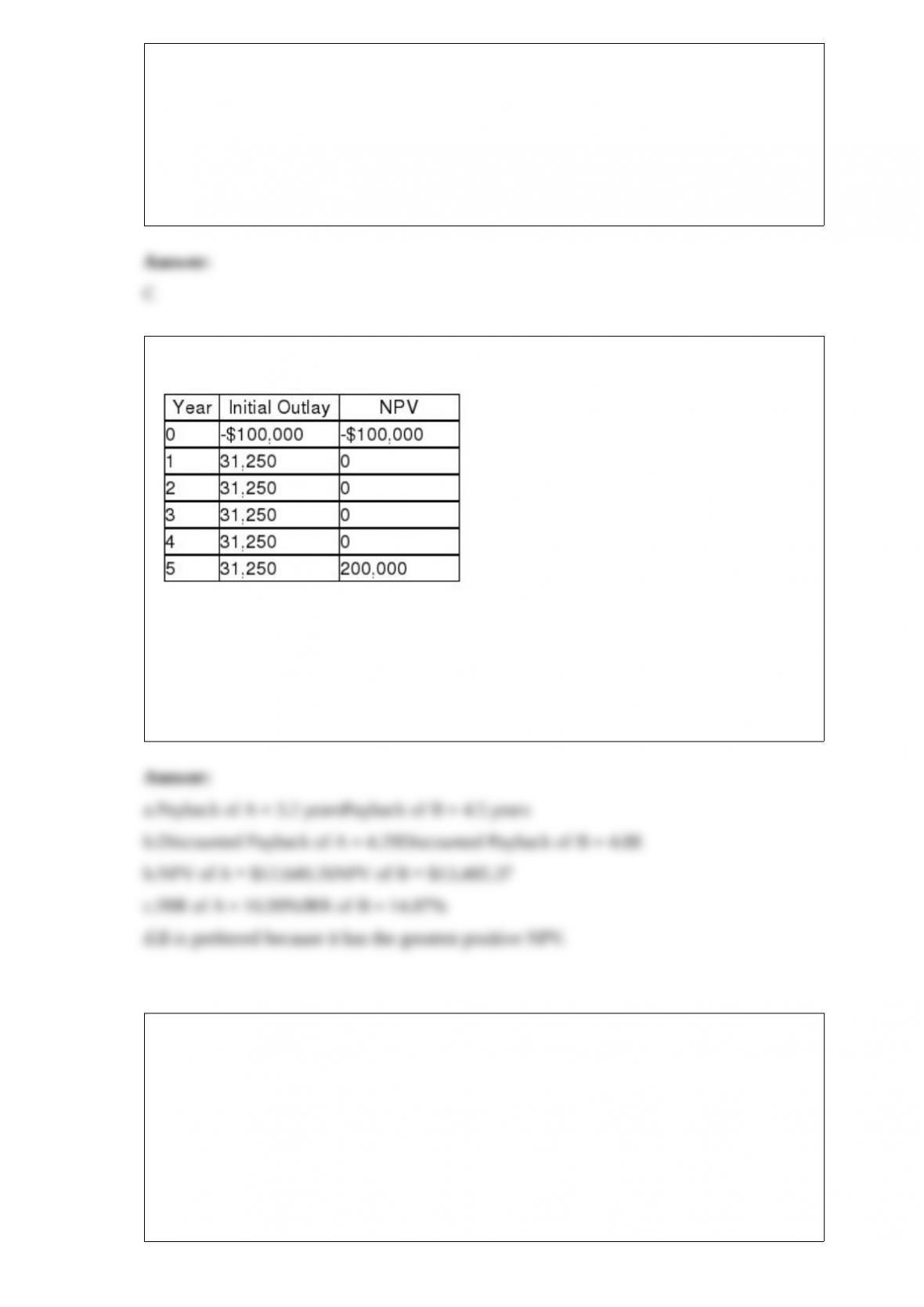
37) The Bolster Company is considering two mutually exclusive projects:
The required rate of return on these projects is 12 percent.
a.What is each project’s payback period?
b.What is each project’s discounted payback period?
c.What is each project’s net present value?
d.What is each project’s internal rate of return?
e.Fully explain the results of your analysis. Which project do you prefer, and why?
38) Lithium, Inc. is considering two mutually exclusive projects, A and B. Project A
costs $95,000 and is expected to generate $65,000 in year one and $75,000 in year two.
Project B costs $120,000 and is expected to generate $64,000 in year one, $67,000 in
year two, $56,000 in year three, and $45,000 in year four. Lithium, Inc.’s required rate
of return for these projects is 10%. The internal rate of return for Project A is
A) 31.43%
B) 29.42%
C) 25.88%
D) 19.45%

39) John Maynard Keynes segmented a firm’s demand for cash into the following
motives:
A) risk, investment, and liquidity
B) transaction, speculative and precautionary
C) transaction, liquidity, and speculative
D) transaction, speculative, and risky
40) Humongous Corporation is a multidivisional conglomerate. The Food Division is
undergoing a capital budgeting analysis and must estimate the division’s beta. This
division has a different level of systematic risk than is typical for Humongous
Corporation as a whole. The most appropriate method for estimating this beta is
A) the regression coefficient from a time series regression of Humongous Corporation
stock returns on a market index
B) to multiply the company’s beta by the ratio of the Food Division’s total
assets/Humongous Corporation total assets
C) the regression coefficient from a time series regression of Food Division’s net
income on the Humongous Corporation’s return on assets
D) the regression coefficient from a time series regression of Food Division’s return on
assets on a market index
41) AFB, Inc.’s dividend policy is to maintain a constant payout ratio. This year AFB,
Inc. paid out a total of $2 million in dividends. Next year, AFB, Inc.’s sales and earnings
per share are expected to increase. Dividend payments are expected to
A) remain at $2 million.
B) increase above $2 million.
C) decrease below $2 million.
D) increase above $2 million only if the company issues additional shares of common
stock.
42) The MAX Corporation is planning a $4,000,000 expansion this year. The expansion
can be financed by issuing either common stock or bonds. The new common stock can
be sold for $60 per share. The bonds can be issued with a 12 percent coupon rate. The
firm’s existing shares of preferred stock pay dividends of $2.00 per share. The
company’s corporate income tax rate is 46 percent. The company’s balance sheet prior
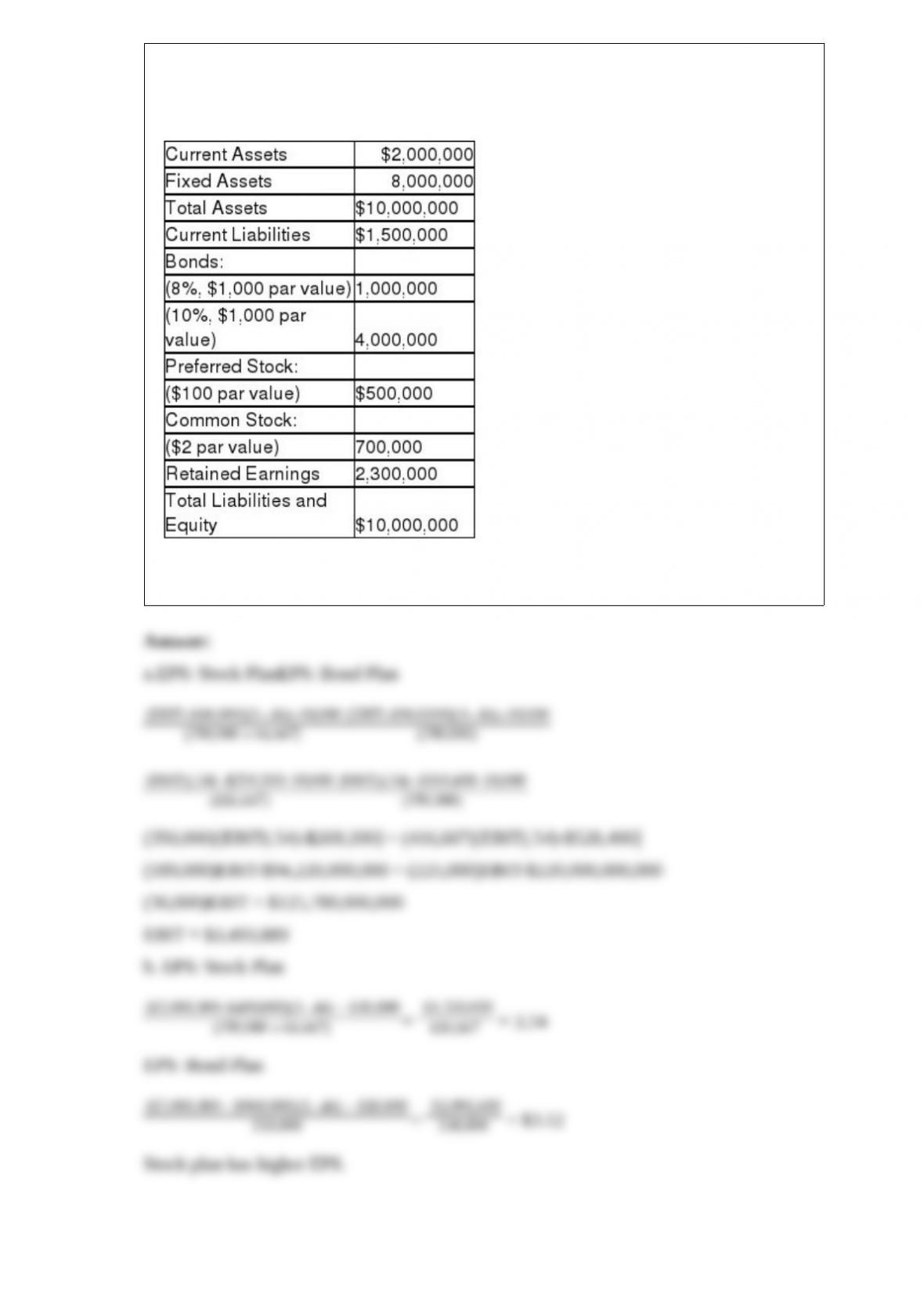
to expansion is as follows:
MAX Corporation
a.Calculate the indifference level of EBIT between the two plans.
b.If EBIT is expected to be $3 million, which plan will result in higher EPS?
43) The net present value method
A) is consistent with the goal of shareholder wealth maximization
B) recognizes the time value of money
C) uses all of a project’s cash flows
D) all of the above
44) If a corporation were to choose between issuing a debenture, a mortgage bond, or a
subordinated debenture, which would have the highest yield to maturity, everything else
equal?
A) the debenture
B) the mortgage bond
C) the subordinated debenture
D) all of the above
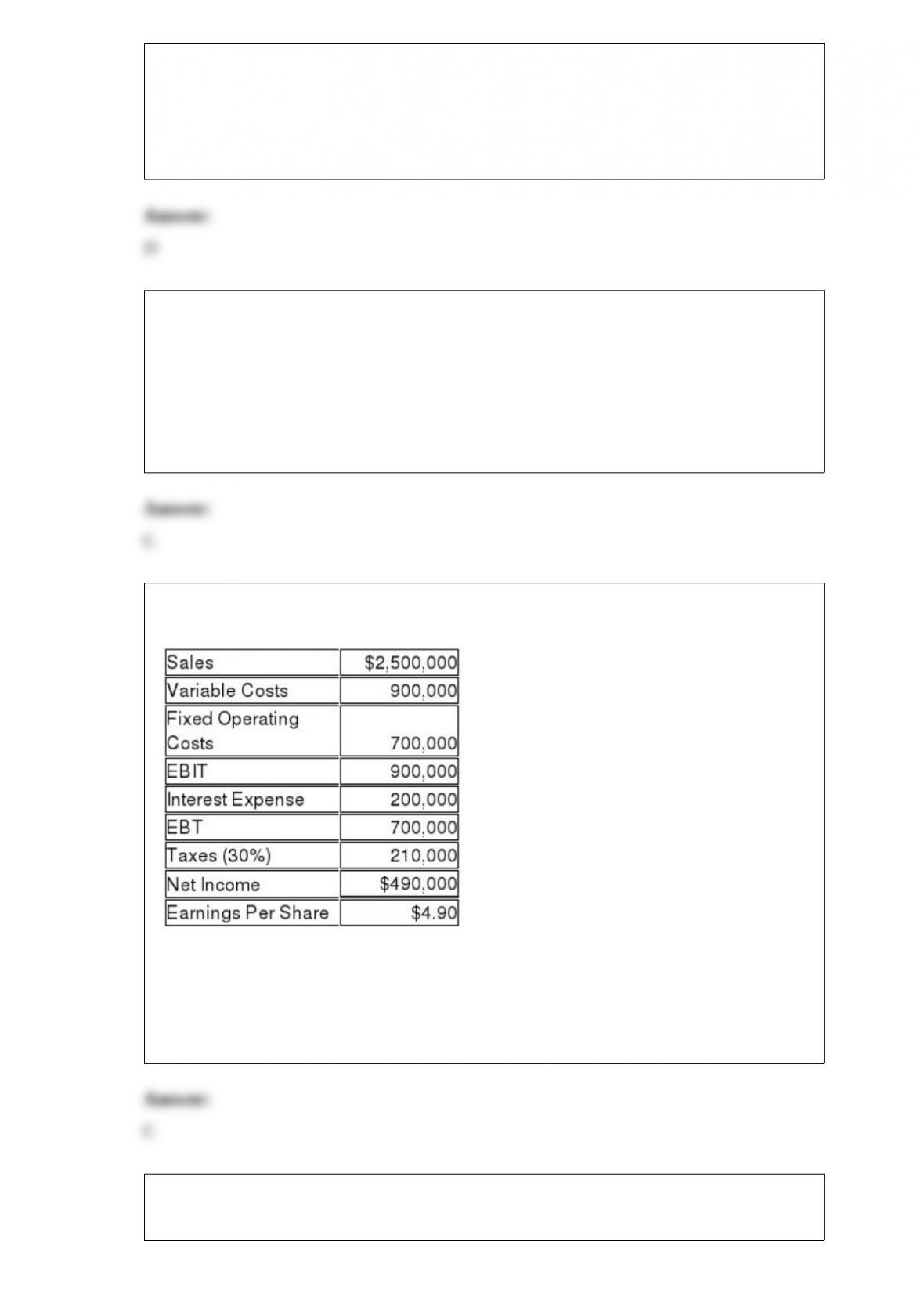
45) ACME, Inc. reported the following income statement for 2009:
If ACME’s sales next year increase by 20%, ACME’s EBIT will increase
A) 20%, showing no operating leverage
B) 20%, showing no financial leverage
C) over 35%, due to operating leverage
D) over 35%, due to operating leverage and financial leverage
46) Discretionary financing needs will be higher if ________. Assume “all else equal.”
A) the firm’s net profit margin increases

B) sales decline
C) the dividend payout ratio is raised
D) excess capacity exists for fixed assets
47) U.S. Savings Bonds are sold at a discount. The face value of the bond represents its
value on its future maturity date. Therefore
A) the current price of a $50 face value bond that matures in 10 years will be greater
than the current price of a $50 face value bond that matures in 5 years
B) the current price of a $50 face value bond that matures in 10 years will be less than
the current price of a $50 face value bond that matures on 5 years
C) the current prices of all $50 face value bonds will be the same, regardless of their
maturity dates because they will all be worth $50 in the future
D) the current price of a $50 face value bond will be higher if interest rates increase
48) Charlie wants to retire in 15 years, and he wants to have an annuity of $50,000 a
year for 20 years after retirement. Charlie wants to receive the first annuity payment the
day he retires. Using an interest rate of 8%, how much must Charlie invest today in
order to have his retirement annuity (round to nearest $10).
A) $167,130
B) $200,450
C) $256,890
D) $315,240
49) Many preferred stocks have a provision that entitles a company to repurchase its
preferred stock from their holders at stated prices over a given time period. What is the
name of this provision?
A) cumulative
B) putable
C) callable
D) convertible