
The Wesson Wisconsin State Bank has purchased a bank-qualified municipal bond with
a coupon rate of 7.5%. The bank had to borrow funds to make this purchase at a cost of
6%. The bank is in the 25% tax bracket. What is the net after-tax return on this
bank-qualified municipal bond?
A. 7.5%
B. 2.7%
C. 3.0%
D. 1.5%
E. None of the options is correct
Answer:
In banking, organizational form follows _________, because banks usually are
organized in such a way as to carry out the tasks and supply the services demanded of
them.
A. bank size
B. management’s decision
C. function
D. regulation
E. location
Answer:
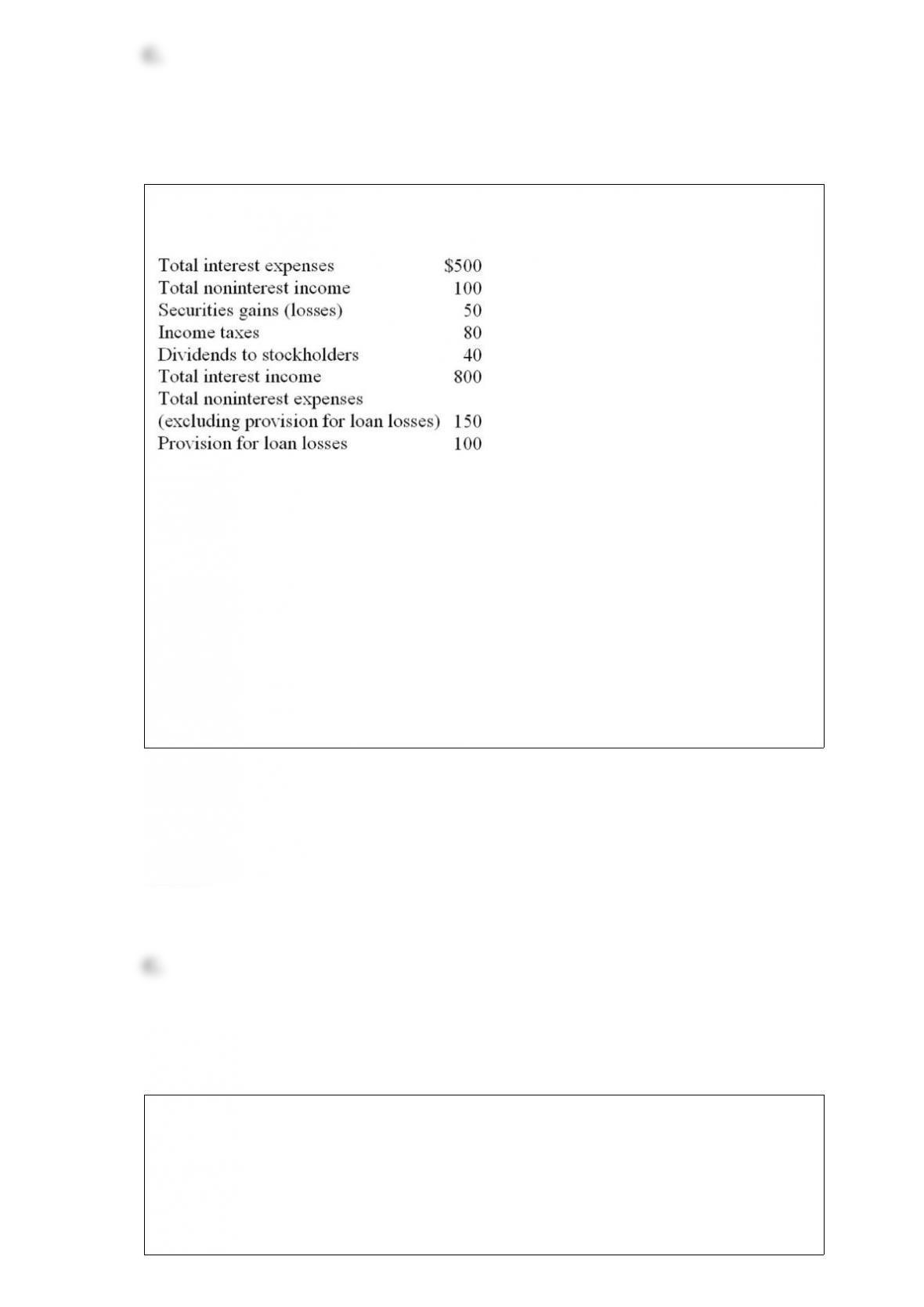
You know the following information about the Davis National Bank:
Given this information, what is the value of this firm’s net noninterest income?
A. $300
B. $150
C. ($150)
D. $120
E. $80
Answer:
A loan to a local business to purchase a new machine would be categorized as:
A. a consumer loan.
B. an agriculture loan.

C. a commercial and industrial loan.
D. a real estate loan.
E. None of the options is correct.
Answer:
A “typical” money center bank: A. has a complex organizational chart.
B. is often plagued by span of control.
C. is owned by a bank holding company.
D. is well diversifiedboth geographically and by product line.
E. All the options are correct.
Answer:
A bank is considering making a loan to Ron Weasley. Ron has a gross salary per month
of $4,000 but has take-home pay of $2,800 per month. What aspect of evaluating a
consumer loan application is this fact most concerned with?
A. Character and purpose

B. Income level
C. Deposit balance
D. Employment and residential stability
E. Pyramiding of debt
Answer:
Which of the following are the implied motivators of reforms that have taken place in
the banking sector since the credit crisis of 2007-2009?
A. Increased liquidity
B. Increased dominance of the largest financial firms
C. Increased disclosure of credit charges and other consumer expenses
D. Increased number of bank branches
E. Increased speed of innovation and invention
Answer:

A bank has an average asset duration of 1.15 years and an average liability duration of
2.70 years. This bank has $250 million in total assets and $225 million in total
liabilities. This bank’s leverage-adjusted duration gap is a:
A. negative gap of 1.55 years.
B. positive gap of 1.28 years.
C. negative gap of 3.85 years.
D. negative gap of 1.28 years.
E. None of the options is correct.
Answer:
Jerry LeGere, a loan officer with First National Bank, checks to see if the house
pledged to back up a home mortgage has a clear title and proper insurance. What step in
the lending process is Jerry performing?
A. Finding prospective customers
B. Evaluating a customer’s character and sincerity
C. Making a site visit and evaluating a customer’s credit history
D. Evaluating a prospective customer’s financial condition
E. Assessing possible collateral and signing the loan agreement
Answer:

A bank plans on borrowing $225 million for 10 days through an RP transaction
collateralized by T-Bills. The current RP rate is 4.5 percent. What is the bank’s total
interest cost in dollars?
A. $10,125,000
B. $1,125,000
C. $281,250
D. $28,125
E. None of the options is correct
Answer:
Senior management of a community bank reports periodically to the:
A. management.
B. managing director.
C. CEO.
D. board of directors.
E. stockholders.
Answer:

Which federal banking act reduces the need for banks to transport paper checks across
the country?
A. The Sarbanes-Oxley Act
B. The USA Patriot Act
C. The Check 21 Act
D. The Fair and Accurate Credit Transactions Act
E. The Bankruptcy Abuse Prevention and Consumer Protection Act
Answer:
A bank has $500 million in checking deposits with interest and non-interest costs of
6%, $250 million in savings and time deposits with interest and non-interest costs of
14%, and $250 million in equity capital with a cost of 25%. The bank has estimated that
reserve requirements, deposit insurance fees and uncollected balances reduce the
amount of money available on checking deposits by 15% and on savings and time
deposits by 4%. What is the bank’s before-tax cost of funds?
A. 15.00%
B. 12.75%
C. 13.29%
D. 15.74%
E. None of the options is correct

Answer:
Which of the following is a category of authentication factors used by federal banking
agencies?
A. Something a customer knows
B. Something a customer has
C. Something a customer is
D. Something a customer knows, has, or is
E. None of the options are correct
Answer:
Which of the following is a characteristic of a swap seller?
A. They generally have a higher credit rating
B. They prefer flexible short-term interest rate
C. They often have a negative duration gap
D. They generally have large holdings of short-term assets

E. All of the options are correct
Answer:
According to the text, which of the following is a trigger that created a wave of mergers
in Europe?
A. Passage of the Riegle-Neal Interstate Banking Act
B. Passage of the Gramm-Leach-Bliley Act
C. Passage of the Bank Merger Act
D. Formation of the European Union
E. Unicredito Italiano’s take-over of Germany’s HUB Group AG
Answer:
Loyola Bank classifies its assets and liabilities and the period (maturity buckets) within
which they are subject to repricing as on March 31, 2015 as follows:
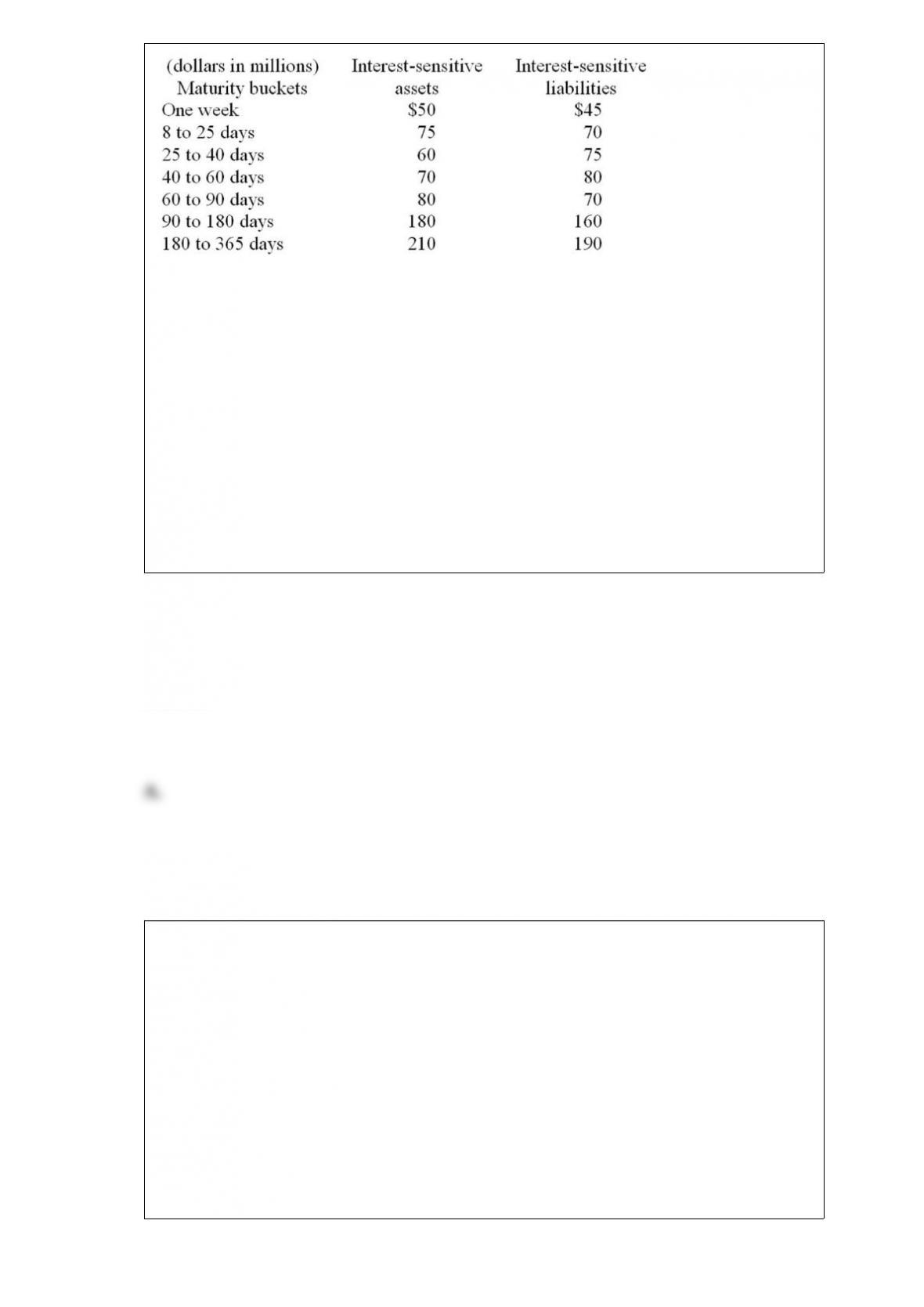
What is the cumulative gap of the bank for interest-sensitive assets and
interest-sensitive liabilities of maturity buckets up to 180 days as on March 31, 2015?
A. -$65 million
B. -$60 million
C. $65 million
D. $60 million
E. $45 million
Answer:
The HTR Bank of Summerville has just calculated the ratios of its money market (short
term) assets to volatile liabilities. Which liquidity indicator is this?
A. Cash position indicator
B. Liquid securities indicator
C. Net federal funds and repurchase agreement position
D. Capacity ratio
E. Hot money ratio

Answer:
The Tidewater State Bank has $1,000 in total assets (all of which are earning assets),
$700 of which will be repriced within the next 90 days. This bank also has $800 in total
liabilities, $400 of which will be repriced within the next 90 days. Currently, the bank is
earning 8 percent on its assets and is paying 5 percent on its liabilities.
If interest rates do not change in the next 90 days, what is this bank’s net interest
margin? A. 8 percent
B. 5 percent
C. 4 percent
D. 1.4 percent
E. 3 percent
Answer:
Which of the following is not a factor considered in the evaluation process of an
installment loan?
A. Evidence of caring for and maintaining property
B. Evidence of stable employment

C. Evidence of residence stability
D. Evidence of income stability
E. All of the options are factors considered in the evaluation of an installment loan
Answer:
The Raymond Burr National Bank has $1,000 in assets with an average duration of 5
years. This bank has $800 in liabilities with an average duration of 6.25 years. What is
the duration gap of this bank?
A. -1.25 years
B. 0 years
C. 1.25 years
D. -2.25 years
E. None of the options is correct.
Answer:

Deposits designed to attract customers who wish to set aside money in anticipation of
future expenditures or financial emergencies are called:
A. drafts.
B. second-party payment accounts.
C. thrift deposits.
D. transaction accounts.
E. None of the options is correct.
Answer:
If a bank has a negative interest-sensitive gap, one of the possible management
responses would be to:
A. lengthen asset maturities.
B. shorten liability maturities.
C. increase interest-sensitive liabilities.
D. decrease interest-sensitive assets.
E. wait for the interest rates to fall or be stable.
Answer:

The Smith-James Bank has an ROE of 17.5%, an asset utilization ratio of 13%, and a
net profit margin of 9%. What is the bank’s equity multiplier?
A. 14.96 times
B. 1.58 times
C. 1.17 times
D. 134.62 times
E. None of the options is correct
Answer:
The Second State Bank has less than $100 million in assets and as a result primarily
makes real estate loans, other consumer loans and loans to very small businesses. What
factor determining the growth and mix of loans does this fact reflect?
A. Characteristics of the market area
B. Lender size
C. The experience and expertise of management
D. The written loan policy of the bank
E. Bank regulations
Answer:

For a bank with deficient capital ratios, which of the following actions could be
required by regulators to increase the capital ratios, all else constant?
A. Cut the bank’s dividend payment.
B. Increase the bank’s leverage.
C. Reduce the bank’s holdings of cash.
D. Increase the bank’s growth rate by making additional commercial loans.
E. Reduce the bank’s holdings of Treasury securities.
Answer:
A bank has an average asset duration of 5 years and an average liability duration of 3
years. This bank has total assets of $500 million and total liabilities of $250 million.
Currently, market interest rates are 10 percent. What will be this bank’s
leverage-adjusted duration gap?
A. 2 years
B. -2 years
C. 3.5 years
D. -3.5 years
E. None of the options is correct.

Answer:
Which of the following would be an example of a nonrepriceable asset?
A. Money the bank has borrowed from the money market
B. Cash in the vault
C. Demand deposits that do not pay an interest rate
D. Short term securities issued by the government about to mature
E. All of the options are correct.
Answer:
Which of the following activities do the banks perform as dealers in arranging for risk
protection for customers from third parties?
A. Hedging services
B. Merchant banking services
C. Investment banking services
D. Mutual funds services
E. Security underwriting services

Answer:
Which of the following is an unresolved issue in the new century?
A. What should be done about the regulatory safety net set up to protect small
depositors?
B. If financial institutions are allowed to take on more risk, how can taxpayers be
protected from paying the bill when more institutions fail?
C. Does functional regulation actually work?
D. Should regulators allow the mixing of banking and commerce?
E. All of these are unresolved issues
Answer: