
The change in the market price of an asset due to a change in market interest rates is
roughly equal to the asset’s duration times the relative change in interest rates attached
to that particular asset.
Answer:
Under FNMA rules for buying home mortgages, FNMA does not purchase a borrower’s
mortgage if the borrower’s credit report is more than 45 days old.
Answer:
The burden of proof is on a bank to demonstrate that its credit scoring system
successfully identifies quality loan applications at a statistically significant level.
Answer:

The liquidity indicator, core deposits divided by total assets, is a measure of stored
liquidity.
Answer:
An account party will seek a standby credit guarantee if the bank’s fee for issuing the
guarantee is less than the value assigned to the guarantee by its beneficiary.
Answer:
The Community Reinvestment Act is designed to prevent a lender from arbitrarily
marking out certain neighborhoods as undesirable and refusing to lend to people who
live in those neighborhoods.
Answer:

The experience method of accounting for future loan loss reserves allows a bank to
deduct from their income statement up to 0.6 percent of their eligible loans.
Answer:
The main use of federal funds today is still the traditional one. Federal funds provide a
mechanism that allows banks short of legal reserves to satisfy the reserve requirements
or to satisfy a loan demand by tapping into immediately available funds from other
institutions possessing temporarily idle funds.
Answer:
Liquidity risk examines the quality of a bank’s assets and, in particular, the quality of
the bank’s loans.
Answer:

The 2007-2009 credit crunch resulted in numerous banks experiencing financial distress
for which mergers and acquisitions were often the only option.
Answer:
“Public need” is usually established with federal or state chartering authorities by
showing that existing banks in the area are adequately profitable and have satisfactory
amounts of capital.
Answer:
As a consequence of recent legislation, banks cannot offer insurance products or
services.
Answer:

U.S. Treasury bond futures contracts call for the future delivery of U.S. T-bonds with
minimum denominations of $100,000 and minimum maturities of 15 years.
Answer:
An international bank’s net position in a foreign currency is measured by the difference
between the volume of that currency purchased and the volume of that currency sold.
Answer:
The basic weakness of the cost-plus loan pricing method is that it gives little regard to
the competition from other lenders while setting the loan price.
Answer:

Banks tend to have a higher proportion of outside directors than a typical manufacturing
firm.
Answer:
Loans granted to businesses appear to convey positive information to the market place
about a borrower’s credit quality, enabling a borrower to obtain more and cheaper funds
from other sources.
Answer:
Financial securities that are the same in all other ways may have differences in interest
rates that reflect the differences in the ease of selling the security in the secondary
market at a favorable price.

Answer:
Recent research suggests that branch banks tend to be more profitable than either unit
or holding company banks, while interstate banks tend to be the most profitable of all.
Answer:
A bank’s asset utilization ratio reflects the effectiveness of the bank’s expense
management.
Answer:
Competition tends to raise deposit interest costs.
Answer:

The most important factor used in the FICO credit score appears to be the borrower’s
payment history.
Answer:
Servicing rights on loans sold consist of the collection of interest and principal
payments from borrowers and monitoring borrower compliance with loan terms.
Answer:
Affirmative covenants restrict a borrower from doing certain things, like taking on new
debt without the lender’s approval.

Answer:
When a bank examines a borrower’s operating efficiency, it is looking at the protection
afforded to creditors from the borrower’s earnings.
Answer:
The optimal choice for a new branch site must be one that offers the bank the highest
expected rate of return on the capital invested in the project.
Answer:
Agency theory suggests that bank management will always pursue the goal of
maximizing returns of the bank’s shareholders.

Answer:
Robberies of cash from banks have declined in recent years.
Answer:
The Truth in Savings Act requires a bank to disclose to its deposit customers, the
frequency with which interest is compounded on all interest-bearing accounts.
Answer:
According to the textbook, high-volume transactions are required to make efficient use
of automation and other technological innovations.
Answer:

Term loans look primarily to the flow of future earnings of the borrowing business firm
to amortize and retire its loan.
Answer:
The principal reason why banks are chartered by federal and state governments is to
make loans to their customers.
Answer:
All of the following types of loans are available through the discount window except:
A. adjustment credit.
B. primary credit.
C. secondary credit.

D. seasonal credit.
E. None of the options is correct.
Answer:
Which of the following is true of the price leadership loan pricing method?
A. It does not consider the marginal cost of raising funds.
B. It does not give much regard for the competition from other lenders.
C. The bank must know what their costs are in order to make correctly priced loans.
D. The bank must consider the revenues and expenses from all of the bank’s dealings
with the customer.
E. None of the options is correct.
Answer:
The Taylor Treadwell Bank has just calculated the ratio of its net loans and leases to
total assets. Which liquidity indicator is this?

A. Cash position indicator
B. Liquid securities indicator
C. Net federal funds and repurchase agreement position
D. Capacity ratio
E. None of the options is correct
Answer:
Which of the following is not an advantage of ATMs?
A. Personalized service
B. Cost per transaction
C. Number of transactions processed
D. Staffing needs
E. Geographic accessibility
Answer:

A bank that primarily makes its loans to individuals, families, and small businesses is
categorized as:
A. a retail bank
B. a wholesale lender
C. a money center bank
D. a money market bank
E. None of the options is correct
Answer:
A bank has $200 million in assets in the 0 percent risk-weight category. It has $400
million in assets in the 20 percent risk-weight category. It has $1,000 million in assets
in the 50 percent risk-weight category and has $1,000 million in assets in the 100
percent risk-weight category. This bank has $96 million in Tier 1 capital and $48
million in Tier 2 capital. What is this bank’s ratio of Tier 2 capital to risk assets?
A. 6.08 percent
B. 3.04 percent
C. 9.11 percent
D. 5.54 percent
E. None of the options is correct.
Answer:

A bank has Federal funds totaling $25 million with an interest-rate sensitivity weight of
1.0. This bank also has loans of $105 million and investments of $65 million with
interest rate sensitivity weights of 1.40 and 1.15 respectively. It also has $135 million in
interest-bearing deposits with an interest rate sensitivity weight of 0.90 and other
money market borrowings of $75 million with an interest rate sensitivity weight of 1.0.
What is the weighted interest-sensitive gap for this bank?
A. $50.25 million
B. -$15.00 million
C. -$50.25 million
D. $34.25 million
E. $196.5 million
Answer:
Of the principal reasons for regulating banks, what was the primary purpose of the
Federal Reserve Act of 1913?
A. Establishment of a network to clear and collect checks
B. Control of the money supply
C. Preventing banks from realizing monopoly powers
D. Ensuring an adequate and fair supply of loans
E. None of the options are correct.

Answer:
Interest payments on regular checking accounts were prohibited in the United States
under terms of the:
A. Glass-Steagall Act.
B. McFadden-Pepper Act.
C. National Bank Act.
D. Garn-St. Germain Depository Institutions Act.
E. None of the options is correct.
Answer:
The interest rate on a Fed funds loan is:
A. decided by the Federal Reserve Board.
B. based on LIBOR.
C. decided by the U.S. Treasury Department.
D. subject to negotiation between the borrower and the lender.

E. based on Euribor.
Answer:
Which of the following is an example of a commercial bank?
A. State and local government retirement funds
B. Foreign banking offices in the United States
C. Finance and mortgage companies
D. Property/casualty and other insurers
E. Mutual funds
Answer:
Tammy Payne wants to buy a used car and wants a loan that she will pay off over the
next three years with monthly payments. Which of the following categories will this
loan fall into?
A. Residential mortgage loan

B. Installment loan
C. Noninstallment loan
D. Revolving line of credit
E. None of the options is correct
Answer:
Royal Bank of New York, a U.S. national bank, has $25 million in capital and surpluses
and $42 million in total time and savings deposits. Average revenue for the bank in the
last three years is $8.5 million and a net interest income of $2.1 million. What is the
maximum volume of real estate loans that the bank can make?
A. $25 million
B. $29.4 million
C. $8.5 million
D. $25.5 million
E. $2.1 million
Answer:
A firm has net sales of $25,000, costs of goods sold of $10,000, selling, general and
administrative expenses of $8,000 (of which $2,000 are depreciation expenses), and
taxes (in cash) of $3,000. What is this firm’s operating cash flow (using the traditional
or direct method)?
A. $4,000
B. $15,000
C. $6,000
D. $8,000
E. None of the options is correct.
Answer:
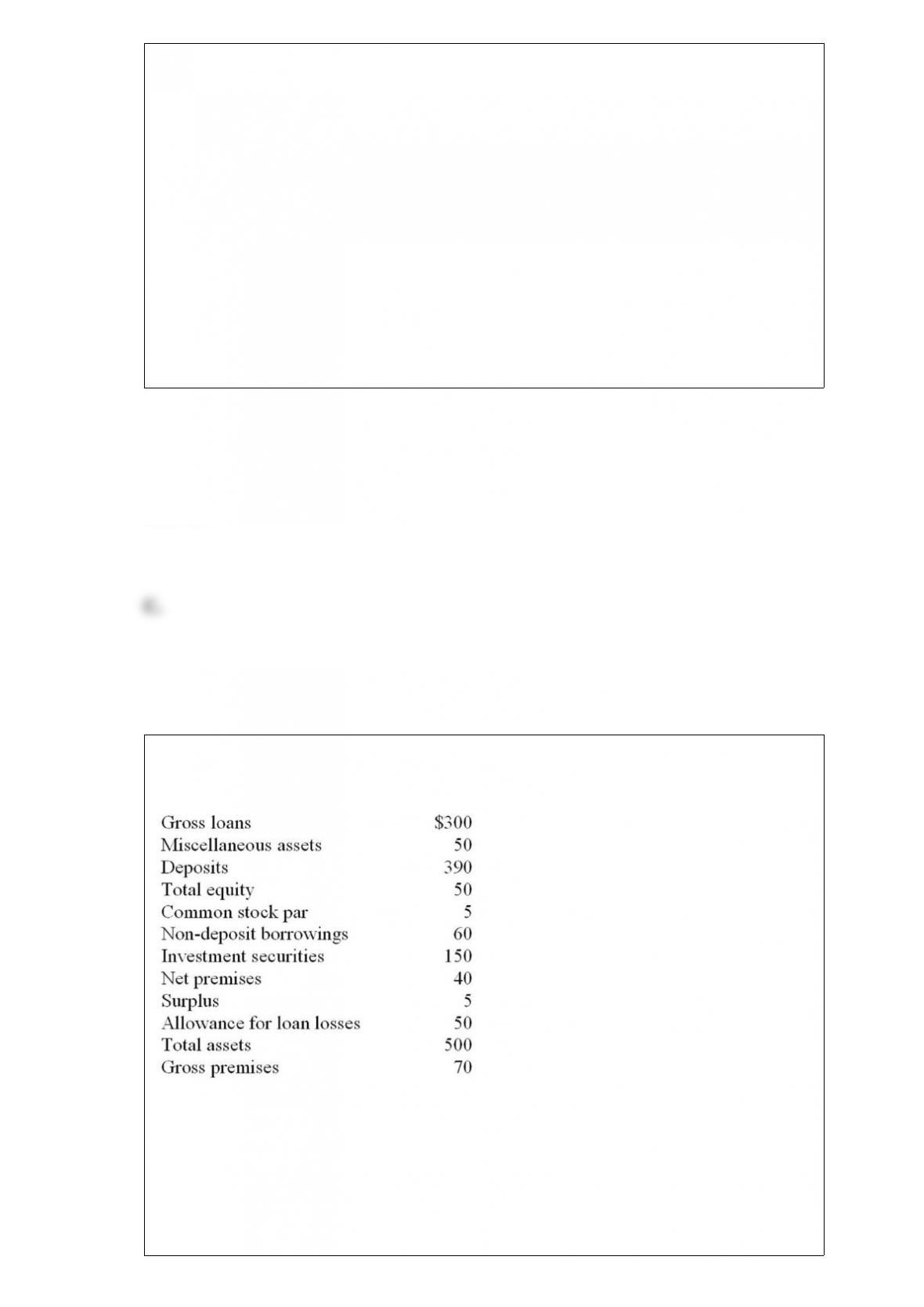
You know the following information about the Miller State Bank:
Given this information, what the value of this firm’s undivided profits?
A. $50
B. $5

C. $10
D. $40
E. $450
Answer:
Which federal banking act prohibits publishing false or misleading information about
the financial performance of a public company and requires top corporate officers to
vouch for the accuracy of their company’s financial statements?
A. The Sarbanes-Oxley Act
B. The USA Patriot Act
C. The Check 21 Act
D. The Fair and Accurate Credit Transactions Act
E. The Bankruptcy Abuse Prevention and Consumer Protection Act
Answer:
A bank expects to raise $20 million in new money if it pays a deposit rate of 7%, $60

million in new money if it pays a deposit rate of 7.5%, $100 million in new money if it
pays a deposit rate of 8%, and $120 in new money if it pays a deposit rate of 8.5%. The
bank expects to earn 9.5% on all money that it receives in new deposits. What is the
marginal cost of deposits if the bank raises their deposit rate from 8 to 8.5%?
A. 11%
B. 8.75%
C. 7.75%
D. 7%
E. 0.5%
Answer:
Which of the following trust agreements allows the bank trust officer to act on behalf of
a living customer?
A. Revocable trust
B. Irrevocable trust
C. Charitable trust
D. Indenture trust
E. None of the options is correct.
Answer:

Which of the following is a reason for standby credit letters’ growth in the recent
years?
A. The growth of bank loans sought by companies in recent years
B. The decreased demand for risk-reduction devices
C. Regulatory embargo on traditional lenders
D. The rapid growth of direct financing by companies
E. All of the options are correct
Answer:
The doctrine that the first priority of a bank is to make loans to all those customers from
whom the bank expects to receive positive net earnings is called the: A. funds
management doctrine.
B. customer relationship doctrine.
C. loan priority doctrine.
D. revenue flows doctrine.
E. None of the options is correct.
Answer:

The underlying on the Eurodollar futures contract is the: A. U.S. dollar.
B. Euro.
C. U.S. T-bills.
D. Eurodollar CD paying three-month LIBOR rate.
E. 10-year U.S. treasuries.
Answer:
Which of the following is true of the cost-plus loan pricing method?
A. It takes the whole customer relationship into account.
B. It gives much regard for the competition from other lenders.
C. It assumes the bank’s costs in order to make correctly priced loans.
D. It takes into consideration the prime rate to correctly price a loan.
E. All of the options are correct.
Answer:

A bank’s stock price will tend to rise if the:
A. value of the stream of future stockholder dividends is expected to increase.
B. banking organization’s perceived level of risk increases.
C. expected dividends decrease.
D. All of the options are correct.
E. None of the options is correct.
Answer:
A swap where the notional amount accumulates over time is called:
A. a quality swap
B. a bullet swap
C. an amortizing swap
D. an accruing swap
E. None of the options are correct
Answer:

Andover Bank is planning to purchase Berkley Bank. The current market value of
Andover’s stock is $55 per share while that of Berkley’s stock is $15 per share. Andover
plans to pay Berkley’s stockholders a $5 bonus per share. Currently, Andover has
100,000 shares outstanding and earnings per share of $12, while Berkley has 50,000
shares outstanding and earnings per share of $5. Suppose that the earnings of the new
bank are $1,600,000 and the combined bank will have 118,182 shares outstanding.
What will be the earnings per share for the new bank?
A. $17.00 per share
B. $13.54 per share
C. $9.67 per share
D. $12.27 per share
E. None of the options is correct
Answer:
Under the Bank Holding Company Act, control of a bank is assumed to exist only if:
A. The bank holding company acquires 100% of at least one bank’s outstanding stock
B. The bank holding company acquires 50% or more of at least one bank’s outstanding
stock
C. The bank holding company acquires 25% or more of at least one bank’s outstanding
stock

D. The bank holding company acquires at least three banks
E. None of the options are correct
Answer:
The _________________________________ is a measure of the market concentration
in a given market area. The larger this number, the more concentrated the market.
Answer:
Consolidation, particularly among saving associations, finance companies, credit
unions, security firms, and insurance companies, is:
A. occurring at a rapid pace.
B. non-existent.
C. occurring at a slow pace.
D. disapproved of by the regulators.
E. None of the options are correct.

Answer:
Which of the following would be an example of crime risk? A. A bank manager
embezzles $1,000,000 from the bank.
B. A bank that loses $500,000 from trading in foreign currencies.
C. A $1,000,000 loan given to a business on which no interest and principal has been
collected in 2 years.
D. A bank manager predicts that interest rates will rise. However, interest rates fall
causing the bank ‘s net income to fall by $250,000.
E. All of the options are examples of crime risk.
Answer:
Under the Truth in Savings Act, a bank must inform its customers of the terms being
quoted on their deposits. Which of the following is not one of the terms listed?
A. Interest rate information
B. Balance computation method
C. Early withdrawal penalty
D. Transaction limitations
E. Minimum balance requirements

Answer:
An average new bank branch today reaches the break-even point in:
A. 12 months.
B. 18 months.
C. 24 months.
D. 5 years.
E. 10 years.
Answer:
Which of the following is not a weakness of Basel I risk-based capital standards?
A. They ignore interest rate risk
B. They ignore changes in value due to currency value changes
C. They ignore changes in value due to commodity price changes
D. They ignore credit risk

E. They ignore the market value
Answer:
A bank has determined that its marginal cost of raising funds is 4.5 percent and that its
nonfunds costs to the bank are 0.5 percent. It has also determined that its margin to
compensate the bank for default risk for a particular customer is .30 percent. It has also
determined that it wants to have a profit margin of .3 percent. What business loan model
is this bank using to price the loan for this customer?
A. The cost-plus loan pricing method
B. The price leadership model
C. The below-prime rate pricing model
D. Customer profitability analysis
E. None of the options is correct.
Answer:
The __________________________ is equal to the duration of each individual type of
asset weighted by the market value of each type of asset out of the total market value of
all assets.

Answer:
A(n) __________________________ is where the financial institution agrees to
guarantee repayment of a customer’s loan, which the customer has received from a third
party.
Answer:
__________________________ is the difference between interest-sensitive assets and
interest-sensitive liabilities.
Answer:
The _____________________________ is the center of authority and decision making

within the Federal Reserve. It consists of seven members appointed by the president for
terms not exceeding 14 years.
Answer:
In a loan workout process, the preferred option is nearly always to seek a ___________,
which gives both the lending institution and its customer a chance to restore normal
operations.
Answer:
When the assets items on a bank’s balance sheet and each off-balance-sheet
commitment it has made are multiplied by the appropriate risk-weighting factor, they
are often called ________________________.
Answer:

One of the three types of loans in the Fed Funds market, __________________ loans
are longer-term Fed funds contracts lasting several days, weeks or months, often
accompanied by a written contract.
Answer:
Interest sensitive assets less interest sensitive liabilities divided by total assets of the
bank is known as _______________________.
Answer:
_________________________ are the deposits and other borrowings of a bank which
are very interest sensitive or the ones bank is sure will be withdrawn during the current
period.
Answer:

The _____________________ makes it faster and less costly for banks to clear checks.
It allows for banks to electronically send check images instead of shipping paper checks
across the country.
Answer:
The __________________ premium on a bond reflects the differences in the ease and
ability to sell the bond in the secondary market at a favorable price.
Answer:
There has been an exponential growth in the ___________________ market in recent
years. These instruments rest on pools of credit derivatives that mainly insure against
defaults on corporate bonds. The creators of these instruments do not have to buy and
pool actual bonds but can create these instruments and generate revenues from selling
and trading in them.

Answer:
A(n) ________________________ is a corporation chartered for the specific purpose
of holding the stock of one or more banks, often along with other businesses.
Answer:
In the ______________________ method of acquisition, a bank purchases all or a
portion of another bank’s assets.
Answer:
The cumulative impact of all the risks (market risk, credit risk, operational risk, and
legal and compliance risk) put together that can affect a financial firm’s long-run
survival is often referred to as _________________________.

Answer:
Securities sold by Fannie Mae, Freddie Mac, and other similar agencies owned or
sponsored by the federal government are known as ________________________.
Answer:
A(n) _________________________ is a form of loan sale where the ownership of a
loan is transferred to the buyer of the loan, who then has a direct claim against the
borrower.
Answer:
The state banking commissions (at the state level) and the Office of the Comptroller of
the Currency (at the federal level) are the only ones able to issue a(n)
______________________ for a new U.S. bank.

Answer: