
The duration of a perpetuity with a yield of 10% is
A. 13.50 years.
B. 11 years.
C. 6.66 years.
D. Cannot be determined
Suppose you own two stocks, A and B. In year 1, stock A earns a 2% return and stock B
earns a 9% return. In year 2, stock A earns an 18% return and stock B earns an 11%
return. __________ has the higher arithmetic average return.
A. Stock A
B. Stock B
C. The two stocks have the same arithmetic average return.
D. At least three periods are needed to calculate the arithmetic average return.
Fama and MacBeth (1973) found that the relationship between average excess returns
and betas was
A. linear.
B. nonexistent.
C. as expected, based on earlier studies.
D. linear and as expected, based on earlier studies.
E. Fama and MacBeth did not examine the relationship between excess returns and
beta.

Sunshine Corporation is expected to pay a dividend of $1.50 in the upcoming year.
Dividends are expected to grow at the rate of 6% per year. The risk-free rate of return is
6%, and the expected return on the market portfolio is 14%. The stock of Sunshine
Corporation has a beta of 0.75. The intrinsic value of the stock is
A. $10.71.
B. $15.00.
C. $17.75.
D. $25.00.
The growth in dividends of XYZ, Inc. is expected to be 10% per year for the next two
years, followed by a growth rate of 5% per year for three years. After this five-year
period, the growth in dividends is expected to be 2% per year, indefinitely. The required
rate of return on XYZ, Inc. is 12%. Last year’s dividends per share were $2.00. What
should the stock sell for today?
A. $8.99
B. $25.21
C. $40.00
D. $110.00
E. None of the options are correct.
A hedge fund pursuing a ______ strategy is betting one sector of the economy will
outperform other sectors.
A. directional
B. nondirectional
C. stock or bond
D. arbitrage or speculation
E. None of the options are correct.
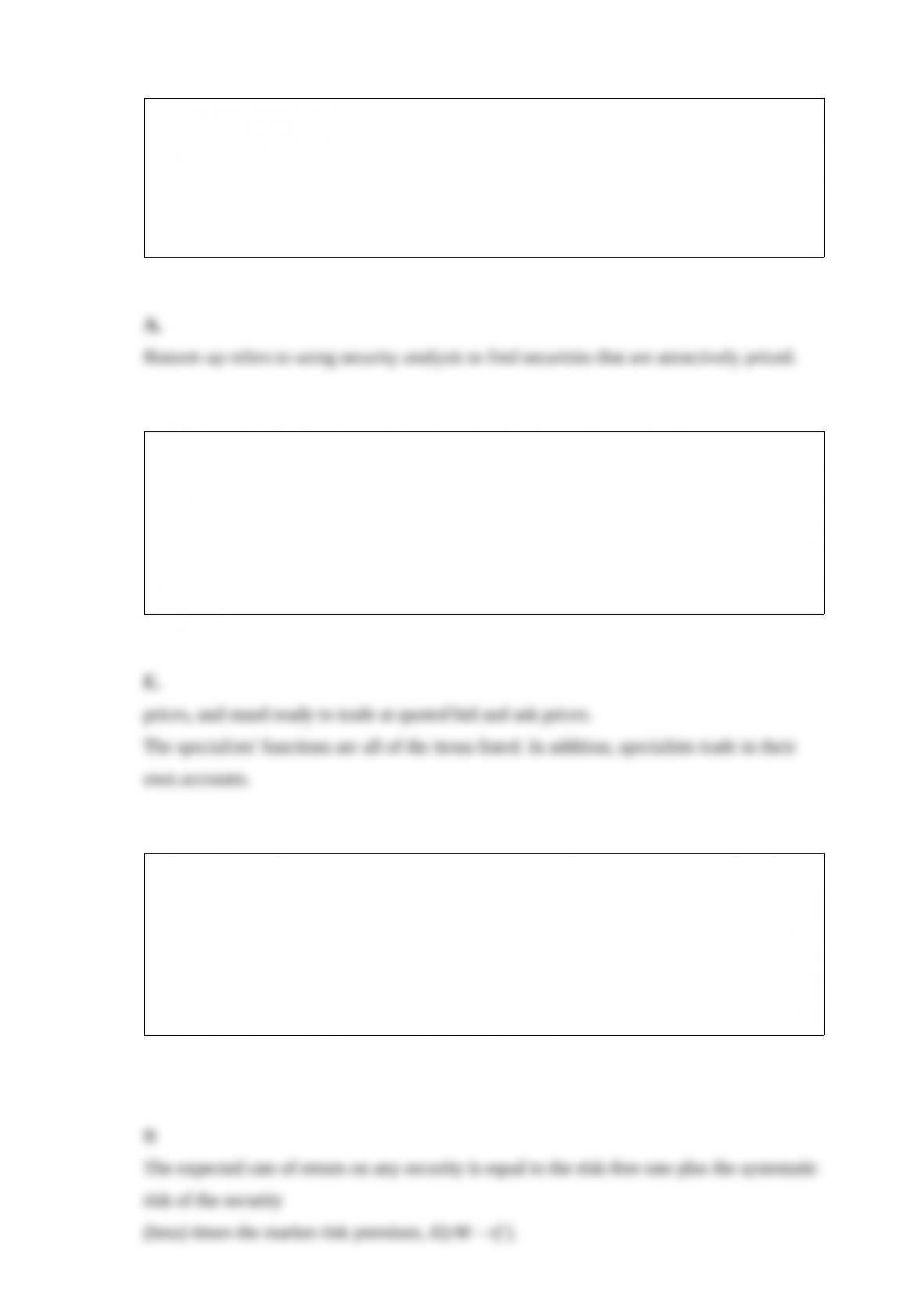
The following data are available relating to the performance of Monarch Stock Fund
and the market portfolio:
The risk-free return during the sample period was 4%.
Calculate Jensen’s measure of performance for Monarch Stock Fund.
A. 1.00%
B. 2.80%
C. 44.00%
D. 50.00%

The means by which individuals hold their claims on real assets in a well-developed
economy are
A. investment assets.
B. depository assets.
C. derivative assets.
D. financial assets.
E. exchange-driven assets
A peak is
A.-a transition from an expansion in the business cycle to the start of a contraction.
B. a transition from a contraction in the business cycle to the start of an expansion.
C. a depression that lasts more than three years.
D. only a feature of geography and not an investment term.
E. None of the options are correct.
If you took a short position in two S&P 500 futures contracts at a price of 1,510 and
closed the position when the index futures was 1,492, you incurred
A. a gain of $9,000.
B. a loss of $9,000.
C. a loss of $18,000.
D. a gain of $18,000.
E. None of the options are correct.
Which of the following portfolio construction methods starts with asset allocation?
A. Top-down
B. Bottom-up
C. Middle-out
D. Buy and hold
E. Asset allocation
Which of the following statements regarding the specialist are true?
A. Specialists maintain a book listing outstanding, unexecuted limit orders.
B. Specialists earn income from commissions and spreads in stock prices.
C. Specialists stand ready to trade at quoted bid and ask prices.
D. Specialists cannot trade in their own accounts.
E. Specialists maintain a book listing outstanding, unexecuted limit orders, earn income
from commissions and spreads in stock
According to the Capital Asset Pricing Model (CAPM), the expected rate of return on
any security is equal
To
A. r f + [E(r M)].
B. r f + [E(r M) – r f ].
C. [E(rM) – r f ].
D. E(r M) + r f .
Suppose you forecast that the market index will earn a return of 12% in the coming
year. Treasury bills are yielding 4%. The unadjusted β of Mobil stock is 1.50. A
reasonable forecast of the return on Mobil stock for the coming year is _________ if
you use a common method to derive adjusted betas.
A. 15.0%
B. 15.5%
C. 16.0%
D. 14.7%
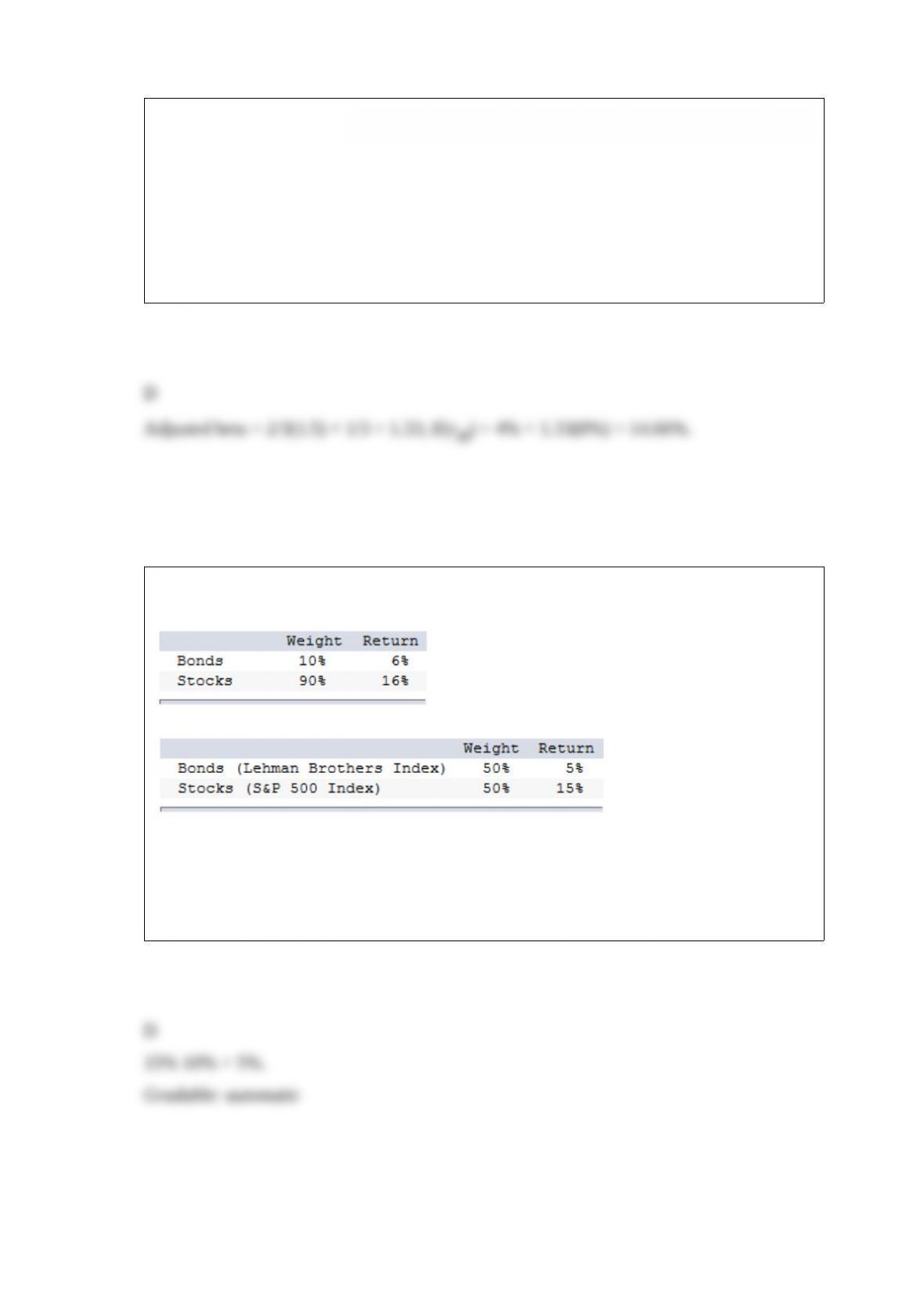
In a particular year, Aggie Mutual Fund earned a return of 15% by making the
following investments in the following asset classes:
The return on a bogey portfolio was 10%, calculated as follows:
The total excess return on the Aggie managed portfolio was
A. 1%.
B. 3%.
C. 4%.
D. 5%.
A CDS is a
A. command duty supervisor.
B. collateralized debt security.
C. commercial debt servicer.
D. collateralized debenture security.
E. credit default swap.
The Food and Drug Administration (FDA) just announced yesterday that they would
approve a new cancer-fighting drug from King. You observe that King had an abnormal
return of 0% yesterday. This suggests that
A. the market is not efficient.
B. King stock will probably rise in value tomorrow.
C. King stock will probably fall in value tomorrow.
D. the approval was already anticipated by the market.
To hedge a short position in Treasury bonds, an investor would most likely
A. ignore interest rate futures.
B. buy S&P futures.
C. buy interest rate futures.
D. sell Treasury bonds in the spot market.
Perfect timing ability is equivalent to having __________ on the market portfolio.

A.a call option
B. a futures contract
C. a put option
D. a commodities contract
A variety of factors relating to industry structure affect the performance of the firm,
including
A. threat of entry.
B. rivalry between existing competitors.
C. the state of the economy.
D. threat of entry and the state of the economy.
E.-threat of entry and rivalry between existing competitors.
Two firms, C and D, both produce coat hangers. The price of coat hangers is $1.20
each. Firm C has total fixed costs of $750,000 and variable costs of 30 per coat hanger.
Firm D has total fixed costs of $400,000 and variable costs of 50 per coat hanger. The
corporate tax rate is 40%. If the economy is strong, each firm will sell 2,000,000 coat
hangers. If the economy enters a recession, each firm will sell 1,400,000 coat hangers.
If the economy is strong, the after-tax profit of firm C will be
A. $0.
B. $6,000.
C. $36,000.
D. $60,000.
E.-$630,000.
Assume there is a fixed exchange rate between the Canadian and U.S. dollar. The
expected return and standard deviation of return on the U.S. stock market are 18% and
15%, respectively. The expected return and standard deviation on the Canadian stock

market are 13% and 20%, respectively. The covariance of returns between the U.S. and
Canadian stock markets is 1.5%.
If you invested 50% of your money in the Canadian stock market and 50% in the U.S.
stock market, the standard deviation of return of your portfolio would be
A. 12.53%.
B. 15.21%.
C. 17.50%.
D. 18.75%.
If you believe in the _________ form of the EMH, you believe that stock prices reflect
all available information, including information that is available only to insiders.
A. semistrong
B. strong
C. weak
D. All of the options are correct.
E. None of the options are correct.
A 9% coupon bond with an ask price of 100:00 pays interest every 182 days. If the
bond paid interest 112 days ago, the invoice price of the bond would be
A. $1,027.69.
B. $1,027.35.
C. $1,026.77.
D. $1,027.98.
E. $1,028.15.
Covered interest arbitrage
A. ensures that currency futures prices are set correctly.
B. ensures that commodity futures prices are set correctly.
C. ensures that interest rate futures prices are set correctly.
D. ensures that currency futures prices and commodity futures prices are set correctly.
E. None of the options are correct.
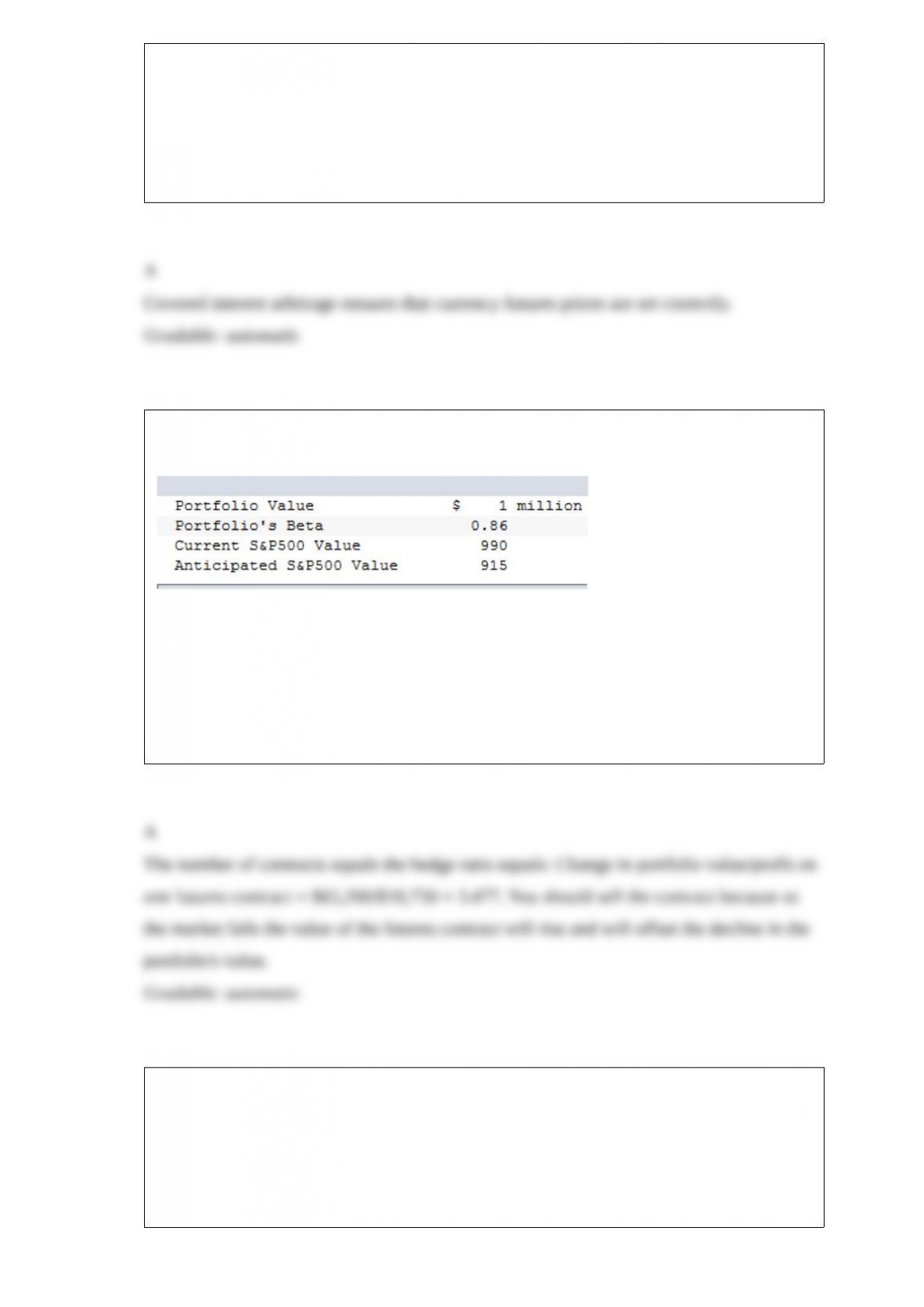
You are given the following information about a portfolio you are to manage. For the
long term, you are bullish, but you think the market may fall over the next month.
How many contracts should you buy or sell to hedge your position? Allow fractions of
contracts in your answer.
A. Sell 3.477
B. Buy 3.477
C. Sell 4.236
D. Buy 4.236
E. Sell 11.235
Agricultural futures contracts are actively traded on
A. rice.
B. sugar.
C. canola.
D. rice and sugar.
E. All of the options are correct.

Two firms, A and B, both produce widgets. The price of widgets is $1 each. Firm A has
total fixed costs of $500,000 and variable costs of 50 per widget. Firm B has total fixed
costs of $240,000 and variable costs of 75 per widget. The corporate tax rate is 40%. If
the economy is strong, each firm will sell 1,200,000 widgets. If the economy enters a
recession, each firm will sell 1,100,000 widgets. If the economy is strong, the after-tax
profit of Firm B will be
A. $0.
B. $6,000.
C.-$36,000.
D. $60,000.
The typical hedge fund fee structure is
A. a management fee of 1% to 2%.
B. an annual incentive fee equal to 20% of investment profits beyond a stipulated
benchmark performance.
C. a 12-b1 fee of 1%.
D. a management fee of 1% to 2% and an annual incentive fee equal to 20% of
investment profits beyond a stipulated benchmark performance.
E. a management fee of 1% to 2% and a 12-b1 fee of 1%.
“Bracket Creep” happens when
A. tax liabilities are based on real income and there is a negative inflation rate.
B. tax liabilities are based on real income and there is a positive inflation rate.
C. tax liabilities are based on nominal income and there is a negative inflation rate.
D. tax liabilities are based on nominal income and there is a positive inflation rate.
E. too many peculiar people make their way into the highest tax bracket.
A 10%, 30-year corporate bond was recently being priced to yield 12%. The Macaulay
duration for the bond is 11.3 years. Given this information, the bond’s modified duration
would be
A. 8.05.
B. 10.09.
C. 9.27.
D. 11.22.
The financial statements of Black Barn Company are given below.
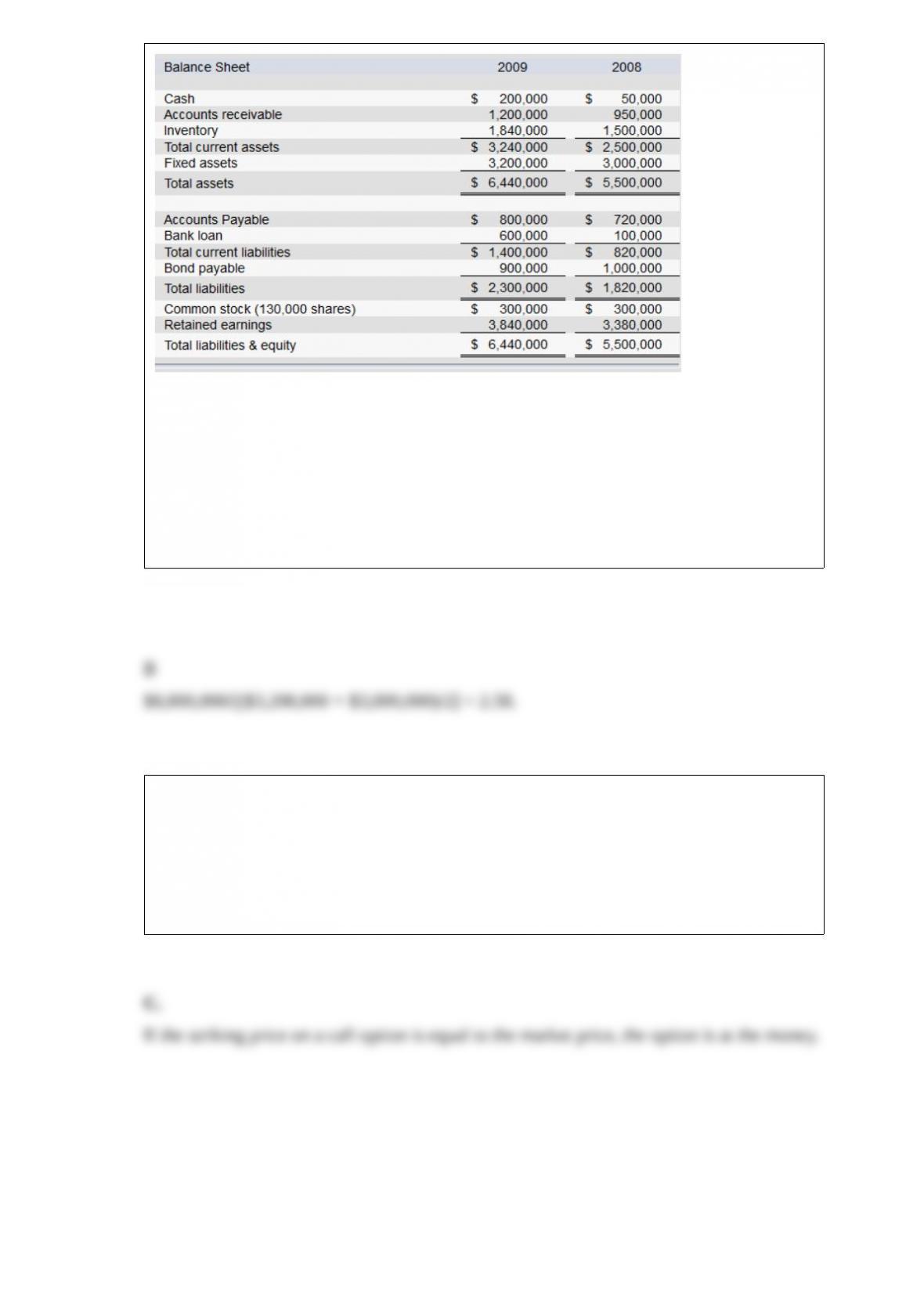
Note: The common shares are trading in the stock market for $40 each.
Refer to the financial statements of Black Barn Company. The firm’s fixed asset
turnover ratio for 2009 is
A. 2.04.
B. 2.58.
C. 2.97.
D. 1.58.
E. None of the options are correct.
The current market price of a share of CAT stock is $76. If a call option on this stock
has a strike price of $76, the call
A. is out of the money.
B. is in the money.
C.is at the money.
D. None of the options are correct.