
1) narrbegin: coyote valley
coyote valley products
coyote valley products has daily cash collections of $500,000. the cash management
staff has determined (1) customers payments are in the mail an average of 3 days; (2)
processing after receipt averages 1 day; and (3) after deposit funds are cleared on
average in 2 days. assume a 365 day year.
narrend
refer to coyote valley products. what is the firms collection float, in days?
a.6
b.5
c.4
d.3
2) narrbegin: miller venture capital
miller venture capital
miller venture capital made a $5 million investment in bavarian sausage technology
(bst) 8 years ago and in return received 1 million shares of convertible preferred stock
that can be converted into 2 shares of common stock. after all stock has been converted
bst will have 15 million shares outstanding. in addition, the company is planning on
issuing an additional 3 million shares in an ipo.
narrend
refer to miller venture capital. if bsts stock trades at $25 at the end of the first trading
day, what is the annual return on millers investment?
a.900.00%
b.24.65%
c.33.35%
d.350.00%
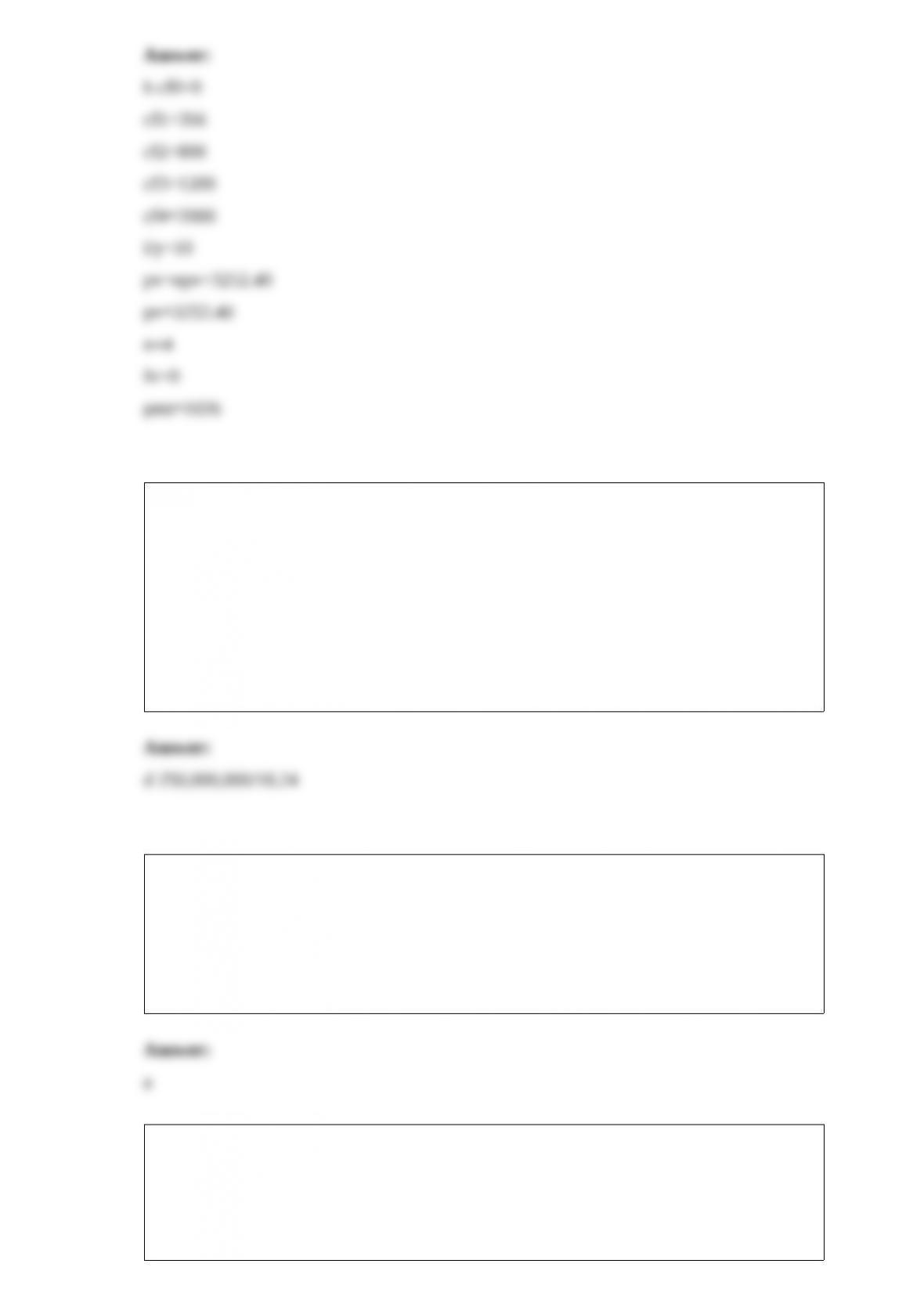
3) emmacat industries estimates that the scratching post project wonder post will have
the following end of the year cash flows. what is the equivalent annuity (4-year)
of the inflows of wonder post if the annual rate of interest is 10%?
a.$1,260
b.$1,026
c.$ 827
d.$1322
4) emma international needs $250 million in new equity capital; currently shares are
trading at $20 per share. morgan steely (the investment banker) requires a 4% spread of
the offer price which will be $19 per share and is fully subsribed at that price. the fixes
costs (legal, accounting, etc.) are estimated at $750,000. how many shares must be sold
for the $250 million?
a.13,157,895
b.13,736,264
c.13,020,833
d.13,706,140
5) the relationship between time to maturity and yield to maturity for bonds of equal
risk is referred to as
a.the term structure of interest rates
b.the forward rate
c.the spot curve
d.the forward curve
6) emma international has earnings per share of $3.29; just paid dividend $1.25 and
expects a roi next year (and the foreseeable future) of 14% what is the dividend payout
ratio?
a.37.99%
b.14.00%
c.62.01%
d.23.99%
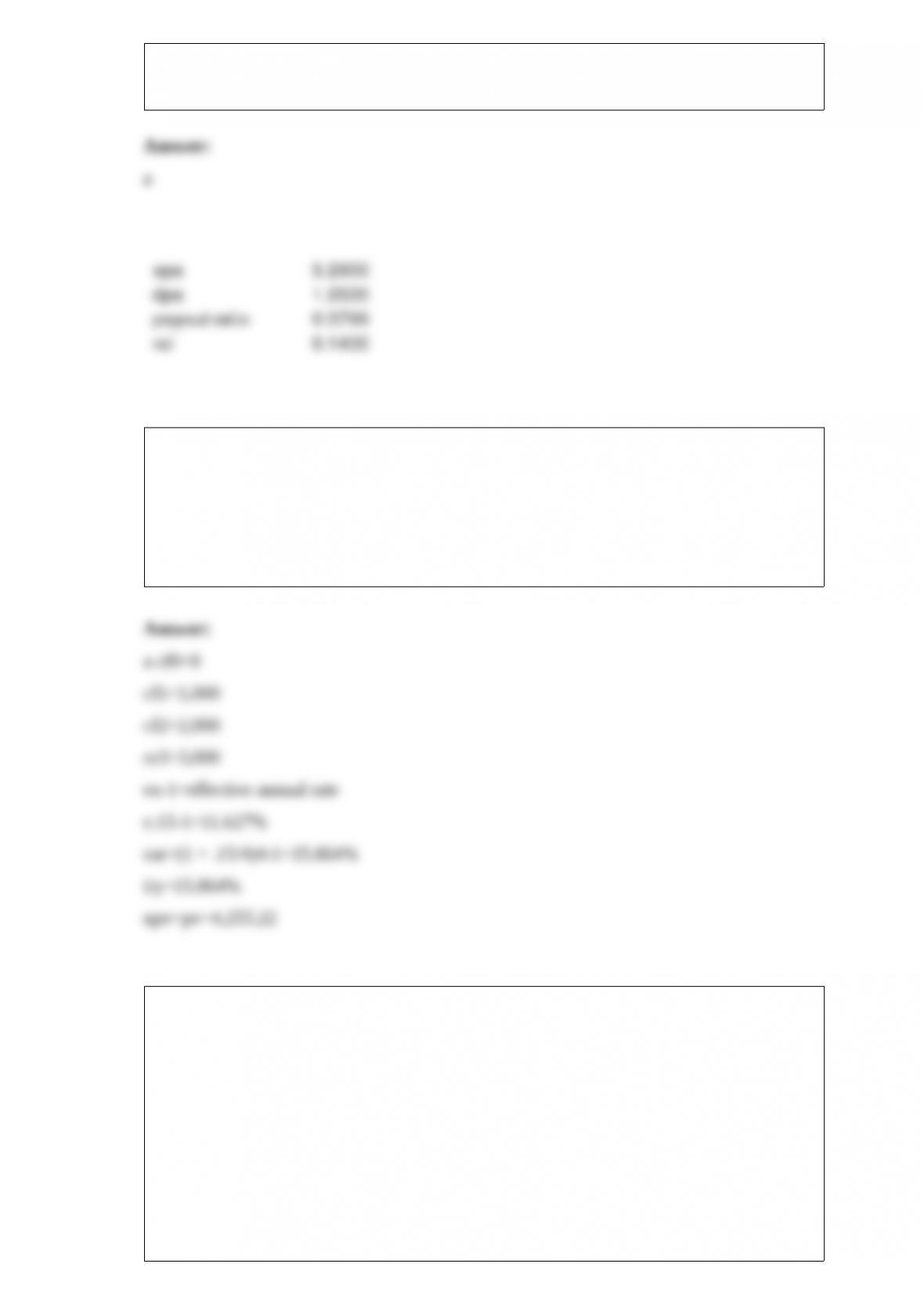
7) consider the following cash flows each arriving at the end of the year. if the discount
rate is 15% compounded continously, what is the present value?
a.$4,255.22
b.$4,270.36
c.$4,312.07
d.$4,354.40
8) narrbegin: abc corp.
abc corporation
abc corporation just paid a dividend of $1.50 a share. the dividend is expected to grow
at 10% a year for the next 2 years, and the 5% per year thereafter. the required return to
invest in abc stock is 12.50%.
narrend
suppose you want to buy abc and hold it for the next 4 years. what would the selling
price be for abc in 4 years, assuming that none of our assumptions change?
a.$28.01
b.$28.76
c.$29.40

d.$30.80
9) which of the following statements is true?
a.while asset classes with higher standard deviations tend to have higher returns, this
relationship seems to break down for specific securities
b.asset classes with higher standard deviations tend to have higher returns, and this
relationship tends to hold true when examining specific securities as well
c.asset classes with higher standard deviations tend to have higher returns, but when we
examine specific assets within those classes we find that high standard deviation
securities tend to have lower returns
d.none of the above
10) narrbegin: silly sally
silly sally, inc.
silly sally, inc. forecasts the following sales levels: january, $420; february, $435;
march, $450; and april, $470. historically, 40% of its sales are for cash. of the remaining
sales, 80% are collected in one month, 15% are collected in the second month, while
the rest remain uncollected. november sales were $380 and december sales were $500.
(all values $000)
purchases are made at 60% of the next months sales forecast, and are paid for in the
month of purchase. other cash outlays are: rent, $10 monthly; wages and salaries, $50
monthly; a tax payment of $30 in march; an interest payment of $15 in march; and a
planned purchase of $20 of new fixed assets in january.
narrend
suppose silly sally experiences a change in customer payment patterns in accounts
receivable, so that payments are now 30% in cash, and of the credit sales, 60% are
collected in one month, 35% are collected in the second month, with the rest
uncollected. what is the new forecasted collection for january, and how much is this
different from the original forecast?
a.$408; $72 higher
b.$336; $93 lower
c.$442; $13 higher
d.$429; $13 lower

11) security i has a beta of 1.3, the risk-free rate is 4%, and the expected return on the
market is 11%. what is the expected return for security i?
a.15.0%
b.18.3%
c.14.6%
d.13.1%
12) which type of finance position focuses on preparing firm financial plans and the
evaluation of the firms financial ratios?
a.financial analyst
b.capital budgeting analyst
c.cash manager
d.portfolio manager
13) a problem with the payback method is:
a.it assigns a 0 percent discount rate to cash flows that occur before the cutoff point
b.it assigns a 10 percent discount rate to cash flows that occur before the cutoff point
c.it assigns a 20 percent discount rate to cash flows that occur before the cutoff point
d.it assigns a 30 percent discount rate to cash flows that occur before the cutoff point
14) a “dealer market” is:
a.when buyers and sellers contact each other directly to arrange an exchange of
securities
b.a market in which the buyer and seller are not brought together directly but, rather,
have their orders executed by securities dealers
c.a market in which buyers and sellers are brought together on a securities exchange to
trade securities
d.none of the above